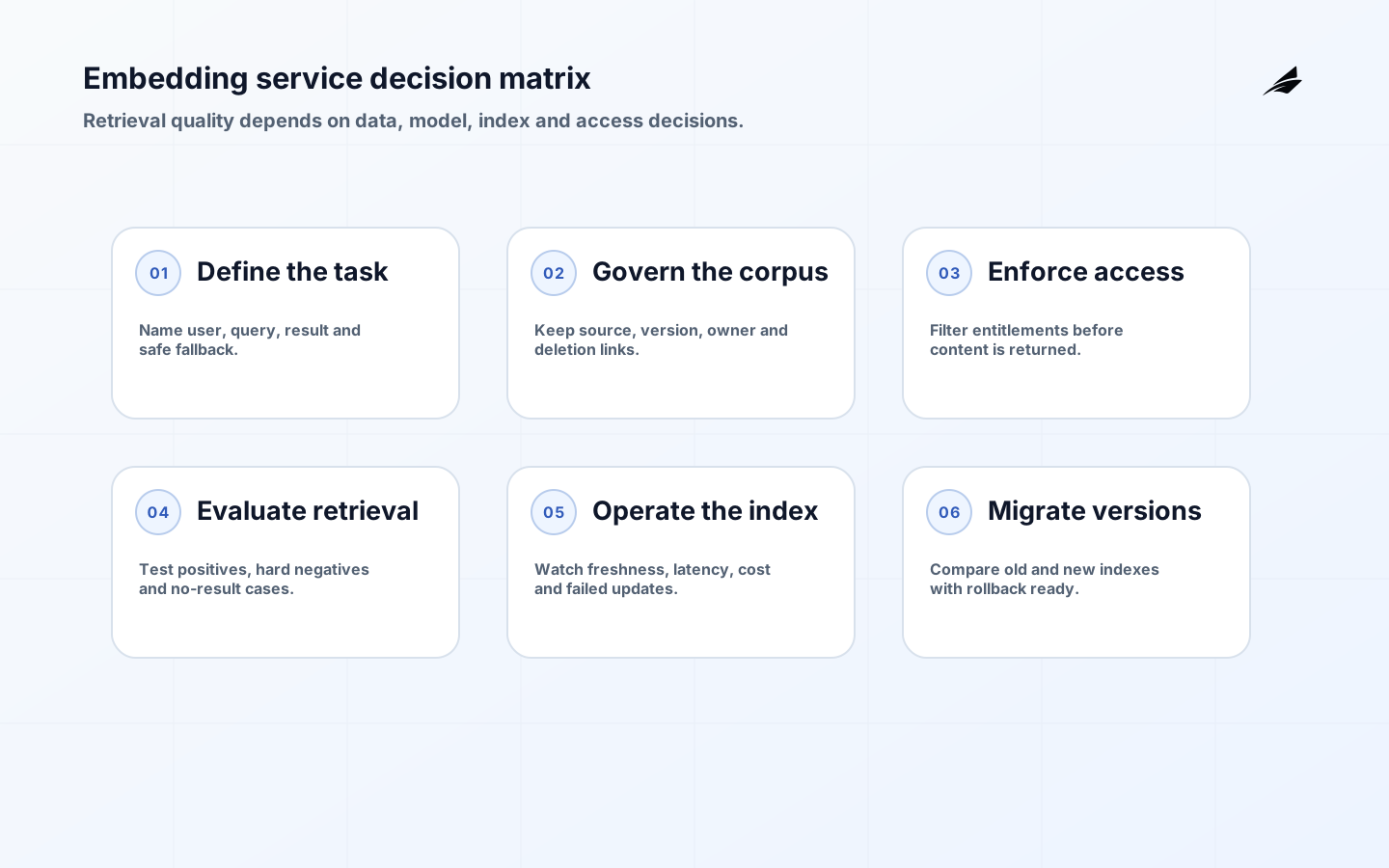
Embeddings turn content or other items into numerical representations that can support semantic search, recommendations, clustering, and retrieval for AI applications. For IT managers, the hard problem is not creating vectors; it is keeping source content, permissions, model versions, indexes, evaluation, and deletion aligned as a production service. Pair this guide with Edilec’s vector search implementation checklist, embeddings mistakes guide, and tool-calling cost guide.
Set the operating boundary for embeddings
Define embeddings through the retrieval job they enable, not as a platform capability. A procurement example might allow analysts to find clauses in currently approved supplier agreements and policy notes while preparing a review. State which repositories are indexed, which document versions qualify, how access is inherited, and whether results may only inform a draft. Similarity must not authorize a supplier, determine compliance, or substitute one contract’s terms for another. Record the expected query types, freshness requirement, languages, and the manual research route used when retrieval is weak. This boundary decides what belongs in the vector collection and what metadata must travel with every chunk. It also creates an enforceable test for later feature requests: a new use involving employee records, negotiation strategy, or automatic action needs its own sources, evaluation, permissions, and accountable owner rather than quietly reusing the procurement index.

| Design question | Practical decision | Evidence to retain |
|---|---|---|
| Purpose | Name the specific user task and prohibited autonomous action. | A current workflow map and an accountable owner. |
| Inputs | Limit sources to records that are permitted and maintained. | embedding model, source snapshot, normalization rule, query set, ranking result, and assessor label. |
| Outcome | Define a usable result and an explicit pending state. | A sample of normal, adverse, and incomplete cases. |
| Recovery | Decide who pauses the flow and how work continues. | restore the prior index, preserve the comparison set, and investigate before migration. |
Test embeddings against real work
Create retrieval judgments from real analyst questions and the documents that actually resolve them. Include exact terminology, abbreviations, paraphrases, ambiguous vendor names, numeric thresholds, multilingual passages, superseded policies, scanned text, and questions whose answer is absent. Label relevant chunks and hard negatives—passages that sound similar but belong to another entity, jurisdiction, date, or contract type. Measure recall at the number of results the interface shows, ranking quality, no-answer behavior, and permission leakage; cosine similarity alone has no universal business threshold. Keep a frozen comparison set for every embedding-model, chunking, preprocessing, or index change. If vectors from different models are incompatible, rebuild a separate candidate index rather than mixing spaces. Have procurement specialists examine misses and false matches, because a benchmark assembled only from easily searchable wording rewards lexical familiarity and overlooks the cases where semantic retrieval is supposed to help.
| Test slice | What to inspect | Decision |
|---|---|---|
| Routine cases | Usefulness, source match, and completion effort. | Release only if the result is consistently actionable. |
| Hard cases | Missing data, ambiguity, conflict, and policy triggers. | Require a safe pending or escalation route. |
| Adversarial input | Attempts to alter instructions or obtain restricted information. | Block the action and record the attempted path. |
| Changed conditions | New source, version, role, or downstream dependency. | Re-evaluate before continuing normal operation. |
Assign controls and ownership for embeddings
Split accountability across the corpus, retrieval service, and supported decision. The procurement content owner decides which agreements and policies are current; data stewards define classification, retention, and deletion; the ML or search owner controls chunking, embedding versions, indexing, and evaluation; the application owner enforces identity and displays citations; procurement leadership owns acceptable use. Filter candidates with authoritative access metadata before returning content, and recheck permissions at read time so a vector result cannot bypass the document system. Store source identifier, revision, page or section, chunk boundaries, embedding version, and index timestamp with each vector. Reviewers need the original passage and surrounding context, not a score presented as certainty. The NIST AI RMF functions—Govern, Map, Measure, and Manage—provide a useful structure for keeping these responsibilities, evaluation evidence, and response choices connected as the corpus and model evolve.
- Name one owner for the workflow and one owner for each authoritative data source used by embeddings.
- Use least-privilege access for tools, records, and administrative changes.
- Make a pending state normal when evidence, policy, or authority is missing.
- Keep logs useful for investigation without turning protected traces into a new broadly accessible data store.
- Review the control design whenever the workflow scope, vendor, or connected system changes.
Measure live embeddings behavior
Monitor the retrieval chain in layers. Operational signals include indexing lag, documents rejected during parsing, vector-count changes, query latency, empty-result rate, permission-filter removals, and failures to open a cited source. Quality signals come from sampled analyst judgments: whether a relevant passage appeared in the displayed results, whether rank was useful, whether citations matched the current document, and whether an unsupported answer should have abstained. Segment those findings by query class, repository, language, contract family, embedding version, and index generation. Watch for distribution changes such as new document formats or vocabulary that the evaluation set does not cover. A similarity-score shift can indicate a pipeline change, but it does not by itself prove relevance or harm. Assign a response to each threshold: stop ingestion, roll traffic to the previous index, suppress a repository, or require manual search while the owner investigates.
| Signal | Why it matters | Review response |
|---|---|---|
| top-result relevance | Shows whether the bounded task is producing acceptable work. | Sample cases and identify a version or source pattern. |
| hard-negative performance | Shows whether review is catching material problems. | Inspect evidence and adjust the decision boundary. |
| index freshness | Shows whether the fallback path has a real owner. | Escalate capacity or change the route. |
| and migration errors | Shows whether automation shifts burden downstream. | Compare against the manual baseline and recover if needed. |
Run and recover embeddings safely
Make every index release replaceable. Build candidate indexes under a new generation identifier, run the frozen retrieval suite, verify document counts and access filters, then shift queries gradually. Retain the prior generation and its model, preprocessing configuration, chunk manifest, and deletion state long enough to restore service safely. Practice a rollback after discovering that a parser dropped tables or that permission metadata was omitted from one repository. Recovery must stop new exposure, invalidate affected caches, restore the last verified index, and identify queries that may have returned incorrect material. Preserve investigation evidence without retaining deleted source content beyond policy. The corpus owner decides whether documents need correction; the search owner repairs ingestion or ranking; the service owner communicates impact and validates return to normal. A manual search link should remain available while retrieval quality is uncertain.
- Give front-line users a clear route to flag a questionable embeddings result without needing technical access.
- Practice pausing the relevant capability while leaving unrelated work available.
- Reconcile any downstream changes against the system of record after an incident.
- Record the decision, affected scope, correction, and criteria for resuming normal operation.
- Bring repeated exceptions back to the workflow owner rather than asking individual reviewers to absorb the pattern.
Diagnose retrieval failures at the correct layer before replacing the embedding model. A missing answer may come from an unindexed source, OCR loss, bad chunk boundaries, stale metadata, permission filtering, vocabulary mismatch, ranking, or an interface that hides useful lower results. A false match may expose duplicate versions or inadequate entity and date filters. Reproduce the query against a recorded index generation, inspect candidate passages, and compare with the expected source. Fix ingestion or metadata when that is the cause; change embeddings only when evaluation shows a representation problem across a meaningful class. For every adjustment, retain the triggering cases, configuration diff, regenerated collections, benchmark result, specialist approval, rollout cohort, and live confirmation signal. Test neighbouring queries and deletion behavior as well as the reported example. This history prevents teams from chasing individual anecdotes with model changes that damage stable retrieval elsewhere.
Release checklist
- The team can state the permitted purpose, prohibited action, owners, and fallback for embeddings in plain language.
- Evaluation includes normal, incomplete, adverse, and changed-condition examples from the real workflow.
- Authorization, output validation, and escalation occur outside untrusted model text.
- Live signals have a baseline, review cadence, accountable owner, and documented action threshold.
- The recovery path has been tested from detection through reconciliation before scope expands.
Before adding repositories or user groups, review an evidence pack with procurement, data stewardship, security, and the search-service owner. It should show source inventory and freshness, parsing failures, access-filter tests, frozen-set retrieval results, latency, sampled analyst judgments, deletion checks, and a successful index rollback. Inspect specific queries: a straightforward clause lookup, an ambiguous supplier question, a superseded document, a hard negative, a user lacking source access, and a genuine no-answer case. Confirm that citations open the exact authorized revision and that analysts can reach the manual research route. Record residual gaps and convert them into rollout limits—for example, excluding scanned schedules until table extraction improves. Expansion should follow demonstrated retrieval and governance performance, not vector count or demo appeal. A new corpus with different language, sensitivity, or document structure deserves new evaluation evidence rather than inheriting approval from the original collection.
Worked example: permission-aware policy search
An internal policy search service might ingest approved documents from several repositories. Preserve document ID, owner, version, effective date, jurisdiction, section, source location, classification, and access-control references beside every chunk. Apply entitlement filtering before results reach the generator or user. A high similarity score cannot authorize access, prove that a passage is current, or show that it answers the question. Keep the original text and provenance available for citation and investigation.
Build an evaluation set from real tasks: finding the current travel limit, distinguishing country-specific leave rules, locating an exception owner, and refusing superseded or inaccessible content. Label relevant passages and important negatives, then measure retrieval at a chosen result depth, permission leakage, stale-result rate, no-result handling, latency, and cost. Compare keyword, vector, and hybrid retrieval. Re-run the set when the embedding model, chunking, metadata, filters, or index parameters change; those are behavior changes even when the user interface is unchanged.
Key takeaways
- Embeddings should improve a bounded task, not quietly claim broader authority.
- Evidence, permission, and recovery are product requirements alongside model quality.
- Evaluate the cases where the system should stop or seek review, not only the easy successes.
- Use operating signals to decide when to investigate, restrict, or expand the workflow.
Frequently asked questions
What is a sensible first embeddings use? Choose retrieval over a bounded, current corpus where users already perform manual search and can judge relevance, such as finding approved policy passages. Can one similarity threshold determine relevance? No; score distributions vary by model, corpus, query, and distance function, so calibrate ranking and abstention with labelled examples. May old and new embedding vectors share an index? Usually not unless the provider explicitly establishes compatibility; build and evaluate a separate generation. How should permissions work? Filter with authoritative document access and verify at retrieval time, never by asking the model to obey a prompt. When is expansion justified? Add a repository or workflow after its formats, vocabulary, sensitivity, freshness, hard negatives, and no-answer cases are represented in evaluation and operators have proved rollback.
Conclusion
For the adjacent operating question, read Vector Search Implementation Checklist. For embeddings, use it to compare the specific control choices, evidence, and escalation route before widening the workflow.
Embeddings become operationally useful when a team can trace every retrieved passage to an authorized source revision, evaluate ranking against realistic questions, and replace an index generation without losing control of access or deletion. Treat chunking, metadata, model choice, and corpus freshness as versioned parts of one retrieval service. That discipline produces search that analysts can challenge and owners can improve safely.