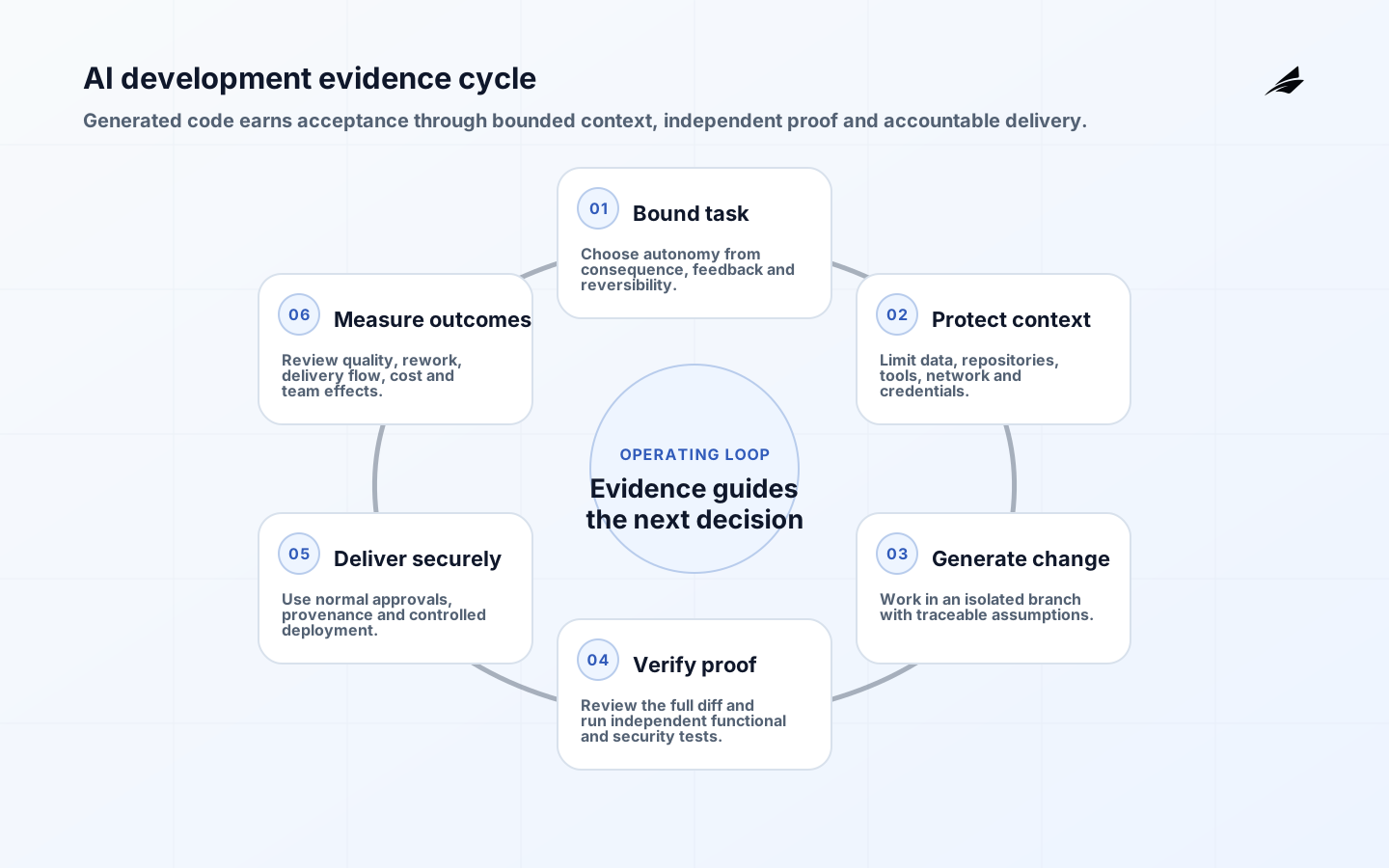
This development with AI FAQ is for engineering leaders and developers deciding how coding assistants, chat tools and software agents should enter a real delivery system. The useful question is not whether a model can produce code. It is whether the team can accept a resulting change with evidence of intent, correctness, security, maintainability and production fitness. AI changes the speed and shape of work, but it does not transfer accountability away from the people and organization shipping software.
NIST’s AI Risk Management Framework organizes work around Govern, Map, Measure and Manage, while its generative AI profile emphasizes governance, content provenance, pre-deployment testing and incident disclosure. Apply those ideas proportionately to the complete AI-assisted workflow: provider, model, prompts, retrieved context, tools, generated artifacts, reviewer, build system and runtime. The companion development with AI implementation checklist can turn the decisions here into launch evidence.
Where does AI-assisted development fit best?
Begin with bounded, reversible tasks that have strong feedback: explaining unfamiliar code, drafting tests for known behavior, producing migration scaffolding, suggesting repetitive transformations or reviewing documentation against an interface. A high-quality test suite, typed interfaces and short deployment path make errors easier to detect. Avoid granting broad autonomy merely because a tool can traverse a repository. Consequence, observability and reversibility should determine autonomy.
Treat AI as one component in an engineering system. The same model may be suitable for low-risk test fixtures but inappropriate for cryptographic design, authorization policy or an emergency production command. Define allowed task classes, repositories, data, tools and execution environments. Assign an accountable human for every accepted change. OWASP’s secure coding guidance for AI explicitly calls for human ownership and heightened scrutiny of build scripts, package manifests, CI configuration and deployment infrastructure.
| Task class | Starting autonomy | Required evidence |
|---|---|---|
| Explanation or search | Suggest only | Developer verifies cited code and current documentation |
| Test or documentation draft | Write in branch | Review for behavior coverage, false assertions and sensitive data |
| Routine application change | Write and run bounded tests | Diff review, automated checks, dependency verification and owner approval |
| Security, identity or data migration | Assist under specialist supervision | Threat model, targeted tests, rollback proof and specialist approval |
| Production operation | No direct action by default | Explicit authorization, preview, least privilege, audit event and recovery route |
How should code and data context be protected?
Inventory what leaves the developer environment: prompts, source snippets, filenames, logs, tickets, database examples and tool outputs. Confirm provider retention, training use, subprocessor, region, access and deletion terms against the organization’s policy and contracts. Classify repositories and prohibit secrets, production personal data and regulated records unless the approved architecture specifically supports them. Redaction should be tested; replacing a customer name does not necessarily de-identify a distinctive record.
Use separate identities for the developer, the AI service and any agent tools. Scope repository access to the task and keep write, network, package-install and deployment permissions off by default. Short-lived credentials and sandboxed workspaces reduce consequences. Rules files and retrieved documents are untrusted inputs: a malicious instruction in an issue, dependency or documentation page can attempt to redirect an agent. Keep trusted policy outside untrusted content and require confirmation before consequential tool calls.
How should generated code be reviewed?
Review the change as code, not as a fluent answer. Ask what requirement it satisfies, which assumptions it makes, what it deletes, what dependencies it introduces and how it fails. Inspect the complete diff and generated files. Run the repository’s formatter, static analysis, tests and security checks in a clean environment. For unfamiliar packages, verify that the package exists in the official registry, has the intended maintainer and version, and is permitted by policy before installation.
Tests generated by the same model can repeat its mistaken interpretation. Preserve independent oracles: requirements, existing acceptance tests, invariants, reference implementations, property tests, production traces with lawful handling, and human domain review. Mutation testing can reveal assertions that never detect a fault. For authorization, money, time zones, concurrency and migration logic, add adversarial examples and review boundary conditions explicitly.
| Failure mode | Control in the workflow | Acceptance signal |
|---|---|---|
| Invented dependency or API | Registry and official-document verification before install | Locked approved dependency resolves and integration test passes |
| Secret or personal data disclosure | Context classification, scanning and provider restrictions | No prohibited material in prompt, logs, output or telemetry |
| Plausible but wrong behavior | Independent acceptance tests and domain review | Named scenarios and invariants pass |
| Unsafe agent action | Sandbox, least privilege and human checkpoint | Tool audit shows only approved resources and commands |
| Hidden maintainability cost | Diff-size limit, explanation and ownership review | Maintainer can explain, test and support the change |
How does AI fit a secure delivery pipeline?
NIST’s Secure Software Development Framework recommends preparing the organization, protecting software, producing well-secured releases and responding to vulnerabilities. AI-generated changes should travel through that same framework. Protect branches, require review, pin dependencies, preserve build provenance and separate build from deployment authority. SLSA provides a supply-chain vocabulary for provenance and build integrity; model output is source input, not trusted provenance by itself.
Do not let an agent weaken a failing control to make the pipeline green. Changes to tests, security policies, workflow permissions, lockfiles or suppression rules deserve focused review. Record tool and model identity when useful for investigation, but avoid storing sensitive prompts indiscriminately. Preserve the evidence needed to reproduce the accepted artifact: source commit, dependency lock, build definition, approvals, test results and deployed digest.
How should teams evaluate usefulness and risk?
Create an evaluation set from representative tasks and known failure stories before broad rollout. Score task completion, correctness, security findings, review effort, maintainability and policy compliance. Include abstention and ambiguous requirements. Re-run the set when the model, tool configuration, repository or policy changes. A tool that performs well on isolated functions may still fail when asked to edit a multi-service transaction or interpret organization-specific conventions.
Pilot with a small voluntary group and compare matched work rather than relying on self-reported speed alone. Measure end-to-end outcomes over time. DORA’s delivery measures include change lead time, deployment frequency, failed deployment recovery time, change fail rate and deployment rework rate. Add review time, escaped defects, security findings, developer experience and concentration of knowledge. Faster code generation with more rework is not a productivity gain.
What implementation procedure should a team follow?
- Map candidate tasks, affected people, data classes and consequences; choose a bounded pilot with a baseline.
- Approve providers, models, retention terms, identities, repository scope and prohibited data or actions.
- Configure sandboxed tools, branch protection, dependency policy, logging and explicit human checkpoints.
- Build representative functional, security and policy evaluations, including known edge cases and malicious context.
- Pilot through the normal review and delivery path; measure accepted outcomes, review burden, defects and team experience.
- Expand, constrain or stop use based on evidence, and repeat evaluation whenever models, tools, policy or system context changes.

Publish a short internal use policy with examples rather than a vague instruction to use AI responsibly. Explain allowed tasks, prohibited data, required review, package verification, incident reporting and how developers can challenge the policy. Train reviewers as well as tool users. Provide an easy route to report a surprising output or unintended disclosure without blaming the reporter; early reports are valuable operational evidence.
Include procurement and engineering representatives in periodic policy review. Provider capabilities may expand faster than approved access, and a harmless chat feature can become an agent with repository or issue-tracker tools after a configuration change. Maintain an approved capability inventory and require reassessment when autonomy, context sources, data handling or model terms materially change.
What costs should be included?
Count licenses or tokens, integration, identity, logging, evaluation, security review, training, support and exit work. Agentic use may also consume build minutes, test environments and external APIs. Attribute cost by team and task class without turning developer surveillance into a management system. Compare cost with accepted delivery outcomes and avoided effort, not raw suggestions or generated lines. Budget for model or vendor change because behavior and terms will evolve.
A credible exit plan exports prompts or templates that are safe to retain, disconnects integrations, revokes credentials, removes local agents, validates provider deletion obligations and preserves required development evidence. Keep portable tests and repository conventions as organizational assets. A workflow that only functions through one model-specific behavior is a technical dependency that should be named and tested.
Key takeaways
- Choose autonomy from consequence, observability and reversibility rather than model capability alone.
- Protect source, prompts, tools and credentials as one connected security boundary.
- Require independent evidence for correctness; generated tests are not automatically independent.
- Keep every accepted change owned and understandable by a human maintainer.
- Measure end-to-end delivery, quality and team outcomes, then re-evaluate after material changes.
Frequently asked questions
Must every AI-assisted commit be labeled?
There is no universal requirement. Record assistance when policy, contract, regulated evidence or investigation needs justify it. The essential control is accountable review and reproducible release evidence. Avoid collecting detailed prompts when doing so creates a larger confidentiality risk than the metadata solves.
Can junior developers use coding assistants safely?
Yes, with scoped tasks, mentoring, strong tests and review. Do not use fluent output as a substitute for learning system behavior. Ask the developer to explain the accepted code, its failure modes and tests. Senior engineers need the same accountability; expertise changes the review strategy, not the requirement to verify.
When should an agent be allowed to execute commands?
After commands are constrained to an isolated environment, permissions and network access are minimal, sensitive resources are absent, actions are logged and consequential steps require explicit approval. Production write access should remain exceptional and tied to a separately authorized operational procedure.
Conclusion
Development with AI becomes dependable when fast generation is surrounded by strong context boundaries, independent verification, secure delivery and measured learning. The development scope, cost and risk plan helps buyers frame an initiative, while the AI application development guide extends the controls to customer-facing AI systems and the agentic platform delivery plan addresses broader tool autonomy.