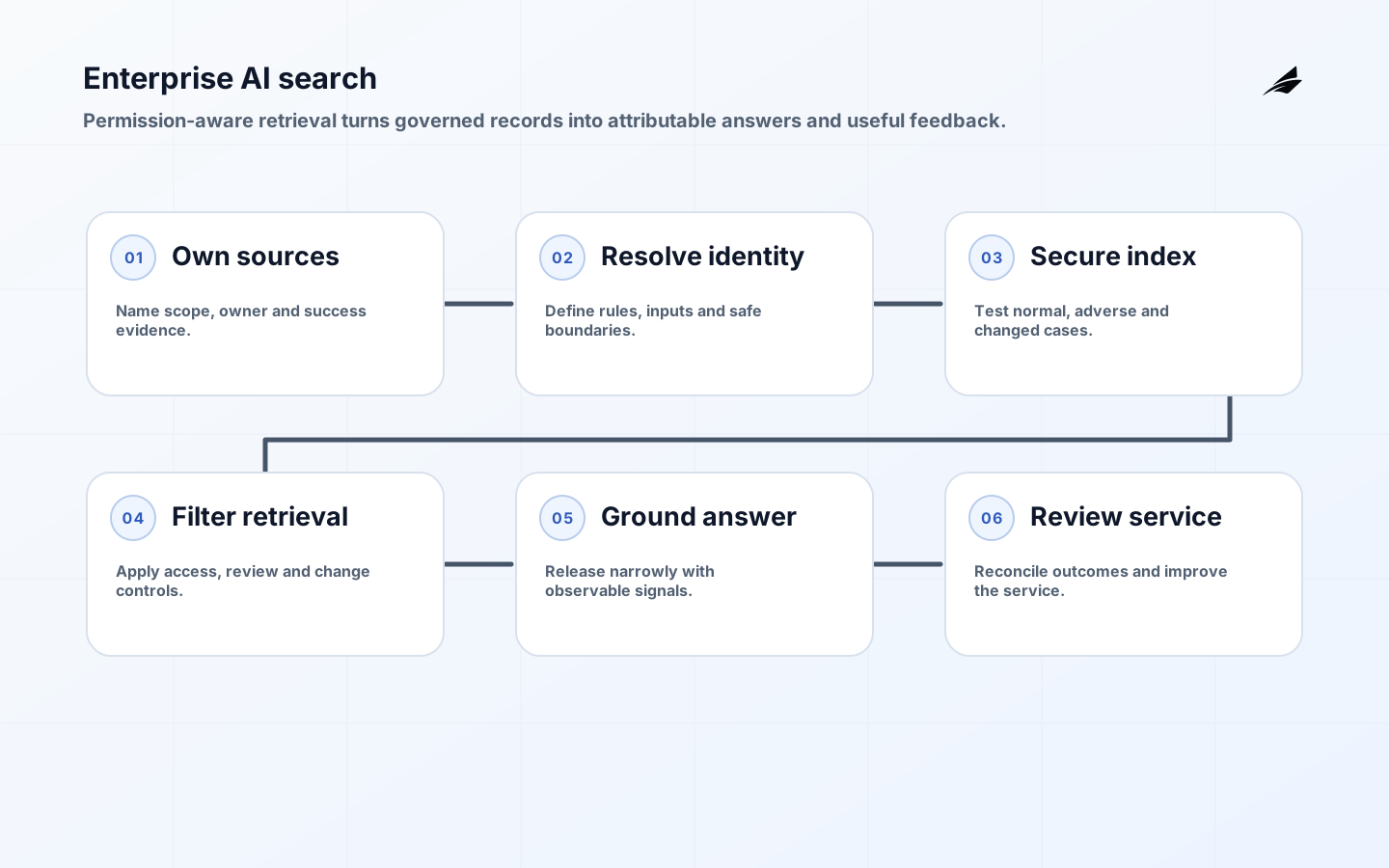
AI search across company records is a retrieval and access-control service before it is a conversational feature. A useful answer must come from sources the current user may see, distinguish approved policy from informal discussion, expose citations, and state when the record set cannot support a conclusion. Production design therefore joins content ownership, permission-aware indexing, retrieval evaluation, freshness controls, and an accountable correction path. Contract and policy questions are a demanding starting point because the answer can vary by entity, jurisdiction, effective date, and document status. Fluency cannot resolve those distinctions. Teams should define the eligible corpus and decision purpose, then examine the employee assistant mistakes guide, AI escalation guide, and growing-company AI governance model for adjacent controls.
Set the operating boundary for AI search across company records
Define one search promise in operational terms. For example: employees may ask which approved procurement clause applies to a new software purchase, and the assistant will answer only from the current policy library and published contract playbook. Specify eligible user groups, repositories, document statuses, languages, effective dates, and questions that require legal or procurement review. Exclude drafts, personal drives, privileged matter files, and superseded policies unless a particular role has both a legitimate purpose and direct access. The assistant may summarize and compare cited text; it must not approve a deviation or infer permission from a document it retrieved. This corpus boundary gives content owners something concrete to certify and gives evaluators a stable answer to “should this record have been searched?” before they debate ranking quality.
| Search design question | Production requirement | Verification evidence |
|---|---|---|
| Eligible knowledge | Define repositories, approved statuses, effective dates, languages, and excluded record classes. | Corpus inventory with content owners and inclusion rules. |
| Permission enforcement | Filter candidates using the current user's source-system rights before model access. | Principal, group snapshot, document identity, and allow or deny result. |
| Answer support | Cite authoritative passages and decline when accessible evidence is absent or conflicting. | Retrieved passages, status metadata, response, and citation checks. |
| Content correction | Suppress exposed or superseded records and provide direct search or owner escalation. | Affected queries, index action, user notice, and re-evaluation result. |
Test AI search across company records against real work
Build retrieval tests from real information needs and known corpus traps. Include renamed policies, conflicting regional guidance, a draft beside an approved version, a table whose row headers carry meaning, scanned attachments, records the tester cannot access, and questions for which no company source contains an answer. Label relevant passages, authoritative document status, expected refusal, and acceptable citations—not merely a preferred prose response. Evaluate permission filtering before retrieval, recall of the necessary evidence, ranking of the authoritative version, citation entailment, and whether the final answer preserves qualifiers such as dates and thresholds. Re-run the set after connector, parser, chunking, embedding, reranking, permission, prompt, or model changes. A system that performs well on popular documents can still fail its purpose if it misses a rare exception that changes the employee's next action.
| Enterprise-search case | Quality and control checks | Required response |
|---|---|---|
| Current approved policy | Retrieve the authoritative version and preserve dates, thresholds, and scope qualifiers. | Answer with direct citations and document status. |
| Conflicting regional records | Determine whether the user's entity and location select one rule or require review. | Explain the conflict and route unresolved interpretation to the owner. |
| Restricted document lure | Verify that titles, snippets, embeddings, citations, and generated text reveal no denied record. | Return only permitted evidence and log the access-control test. |
| Revoked or superseded source | Measure propagation through connector, index, cache, and stored answers. | Suppress stale results until removal and replacement are verified. |
Assign controls and ownership for AI search across company records
Assign ownership at the repository and answer levels. Repository owners decide which records are authoritative, how long they remain current, and which groups may access them. Identity and security teams ensure that connector, index, cache, and query-time permissions preserve source restrictions, including revocation and group changes. The search service owner manages ingestion, ranking, citations, evaluation, and incident response. A policy or legal owner defines topics that require escalation rather than synthesis. Enforce access before candidate text reaches the model; asking the model to hide unauthorized passages after retrieval is not a control. Results should display title, owner, status, and effective date where available so users can judge evidence. The NIST AI RMF functions help make governance, contextual mapping, measurement, and treatment of retrieval risk visible across these roles.
- Maintain a named owner, approval status, effective date, and retention rule for every production search corpus.
- Carry source permissions through connectors, indexes, caches, citations, logs, and saved answer histories.
- Prefer the authoritative current record over a popular draft, duplicate, or superseded copy.
- Require citations that open to the exact evidence the querying user is allowed to inspect.
- Send unsupported, conflicted, or consequential interpretation to the responsible knowledge owner.
Measure live AI search across company records behavior
Monitor the chain from source connector to cited answer. Track ingestion lag, failed parses, documents with missing owner or status, permission-sync delay, zero-result queries, retrieval with no authoritative hit, citation-open failures, unsupported-answer samples, and user reports of stale or inaccessible evidence. Segment by repository, department, language, and access group so improvements for a large public corpus do not conceal failures in a restricted knowledge base. Retain query and source identifiers under an appropriate privacy policy; avoid collecting more employee search content than investigation and evaluation require. Establish triggers: a permission mismatch disables the affected corpus, excessive freshness lag adds a warning or pauses answers, and declining citation support sends samples to the search owner. Compare results with the pre-release path, including time spent verifying answers and work transferred to subject-matter experts.
| Signal | Why it matters | Review response |
|---|---|---|
| citation coverage | Shows whether the bounded task is producing acceptable work. | Sample cases and identify a version or source pattern. |
| permission denials | Shows whether review is catching material problems. | Inspect evidence and adjust the decision boundary. |
| stale-content rate | Shows whether the fallback path has a real owner. | Escalate capacity or change the route. |
| and unresolved search sessions | Shows whether automation shifts burden downstream. | Compare against the manual baseline and recover if needed. |
Run and recover AI search across company records safely
Recovery depends on knowing whether the fault is exposure, freshness, retrieval, or generation. For suspected unauthorized disclosure, stop queries against the affected index, preserve access-decision logs, revoke cached content, and notify security and the record owner under the established incident process. For stale guidance, suppress the superseded source, point users to the authoritative record, and identify sessions that cited the old version. Retrieval defects may require reparsing or reindexing; unsupported synthesis may require answer constraints and new evaluation cases. The fallback experience should offer direct search or a route to the knowledge owner rather than fabricate a helpful substitute. Test corpus disablement and reindexing before launch, including how long deletion and permission revocation take to propagate through embeddings, caches, and generated-answer stores.
- Place a stale, unsupported, or access concern action beside each cited enterprise-search answer.
- Allow operators to remove one repository from retrieval while unaffected corpora remain available.
- Purge denied or retired content through the connector, vector index, cache, and retained answer layers.
- Notify the content and security owners when earlier answers may have exposed or relied on an invalid source.
- Re-run permission and retrieval evaluations before the corrected corpus returns to service.
Treat a bad search answer as a traceable pipeline defect until evidence identifies the layer. Was the current document absent from the source, skipped by the connector, parsed without its table structure, divided into misleading chunks, removed by permission filtering, ranked below a draft, or cited inaccurately by the generator? A policy change is different: the content owner should publish a newly approved version with effective metadata, after which ingestion and evaluation confirm that queries select it. Record the query class, eligible corpus at that time, retrieved passages, answer, user consequence, cause, correction, and regression examples. This history prevents teams from repeatedly adjusting prompts when the true fault is record stewardship or indexing. It also shows content owners which recurring questions need clearer source material rather than increasingly elaborate search behavior.
Release checklist
- The eligible corpus is inventoried by repository, record status, owner, sensitivity, and freshness expectation.
- Representative roles have verified that denied records do not appear in candidates, snippets, citations, or answers.
- Evaluation covers authoritative retrieval, version conflicts, table context, no-answer cases, and citation support.
- Monitoring identifies ingestion lag, permission drift, failed parsing, unsupported claims, and broken citation access.
- Repository disablement, deletion propagation, reindexing, direct-search fallback, and owner escalation have been rehearsed.
Expand one corpus or question family at a time. In the readiness review, content owners inspect sampled citations for authority and freshness, security verifies permission decisions with representative roles, and service-desk staff show how unresolved questions reach the right owner. Include searches that returned nothing, refused to synthesize, or found conflicting documents; these reveal gaps that a satisfaction average hides. Compare answer time with verification effort, escalations, correction volume, and the burden of maintaining metadata. Before adding a sensitive repository, require a current owner inventory, tested revocation latency, deletion behavior, baseline retrieval results, and a documented containment switch. Before adding a consequential use case, decide what the assistant may state, which evidence it must show, and what judgment remains with a qualified person. Growth should follow demonstrated corpus control, not simply user demand for more indexed drives.
Test one sensitive query end to end
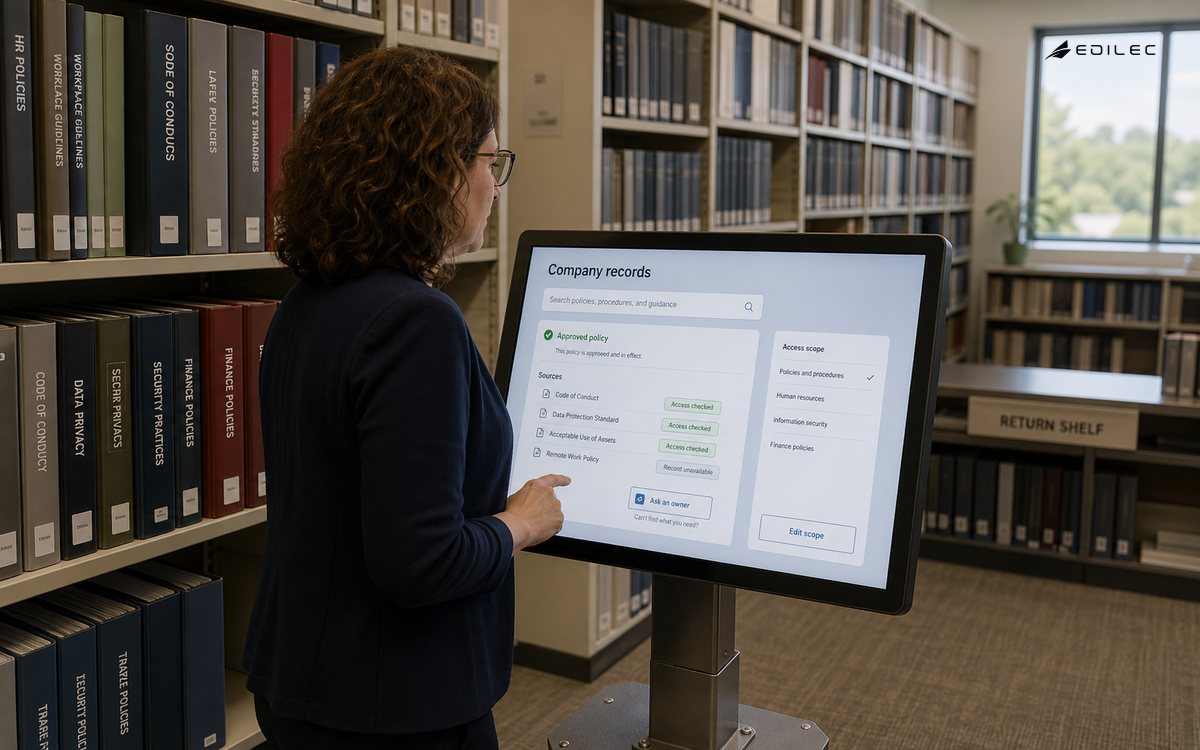
Test a query whose answer differs by role, such as severance terms for an employee. Use identities for the employee, manager, HR, and an unrelated colleague. Preserve source identity, owner, classification, effective dates, deletion state, and access rules. Filter candidates with current authorization before text reaches generation. Remove access and verify that caches, snippets, embeddings, and generated history no longer expose the record. Relevance cannot compensate for a permission or source-governance defect.
Use this review with the article tables and linked Edilec guides. Sample completed records as well as exceptions, retain the rule and source versions that produced each outcome, and assign every corrective action to a policy, data, interface, integration, security, or operating owner. Metrics indicate where to investigate; representative cases reveal what must change. Before scope expands, repeat the exercise with an unavailable dependency, a delayed message, an unauthorized user, and a correction after the nominal process has finished. This review is specific to permission-aware search and source governance.
- Assign owner audience date and source identity.
- Synchronize grants denials groups and deletion.
- Authorize before model context.
- Test citations refusals staleness and leakage.
- Show source passage date and owner.
- Practice revocation purge replay and notice.
Key takeaways
- Govern the record collection before optimizing conversational answers across it.
- Enforce the query user's source permissions before any candidate passage reaches the model.
- Measure authority, freshness, retrieval, and citation entailment alongside relevance and user preference.
- Add repositories only when owners, revocation behavior, evaluation coverage, and containment are demonstrably ready.
Frequently asked questions
Which records should enter the first corpus? Choose a maintained collection with named owners, meaningful permissions, clear approval status, and recurring questions whose answers can be cited. Should every matching document be summarized? No; the service should prefer authoritative evidence, disclose conflicts, and decline when accessible sources do not support an answer. Does source-system access automatically protect generated results? Not necessarily. Connectors, indexes, caches, logs, and answer stores must all preserve restrictions and respond to revocation. How should quality be judged? Measure eligible-document retrieval, authority and freshness, citation support, permission correctness, and the user's ability to verify or escalate—not just answer preference. When is expansion appropriate? Add repositories only after ownership, ingestion health, access propagation, evaluation coverage, and containment have been demonstrated for the current scope.
Conclusion
Production AI search succeeds when users can see why an answer deserves trust and operators can locate why it failed. Govern the corpus, enforce source permissions throughout retrieval, evaluate authority as well as relevance, and make stale or unsupported evidence visible. That creates a company search service whose reach can grow without quietly outrunning record ownership and access control.