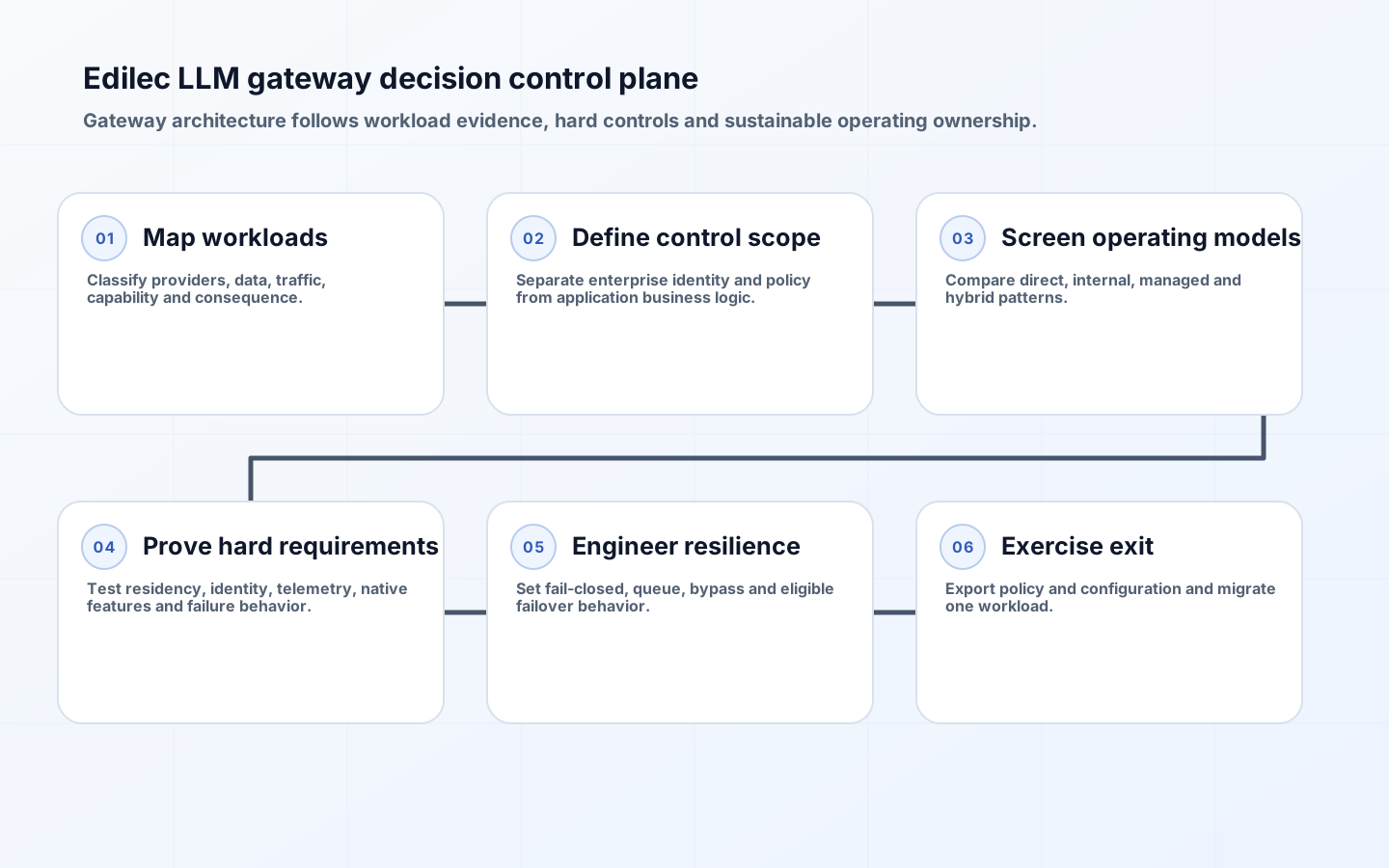
An LLM gateway build vs buy decision is a control-plane choice, not a proxy-feature contest. The gateway sits between applications and model providers, where it can centralize credentials, routing, quotas, telemetry, policy and failure handling. That position offers leverage, but it also creates a shared dependency with broad access to prompts and outputs. Enterprises should choose the smallest control plane that meets real governance and operating needs, then design it as critical infrastructure rather than an invisible HTTP relay.
Four patterns are viable: direct provider integrations with shared libraries, an internally built gateway, a managed gateway, or a hybrid in which enterprise policy and identity remain internal while managed components handle transport or analytics. The right answer depends on workload diversity, regulatory constraints, platform maturity and how quickly provider capabilities change. A scorecard can support the decision, but teams first need a workload map and explicit non-negotiables.
Define the control-plane job
List the decisions the gateway must make. Common examples are authenticating workloads, selecting an approved provider endpoint, enforcing data-region restrictions, applying spend limits, attaching trace context and blocking unsupported models. Separate those from application decisions such as retrieval, business authorization, prompt composition and human approval. A gateway that accumulates domain logic becomes difficult to change and test. Keep enterprise-wide policy at the shared layer and business meaning with the product that owns it.
Define success in operational terms: applications can onboard through a documented path; credentials are not embedded in product code; prohibited data routes are rejected; provider usage is attributable; and one gateway failure cannot halt every AI-assisted workflow without a recovery path. The NIST Generative AI Profile supports a Govern, Map, Measure and Manage approach. Use it to connect gateway controls to named risks rather than implementing every available feature.
Compare four gateway operating models
| Model | Best fit | Primary advantage | Primary risk |
|---|---|---|---|
| Direct integrations with shared SDK | Few teams, few providers, low central-policy need | Fast access to native capabilities | Policy and telemetry drift across applications |
| Internal gateway | Distinct enterprise controls and strong platform team | Maximum control over identity, routing and data path | Long-term product ownership and bottleneck risk |
| Managed gateway | Need rapid standardization and acceptable external processing | Faster operations and broad provider adapters | Vendor dependency, data handling and feature lag |
| Hybrid control plane | Strict policy with selective managed capabilities | Keeps high-value decisions internal | Boundary complexity and split incident ownership |

Do not interpret this table as a maturity ladder. Direct integration can be safer for one isolated high-risk application because it avoids a multi-tenant intermediary. A managed service can be the soundest enterprise choice when it meets residency, security and availability requirements and the internal team cannot sustain a reliable platform. Hybrid is useful only when the boundary is clear: for example, internal identity and policy produce a signed routing decision while a managed data plane performs the provider call.
Turn requirements into acceptance evidence
Inventory provider endpoints, regions, data classes, expected traffic, streaming needs, tool-calling formats, batch jobs, latency objectives and retention terms. Identify which capabilities must pass through without flattening: structured output, multimodal input, provider-specific safety controls and asynchronous execution may not fit a lowest-common-denominator API. Abstraction should normalize stable concerns such as identity and telemetry while allowing explicit escape hatches for valuable native features. Every escape hatch remains governed and observable.
Convert requirements into tests. Can a workload with expired identity call a model? Does restricted data route only to approved regions? Can operators attribute retries and cached tokens? What happens when the gateway policy store is unavailable? Can an application bypass the gateway, and is that detected? The NIST Zero Trust Architecture focuses protection on users, assets and resources rather than network location. Apply that principle by authenticating each workload and authorizing each model resource instead of trusting traffic because it originates inside a corporate network.
Build only for durable enterprise differentiation
An internal build is justified when controls are both material and poorly served by available products: proprietary policy evaluation, unusual deployment boundaries, deeply integrated chargeback, custom confidential-computing paths or a large internal ecosystem that needs a stable contract. The business case should include a staffed product team, on-call ownership, security review, provider-adapter maintenance, capacity engineering and a deprecation process. A prototype reverse proxy is not evidence that the organization can operate a multi-provider control plane.
Design an internal gateway in layers. A policy plane evaluates workload identity, data classification, approved model set and quotas. A routing plane chooses an eligible endpoint. A data plane handles transport, streaming and backpressure. An evidence plane exports traces, usage and decisions. Keep prompts out of policy logs unless needed, and make sensitive capture configurable by workload. Version provider adapters and run contract tests against native APIs because small upstream changes can break streaming, tool schemas or error interpretation.
Buy for commodity breadth and operating leverage
A managed gateway is attractive when provider integration breadth, global operation, usage accounting and telemetry pipelines are commodity needs. Evaluate the service as a privileged subprocessor and critical dependency. Review prompt and output handling, metadata retention, encryption, key custody, regional routing, tenant isolation, support access, incident notification, service objectives, change policy and deletion. Determine whether the provider can use content for service improvement and whether configuration or telemetry leave the selected region.
Run a technical proof with adverse cases, not a polished happy path. Exercise long streams, cancellations, model timeouts, provider throttling, malformed tool calls, failover, quota exhaustion and control-plane unavailability. Verify exportability of configuration and telemetry. Ask how quickly a new native provider capability appears and whether the gateway can pass it through before full normalization. Commercial terms should address egress, premium support, overage, log volume and the cost of retaining detailed traces.
Use a weighted decision scorecard
| Criterion | Weight question | Build evidence | Buy evidence |
|---|---|---|---|
| Security and privacy | Could gateway exposure create material harm? | Threat model, isolation tests, key design | Independent assurance, data-flow and contract terms |
| Policy specificity | Are controls unique and durable? | Policy prototype and owner | Configuration proof and extension model |
| Reliability | How much business stops if it fails? | Capacity tests, failover and on-call plan | SLO, architecture and incident history |
| Capability velocity | How often do applications need native features? | Adapter release process | Roadmap, passthrough and compatibility policy |
| Economics | What is total cost per useful workflow? | Staffing, infrastructure and opportunity cost | License, usage, support and egress |
| Exit | Can workloads move without a rewrite? | Portable contract and config export | Export test, termination help and data deletion |
Weight criteria by portfolio, then apply hard gates before scores. A service that cannot satisfy a mandatory residency path should not win through lower cost elsewhere. Score with evidence and confidence, not sales promises. Include application teams, security, privacy, finance and operations because a gateway redistributes work among them. Document assumptions such as traffic growth and provider count, and rerun the model when those assumptions change.
Standardize telemetry without creating a data lake of prompts
The OpenTelemetry GenAI semantic conventions provide a vendor-neutral starting point for model and agent telemetry. Capture provider, model, operation, token usage, latency, retries, routing policy and error category. Correlate the gateway span with application and tool spans. Treat prompt and completion bodies as sensitive optional events, not default attributes. High-cardinality user or document identifiers need controlled handling and may belong in governed references rather than general metrics.
Use gateway measurements for allocation and diagnosis, while preserving application-level outcome data. A lower provider bill can coincide with more failed workflows or human rework. The LLM cost controls guide explains budgets and unit economics, and the LLM observability checklist covers workflow signals. The gateway should supply consistent infrastructure evidence to both, not claim ownership of business quality.
Gateway policy also needs application-level safety context. The AI guardrails security review shows why layered controls and evaluations remain necessary around model inputs, outputs and workflow state. A shared proxy can enforce route and payload limits, but it cannot determine whether retrieved evidence supports a domain decision or whether a customer-facing action is appropriate.
Design bypass, failover and exit before launch
A central gateway expands the blast radius of configuration errors, expired certificates and capacity limits. Define whether each workload fails closed, queues, falls back to a local model, or uses a preapproved direct endpoint. Emergency bypass must be authenticated, time-bound, observable and narrower than normal access. Avoid automatic cross-provider failover when data terms, region or model behavior differ. Routing eligibility must be checked again for the fallback, and consequential workflows may require a human decision instead.
Maintain an exit package: application contract, provider mappings, policy definitions, encrypted configuration export, telemetry dictionary and migration tests. Avoid vendor-specific policy logic in every application; keep an enterprise policy representation that can target another enforcement point. Test one workload leaving the gateway annually. The NIST SSDF AI profile reinforces lifecycle security; exit and decommissioning are part of that lifecycle, including revoking credentials and confirming data deletion.
Key takeaways
- Frame the gateway as a privileged control plane and shared dependency.
- Keep cross-enterprise policy central while leaving business logic in owning applications.
- Choose among direct, internal, managed and hybrid models based on evidence, not assumed maturity.
- Preserve valuable provider-native capabilities through governed escape hatches.
- Use vendor-neutral telemetry while minimizing prompt and completion capture.
- Test failure, bypass and exit paths before routing critical workloads through the gateway.
Frequently asked questions
Does every enterprise need an LLM gateway? No. A few isolated workloads may be governed more clearly through direct integrations and shared controls. Centralization is valuable when it reduces real duplication or enforces material policy.
Should a gateway hide provider identity from applications? It can hide credentials and transport details, but applications often need declared model capabilities and behavior. Pretending all models are interchangeable produces fragile abstractions.
Can the gateway enforce all AI safety policy? No. It can enforce route, identity, quota and some content rules. Domain authorization, evidence quality, approval and outcome evaluation remain application responsibilities.
Conclusion
The LLM gateway build vs buy choice should follow a workload map, hard constraints and proof-based operating model. Build when durable proprietary controls justify a real platform team; buy when commodity breadth and operations create more value than internal ownership; use direct or hybrid patterns when they better contain risk. Whichever path wins, protect workload identity, preserve native capability, minimize sensitive capture, test resilience and keep an executable exit. The goal is a control plane that makes enterprise AI easier to govern without becoming its least understood dependency.