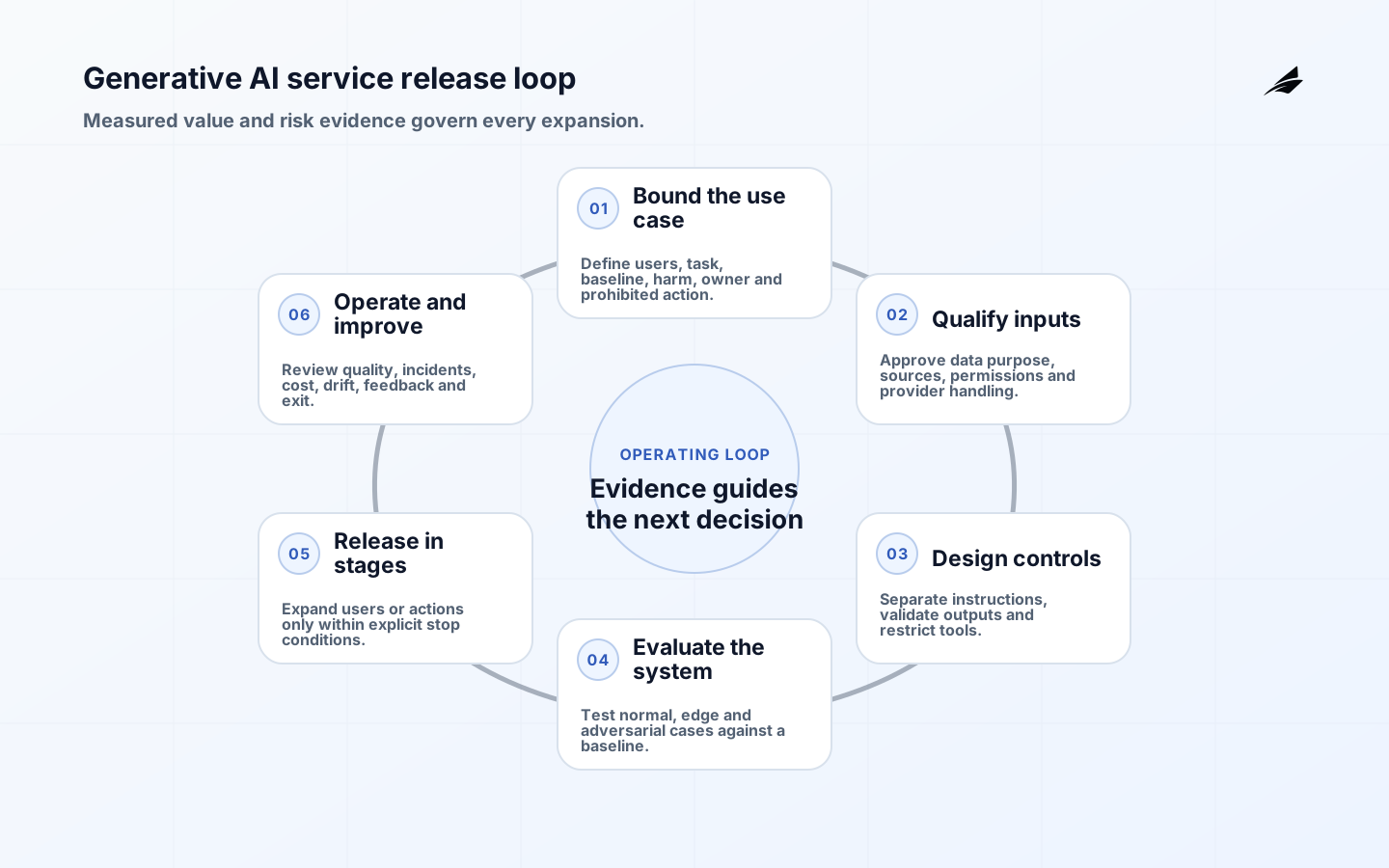
A generative AI services implementation checklist should connect a valuable use case to a service the organization can evaluate, secure, operate and stop. Selecting a model is only one decision. Production quality also depends on source data, retrieval, prompts, tools, user experience, human authority, provider terms, observability and the business process around the output.
Start narrow enough to prove quality and risk controls with representative work. Drafting internal summaries from approved material is easier to bound than an agent that changes customer accounts. Define the desired outcome, baseline performance, unacceptable failures and accountable owner before a vendor demonstration. This protects the program from optimizing impressive examples that do not survive ordinary operations.
Use Edilec's generative AI delivery plan for commercial planning, generative AI services FAQ for buyer questions, and AI workflow automation checklist for action-oriented automation.
Key takeaways
- Choose a bounded workflow with a measurable non-AI baseline.
- Evaluate the full system on representative tasks and explicit failure categories.
- Keep untrusted content separate from instructions and bound every tool action.
- Review provider data use, retention, regions, changes and exit before launch.
- Roll out progressively with stop conditions, incident ownership and cost controls.
Choose the use case and risk boundary
Describe the user, task, input, output, decision, downstream action and current baseline. Separate assistance from authority. A service may summarize a support case without deciding compensation; it may draft a reply without sending it. List affected people and failure consequences across accuracy, privacy, security, fairness, intellectual property, reputation and continuity. Identify prohibited inputs and actions.
The NIST AI Risk Management Framework provides a voluntary structure for governing, mapping, measuring and managing AI risks. Use it to frame ownership and evidence, then add applicable sector and jurisdiction requirements. Create an AI system record with purpose, owners, components, data classes, providers, evaluations, controls, incidents and retirement state.
| Use-case question | Good evidence | Warning sign | Decision |
|---|---|---|---|
| Is the task valuable? | Measured time, quality or service baseline | Benefit stated only as innovation | Baseline before pilot |
| Can quality be judged? | Representative cases and acceptance rubric | No owner can define a good output | Do not automate yet |
| Is authority bounded? | Explicit allowed and prohibited actions | Model can call broad tools | Reduce permissions |
| Can failure recover? | Fallback and correction route | Output directly creates irreversible effect | Add control or keep manual |
| Can data be used? | Purpose, rights, retention and access review | Unclear provider data handling | Resolve before transfer |
| Can it be operated? | Owner, service level, monitoring and budget | Pilot depends on one enthusiast | Fund operating model |
Perform provider and model diligence
Compare models on your tasks, languages, latency, context needs, tool behavior and cost. Review service regions, availability, rate limits, model lifecycle, update notices, security assurance, subprocessors, incident communication, support and export. Determine whether prompts, files and outputs are retained or used to improve services. Provider documentation can be endpoint-specific; for example, OpenAI publishes current platform data controls.
Contract for change and exit. Record model versions where available, define notice expectations, preserve evaluation suites and avoid relying on undocumented behavior. Design an abstraction only where it supports a plausible migration; a universal model wrapper can erase useful capabilities without delivering real portability. Ensure the company, not an implementation partner, owns production accounts, prompts, retrieval assets, telemetry and runbooks.
Design a bounded service architecture
Authenticate the user and derive authorization before retrieval or tool use. Build context from approved, permission-aware sources with provenance and freshness. Keep system instructions, developer rules, user content and retrieved content distinguishable. Treat documents and web content as untrusted data, not instructions. Constrain output format with schemas when downstream code consumes it, then validate business rules outside the model.
For tool use, allowlist operations, validate parameters, set transaction and rate limits, require confirmation for material actions and keep credentials outside the model context. Execute through a policy-enforcing service. Use idempotency for side effects and reconcile outcomes. The OWASP Top 10 for LLM and generative AI applications is a useful current security reference for prompt injection, sensitive information disclosure, supply chain and excessive agency.
Build evaluations before the pilot
Create a dataset from representative normal, edge, multilingual, adversarial and high-consequence cases. Keep a held-out release set and label source and expected behavior with qualified reviewers. Define failure categories such as unsupported claim, missed instruction, wrong citation, data leakage, unsafe tool choice, poor refusal and unacceptable latency. Use deterministic graders where possible and calibrated human review where judgment is required.

Evaluate the complete pipeline, not a model in isolation: retrieval coverage, context assembly, output, citations, tool arguments and business outcome. Compare against the current process and prior release. Automated evaluation tooling can make runs repeatable, but the team still owns criteria and representative data. The NIST AI RMF Playbook provides suggested actions that can help connect test evidence to governance and management. Retain failures and reviewer disagreement as evidence.
| Evaluation dimension | Example measure | Release gate | Production signal |
|---|---|---|---|
| Task success | Rubric pass on representative cases | Meets baseline by segment | Accepted result and correction rate |
| Grounding | Claims supported by approved sources | No severe unsupported claims | Citation opens and dispute samples |
| Safety | Prompt-injection and prohibited-action resistance | All critical attacks blocked | Policy violations and tool denials |
| Privacy | Sensitive data exposed beyond purpose | No critical leakage | Access anomalies and redaction events |
| Operations | Latency, availability and fallback | Service objective under load | p95 latency and fallback rate |
| Economics | Cost per completed useful task | Within approved scenario budget | Tokens, retrieval and review cost |
Secure development and production
Separate development, test and production data and credentials. Scan dependencies, protect prompt and configuration repositories, review changes and restrict model and tool administration. Red-team realistic abuse paths, including indirect prompt injection through retrieved content, data exfiltration, privilege escalation, denial of wallet and unsafe output rendering. CISA and the UK NCSC publish secure AI system development guidelines across design, development, deployment and operation.
Log enough to investigate while minimizing sensitive content. Capture request and response identifiers, system version, retrieval references, tool decisions, policy outcomes, latency, cost and user feedback under defined retention and access. Do not place secrets in prompts or broad traces. Monitor new destinations, unusual token use, repeated denials and changes in retrieval mix. Maintain a tested kill switch for tool actions and a graceful fallback for the user workflow.
Place human judgment where it changes outcomes
A reviewer should have authority, evidence, competence, time and choices. Show source material, uncertainty and downstream effect; allow correction, rejection, evidence request and escalation. Do not ask a person to approve thousands of homogeneous outputs without quality controls. For lower-risk drafting, the user may naturally edit the output. For material actions, use explicit approval artifacts bound to the exact parameters and evidence version.
Audit both reviewed and unreviewed samples to detect automation bias and misses. Measure reviewer accuracy and queue capacity, not only speed. The NIST Generative AI Profile identifies risks that can be novel to or intensified by generative AI and offers actions across the lifecycle. Translate relevant actions into product controls, owner routines and retained proof.
Roll out in controlled stages
Begin with employees or a small customer cohort, read-only tools and clear feedback. Shadow the current process where feasible. Expand one dimension at a time: users, document classes, actions or languages. Set stop conditions for severe failure, evaluation regression, incident rate, queue overload, cost or service instability. Avoid a pilot environment so curated that it cannot represent production.
Prepare fallback before launch. Users need to know when the service is unavailable or uncertain and how to continue safely. Operations needs an incident severity model, on-call contacts, provider escalation, communication templates and evidence preservation. Rehearse provider outage, model change, retrieval corruption, compromised tool credential, cost spike and rollback. A model switch should trigger targeted evaluation, not an unreviewed configuration edit.
Example: support reply assistance
A service drafts replies from authenticated customer context and approved support articles. It cannot issue refunds or change account data. Evaluation covers common intents, outdated articles, conflicting policies, prompt injection in customer text and unsupported claims. Agents see citations and edit before sending. A missing or stale source routes to knowledge maintenance, while sensitive account questions require existing verification.
The pilot measures resolution time, edit distance, citation validity, reopened cases, harmful error rate, agent satisfaction and total cost including review. Expansion occurs only where the service meets the human baseline without overloading knowledge owners. This produces a defensible operating decision rather than a broad claim that generative AI improved productivity.
Generative AI services implementation checklist
- Name the use case, baseline, owner, users, prohibited actions and stop criteria.
- Review data purpose, rights, sensitivity, retention, residency and provider handling.
- Evaluate model and full pipeline on representative and adversarial cases.
- Enforce retrieval permissions, output validation and bounded tool authority.
- Design human review with evidence, choices, capacity and audit samples.
- Instrument quality, security, latency, cost, feedback and business outcomes.
- Stage rollout with fallback, incident response and model-change gates.
- Retain system records, decisions, evaluation results and retirement plans.
Generative AI services FAQ
Should we choose the model before the implementation partner?
Define the use case and evaluation first. A capable partner should compare suitable models and architecture against your data, quality, security, latency, cost and exit requirements.
How long should a proof of concept run?
Long enough to cover representative work and failure paths, not an arbitrary calendar period. Set evidence and stop criteria before starting, then end the experiment when the decision is supported.
Do we need fine-tuning?
Often not initially. Improve task definition, context, examples, retrieval, validation and tool boundaries first. Consider fine-tuning when evaluation shows a repeatable gap that training data can address safely.
Conclusion
Generative AI services become production capabilities when use-case value, evaluation, security and ownership move together. Bound the system, test the whole workflow, protect tools and data, stage exposure and keep evidence after launch. The durable advantage is not early access to a model; it is the ability to improve an AI-enabled service without losing control of the business process.