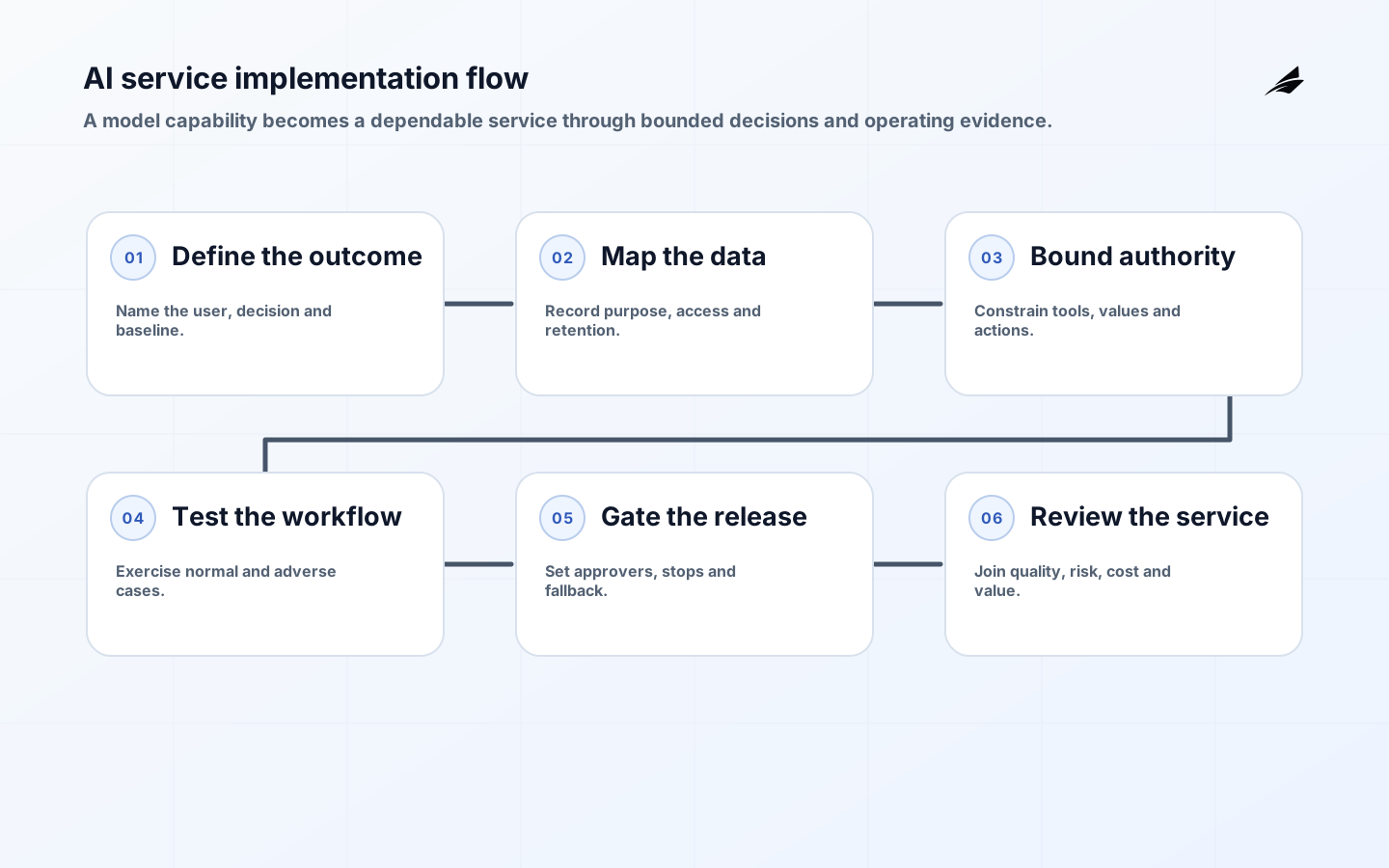
An AI services and solutions implementation checklist should answer a harder question than whether a model can produce an impressive demonstration. It should establish whether a defined group of people can use an AI-enabled workflow to reach a better outcome, within known authority, with evidence strong enough for the organization to release and support it. That means examining the surrounding data, decisions, interfaces, controls and operations as carefully as the model.
The checklist below is designed for product owners, technology leaders, risk teams and delivery partners. It complements Edilec's practical AI governance operating model, the AI search guide for permissioned company records and the wider business process solutions delivery plan. Each one treats AI as part of a service rather than a detached feature.
Key takeaways
- Begin with a consequential, observable business decision and a credible non-AI baseline.
- Write boundaries for data, model behavior, tool authority and human review before choosing a platform.
- Evaluate the complete workflow on representative and adverse cases, not a curated prompt collection.
- Release through explicit gates with owners, rollback conditions and a usable fallback.
- Operate cost, quality, security, privacy and accessibility as one service scorecard.
1. Define the outcome and the people affected
Write a one-sentence decision statement: who is trying to do what, what evidence they use, what action follows and how success is observed. A claims assistant might help an examiner identify missing documents; it should not silently decide eligibility. A support assistant might explain an approved policy; it should not invent an exception. This distinction exposes the actual service boundary and prevents a vague request such as “add AI to operations” from becoming an untestable program.
Document the present path before proposing a new one. Measure volume, waiting time, rework, error types, abandonment, accessibility barriers, staff effort and material harms. Interview the people doing the work and the people subject to its decisions. The NIST AI Risk Management Framework organizes work through Govern, Map, Measure and Manage; mapping the real context is what makes the later measurements meaningful.
| Question | Acceptable evidence | Warning sign |
|---|---|---|
| What improves? | Named user outcome and baseline | A generic productivity promise |
| Who is affected? | Users, reviewers and indirectly affected groups | Only the buyer is considered |
| What may the system do? | Typed, bounded actions and prohibited outcomes | Open-ended tool access |
| How is success verified? | Observable downstream result | A fluent answer or model score alone |
2. Establish data, authority and accountability boundaries
Create an inventory for every input, retrieved document, model, prompt, tool, output destination and log. Record the owner, purpose, permitted users, classification, retention, region, update process and deletion route. If a document should not be visible to the current user, retrieval must not make it visible to the model. If personal data is unnecessary for the task, remove or transform it before inference and telemetry. The ICO guidance on AI and data protection is a useful reference for lawfulness, fairness, transparency, security and individual rights; local legal duties still need explicit review.
Name a business owner who accepts the outcome, a data owner for each material source, an engineering owner for the runtime, and accountable reviewers for security, privacy, accessibility and model risk. Define what must be reviewed by a person and what that reviewer can see. Human approval is not a control when the interface hides provenance, presents a recommendation as settled fact, or rewards rapid acceptance. Reviewers need time, competence and authority to challenge the system.
3. Choose the least complex dependable architecture
Compare several patterns before settling on generative AI: deterministic rules, conventional search, a predictive model, retrieval-assisted generation, a tool-using assistant or a human-led workflow with AI support. The smallest sufficient pattern is easier to evaluate and recover. Keep the model behind an application boundary that validates inputs, enforces permissions, constrains tool schemas, records versions and handles unavailable dependencies. A vendor console can accelerate exploration, but it is not the production control plane.

For tool use, separate proposal from execution. The model proposes a typed action; deterministic software authenticates the user, checks authorization, validates values, applies transaction rules and records the result. Threat-model untrusted retrieved text and user content as data, not instructions. The OWASP guidance for LLM and generative AI highlights prompt injection, sensitive information disclosure and excessive agency among risks that must be addressed in the surrounding application.
| Architecture pattern | Best fit | Primary control | Fallback |
|---|---|---|---|
| Rules or workflow | Stable policy and finite states | Versioned decision logic | Manual queue |
| Search | Authoritative information retrieval | Access-aware indexing | Browse approved source |
| Retrieval plus generation | Synthesis from controlled evidence | Citation and support checks | Return source excerpts |
| Tool-using assistant | Bounded multi-step action | Typed least-privilege tools | Human completes transaction |
4. Build evaluation and acceptance evidence
Construct an evaluation set from real, permission-cleared work. Include common requests, rare but important cases, ambiguous inputs, stale or conflicting sources, different languages, assistive technology needs, malicious instructions, timeouts and unavailable tools. Label the expected outcome, acceptable variation, prohibited result and escalation path. Preserve a holdout set so repeated tuning does not merely optimize against the visible test collection.
Use deterministic checks for contracts and permissions, task-specific scoring for groundedness or classification, and sampled expert review for nuance. Measure the whole path: retrieval quality, action correctness, safe refusal, handoff completeness, latency, cost and downstream outcome. The NIST Generative AI Profile recommends risk-management actions for generative systems, including testing and incident considerations. An aggregate score should never conceal a severe failure mode.
5. Release through controlled gates
Start with offline replay, then an internal or agent-assist mode, a small production cohort and wider availability. Each gate needs entry evidence, a named approver, observation time and stop conditions. Confirm model and prompt versions, source snapshots, tool scopes, evaluation results, security findings, accessibility checks, support documentation, budgets and rollback instructions. A fallback must be tested under load and understandable to users; a hidden queue that nobody monitors is not a fallback.
Run an abuse review before widening access. Test prompt injection through user input and retrieved content, data extraction, privilege confusion, denial of wallet, unsupported claims and misuse of high-impact actions. Test the interface against WCAG 2.2 and with people who use assistive technology. A conversational interface must not remove an accessible non-conversational route or make human help harder to obtain.
6. Operate the AI service with joined evidence
A production scorecard should join quality, risk, service and value. Useful measures include verified task success, unsupported-claim rate, unsafe-action blocks, human override, repeat contact, latency percentiles, cost per successful outcome, accessibility defects and unresolved incidents. Segment by use case, model, prompt, source version, channel and affected group. Review samples from ordinary traffic as well as complaints; absence of complaints is weak evidence when people cannot recognize or report an error.
Treat every material change as a release: model aliases, prompts, tools, retrieval settings, source documents, safety policies and routing rules can all change behavior. Maintain an inventory, change record and reproducible evaluation result. The NIST AI RMF Playbook offers suggested actions and documentation practices across the framework functions. Use those ideas to create operating evidence, not a compliance theatre checklist.
Make procurement and handover testable
Convert supplier claims into acceptance tests before contracting. If a service promises regional processing, private connectivity, deletion, audit export, model-version stability or a particular availability level, specify how the team will verify it and what happens when the condition changes. Record subprocessors, support access, incident notification, quota behavior and scheduled retirement policy. Commercial terms should identify which usage, storage, evaluation and support charges are included. A data-processing agreement and security questionnaire are important records, but neither demonstrates that the configured production path behaves as promised.
Plan the transition from pilot to operations as a deliverable. Support and incident responders need a service map, known failure modes, safe diagnostic views, fallback instructions and an escalation route that works outside the project team. Product owners need a release calendar and a way to interpret quality and cost movement. Data owners need evidence that access, retention and deletion still match the approved purpose. Run one handover simulation in which an operator investigates a failed request, identifies its model, prompt, sources and tools, applies the fallback and communicates the result. If that exercise depends on the original builder's memory, the service is not ready for routine use.
Implementation readiness checklist
- The use case has an observable outcome, baseline, eligible population and excluded cases.
- Data, prompts, models, tools and logs have owners, purposes, access rules and retention decisions.
- Tool execution is deterministic, least-privilege, validated, auditable and recoverable.
- Evaluation covers representative, adverse, accessibility and outage conditions.
- Release gates define approvers, observation windows, stop thresholds and tested fallback.
- Operations can trace each result to versions and measure quality, harm, cost and business value together.
Frequently asked questions
Should a team choose an AI platform before selecting the use case?
No. First establish the decision, data and operating constraints. Then compare platforms against those requirements with a portable evaluation set. Otherwise, the platform's easiest demonstration can quietly define the problem.
How long should an AI pilot run?
Long enough to observe representative demand and known edge cases, not for an arbitrary number of weeks. Define the required sample, operating periods and acceptance evidence before launch. A low-volume consequential process may require targeted simulation as well as live observation.
Does human review make an AI service low risk?
Only when the reviewer has useful evidence, sufficient time, relevant expertise and genuine authority to reject or correct the result. Review quality must itself be measured.
Conclusion
The strongest AI services and solutions implementation checklist connects a bounded outcome to owned data, constrained authority, representative evaluation and daily operation. Choose the simplest architecture that can do the job, preserve a usable human path, and make every release decision traceable to evidence. That discipline turns a promising model capability into a service people can rely on.