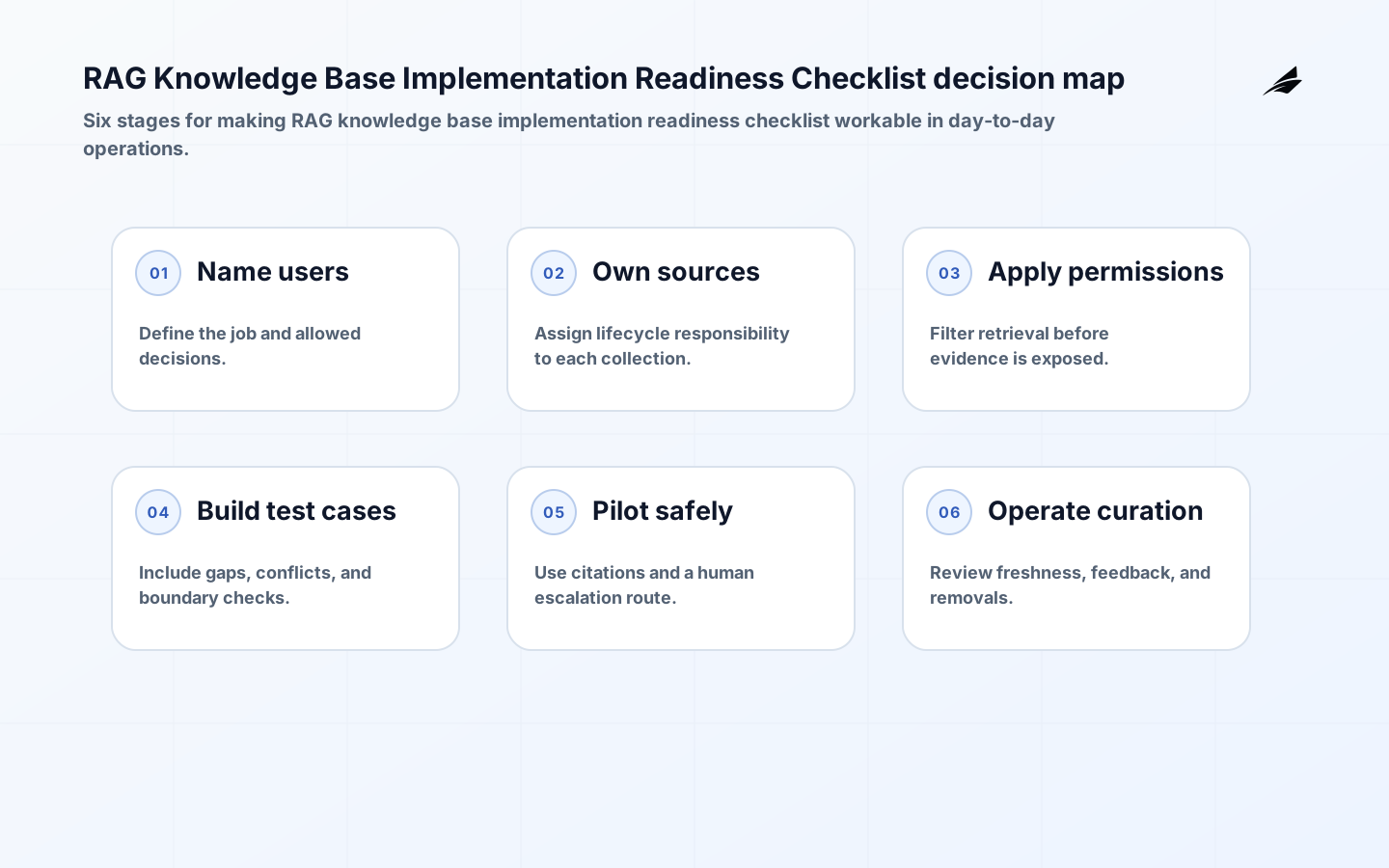
RAG Knowledge Base Implementation Readiness Checklist is a reader-first guide to deciding whether a RAG knowledge base is ready to pilot. The practical question is how an employee or support team querying a maintained knowledge collection can use AI assistance without leaving an answer based on obsolete material, restricted records, or missing evidence to chance. The test is not whether a demonstration sounds capable. It is whether the team can explain the task, show the evidence used, enforce the decision boundary, and recover when the result is wrong or incomplete. This guide treats allowing users to rely on retrieved knowledge in a work decision as a business responsibility with accountable people and controllable system behavior. For this design choice, name the accountable owner, supporting evidence, exception route, and next measurable check.
Set the decision boundary for RAG knowledge base implementation readiness checklist
Start by separating assistance from authority. Describe the intended outcome, the user who depends on it, the authoritative record, acceptable delay, and the person allowed to override the normal path. Define what is excluded from the first release as carefully as what is included. For RAG knowledge base implementation readiness checklist, a narrow, observable workflow gives the team a better foundation than a broad launch whose exceptions are already invisible. Within this decision boundary, name the accountable owner, supporting evidence, exception route, and next measurable check.
| Question | Decision to record | Evidence to keep |
|---|---|---|
| What is in scope? | allowing users to rely on retrieved knowledge in a work decision | Workflow description and named owner. |
| What must be protected? | an answer based on obsolete material, restricted records, or missing evidence | A concrete failure scenario and response. |
| Who decides? | A role that can approve, decline, or pause work. | Approval or escalation record. |
| What proves value? | A useful user and business outcome. | Sampled completed cases. |
Set risk and authority before implementation
Classify actions by consequence, reversibility, and uncertainty. A low-impact reversible suggestion may be automated with monitoring; a material or ambiguous action needs a named reviewer and visible evidence. Do not use model confidence as a permission slip. A system can sound certain for the wrong reason, while a low-confidence recommendation may be harmless. Make the application enforce the rule that decides whether allowing users to rely on retrieved knowledge in a work decision may proceed. When implementing this control, name the accountable owner, supporting evidence, exception route, and next measurable check.
- Name the business owner, technical owner, and user affected by allowing users to rely on retrieved knowledge in a work decision.
- List approved data sources and prohibited uses related to an answer based on obsolete material, restricted records, or missing evidence.
- Define a human decision point for consequential or uncertain cases.
- Write the correction, rollback, and incident route before release.
- Set review dates for permissions, source material, and evaluation cases.
Design the workflow around evidence and recovery
For delivery teams working on RAG knowledge base implementation readiness checklist, this information boundary should connect governed inputs, model behavior, permitted tools, human judgment, and recorded outcomes to evidence an accountable owner can inspect. Treat retrieved text as evidence, not as authority. Permission filtering, source ownership, freshness, citations, and a no-answer route belong in the retrieval design. In this readiness review, move beyond the information boundary only after the owner can show the accepted result, the exception path, and the signal for another review.
| Control | Practical question | Useful default |
|---|---|---|
| Identity | Which user or service is acting? | Use scoped identities and record the actor. |
| Evidence | What supports the result? | Show source references and validation outcomes. |
| Authority | What may happen without review? | Use narrow, revocable limits. |
| Recovery | What happens when it is wrong? | Provide a pause and correction owner. |
Test normal work and uncomfortable cases
In RAG knowledge base implementation readiness checklist, delivery teams should make the relationship between governed inputs, model behavior, permitted tools, human judgment, and recorded outcomes explicit and reviewable. Test real questions with expected sources, conflicting documents, permission boundaries, recently changed content, and questions that should receive no answer. A system should be able to cite support or escalate; similarity alone does not establish truth. This readiness review should close the acceptance decision only when the result, unresolved exception, and next review condition are recorded.
Roll out in a way the team can operate
A dependable RAG knowledge base implementation readiness checklist design makes governed inputs, model behavior, permitted tools, human judgment, and recorded outcomes visible to the owner responsible for this operating decision. Begin with a bounded pilot where the current process and its owner are known. Keep a manual path available, establish a baseline, and review representative cases with people who understand the work. Expand by task type only after the team can account for corrections, exceptions, and recovery time. Give users an in-workflow route to flag missing context or a bad result; it is often the fastest way to discover a process assumption that needs repair. The next step in this readiness review is justified when the team can trace the accepted outcome, the fallback route, and the owner of follow-up.
- Document the allowed task, excluded task, and stop conditions.
- Provide a way to correct output and report missing evidence.
- Exercise a recovery scenario with the people who would own it.
- Review sampled outcomes before expanding access or authority.
- Retire temporary exceptions and update the workflow record.
Use operating signals to decide what changes
This operating signal for RAG knowledge base implementation readiness checklist is strongest when governed inputs, model behavior, permitted tools, human judgment, and recorded outcomes can be reviewed as one operating record. Review results by workflow, risk class, and release rather than relying on one headline number. Useful signals include user correction, exception aging, denied or blocked actions, source changes, approval patterns, and incidents that required recovery. Investigate the case behind a trend. A stable average can hide a harmful outlier, and faster completion is not an improvement if work simply returns later as rework or escalation. Acceptance in this readiness review requires a visible outcome, a bounded exception path, and a measurable reason to revisit the decision.
| Signal | What it may reveal | Question for the owner |
|---|---|---|
| Unexpected change | Source, integration, permission, or workflow drift. | What changed, and should the capability pause? |
| Repeated exception | The rule or coverage does not fit real work. | Can the boundary be clarified? |
| User correction | Output lacked context or evidence. | What should enter the test set? |
| Missing trace | A material outcome cannot be explained. | Which record or event is absent? |
Work through a realistic RAG knowledge base implementation readiness checklist scenario
Treat readiness as a set of evidence checks, not a single approval meeting. Ask a content owner to demonstrate how a document is corrected or retired, an access owner to explain a boundary case, and an operator to resolve a deliberately unsupported question. The pilot is ready when those demonstrations work together. A polished retrieval demo is not enough when the collection has no reliable lifecycle or escalation path.
Use authoritative guidance as decision support
Delivery teams can keep RAG knowledge base implementation readiness checklist accountable by recording how governed inputs, model behavior, permitted tools, human judgment, and recorded outcomes shape this recovery path. This guide draws on NIST AI Risk Management Framework, NIST SP 800-207, Zero Trust Architecture, NIST Privacy Framework, and OWASP LLM01:2025 Prompt Injection. They provide useful framing for trustworthy AI, security and privacy controls, access boundaries, and risks from untrusted inputs. They do not replace context-specific legal, security, privacy, finance, or safety assessment. For this readiness review, the responsible owner should be able to explain what passed, what remains exceptional, and which signal reopens review.
Related reading
For connected decisions, read RAG Knowledge Bases for Support Teams: A Practical Operations Guide, RAG Knowledge Bases for Support Teams: A Checklist for Trusted Internal Answers, and RAG for Company Knowledge and Support: Architecture, Controls and Rollout. Use them as complementary guides while keeping the actual workflow, records, and accountable owners in view. To govern this part of the system, name the accountable owner, supporting evidence, exception route, and next measurable check.
Key takeaways for RAG knowledge base implementation readiness checklist
- RAG knowledge base implementation readiness checklist is an operating-design decision, not only a model choice.
- Keep authority, evidence, and recovery visible in the application workflow.
- Use real and adversarial cases before expanding access.
- Treat feedback and incidents as inputs to ongoing control review.
RAG Knowledge Base Implementation Readiness Checklist FAQ
What must exist before a pilot?
A bounded user group, owned source collection, access rules, representative questions, citations, and a named route for a missing or harmful answer. When explaining this part of the system, name the accountable owner, supporting evidence, exception route, and next measurable check.
Can every company file be indexed first?
Broad indexing increases access and freshness risk. Start with an owned domain, then expand when permissions and lifecycle controls are demonstrated. For this part of the system, test one expected case, one ambiguous case, and one failure with a documented recovery action.
Who maintains the knowledge?
Platform staff can run the service, while business owners remain accountable for content accuracy, review dates, and retirement. Within this part of the system, test one expected case, one ambiguous case, and one failure with a documented recovery action.
Conclusion: make RAG knowledge base implementation readiness checklist accountable
The durable test for RAG knowledge base implementation readiness checklist is whether a responsible person can explain the task, authority, evidence, exception path, and recovery action for a meaningful case. Start with a scope that can be observed end to end, then expand only when operating evidence earns the extra trust. When implementing this design choice, test one expected case, one ambiguous case, and one failure with a documented recovery action.