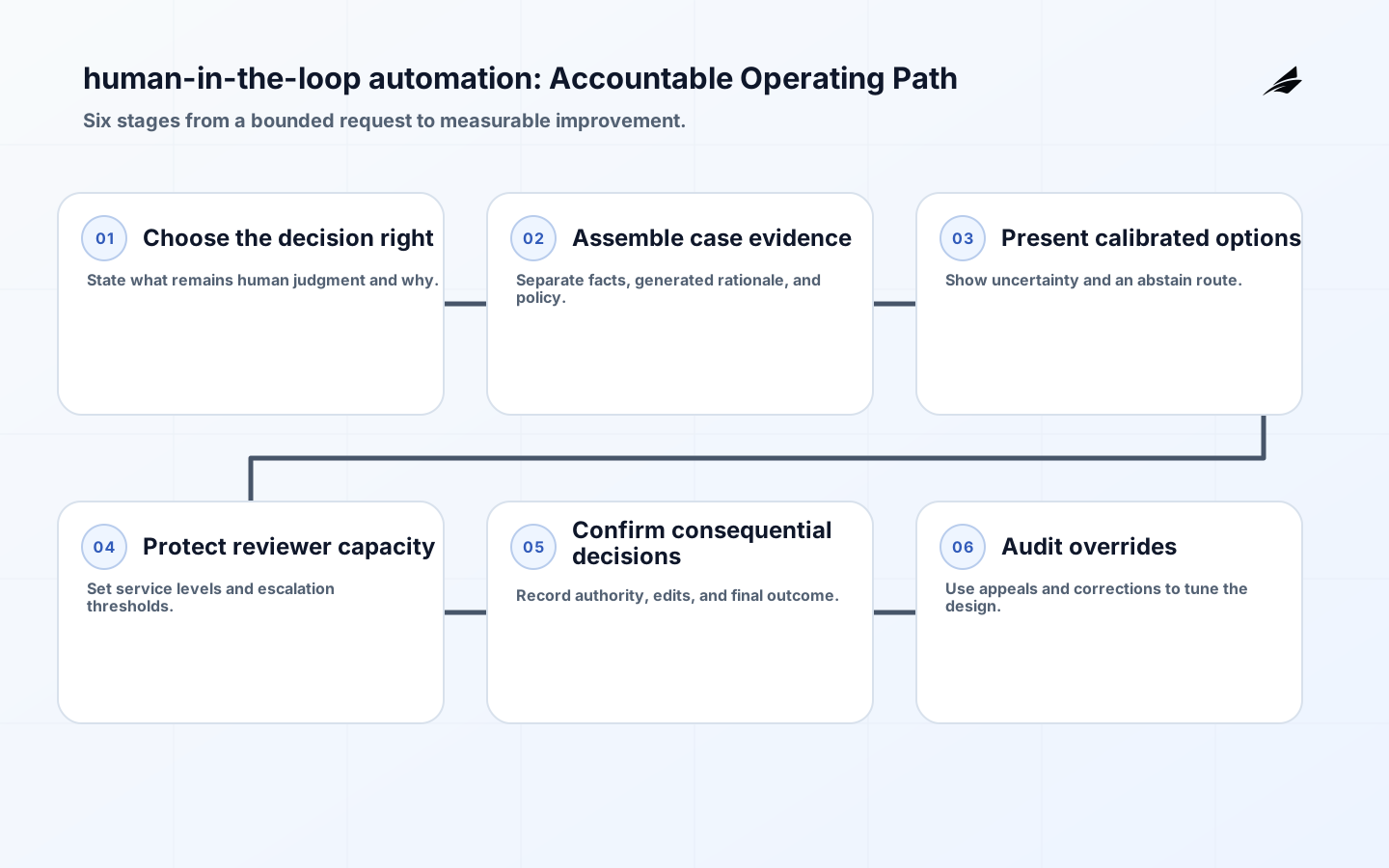
Human-in-the-loop automation becomes dependable when the team treats a recommendation that a person may accept, edit, or reject as an accountable operational object rather than a prompt that happens to sound useful. The first design decision is to name the manager who holds the decision authority, the exact outcome, and the point at which the service may stop assisting and must ask for help. In reviewed automation, hard failures rarely concern prose quality. They arise when a nominal reviewer becomes a rubber stamp under queue pressure, when a source is stale, or when a hurried person assumes that a generated recommendation has already been authorized. A credible design keeps the original case visible, distinguishes facts from inference, and makes the next accountable decision obvious. That foundation lets engineering improve model behavior without turning policy, access control, or business judgment into invisible instructions.
Set the human-in-the-loop automation operating boundary
Begin with a written boundary for human-in-the-loop automation. Describe the initiating event, the permitted inputs, the system that remains authoritative, the allowed output, and the prohibited outcome. For this guide, the authoritative evidence is the original case, governing policy, and the evidence used to form the recommendation. A useful boundary also names the recovery route: when missing evidence, a contested recommendation, or an overloaded queue appears, work is held or transferred rather than forced through a confident-looking path. This is more specific than a general promise of human oversight. It tells builders where to enforce rules, tells operators when to intervene, and gives auditors a way to reconstruct why a particular case did or did not proceed.
| Control question | Decision for this workflow | Evidence to retain |
|---|---|---|
| Accountable outcome | Define a measurable result for a recommendation that a person may accept, edit, or reject; assign the manager accountable for the decision right. | Case contract, owner, baseline, and acceptance threshold. |
| Authoritative context | Allow only the original case, governing policy, and the evidence used to form the recommendation; treat all other content as untrusted or contextual. | Source owner, version, effective date, access decision, and trace. |
| Action boundary | Require the named human decision maker before releasing a decision with customer, employee, or financial impact when impact or uncertainty crosses the stated threshold. | Policy rule, approval record, execution receipt, and final state. |
| Exception route | Hold or escalate missing evidence, a contested recommendation, or an overloaded queue instead of completing an unsupported path. | Reason code, assignee, service target, and resolution note. |
| Recovery | Pause the affected capability and return work to a safe fallback when controls fail. | Pause event, affected cases, reconciliation, and restart approval. |
Make evidence actionable
Evidence should help the next person make a decision, not become a sprawling archive of model chatter. Store the case identifier, source version, identity and permission result, configuration version, tool or retrieval trace, proposed result, reviewer action, and downstream receipt where one exists. For human-in-the-loop automation, preserve the minimum sensitive content needed to investigate a defect and apply retention rules deliberately. A reviewer should be able to answer what the service saw, which rule applied, what it proposed, and who made the final decision. If the team cannot answer those questions from the trace, the workflow is not yet ready to carry consequential volume.
Design for failure and recovery
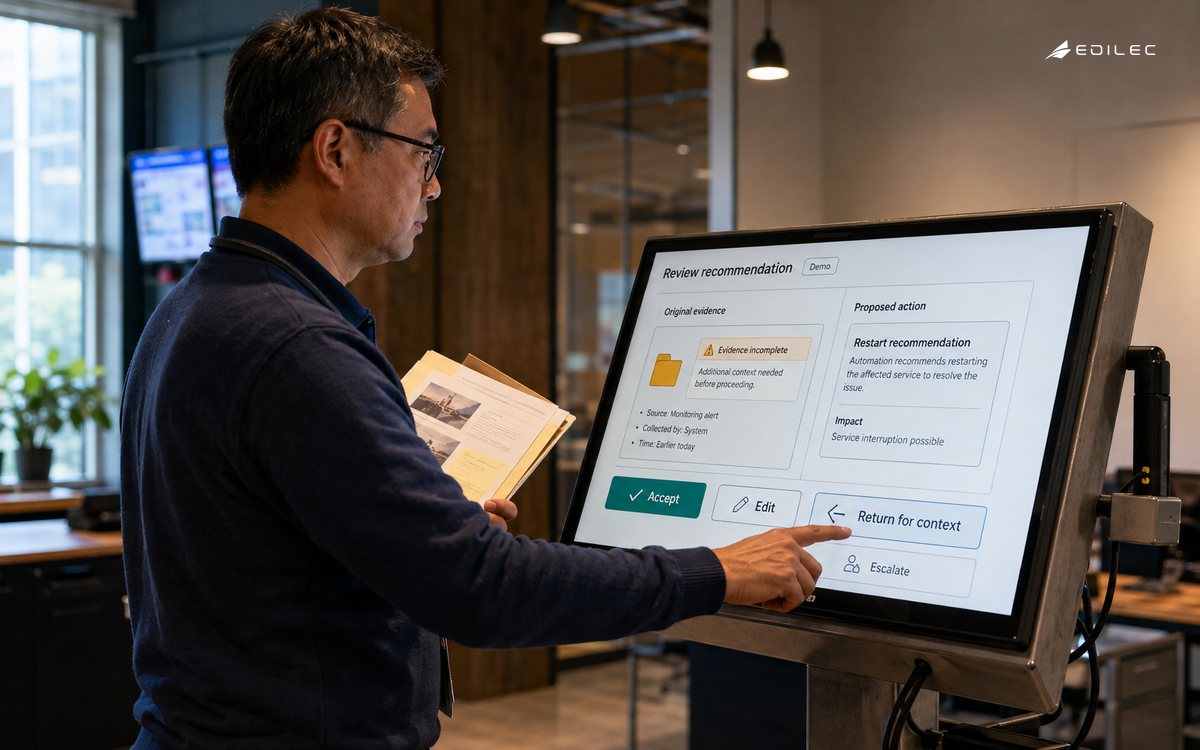
Failure design is the part of human-in-the-loop automation that reveals whether the system is actually engineered. Test the ordinary case, but spend comparable attention on missing evidence, a contested recommendation, or an overloaded queue. Make uncertainty visible rather than converting it into a false sense of precision. Separate a refusal to act from a system error; both deserve a useful reason code and a route to resolution. Protect the original evidence before retries or corrections alter it. When a dependency is unavailable, use a documented manual or deterministic fallback and reconcile afterward. A pause control should be quick to invoke, scoped to the affected function, and accompanied by a named owner who decides when restart evidence is sufficient.
| Test condition | Expected behavior | Release signal |
|---|---|---|
| Eligible ordinary case | Assist within the stated boundary and expose evidence needed by the named human decision maker. | Completion quality is sampled and traceable. |
| Conflicting or incomplete evidence | Name the missing fact, avoid invented resolution, and route the case. | Exception handling meets its service target. |
| Unauthorized or unsafe request | Deny releasing a decision with customer, employee, or financial impact at the enforcement point, not only in model instructions. | No protected action occurs without a valid policy decision. |
| Model or dependency failure | Preserve the original case, use fallback, and reconcile later. | Recovery time and backlog remain within agreed limits. |
| Human correction or appeal | Retain the original proposal and turn repeated causes into owned improvement work. | Corrections decline by cause without suppressing reporting. |
Evaluate the whole service
Evaluation for human-in-the-loop automation must follow the whole path, including identity, data handling, policy checks, human queues, integrations, and the final business effect. Build cases from completed work and include minority slices, new-policy scenarios, malformed inputs, and attempted misuse. Define a rubric before comparing alternatives: what is acceptable, what requires review, and what is a release-blocking failure? Sample outputs with domain experts, record disagreement, and investigate root causes instead of merely tuning a score. A model change, prompt change, retrieval change, or tool-schema change can alter outcomes; treat each as a change to the service and rerun the relevant cases.
Release with operational ownership
Release human-in-the-loop automation as a bounded service with a real operating owner. Start with a limited population, explicit eligibility rules, a support route, and a reversible action boundary. Train reviewers on the evidence they should inspect and the situations they should escalate. During the pilot, review completed cases alongside rejected and abandoned ones; the latter often expose friction that aggregate adoption masks. Expand only when the team can show stable quality, manageable queue behavior, and a working recovery process. A popular demo is not evidence that broader authority is safe or economically justified.
- Observe a recommendation that a person may accept, edit, or reject from request to final outcome before changing automation scope.
- Write the permitted action, prohibited action, accountable owner, and closure evidence in one case contract.
- Keep the original case, governing policy, and the evidence used to form the recommendation distinct from generated interpretation and untrusted content.
- Test an ordinary case, missing evidence, a contested recommendation, or an overloaded queue, an unauthorized request, and the fallback.
- Give the named human decision maker context, authority, time, and a visible way to disagree.
- Turn repeated corrections into changes to sources, policy, evaluations, or interface design.
Measure decisions, not activity
Metrics for human-in-the-loop automation should lead to decisions, not create a decorative dashboard. Track edit rate, override reason distribution, review time, backlog age, and post-decision correction rate. Define each metric's numerator, denominator, time window, exclusions, and owner. Pair efficiency with a quality or harm measure, because faster routing, extraction, or generation can conceal a growing correction cost. Segment results by case type, source condition, reviewer, and impact tier where that helps reveal a meaningful difference. Review a small, regular sample of traces with operators. Their explanations can distinguish a model issue from a weak source, confusing interface, capacity problem, or policy ambiguity.
Key takeaways
- Human-in-the-loop automation needs an explicit action boundary before it needs more autonomy.
- Evidence should support the next accountable decision, not merely explain an output after the fact.
- Controls for releasing a decision with customer, employee, or financial impact must be enforced at the protected system boundary.
- A narrow pilot is valuable only when it includes meaningful exceptions and a usable recovery route.
- Operational measures should pair speed with quality, correction, or harm signals.
Frequently asked questions
How narrow should the first human-in-the-loop automation release be? Limit it to a case class where the manager accountable for the decision right can describe the outcome, the authoritative evidence, the action boundary, and the recovery route without relying on tribal knowledge. Include a common path and at least one consequential exception. Exclude adjacent work whose policy, source quality, approval authority, or downstream reconciliation is unsettled. A narrow release is not timid; it creates an observable operating pattern that can be evaluated honestly before more volume or authority is added.
When is human review meaningful in human-in-the-loop automation? Review is meaningful when the named human decision maker receives the original case, the relevant evidence, uncertainty signals, and a real ability to accept, edit, reject, defer, or escalate. A person who sees only fluent generated text, lacks time to inspect it, or cannot stop releasing a decision with customer, employee, or financial impact is performing ceremony rather than control. Design review capacity, escalation targets, and feedback capture as carefully as the model interaction. That is what makes corrections useful to both the present case and the next release.
Conclusion
The practical discipline behind human-in-the-loop automation is to preserve accountable judgment while reducing repetitive work. Keep policy and authorization enforceable outside generated prose. Keep the original case and meaningful evidence close to the person who must act. Treat corrections, overrides, appeals, and near misses as work items with owners rather than anecdotes. With that operating loop in place, the team can make a calm decision to expand, narrow, redesign, or retire the service based on evidence instead of momentum.