A test strategy for an appointment workflow
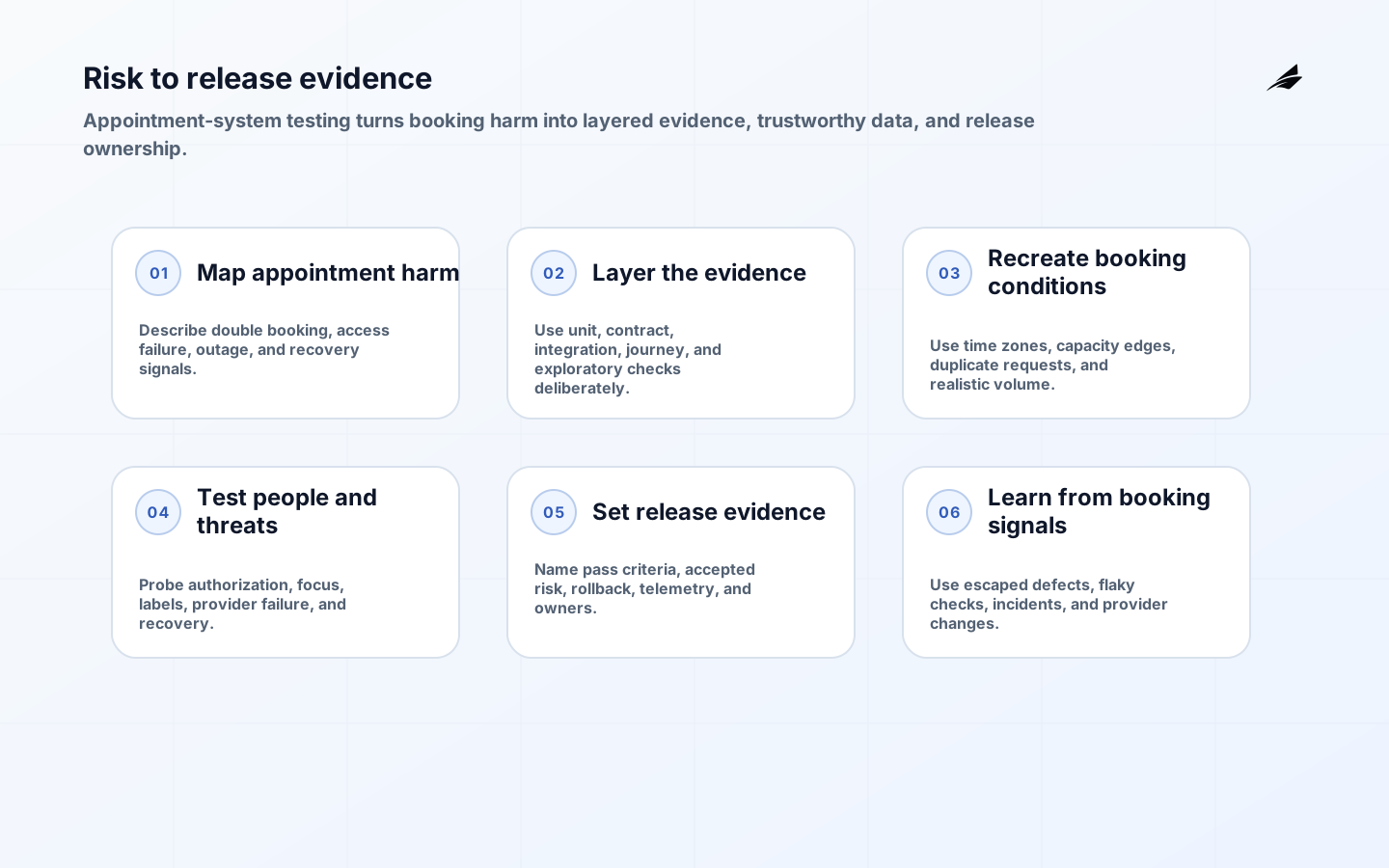
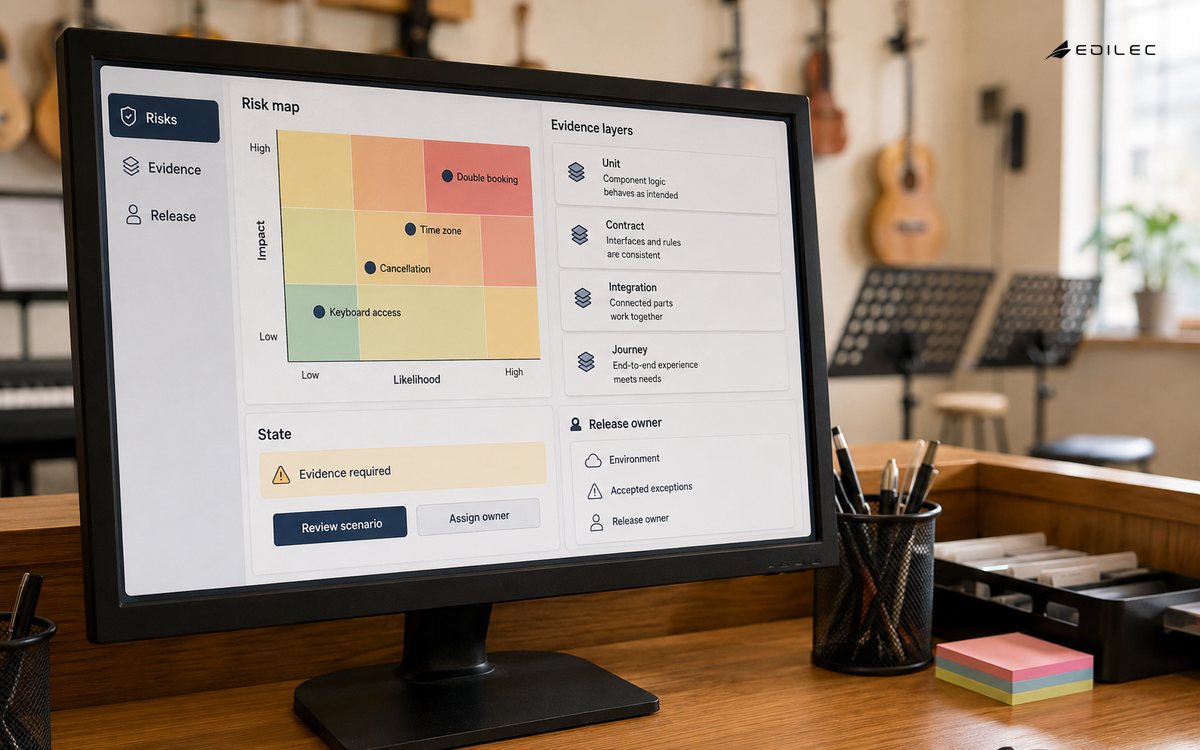
Consider software that lets a customer book an appointment with a limited-capacity provider. The risk map includes double booking, unauthorized changes, time-zone mistakes, duplicate notifications, inaccessible controls, provider outage, payment failure, and cancellation recovery. Unit tests cover slot calculation and state transitions. Contract tests protect calendar and payment boundaries. Integration tests use realistic identity, time, retry, and queue behavior. End-to-end tests prove one booking, change, cancellation, and recovery journey. Exploratory testing probes rapid clicks, refresh, back navigation, daylight-saving boundaries, keyboard-only use, visible focus, contrast, labels, and a slow network. OWASP’s Web Security Testing Guide structures security evidence, WCAG 2.2 covers accessibility evidence, and RFC 9110 clarifies HTTP behavior at the service boundary. Load tests cover popular times, cold deployment, and provider slowdown. Release evidence names the build, data, environment, passed scenarios, accepted exceptions, telemetry, rollback, and owner for each remaining risk. The strategy must be written before the first build because it changes the model of state, time, identity, and failure rather than merely adding checks after the UI exists.
| Decision | Evidence to collect | Stop or change when |
|---|---|---|
| Scope | Representative workflow, owner, and measurable baseline | The boundary or outcome remains ambiguous |
| Safety | Negative, failure, recovery, and permission scenarios | A critical state has no tested response |
| Operations | Telemetry, runbook, capacity, and escalation | No named owner can respond |
| Release | Cohort, rollback, comparison, and acceptance record | The result cannot be compared with baseline |
Test data and environments are part of confidence. Keep fixtures representative of empty states, boundaries, duplicates, corrections, permissions, localization, and realistic volume without exposing unnecessary personal data. Make reset and creation deterministic. Keep a small critical journey suite stable and use lower-level evidence for detail so every change does not wait on a fragile browser path. Treat flaky tests as defects with a named owner and expiry. NIST SSDF is a useful lifecycle reference for assigning secure-development evidence and ownership. Review results by consequence, not only by coverage: a rarely used irreversible action may deserve more attention than a frequently executed harmless branch. Revisit the risk map when group bookings, new providers, or new customer roles are introduced.
Which test decision comes next?
Review the appointment evidence with the product owner, provider-operations lead, and service owner. The next decision should follow booking correctness, accessibility, recovery, and release signals—not the number of test cases delivered.
A test strategy is a set of decisions about risk and evidence made before implementation hardens the architecture. It should answer what could harm a user or business, how that harm will be detected, which environment can reveal it, who owns the result, and what evidence permits release. More tests are not automatically more confidence: a large suite of brittle checks may hide missing scenarios. Begin with the workflow, its contracts, data, permissions, failure modes, and measurable acceptance. NIST’s SSDF is a useful lifecycle reference for integrating secure development practices rather than treating security as a final gate.
Name the risk before the test
List business, data, security, reliability, accessibility, integration, and operability risks. Describe the harm and the signal that would reveal it. A payment flow needs more than unit tests; it needs duplicate-request behavior, authorization, reconciliation, timeout, and recovery evidence. A reporting feature needs data definitions, boundary dates, permissions, and representative volume. Rank risks by consequence and likelihood, then choose evidence proportionate to the decision. This makes the test strategy a delivery tool rather than a calendar of test phases.
| Risk | Useful test | Acceptance evidence |
|---|---|---|
| Wrong business result | Examples and property tests | Expected outcome and edge cases |
| Unauthorized access | Negative identity matrix | No cross-scope response |
| Dependency failure | Timeout and recovery test | Bounded retry and operator signal |
| Inaccessible control | Keyboard and assistive review | WCAG criteria and manual result |
Use the right level of test
Unit tests are fast for local rules; integration tests validate real boundaries; contract tests protect independent consumers; end-to-end tests prove a small number of critical journeys; exploratory testing finds surprises that scripted checks cannot anticipate. Choose the lowest level that gives convincing evidence and add higher-level checks where composition creates risk. Keep test names tied to behavior and failure consequence. A test that passes but does not distinguish a wrong authorization result from a correct one is not useful coverage.
Make data and environments trustworthy
Test data should represent empty states, boundaries, duplicates, corrections, long-running work, permissions, localization, and realistic volume without exposing unnecessary personal information. Document data creation and reset. Keep environment configuration visible and close enough to production to reveal timeouts, queues, identity, and observability behavior. Avoid tests that depend on the order of unrelated cases. Where third parties are unstable or costly, use a contract-verified substitute and retain a small set of live or recorded boundary checks.
| Need | Environment choice | Control |
|---|---|---|
| Fast feedback | Local or isolated CI | Deterministic fixtures |
| Boundary confidence | Production-like integration | Contract and cleanup |
| Load behavior | Dedicated performance stage | Representative volume |
| Recovery | Staging with failure injection | Runbook and owner |
Include security and accessibility from the start
The OWASP Web Security Testing Guide helps teams organize authentication, authorization, input, session, configuration, and error testing. Apply those questions to the actual threat model and data. Use WCAG 2.2 as a conformance reference for keyboard operation, focus, labels, contrast, input assistance, and robust semantics. Automated scanners are useful but incomplete; pair them with manual journeys and assistive technology where appropriate. Security and accessibility defects are cheaper to fix when the interface and boundary are still flexible.
Set release evidence and ownership
Define the evidence that allows release: critical scenarios pass, known risks are accepted by an accountable owner, performance stays within budget, security and accessibility findings have a disposition, telemetry is present, and rollback or recovery has been exercised. Give each suite a maintainer and a response expectation. A red test without ownership becomes background noise; a green test without trustworthy data becomes false confidence. Review the strategy after incidents, escaped defects, and significant changes in traffic or workflow.
Balance speed with confidence
Keep fast checks on every change, run broader suites at meaningful integration points, and schedule exploratory and performance work according to risk. Parallelize safely, quarantine only with an owner and expiry, and track flaky tests as delivery defects. Report duration, failure cause, flake rate, defect escape, and time to restore the suite. A team earns speed by reducing uncertainty, not by deleting evidence. The best test strategy makes the safe path the easy path for developers and release operators.
- Start from harm and acceptance, not a preferred testing tool.
- Match unit, integration, contract, end-to-end, exploratory, and performance evidence to risk.
- Use representative, privacy-conscious data and production-like boundaries.
- Test identity, accessibility, failure, recovery, and observability explicitly.
- Assign ownership and expiry to every suite, exception, and flaky test.
- Revisit the strategy when incidents or architecture change.
Key takeaways
A test strategy makes risk visible before code makes it expensive. Map harm to evidence, use the right test level, keep environments trustworthy, include security and accessibility, and set clear release ownership. Confidence is a maintained property of the delivery system.
A test strategy example
For an appointment workflow, map double booking, authorization, time zones, duplicate notifications, inaccessible controls, provider outage, and partial payment as risks. Unit tests cover slot rules; contract tests protect calendar and payment boundaries; integration tests cover identity, retries, and realistic time; end-to-end tests prove booking, change, cancellation, and recovery. Exploratory testing probes rapid clicks, refresh, back navigation, daylight-saving boundaries, keyboard use, focus, contrast, and a slow network. Load tests cover popular slots and a cold deployment. Release evidence names the owner of every accepted risk and includes reconciliation, alerts, and rollback. The strategy changes when group bookings or a new provider is added because the risk surface changes.
Appointment-test decision signals
For an appointment workflow, map double booking, unauthorized changes, time-zone mistakes, duplicate notifications, inaccessible controls, provider outage, payment failure, and cancellation recovery. Unit tests cover slot rules and transitions; contract tests protect calendar and payment; integration tests use realistic identity, time, retries, and queues; end-to-end tests prove booking, change, cancellation, and recovery. Exploratory testing probes rapid clicks, refresh, back navigation, daylight-saving boundaries, keyboard-only use, focus, contrast, labels, and a slow network. Load tests cover popular slots, cold deployment, and provider slowdown. Every suite needs a maintainer, and flaky tests are delivery defects. Release evidence names build, data, environment, scenarios, exceptions, telemetry, rollback, and owners.
What belongs outside end-to-end tests
Use unit, contract, integration, and exploratory evidence where they provide a convincing signal with less fragility. Reserve end-to-end tests for journeys where composition itself creates risk, such as identity, payment, booking, notification, or recovery across services. A lower-level test should assert behavior and failure, not merely execute lines. Keep a small critical journey suite stable and make test data resettable. Review gaps by consequence and include security, accessibility, time, localization, and dependency failure whenever they change the user outcome.
Frequently asked questions
Is code coverage a test strategy?
No. Coverage can show which lines or branches executed, but it does not prove that important outcomes, permissions, failure modes, accessibility, or recovery behavior were meaningfully asserted.
How many end-to-end tests are enough?
Use a small, stable set for the highest-value journeys and rely on lower-level evidence for detail. Add more when a composition risk cannot be convincingly covered elsewhere.
What should happen to flaky tests?
Treat flakiness as a delivery defect. Quarantine only with a named owner, a reason, replacement evidence if needed, and an expiry date. Otherwise the suite teaches the team to ignore failure.
Conclusion
Decide what must be true before deciding how to test. A risk-led, evidence-based test strategy helps teams release faster because it makes uncertainty explicit, assigns ownership, and protects the behaviors that matter most.
The release owner should receive a concise evidence report naming the build, environment, data, scenarios, failures, exceptions, telemetry, rollback, and risk owners. This report makes testing useful to a decision rather than a pile of pass counts. Revisit the strategy when traffic, roles, integrations, or business consequence changes.