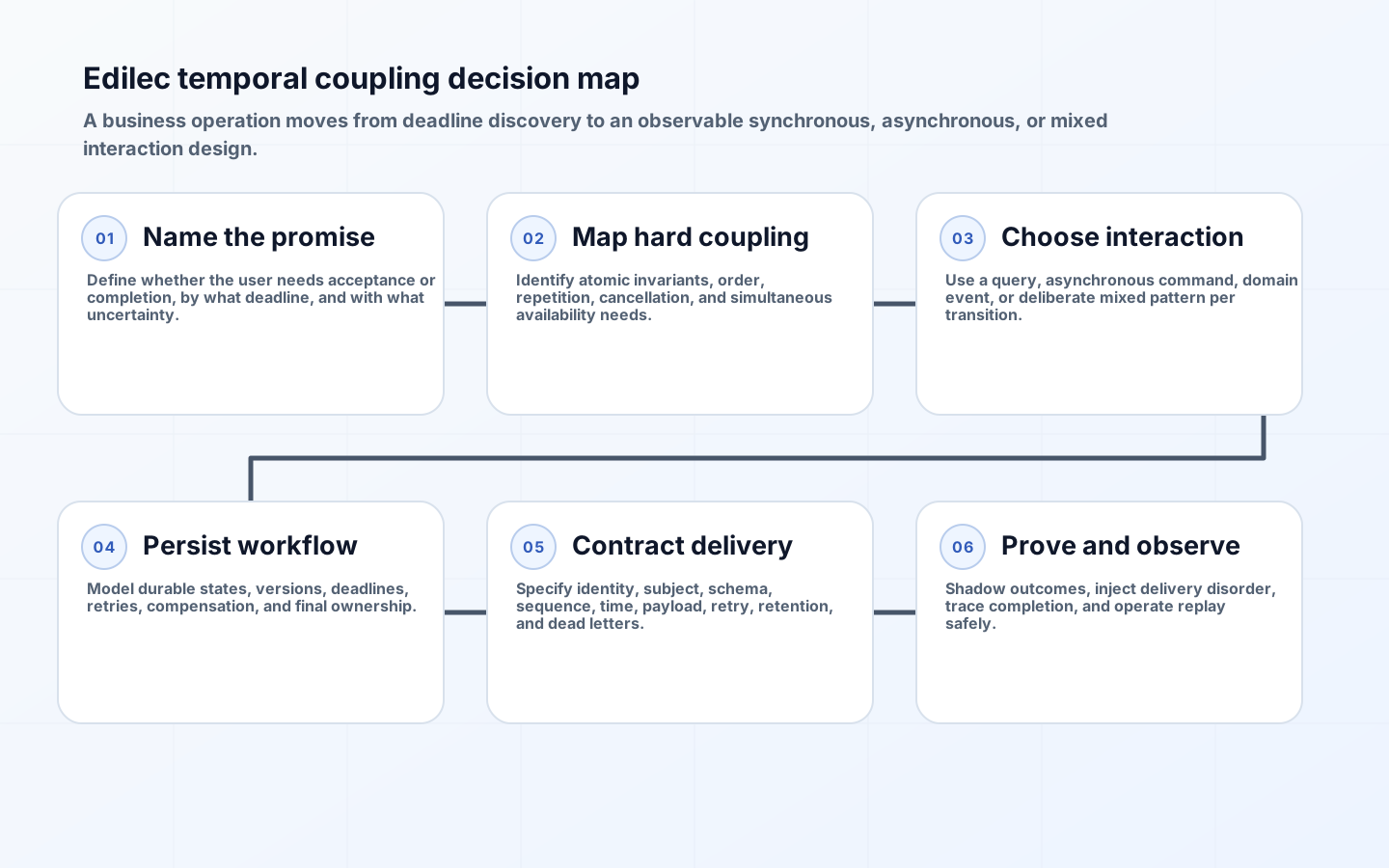
Temporal coupling event-driven architecture analysis asks how strongly participants must be available, ordered, and responsive at the same time for a business outcome to succeed. Replacing an HTTP call with a topic does not automatically remove that coupling. The caller may still poll immediately, the customer may still expect a final answer in two seconds, or downstream work may still depend on strict ordering and one shared transaction.
Before changing communication style, map the promise made to the user and the state transitions required to keep it. Asynchrony is valuable when work can proceed independently, absorb bursts, retry safely, or fan out. It is harmful when it hides an immediate decision behind uncertain status, creates unowned partial completion, or weakens a business invariant that actually requires synchronous confirmation.
Inventory business deadlines and answer types
Trace each operation from trigger to the point where a person or system can safely act. Record the response deadline, whether the answer is acceptance or completion, the consequence of uncertainty, and who owns timeout recovery. A 202 Accepted response is honest only if the caller can observe durable workflow status and knows what acceptance guarantees.
Separate machine latency from business time. Fraud review might take minutes with a clear pending state; stock reservation may need a subsecond answer before checkout proceeds; document generation can continue after the page closes. Microsoft’s event-driven architecture style distinguishes event producers from consumers and notes benefits such as decoupling and independent scaling alongside challenges in eventual consistency, ordering, error handling, and observability.
Build a temporal coupling map
| Question | Synchronous evidence | Asynchronous opportunity | Required design |
|---|---|---|---|
| Must the initiator know success now? | Irreversible action depends on answer | Acceptance can be separated from completion | Durable status and truthful response semantics |
| Must changes commit atomically? | Invariant spans both participants | Compensation is acceptable | Saga state, idempotency, and reconciliation |
| Does order matter? | Later command is invalid before earlier one | Order matters only per entity | Partition key, sequence, and stale-event rule |
| Can work be repeated? | Side effect cannot safely duplicate | Operation has stable identity | Deduplication and idempotent handler |
| Can the user leave? | Open connection is part of experience | Completion can be notified later | Status query, callback, or notification |
| What happens after a deadline? | Caller can cancel before commit | Work may already be in flight | Cancellation state and late-result policy |
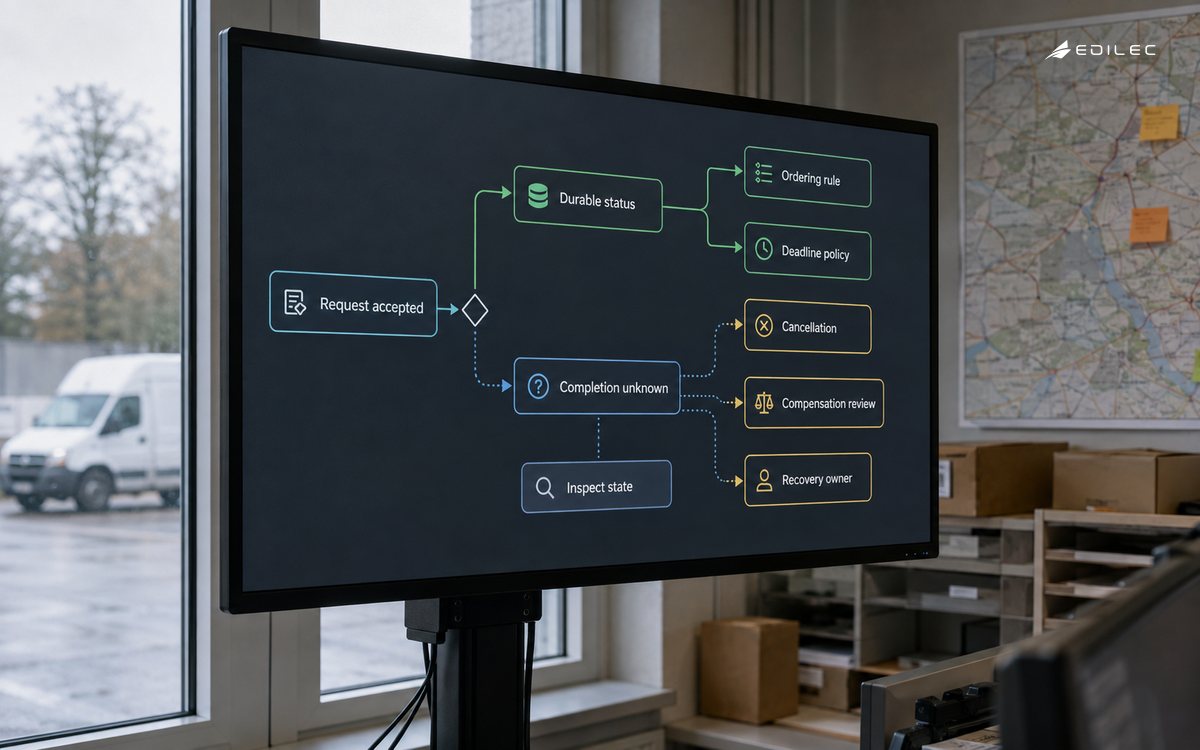
Map present behavior from traces, logs, UI states, timeouts, retries, and support cases. Include human waits and overnight jobs. Mark hidden synchronization: a service may publish an event but then block on a reply topic, creating request-response with more infrastructure. That may be valid, but it should be evaluated as synchronous coupling with broker-mediated failure modes.
Choose the interaction pattern per transition
Use a synchronous query when the caller needs current information to decide and the provider can meet the availability and latency contract. Use an asynchronous command when a durable receiver can own completion and expose status. Publish a domain event after an authoritative state change when multiple consumers may react independently. Do not publish commands disguised as past-tense events; ownership and failure handling differ.
AWS explains that event-driven systems use events to communicate state changes and that Lambda event-driven architectures can decouple producers and consumers. Platform mechanics do not define business semantics. Document whether the broker acknowledges receipt, whether the handler completed, how retries occur, and where dead-lettered work becomes visible to an accountable operator.
Model workflow state, compensation, and cancellation
Persist workflow state when completion spans messages or participants. A useful state model includes requested, accepted, in progress, waiting, completed, failed-retryable, failed-final, cancelling, cancelled, and compensation-required where applicable. Not every workflow needs every state, but every externally visible outcome needs an unambiguous meaning. Store the initiating command identity, current version, deadlines, attempts, and last error.
Design compensation as a business action, not a generic database rollback. Releasing a reservation, issuing a refund, and cancelling a shipment have different authorization and customer effects. Specify which completed steps can be undone, which require manual intervention, and what happens when compensation fails. Cancellation is another command racing with work already underway; define the state/version check that resolves it.
Define event contracts and delivery behavior
| Contract element | Decision | Failure if omitted | Verification |
|---|---|---|---|
| Identity | Unique event and causation IDs | Duplicates create repeated side effects | Replay duplicate and assert one outcome |
| Subject | Stable aggregate or workflow key | Ordering and routing become ambiguous | Partition and concurrency test |
| Version | Schema plus aggregate sequence | Consumer cannot distinguish old state | Compatibility and stale-event tests |
| Time | Occurred, recorded, and optional deadline times | Lag and timeout analysis is unreliable | Clock and delayed-delivery scenarios |
| Payload | Facts needed by authorized consumers | Consumers call back or infer hidden state | Contract review and minimization |
| Delivery | Retry, backoff, retention, and dead-letter policy | Failures disappear or retry forever | Broker fault and poison-message tests |
Describe channels, operations, messages, correlation, and schemas in a versioned contract. AsyncAPI’s 3.0.0 specification provides a machine-readable structure for asynchronous APIs, while the CloudEvents specification defines common event context attributes. Either can improve interoperability, but neither chooses idempotency, business ordering, or authorization for you.
Migrate with shadow evidence and end-to-end observability
Start with one transition whose delayed completion is already acceptable. Publish events from the existing authoritative path, let a shadow consumer calculate but not apply outcomes, and compare results. Then move one side effect behind an idempotent handler, expose workflow status, and test duplicate, delayed, out-of-order, missing, and poison messages. Preserve a routing switch for rollback without creating two active writers.
Trace the initiating request through publication and consumption using propagated context or span links, while retaining business correlation independent of sampling. Monitor age of oldest work, end-to-end completion time, retry distribution, dead-letter depth, duplicate suppression, stale-event rejection, compensation, and workflows stuck beyond deadline. Alert on customer outcomes, not merely broker health.
Capacity design must include retained work, not just event rate. Estimate arrival bursts, processing-time distribution, retry amplification, partition skew, retention, replay rate, and the time needed to drain a peak backlog while new work continues. A queue can protect producers yet violate the business deadline hours later. Set an age objective and scale or shed based on deadline risk rather than message count alone.
Plan schema change for independently deployed consumers. Add fields compatibly, keep old meaning stable, publish consumer usage where possible, and remove only after supported consumers no longer depend on it. If a semantic change cannot be additive, publish a new event type or versioned channel with an explicit migration. Reusing the same field name for a different business meaning is a breaking change even when JSON validation passes.
Authorization also changes when data is copied into events. Minimize payloads, classify topics, authenticate publishers and subscribers, constrain subscription scope, encrypt transport and storage, and set retention from business need. A convenient event carrying a complete customer record can multiply access and deletion obligations. Where consumers only need identity and version, let an authorized projection service materialize the narrower view.
Operational ownership must span the asynchronous gap. Name who responds when publication fails, when a consumer exhausts retries, when a workflow misses its deadline, and when compensation is required. A dead-letter queue is not resolution; it is a durable list of uncompleted business work. Provide replay tooling with preview, authorization, rate limits, idempotency, and an audit trail.
Keep commands and facts distinct during replay. Replaying a historical event should rebuild a projection without charging a card or sending a new notification unless that side effect is explicitly part of the recovery plan. Mark replay context, let consumers suppress nonreconstructive effects, and verify projection checkpoints before reopening live consumption. This makes event history operationally useful instead of dangerous to touch.
Key takeaways
- Map the response promised to the user before choosing synchronous or asynchronous transport.
- Treat atomic invariants, ordering, repetition, cancellation, and human wait time as separate coupling dimensions.
- Persist explicit workflow state when completion spans messages or participants.
- Define identity, subject, version, time, payload, retry, and dead-letter behavior in the event contract.
- Migrate one transition with shadow comparison and observe end-to-end business completion, not only broker metrics.
Frequently asked questions
Does event-driven architecture eliminate temporal coupling?
It can reduce the need for simultaneous availability, but deadlines, ordering, shared invariants, and customer expectations remain. A request-reply exchange over a broker is still temporally coupled if the initiator cannot proceed without a timely response.
Should the design require exactly-once delivery?
Design handlers so repeated delivery does not repeat the business effect. Even where infrastructure offers an exactly-once feature within a boundary, side effects and cross-system recovery still require stable identity, transactional state, and reconciliation. State the precise guarantee and scope rather than using the phrase as a system-wide promise.
Can an event-driven system still use synchronous queries?
Yes. Commands, queries, and events serve different needs. A user may synchronously query durable workflow status while completion proceeds asynchronously. Mixing patterns deliberately is usually clearer than forcing every interaction through one transport.
Conclusion
Moving calls to events succeeds when the business can tolerate and understand time between states. Inventory deadlines, choose interaction patterns transition by transition, make workflow and compensation explicit, and test delivery disorder before production. Event infrastructure then creates real independence instead of relocating a synchronous assumption into a harder-to-debug path.