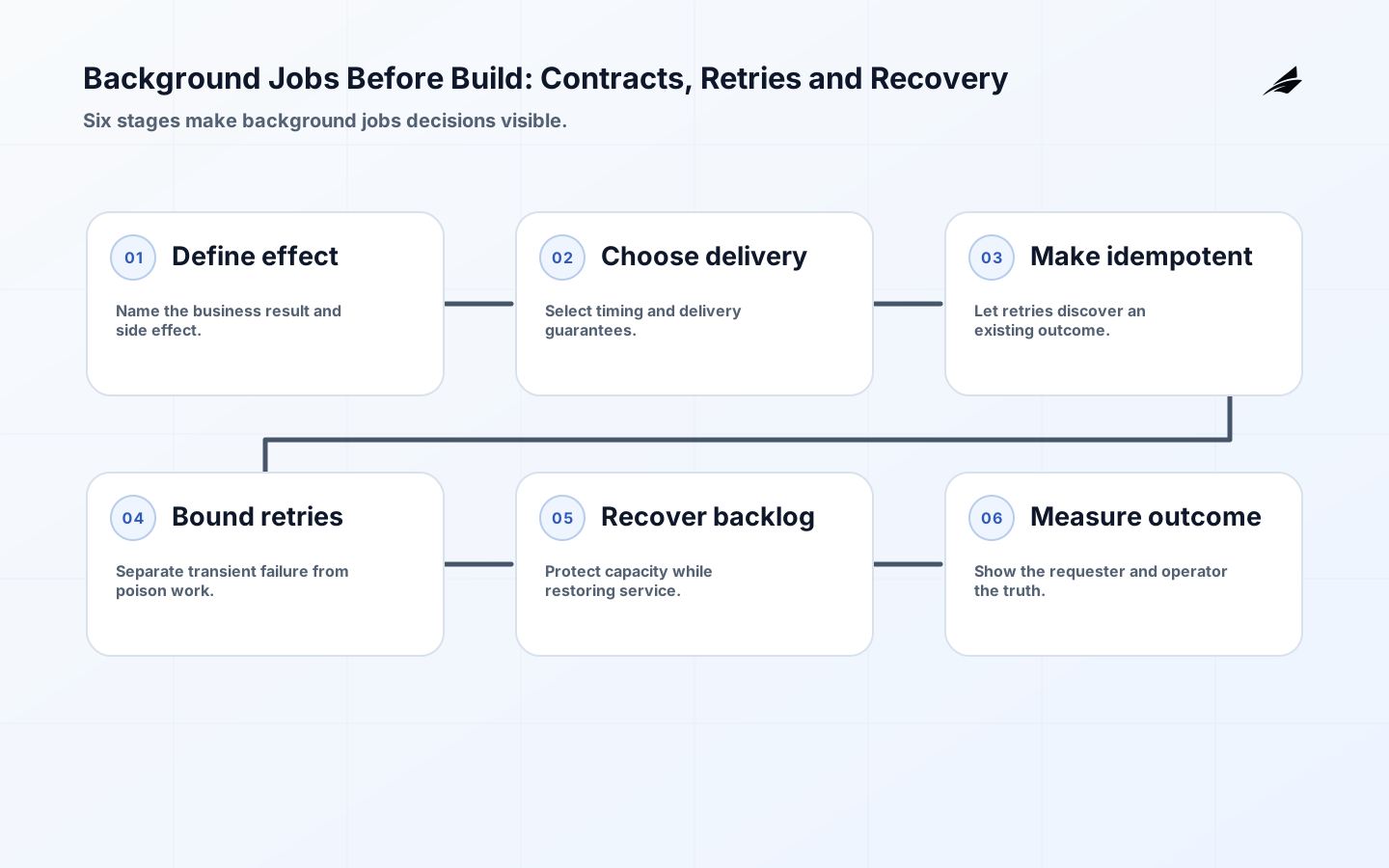
Before selecting a queue, write the job’s business contract in plain language. “Send an email” is incomplete; “send one account-confirmation message, record the provider result, and let support replay it safely” defines identity, retry, and evidence. Decide whether duplicate execution is harmless, compensatable, or dangerous. That answer determines idempotency keys, uniqueness constraints, and operator controls more reliably than a comparison of vendor features.
Define the background jobs decision
Begin by writing one representative journey in plain language. For a user requesting a report that is generated later, stored, emailed, and retried when a dependency is unavailable, identify the initiating actor, the information they can rely on, the action they are allowed to take, the condition that completes the work, and who resolves disagreement. This is more useful than beginning with a vendor comparison because it creates a boundary for scope. The team should be able to say which record is authoritative at each stage and which behavior is visible to the person waiting for an answer. If the answer depends on another service, a scheduled task, or a human review, say so. Ambiguity at this point becomes a misleading status message, an undocumented manual step, or a costly support escalation later.
| Question | Decision to make | Evidence before build |
|---|---|---|
| User outcome | What proves a user requesting a report that is generated later, stored, emailed, and retried when a dependency is unavailable is complete? | A named actor, state transition, and acceptance rule. |
| Authority | Which record decides the current background jobs result? | Owner, freshness expectation, and correction process. |
| Risk | What can go wrong without being immediately visible? | Failure class, safe fallback, and escalation owner. |
| Change | How will callers or users adapt to a changed rule? | Compatibility note, test fixture, and review date. |
Model the facts, not just the interface
The durable model for background jobs should retain durable job identity, payload version, initiating actor, idempotency key, schedule, attempt history, final outcome, and dead-letter reason. Not every value needs the same permanence: temporary presentation state and safely recomputable views can remain outside the authority record. But an operator must be able to reconstruct why a consequential result was produced. Choose identifiers that survive retries and imports; record time in a way that distinguishes event time from processing time; and name the version of any rule or representation that can change. This protects the team from explaining an old decision with today’s code. It also gives testing a realistic target: fixtures can represent a business state, not a collection of anonymous fields.
Amazon SQS documents at-least-once delivery, which is why duplicate-safe execution belongs in the design. Apache Kafka's delivery semantics, Temporal's retry policies, and the CloudEvents specification help teams name the envelope, retry, and outcome boundaries. These references do not decide product policy for a team, but they are a strong check against inventing protocol or security semantics locally. Read them alongside the system’s actual consumers, data classification, and service-level commitments. A standard format is only helpful when ownership and behavior behind it remain clear.
Define retry, poison-message, and recovery rules
The central boundary for background jobs is the fast request that accepts intent, the worker that performs bounded work, and the user-facing status that tells the truth. Make it visible in code and in the operating model. Name which component validates input, which owns the business decision, which persists the result, and which is allowed to communicate externally. Then design the uncomfortable cases: an expired permission, a stale record, a duplicate request, a delayed dependency, and a partial completion. Telling a user that work succeeded when only a volatile message was enqueued, or assuming one delivery implies one execution is a common failure because it postpones a product decision until an incident. A safer design gives each failure an owner, a bounded response, and enough context for a person or process to continue safely.
| Failure condition | Design response | Signal to retain |
|---|---|---|
| Bad or incomplete input | Reject at the trusted boundary with a safe correction path. | Validation category and field or rule reference. |
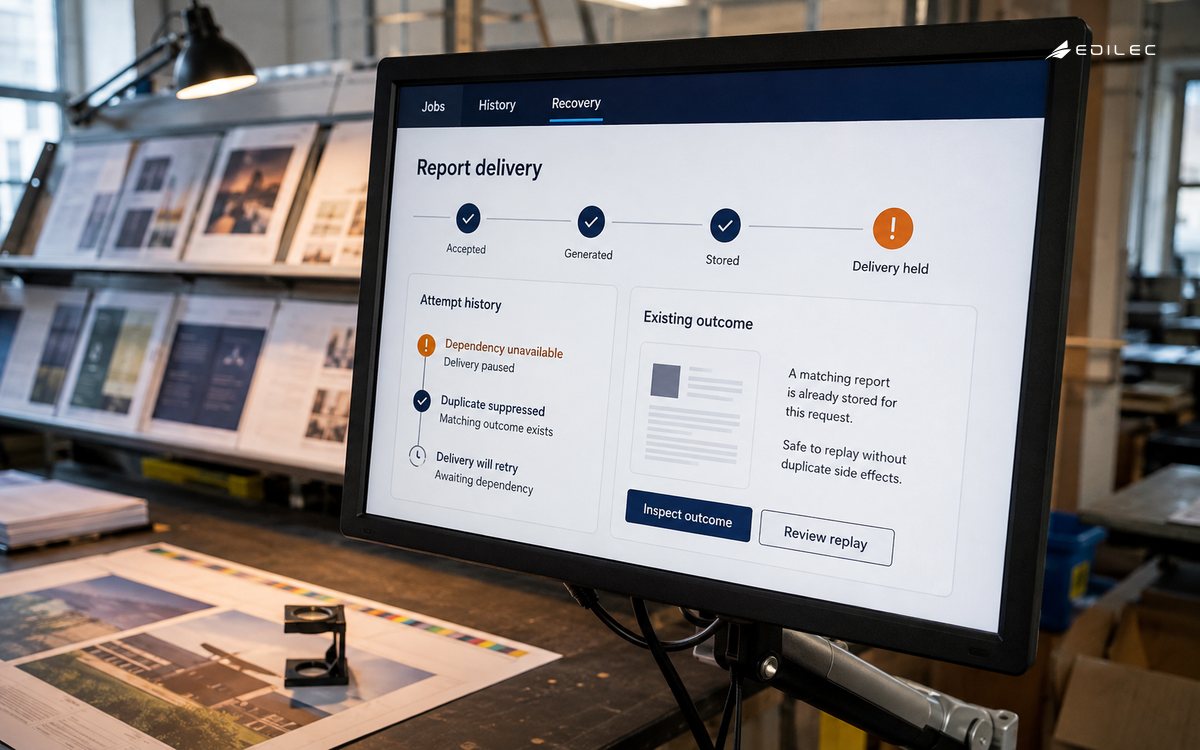
| Duplicate or delayed work | Use a stable operation identity and inspect prior outcome. | Idempotency key, attempt history, and final state. |
| Dependency unavailable | Apply a deadline, bounded retry, or queued recovery path. | Dependency, elapsed time, retry decision, and owner. |
| Policy or authorization conflict | Deny safely and route a review where justified. | Principal, resource, policy version, and correlation ID. |
Deliver in small, observable increments
Build the smallest vertical slice that proves the decision. It should include a real boundary, a durable record, the expected unhappy path, and one way to inspect the outcome. Avoid a demo that bypasses identity, replaces a real dependency with an unrepresentative stub, or assumes a perfect sequence of events. Use representative fixtures, contract checks where another team depends on the result, and a controlled rollout for behavior that cannot be fully reproduced beforehand. The release plan should state who can halt the change, what evidence triggers rollback or containment, and how affected users will be told the current truth. That makes background jobs a delivery capability rather than a single implementation milestone.
Operate from evidence
After launch, review queue age, scheduled-job lateness, success by attempt, duplicate suppression, dead-letter volume, and time from acceptance to visible outcome. A single aggregate dashboard is rarely enough: segment by journey, customer or tenant where appropriate, client version, dependency, and time window. Combine telemetry with sampled support cases, because a technically successful request can still produce a confusing human outcome. Write a lightweight review record for material changes: the intended behavior, observed evidence, decision owner, and follow-up. When a recurring exception appears, decide whether it is bad input, a missing product rule, a capacity constraint, or a broken contract. That discipline prevents permanent manual workarounds from becoming the hidden specification.
For background jobs, stewardship means making a delayed outcome as inspectable as a synchronous one. A support engineer should be able to locate the accepted request, see each attempt, identify whether an external side effect occurred, and take the next safe action. Distinguish a queue outage from a poisoned payload and from a rate-limit response. Those distinctions guide capacity, contract, and product changes; lumping them into a generic failed job counter does not. For adjacent implementation choices, see the background jobs planning guide, Node.js API implementation checklist, and Node APIs reliability checklist.
Before releasing background jobs, rehearse the job lifecycle with a deliberately duplicated message, a worker crash after an external call, a delayed dependency, and a poisoned payload. Confirm that the status visible to the requester matches the durable record at every stage. Assign an owner and time budget for queue buildup, then decide when capacity protection should reject new work rather than silently increasing delay. These exercises transform vague reliability expectations into tested recovery behavior that product and support teams can use.
Key takeaways
- Frame background jobs around one real journey and a named user outcome.
- Store the facts needed to explain a consequential result after rules and code evolve.
- Make authority, authorization, retries, and exception ownership explicit at every boundary.
- Release a vertical slice with a meaningful failure path and a reversible operating decision.
- Use queue age, scheduled-job lateness, success by attempt, duplicate suppression, dead-letter volume, and time from acceptance to visible outcome to select the next improvement from evidence.
Frequently asked questions (FAQ)
A useful failure drill pauses the downstream dependency and observes the queue at each threshold. Can operators see the oldest work, stop an unsafe retry storm, identify poison messages, and replay one item without creating a duplicate side effect? If not, the system is not ready for a larger concurrency setting. Capacity planning should include recovery capacity: a backlog after an outage can be more expensive than ordinary steady-state traffic. How should a background job be made idempotent?
Give the business operation a stable identifier, record the authoritative outcome, and make a repeated execution discover that outcome before performing the side effect again. Do not rely on a broker delivery promise alone; retries can happen after a worker has already touched an external system.
When should work remain synchronous?
Keep an action synchronous when the caller needs a small, reliable answer immediately and the work fits the request budget. Move work out when it is long-running, fan-out, retryable, or dependent on a slow system, then provide a status resource or notification rather than a false success response.
Queue selection should follow the side effect and its recovery cost. A notification can often tolerate delay if the requester sees a truthful pending state, while a stock reservation may require a stronger reservation record before work leaves the request path. For each candidate, specify the durable identity, the duplicate policy, the maximum useful delay, and the operator action when the dependency stays unavailable. That exercise often reveals that a simple scheduled task or status table is enough. When a broker is warranted, these decisions become acceptance criteria for delivery, retry, and replay behavior.
Conclusion
Background jobs are a promise that survives the first implementation. Make the promise narrow enough to test, explicit enough to operate, and durable enough to explain. Begin with the representative journey, record the facts and ownership that govern it, design the failure path before the launch path, and let observed outcomes refine the next version. Those choices give product teams something more useful than a technology decision: a system that can change without losing the trust of the people who depend on it.