A CloudEvents event envelope standardizes the context needed to identify, route, serialize, and observe an event while allowing each domain to own its payload. That narrower goal is a strength. Programs often fail by treating CloudEvents as a canonical enterprise data model, adding every business field as an extension, or assuming a common envelope supplies delivery guarantees. The specification describes event data and its context; brokers, protocols, schemas, and applications still determine delivery and business meaning.
The CloudEvents core specification requires id, source, specversion, and type, defines optional attributes such as time, subject, datacontenttype, and dataschema, and permits extensions. Build a profile that says how your organization assigns those attributes, which formats and bindings it supports, and how payload schemas evolve. Interoperability comes from consistent semantics, not from every producer emitting fields with familiar names but incompatible meanings.
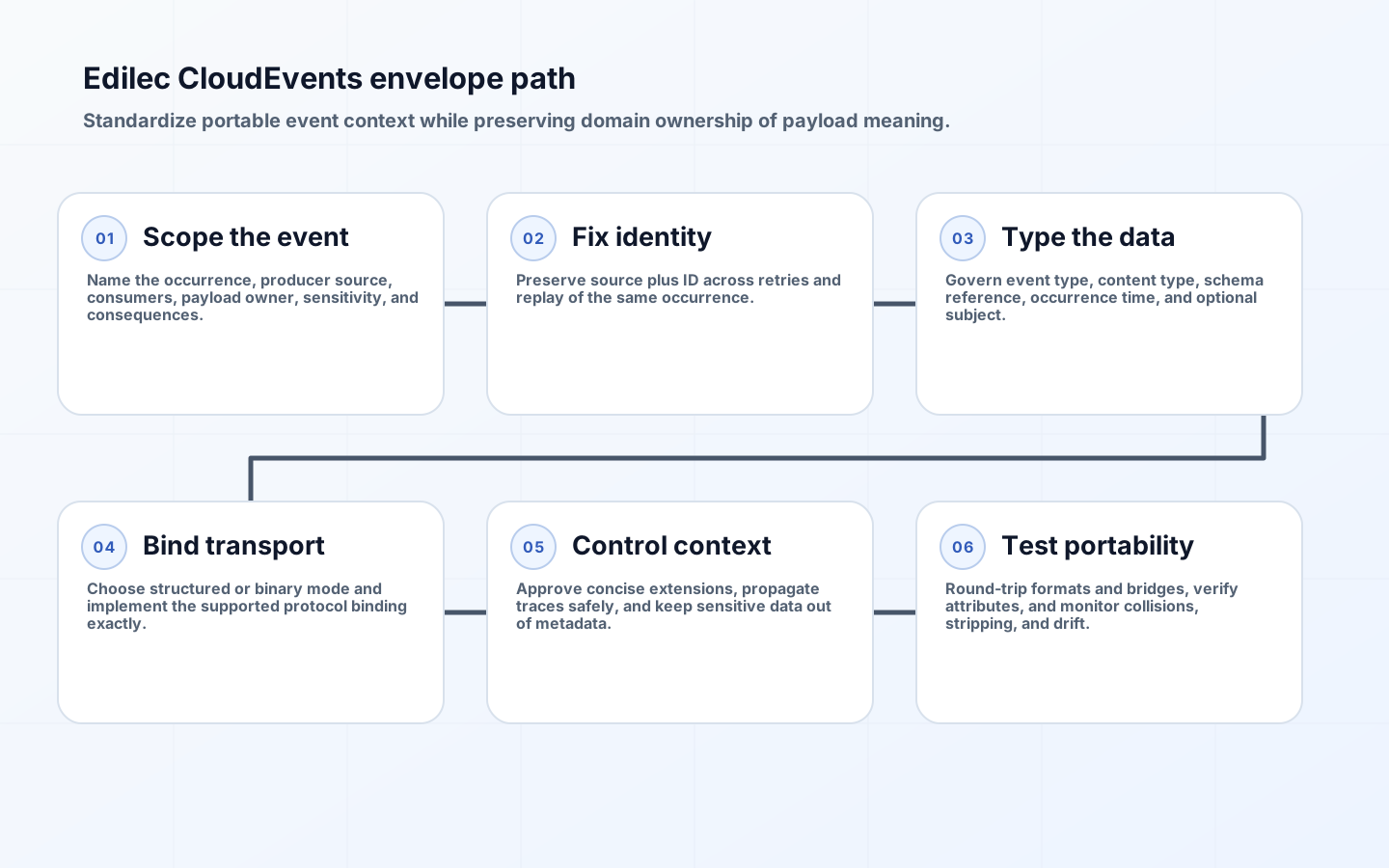
Build the six-stage envelope adoption path
Start with an event catalog entry: domain occurrence, producer, source boundary, consumers, payload owner, transport, retention, sensitivity, and consequences. Decide which metadata must be available to infrastructure without decoding the payload. Event identity, source, type, schema reference, subject, and trace context are common candidates. Keep customer names, email addresses, free-form payload fragments, and secrets out of context attributes because intermediaries may inspect and log them.
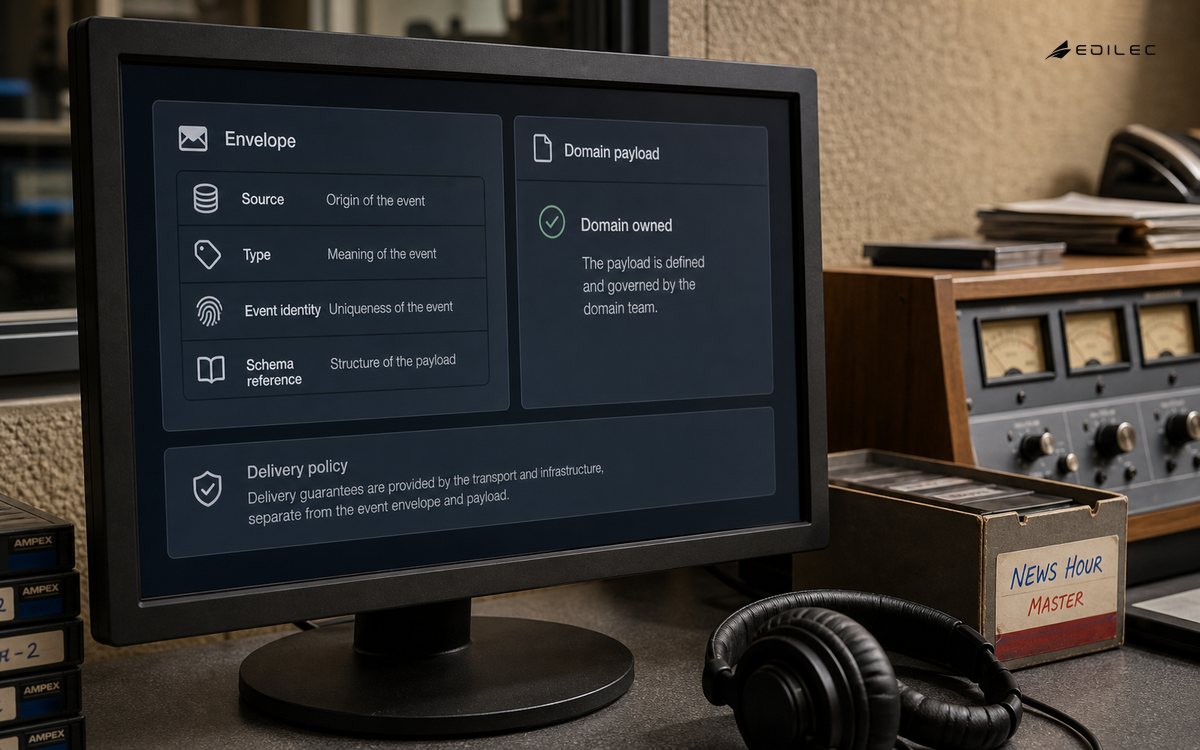
Write an organizational CloudEvents profile rather than forking the specification. Pin the accepted spec version, JSON or other event formats, binary and structured modes, protocol bindings, extension registry, naming rules, size limits, and conformance tests. A profile can require attributes that core CloudEvents makes optional, but it should remain a documented application convention rather than claiming those rules are part of the standard.
| Attribute | Question to settle | Recommended invariant | Failure mode |
|---|---|---|---|
id | What is one event occurrence? | Unique within the producer's source scope | New ID assigned on every transport retry |
source | Which context produced the event? | Stable URI-reference boundary controlled by producer | Host or pod name changes every deployment |
type | What semantic event class is this? | Stable, version-aware domain identifier | Routing based on vague or reused labels |
subject | What resource within source is concerned? | Optional scoped resource identifier | Sensitive customer data exposed in metadata |
time | When did the occurrence happen? | Event occurrence time with clear precision | Broker receipt time substituted silently |
dataschema | Which payload contract applies? | Resolvable or registry-stable schema reference | Mutable latest URL changes historical meaning |
Design event identity for retries and replay
The pair of source and id identifies an event. Producers should preserve it across delivery retries, broker republishing, and ordinary replay of the same occurrence. Assigning a fresh ID at every hop defeats consumer deduplication and audit correlation. If processing intentionally creates a new derived event, give it a new identity and carry causation or correlation through a governed extension or tracing mechanism.
Choose a source boundary stable enough to survive instance changes and specific enough to avoid accidental collisions. A logical service, tenant-aware producer domain, or source resource namespace is usually better than a hostname. Define retention for deduplication separately; CloudEvents does not prescribe how long consumers remember IDs. High-consequence consumers may combine envelope identity with durable domain uniqueness.
Separate event type from payload schema version
type communicates semantic classification used by consumers and routing. dataschema identifies the payload contract when present. Teams must decide whether a compatible schema revision preserves the type and when a semantic break requires a new type or channel. Avoid hiding every change in a version suffix without compatibility policy. Likewise, do not route solely by a schema URL if different business occurrences share a representation.
Treat the payload as domain-owned data under its own schema language and registry. datacontenttype describes its media type; a JSON CloudEvents envelope can carry non-JSON data when represented according to the JSON format rules. Validate the combination of type, content type, and schema reference so a producer cannot label arbitrary bytes with a trusted event type.
| Concern | Envelope responsibility | Payload responsibility | Owner |
|---|---|---|---|
| Interoperable identification | id, source, type, specversion | Domain identifiers inside data where needed | Event platform and producer |
| Routing | Stable type, subject or approved extension | Business fields only when router is domain-aware | Platform with domain governance |
| Serialization | Event format and datacontenttype | Schema encoding and field representation | Platform plus data owner |
| Evolution | Context compatibility and profile version | Field and semantic compatibility | Domain producer and consumers |
| Security | No sensitive context; binding protections | Data classification, minimization and encryption | Security and domain owner |
| Observability | Trace extension and envelope labels | Business metrics with controlled extraction | Observability and application teams |
Choose structured or binary mode by boundary
In structured mode, one event format carries context and data in the message body, and the transport content type identifies that format. In binary mode, protocol metadata carries context while the body carries event data. Binary mode is not raw or nonstandard; it follows a protocol binding. Choose based on intermediary support, content handling, size, and bridge behavior. Test conversions because gateways can normalize headers or content types.
For HTTP, implement the normative binding rather than inventing X-Event-* headers. Preserve method, status, content type, and attribute mapping through proxies. For Kafka or other brokers, use the applicable binding and verify key, headers, topic routing, and batch behavior. Not every binding supports every mode or feature identically. State which combinations your profile supports and reject ambiguous mixtures.
Govern extensions as scarce shared metadata
Create an extension only when a cross-cutting producer, consumer, or intermediary needs metadata not represented by core attributes. Define name, type, semantics, sensitivity, cardinality, owner, and compatibility. Favor established extensions where applicable. Keep attributes concise because they may be repeated in transport headers, indexed, or logged. Large structures belong in data, not context.
Do not turn extensions into an enterprise payload. Adding customer, order, region, department, priority, lineage, policy, and every routing field to all events creates a second schema without domain ownership. Approve routing extensions only with clear bounded values and access review. Intermediaries should tolerate unknown extensions and preserve them where the binding requires, while security boundaries may intentionally remove prohibited metadata.
Manage extension retirement with the same care as payload fields. Measure which routers and consumers read an attribute, stop making new dependencies, publish a replacement, and keep old and new metadata coherent during transition. Removing an extension from the envelope can be operationally breaking even when payload validation still passes. Conformance fixtures should therefore cover organization-required extensions and the behavior of bridges that do not understand them.
Propagate tracing without confusing event and span identity
Event ID identifies the occurrence; trace and span context identify an execution path. They are not substitutes. Follow the OpenTelemetry CloudEvents semantic conventions and the relevant trace-context extension or binding practice. For asynchronous processing, model producer and consumer spans with appropriate links or parent relationships based on actual causality. A replay of the same event can keep event identity while creating a new processing trace.
Control trace metadata at trust boundaries. Propagating untrusted context can join unrelated traces or influence sampling, and recording every CloudEvents attribute as a span label can create high cardinality and expose sensitive values. Capture stable type and source carefully, hash or omit identifiers where necessary, and keep payload data out of generic telemetry.
Roll out with conformance and bridge tests
Begin with a few heterogeneous producers and consumers where envelope portability has clear value. Provide SDK adapters or middleware that enforce the profile without hiding the underlying attributes. Test required fields, canonical types, structured and binary serialization, protocol round trips, unknown extensions, duplicate delivery, size limits, and security redaction. Preserve original identity through bridges and dead-letter paths.
Observe invalid envelopes, identity collisions, unsupported spec versions, type-schema mismatches, stripped attributes, and bridge conversion errors. Maintain a catalog linking type and source to owner and payload schema. Adoption is successful when infrastructure can route and observe events consistently while domain teams evolve payloads under explicit compatibility policy, not when every message has merely acquired a specversion field.
Key takeaways
- Use CloudEvents for common context and protocol portability, not a universal business payload.
- Preserve
sourceplusidacross retries and replay of the same event occurrence. - Give
type,dataschema, anddatacontenttypedistinct governed meanings. - Choose structured or binary mode according to a supported protocol binding.
- Approve extensions only for concise cross-cutting metadata and keep sensitive data out.
- Treat event identity and trace identity separately, especially during asynchronous replay.
CloudEvents event envelope FAQ
Does CloudEvents guarantee delivery or ordering?
No. It standardizes event representation and context. Delivery, retention, redelivery, ordering, and transactions come from the protocol, broker, producer, consumer, and application design.
Should a replay receive a new CloudEvents ID?
Not when it is another delivery of the same occurrence; preserve source and ID so deduplication remains possible. A deliberately created corrective or derived event is a new occurrence and should have new identity with explicit causation.
Must all CloudEvents use the same payload schema?
No. Payloads remain domain-owned and may use different schema formats and media types. Govern their compatibility and references while keeping the envelope conventions common.
Conclusion
CloudEvents works best as a disciplined narrow waist between diverse producers, transports, and consumers. Stable identity, source, type, schema metadata, bindings, extensions, and trace practice make events portable without centralizing every domain model. By resisting envelope inflation and unsupported delivery claims, teams gain common infrastructure while preserving the autonomy needed for useful event payloads.