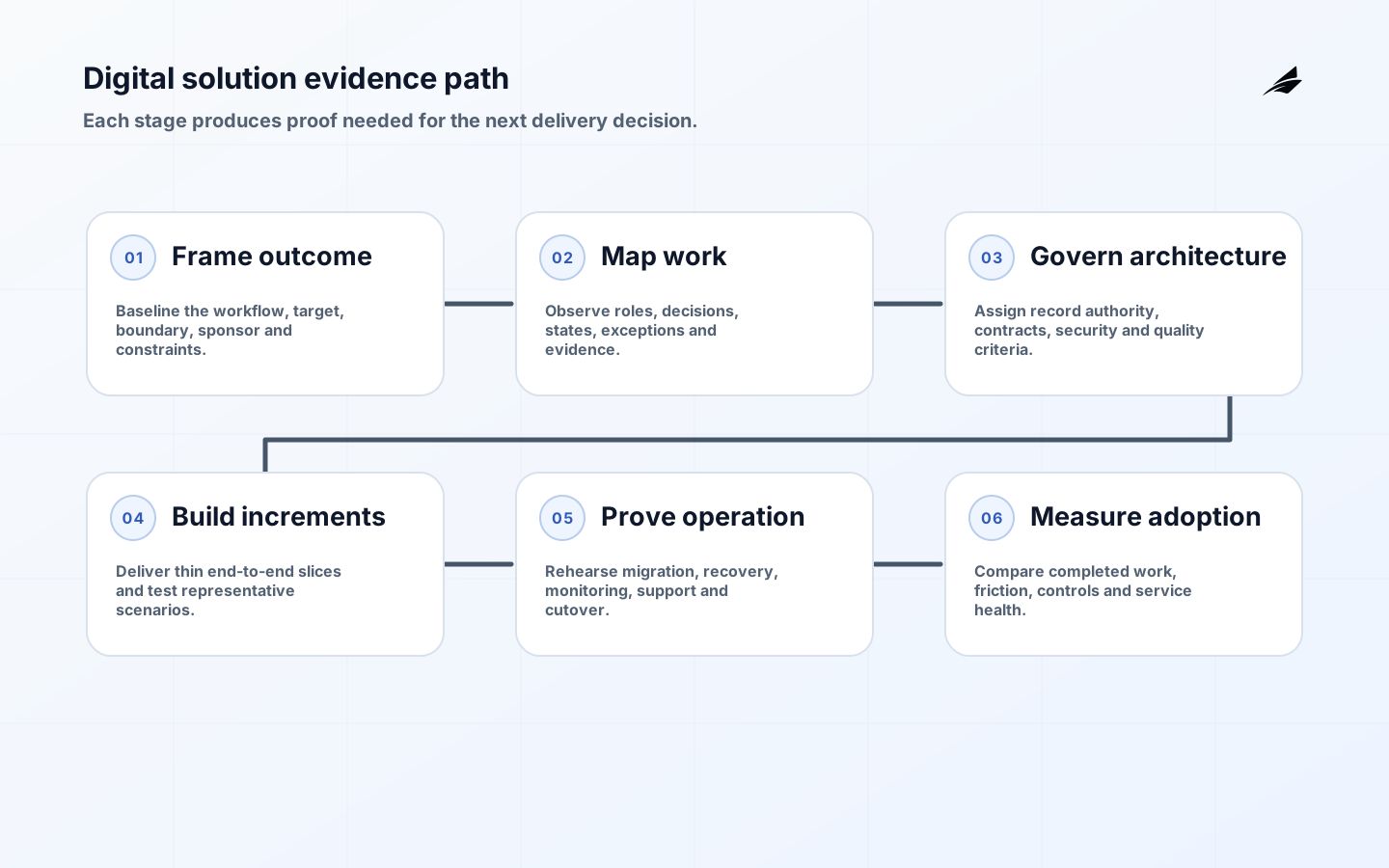
Digital solutions turn a business workflow into a controlled combination of software, data, integrations and operating responsibilities. The implementation challenge is not selecting a fashionable platform. It is preserving the business meaning of each decision while reducing delay, error and manual handoffs. This digital solutions implementation checklist helps teams move from an outcome to a usable, secure and supportable release.
Pair the checklist with the digital solutions scope and cost guide, digital solutions FAQ and enterprise digital solutions checklist. Keep one accountable business owner throughout discovery, build and operation; a project cannot outsource the decision about what good work looks like.
1. Define the outcome and decision boundary
Write the problem in operational terms: who is trying to complete which task, what delay or risk occurs now, and which measurable outcome should change. Baseline cycle time, error, rework, backlog, abandonment, cost or compliance evidence before implementation. Avoid goals such as “create a portal” or “automate approvals”; those are solution ideas. A useful goal is “reduce the median supplier-onboarding time while preserving sanctions, tax and segregation-of-duty checks.”
Name governance decisions early. ISO/IEC 38500:2024 provides principles for governing the current and future use of IT. In practice, the sponsor should set value, risk and investment direction; product and process owners should manage delivery; security, privacy, legal and operations should define applicable constraints. Record who approves scope changes, residual risk and release.
| Checklist item | Evidence | Acceptance question |
|---|---|---|
| Outcome | Baseline, target, population and measurement method | Would improvement change a real business decision? |
| Boundary | Included roles, records, channels, markets and exceptions | Can the team state what the first release will not do? |
| Ownership | Sponsor, product owner, data owners and service owner | Can every high-impact decision reach one accountable role? |
| Constraints | Regulatory, security, accessibility, retention and integration needs | Are non-negotiable obligations known before design? |
| Funding | Build, migration, licenses, operations and contingency range | Does the budget cover operation after launch? |
2. Map the workflow, roles and exceptions
Observe representative users completing real work. Capture triggers, inputs, decisions, queues, handoffs, systems, workarounds and evidence. Model the normal path and the exceptions that consume time: missing documents, disputed amounts, delegated authority, duplicate customers or failed integrations. BPMN 2.0.2 offers a standard notation when formal process exchange is useful, but a simpler map is acceptable if roles and decisions remain unambiguous.
Challenge each step. Some controls can be automated; some require human judgment; others exist only because systems do not share a record. Do not automate a broken approval chain unchanged. Define the state machine behind the interface: allowed states, who may transition them, required evidence, expiry, cancellation and correction. This prevents contradictory status labels from spreading across dashboards and notifications.
3. Establish data authority and integration contracts
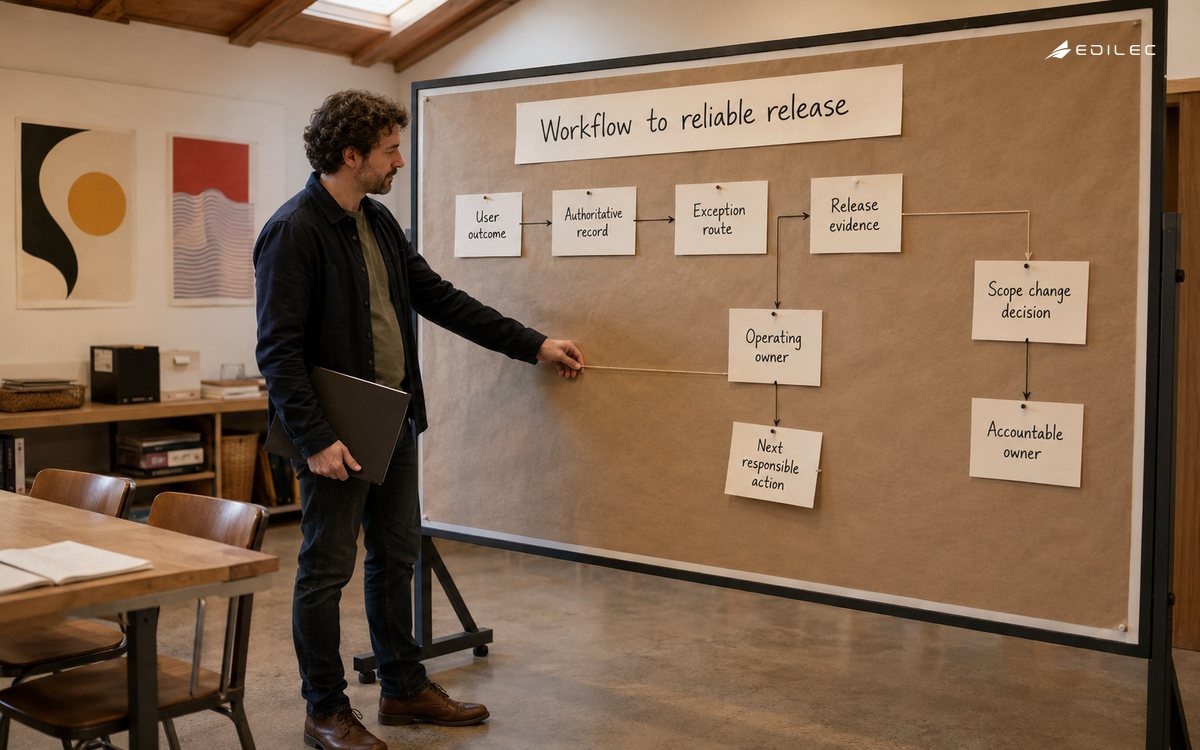
For each business record, choose the authoritative system and owner. Specify stable identifiers, required fields, validation, effective dates, correction policy, retention and deletion. A new solution should not become an accidental second master for customers, employees or products. Where a local projection is needed for performance, document how it is refreshed and reconciled.
Design integrations as contracts. The OpenAPI Specification provides a language-agnostic description for HTTP APIs; complement it with authentication, authorization, idempotency, pagination, rate limits, error semantics, version policy and service objectives. For events, specify schema, ordering assumptions, duplicate handling, replay and dead-letter ownership. Test degraded dependencies so the interface gives users a recoverable state rather than silently losing work.
4. Set quality, accessibility and security requirements
Quality is broader than functional correctness. ISO/IEC 25010:2023 defines a product quality model that can inform requirements and evaluation. Select characteristics relevant to the workflow, such as performance efficiency, reliability, security, maintainability, compatibility and interaction capability. Translate them into observable criteria: response-time distributions for a task, recovery objectives, supported browsers, import limits and audit-event completeness.
Accessibility belongs in design and acceptance. WCAG 2.2 is organized around perceivable, operable, understandable and robust content with testable success criteria. Set an applicable conformance target, use semantic controls, support keyboard operation, expose errors clearly and test with assistive technology and people. Automated scanners find only part of the problem; include manual review of critical journeys.
Integrate secure development practices rather than adding a final penetration test. The NIST Secure Software Development Framework covers preparing the organization, protecting software, producing well-secured software and responding to vulnerabilities. Threat-model sensitive flows, protect development environments, review dependencies and secrets, test authorization by role and object, record releases and maintain a vulnerability response path.
5. Build thin, end-to-end increments
Choose the smallest increment that crosses the real architecture and returns user value. A supplier onboarding slice might capture a request, validate one document type, perform one approval, update the authoritative supplier record and show status. It is more informative than building every form before any integration works. Demonstrate with representative data and include operations, security and support in review.
Maintain a decision log and traceability from outcome to acceptance criteria. Use feature flags or limited cohorts where they reduce release risk. Keep environments and configuration reproducible, and prevent production data from being copied casually into test. Review scope against the first-release boundary; requests that add roles, markets or record authority can change architecture and should be evaluated as such.
| Gate | Minimum evidence | Decision |
|---|---|---|
| Workflow ready | Observed journey, exceptions, state model and owner approval | Proceed to architecture or revisit the process |
| Architecture ready | Record authority, contracts, threat model and operating assumptions | Build the increment or close a design risk |
| Increment ready | Automated tests, accessibility review, security evidence and demo | Pilot, revise or reject |
| Migration ready | Reconciliation, rehearsal, rollback and support runbook | Cut over a cohort or repeat rehearsal |
| Service ready | Monitoring, objectives, on-call, restore proof and ownership | Expand use or hold |
6. Prepare data migration and cutover
Profile source data before writing transformations. Quantify missing identifiers, invalid values, duplicates, orphan references and conflicting histories. Define mapping and survivorship rules with data owners. Preserve provenance and produce reconciliation totals for every rehearsal. Manual corrections need reason, approver and repeatable capture; an unexplained spreadsheet becomes a hidden migration system.
Plan cutover by business state, not only technical deployment. Decide how in-flight work moves, which system accepts new transactions, how interfaces are paused or replayed, and who communicates with users. Set go/no-go thresholds and rollback limits. Rehearse with production-like volume and time constraints. Archive legacy records according to retention and access needs rather than keeping the old system indefinitely “just in case.”
7. Prove operations before broad release
Define service objectives for user journeys and critical dependencies. Instrument structured logs, metrics and traces without exposing sensitive data. Alerts should identify actionable conditions such as failed record synchronization, growing approval queues, unusual authorization denials or missing scheduled outputs. Create runbooks for diagnosis, containment, recovery and escalation, then exercise them.
Support is part of the product. Provide role-based onboarding, clear in-context errors, a service channel, known-issue communication and an ownership route for data corrections. Track defects by root cause rather than forwarding every report to engineering. Confirm backup and restore by restoring a representative service and validating business records, permissions and integrations, not merely a storage snapshot.
8. Measure adoption and improve the workflow
Adoption is successful task completion by intended users, not login count. Compare cycle time, completion, rework, exception volume, support demand and control outcomes against the baseline. Segment by role and journey to find where the solution moves work into a new queue. Pair telemetry with interviews because users may complete a task while maintaining a parallel spreadsheet to compensate for missing trust.
- Review workflow and business outcomes with technical reliability in the same forum.
- Prioritize the constraint causing the greatest decision or service impact.
- Remove obsolete steps and permissions as the operating model changes.
- Revisit accessibility and security after material interface or integration changes.
- Maintain a retirement plan for replaced features, integrations and legacy data stores.
Plan organizational change as operating work. Identify which roles lose, gain or delegate decisions; update policy and performance expectations; and give managers a way to resolve conflicting procedures. Schedule floor support during early use and capture questions as evidence about workflow or language. Retire old forms, inboxes and spreadsheets on an announced date once legal retention and contingency needs are met, because parallel channels fragment state and prevent reliable adoption measurement.
Key takeaways
- Begin with a measurable workflow outcome and a bounded first release.
- Make record authority, state transitions and integration failure behavior explicit.
- Turn quality, accessibility and security into acceptance evidence throughout delivery.
- Rehearse migration, cutover, recovery and support with realistic business states.
- Measure completed work and reduced friction, then improve the operating system continuously.
Frequently asked questions
Should a team buy a platform or build a custom solution?
Compare fit at the workflow, data, integration and control level. Buy when configuration covers differentiating needs without brittle workarounds and the vendor meets operational obligations. Build when the workflow is strategically distinctive or integration and control needs cannot be met economically. Hybrid delivery is common, but ownership boundaries must remain clear.
What should an MVP include?
It should complete one useful end-to-end outcome with the security, data integrity and operational controls needed for its real users. An MVP may narrow roles, volume or exception types; it should not omit authorization, recoverability or evidence and call the resulting risk “later.”
How long does implementation take?
Duration depends on workflow complexity, data condition, integrations, assurance needs and decision speed. Estimate ranges after mapping the first slice and testing the riskiest dependency. Phase funding by evidence gates rather than attaching false precision to an initial feature list.
Conclusion
A digital solution succeeds when people can complete important work with less friction and stronger control. Keep the outcome, record authority and operating ownership visible from discovery through release. Thin increments, explicit quality evidence and rehearsed transition turn a software project into a reliable business capability.