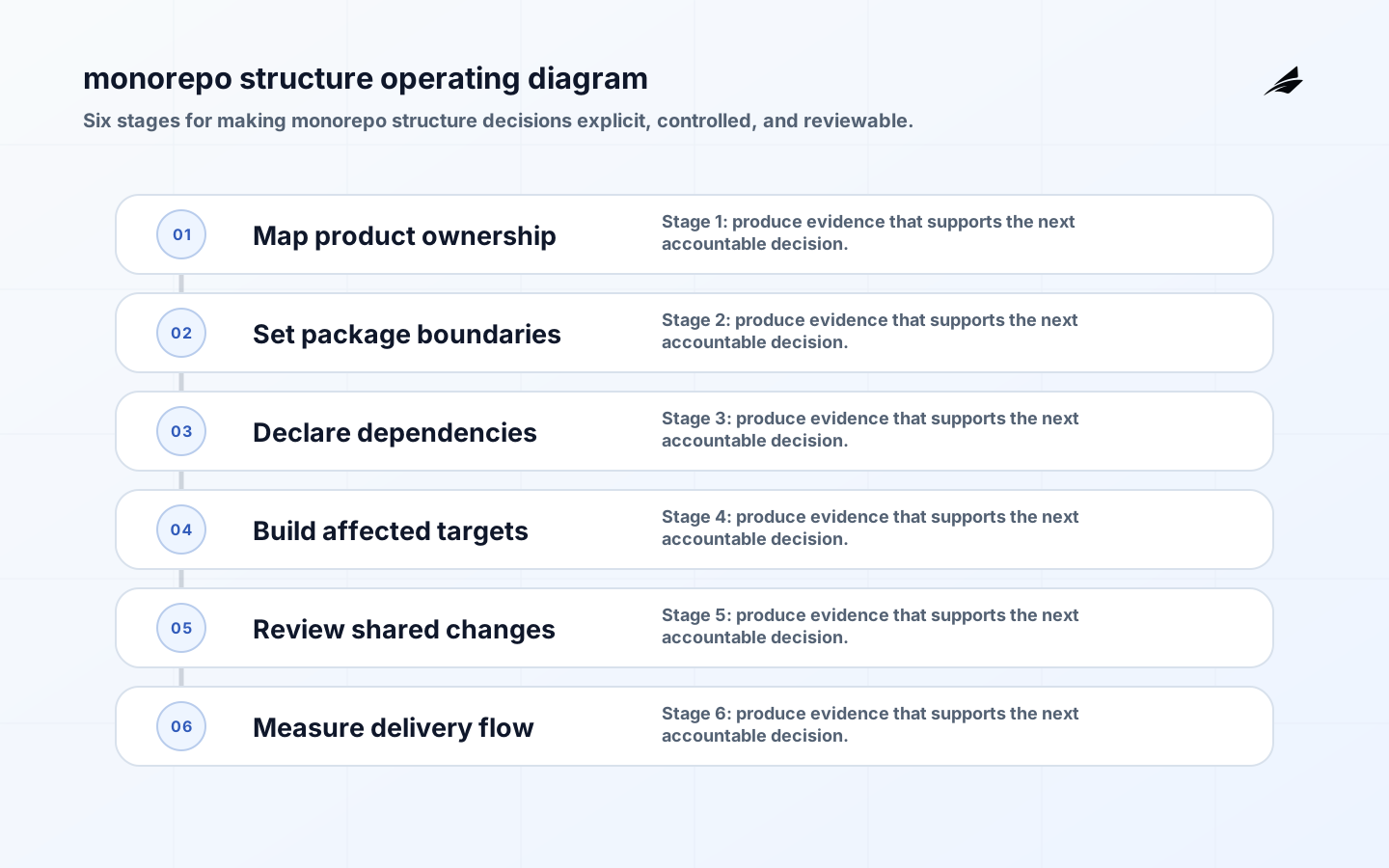
Monorepo structure is a coordination design, not a claim that every repository should be merged. A single repository can make shared types, reusable libraries, atomic changes, and consistent tooling easier to manage. It can also make unrelated teams wait on one slow build, blur ownership, and widen the impact of a careless dependency change. The decision should begin with work that crosses codebase boundaries: does a product change regularly require aligned frontend, API, shared schema, and deployment edits? If so, a monorepo may reduce handoff cost. If not, centralizing code creates a new administrative surface without solving a real delivery problem. The npm workspaces documentation describes one mechanism; the organizational boundary remains the harder part.
Organize around ownership and change paths
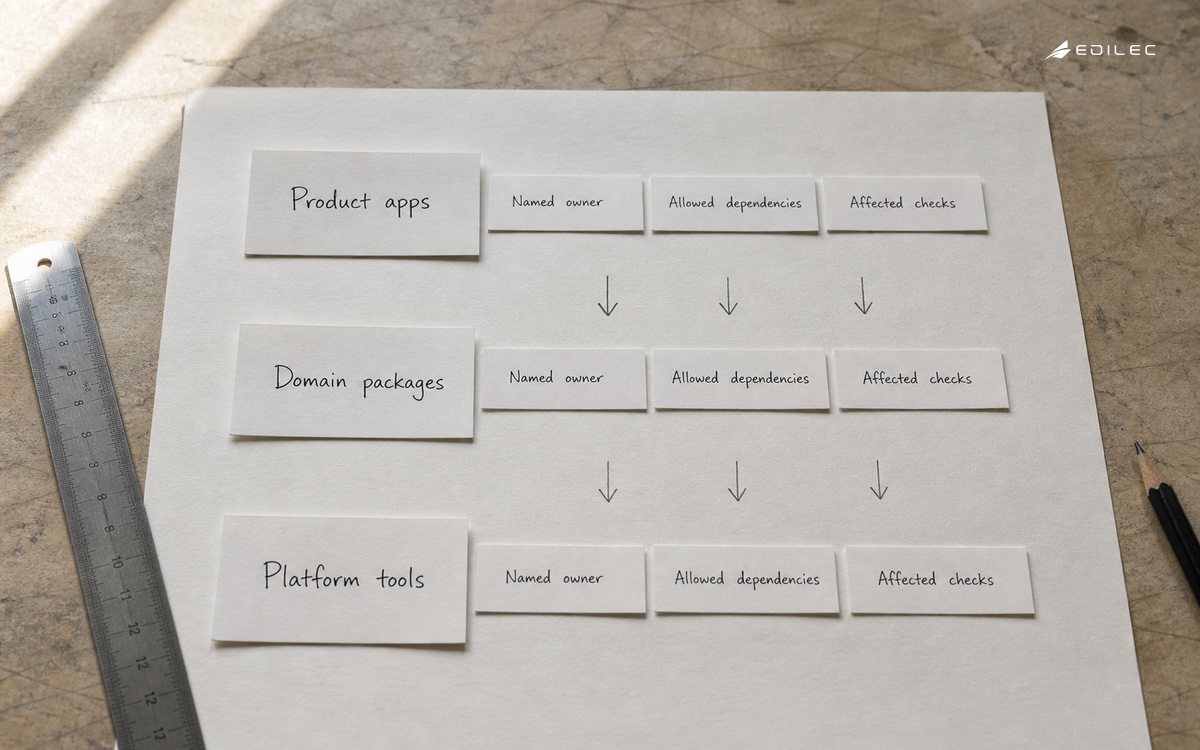
Draw the repository as a set of products and capabilities rather than folders that happen to share a language. A product application owns its user outcome; a domain library owns a cohesive business capability; a platform package owns a stable technical service; and a tool owns a developer workflow. Shared packages should have a specific constituency and a published compatibility expectation. Avoid a broad common or utils area that becomes a dependency dumping ground. Give each package an owner, a short purpose statement, and an allowed-dependency direction. The TypeScript project references guide illustrates why explicit project boundaries can improve build behavior as well as design clarity.
| Package kind | May depend on | Should avoid |
|---|---|---|
| Product application | Domain APIs, approved UI libraries, platform clients. | Another product application or its private implementation details. |
| Domain capability | Domain contracts and narrowly scoped platform abstractions. | Browser components, deployment scripts, and unrelated business domains. |
| Shared UI library | Design tokens, accessible primitives, and explicit peer dependencies. | Product-specific workflows or server-only code. |
| Build and tooling | Declared project metadata and target definitions. | Runtime imports from application packages. |
Make the build graph a first-class product
A large repository stays usable when continuous integration runs the smallest trustworthy set of checks. That requires a dependency graph built from declared package and target relationships, not from a heuristic based on changed folders. Define target inputs, generated outputs, environment assumptions, and cache keys. The Bazel label model is a useful mental model even for teams using other tools: a target is an addressable unit with explicit dependencies. Run fast formatting, type, and unit checks for affected targets; reserve broader integration and release checks for paths where interfaces or infrastructure make the blast radius larger. Report why a change triggered a check so developers can correct accidental coupling.
- Keep lockfiles and workspace configuration under reviewed ownership.
- Forbid undeclared cross-package imports with linting or build rules.
- Publish a package API before other teams depend on internals.
- Cache reproducible work, but key caches on lockfiles, tool versions, and relevant inputs.
- Record which targets and tests a pull request actually exercised.
Migrate incrementally instead of performing a repository ceremony
Move one coherent change path first, such as a web application and the API client it consumes. Preserve existing release behavior while introducing workspace tooling, then extract a stable package only when two callers demonstrate a real shared need. A migration should leave behind fewer duplicated contracts and clearer ownership, not merely a new directory tree. Keep a temporary compatibility layer with an expiry date for old imports, and measure build time, developer setup time, and change failure rate before expanding. The test strategy guide can help define the targeted verification that makes this staged approach credible.
| Signal | What good looks like | Investigate when |
|---|---|---|
| Affected-check duration | Small changes run a narrow, explainable set of checks. | A documentation or isolated package change triggers most of the repository. |
| Dependency direction violations | They are rare and resolved through a named architectural decision. | Teams routinely add exceptions to reach private internals. |
| Shared package churn | Changes have clear consumers and compatible release notes. | A utility package changes for unrelated product needs every week. |
| Developer setup success | A new contributor can build a representative target with documented prerequisites. | Local setup requires tribal knowledge or copying untracked credentials. |
Govern shared code without turning review into a bottleneck
Code ownership should match consequence. Product teams can usually approve changes inside their applications; a domain owner should review contract changes; platform owners should review security, build, and deployment changes. Automate the routing with path ownership, but permit a small emergency path that is audited afterward. A monorepo makes atomic change possible, not automatically safe. The GitHub guidance on dependency caching also underscores a broader principle: build speed work must preserve correctness. Never share a cache or generated artifact across trust boundaries without checking whether it can be written by untrusted code.
Know when separate repositories remain healthier
Separate repositories can be preferable when teams deploy independently, have different compliance boundaries, use incompatible toolchains, or rarely change together. Do not force every integration through source sharing; a published API, package registry, or event contract may be the cleaner boundary. Conversely, avoid splitting repositories solely to make ownership look tidy when each feature then requires coordinated version releases. The choice is empirical. Examine how often changes cross boundaries, how expensive integration failures are, and whether the organization can maintain the build graph. A monorepo is successful when it makes the frequent path simpler, not when it maximizes the number of packages under one root.
Key takeaways
- Choose a monorepo for frequent shared change paths, not for novelty.
- Give every package a purpose, owner, public interface, and allowed dependency direction.
- Build and test affected targets from an explicit graph.
- Migrate one coherent workflow at a time and measure whether coordination improves.
FAQ
Does a monorepo require one deployment? No. Repository topology and deployment topology are separate decisions. Should every helper be shared? No; local code is often clearer until a second genuine consumer exposes a stable abstraction. How do we prevent slow CI? Build an accurate graph, run affected checks, cache reproducible outputs, and keep integration tests targeted. Is a monorepo safer? It can improve visibility and atomic updates, but access control, review rules, and artifact boundaries still need deliberate design.
Conclusion
Repository rules need to be discoverable at the moment a developer makes a change. Put package ownership, public entry points, dependency constraints, and common target commands close to the code, then enforce the important rules in CI. Avoid relying on architecture diagrams that drift from imports. Review generated code separately from source when it is committed, and define who upgrades shared tooling so every team does not make incompatible local changes. For release work, distinguish a source change from a published package change and from a deployed application change; they may have different owners and rollback paths. Run periodic dependency-graph reports to identify unexpected fan-in, circular paths, abandoned packages, and test targets with no meaningful consumers. When a shared library gains too many competing use cases, split its contract deliberately instead of accepting another optional flag. This keeps the monorepo understandable as a collection of intentional products rather than a filesystem where every team can reach everything.
Operational checklist for monorepo structure: before approving a material change, record the decision owner, the systems and user groups affected, the baseline signal, and the exact condition that would require rollback. During implementation, keep a short runbook with the deployment or release step, required permissions, verification query, expected result, escalation contact, and reversal action. After release, review the evidence at a scheduled point rather than relying on memory: compare the baseline with current completion time, correctness, error handling, support demand, and the effort required to make the next safe change. Capture unexpected behavior as a specific observation, not a general concern. If a manual workaround remains necessary, name its temporary owner and expiry condition. This makes monorepo structure a managed capability: people can see what it promises, how it behaves under stress, and what will change when a new requirement appears. It also prevents a successful pilot from becoming an undocumented production dependency. The purpose of these records is practical continuity for operators and future maintainers, not administrative ceremony.
For monorepo structure, make this review concrete with a monthly sample of completed work. Select normal cases, exceptions, and one recently changed path. Confirm that the responsible person can locate the current state, explain the decision history, identify the authoritative data, and perform the documented recovery without relying on a developer’s memory. Compare what the runbook says with what monitoring and audit records show. When they differ, correct the product, documentation, or ownership assignment immediately. This small discipline exposes hidden coupling early and gives leaders a factual basis for the next investment. It also protects users from being asked to compensate for ambiguity with spreadsheets, repeated checks, or private knowledge. Over time, the review should reduce surprise: a new team member can understand the boundary, test a change, and recognize an unhealthy result before it becomes an incident.
A healthy monorepo makes real coordination cheaper while preserving meaningful boundaries. Treat package ownership, dependency direction, and the build graph as operating systems, and the repository can support growth without becoming one enormous shared risk.