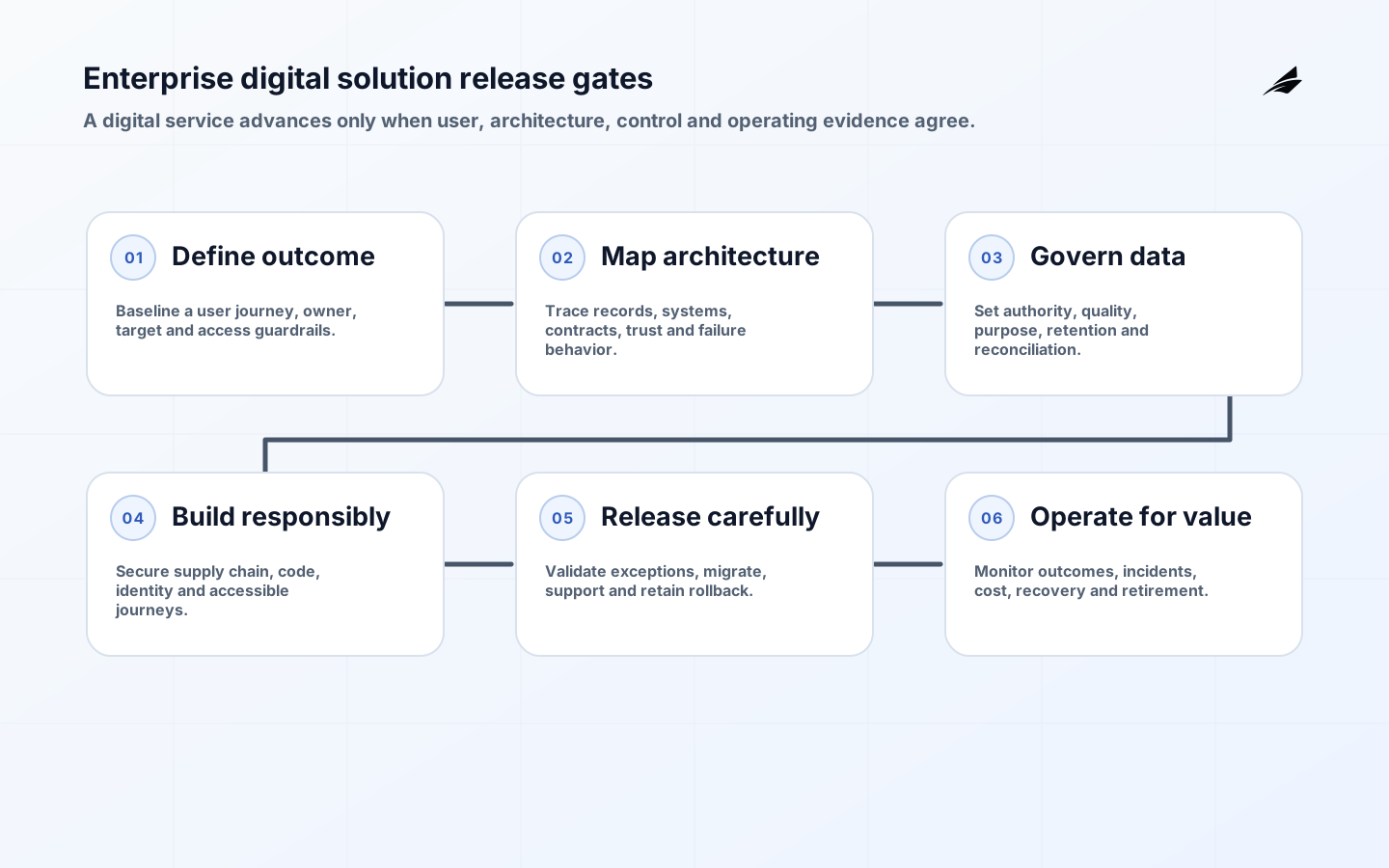
An enterprise digital solutions implementation checklist should connect a business outcome to a service that people can use, trust and operate. A portal, workflow, data product, mobile app or automation succeeds only when process, information, integrations, controls and ownership move together. Use the gates below to challenge assumptions before committing more money. Each gate needs observable evidence and an accountable approver, not a slide that says the topic was considered.
Pair this checklist with the enterprise digital solutions FAQ and the digital solutions scope guide. The software delivery checklist gives deeper engineering gates. Keep the first release narrow enough to prove the end-to-end service, but representative enough to expose real identity, data, integration, support and change constraints.
1. Pass the outcome and service-design gate
Name the user, triggering situation, task and desired result. Map the current journey across channels and internal handoffs. Record baseline completion, elapsed time, error, abandonment, cost and satisfaction. Define which policy or operational decision changes. A request to digitize onboarding is incomplete; reducing eligible-customer onboarding from five days to one, while preserving verification and correction, creates an outcome that design and engineering can test.
Identify affected groups, including people with limited connectivity, language needs or disabilities. Observe actual work before standardizing it. Remove unnecessary approvals and duplicate capture instead of reproducing them in software. Set scope boundaries, prohibited uses and a non-digital route where exclusion would cause harm. Assign one business service owner with authority over policy, process and outcome; delivery cannot resolve conflicting mandates without that decision right.
| Gate | Required evidence | Do not proceed when |
|---|---|---|
| Outcome | User, baseline, target, guardrails and owner | Success is only delivery on time |
| Journey | Observed tasks, exceptions and channel handoffs | The design reflects an idealized process |
| Scope | First cohort, exclusions and dependency map | Every department is in the first release |
| Authority | Decision rights and escalation | Policy conflicts have no owner |
| Equity | Access needs and assisted route | A required population cannot complete the service |
2. Pass the architecture and integration gate
Model the service as capabilities and information flows. Identify systems of record, channels, APIs, events, batch exchanges, identity providers, documents and external parties. For each integration, record owner, contract, authentication, volume, latency, failure behavior and change notice. Prefer supported APIs and event contracts over direct database coupling. A solution diagram should show trust boundaries and operating dependencies, not only vendor product boxes.
Choose build, buy and reuse decisions at capability level. A packaged case platform may fit common workflow while a custom eligibility rule expresses unique policy. Evaluate configuration limits, extension model, export, accessibility, observability, upgrade behavior and exit. Keep business rules versioned and testable outside opaque screen flows. Use architecture decisions to explain alternatives and consequences. Require a recovery path when a dependency is slow, unavailable or sends an incompatible schema.
3. Pass the data, privacy and records gate
Define each material field, authoritative source, purpose, quality threshold, retention and correction owner. Minimize collection and avoid asking users for information the organization already holds unless confirmation is necessary. Trace derived decisions to source values and rule versions. Reconcile data before migration and after cutover. The NIST Privacy Framework helps teams consider risks created by data processing, complementing security controls that protect confidentiality and integrity.
Classify records and evidence. Decide what must be captured for audit, customer support, legal hold or dispute, and prevent mutable logs from becoming the sole record. Test access, export, correction, retention and deletion through downstream systems and backups as policy requires. Use realistic masked or synthetic data in nonproduction. A data migration is complete only when totals, relationships, exceptions and consumer outputs reconcile and the old source has an approved disposition.
| Control area | Design question | Acceptance evidence |
|---|---|---|
| Identity | Who can act, approve and administer? | Role tests and access review |
| Data | What is authoritative and fit for use? | Definitions, quality results and reconciliation |
| Privacy | Is every use necessary and bounded? | Purpose, minimization and lifecycle test |
| Security | How are abuse and compromise contained? | Threat tests, logs and response exercise |
| Records | What proves a material transaction? | Immutable capture, retrieval and disposition |
4. Pass the secure and accessible build gate
Threat-model the service around assets, actors, entry points, trust boundaries and abuse cases. Apply the NIST Secure Software Development Framework to protect code, builds, dependencies and releases. Use reviewed infrastructure definitions, isolated environments, secret management, dependency inventories, artifact provenance and vulnerability response. CISA's Secure by Design guidance reinforces making secure defaults and protective capabilities part of the product rather than optional customer work.

Set an accessibility target and test components and complete journeys against WCAG 2.2. Include keyboard, screen reader, zoom, reflow, contrast, error recovery and accessible authentication with people who use relevant assistive technology. Automated checks find only part of the problem. Protect usability under slow networks, smaller screens and interrupted sessions. Security controls must be accessible too; an inaccessible verification method can block the users it is intended to protect.
5. Pass migration, validation and rollout gates
Test business rules, integrations, security, accessibility, performance, resilience, backup, recovery and support. Use production-like data volume and representative exceptions. End-to-end tests should follow high-value journeys and prove effects in systems of record. Rehearse dependency failure, duplicate messages, delayed batches, expired certificates and an erroneous release. Acceptance belongs to business and operational owners as well as engineering. A successful demonstration is not evidence of sustainable service.
Release through a bounded cohort with entry, exit and rollback criteria. Train service staff on changed work and exceptions, not only screens. Staff support channels for launch, publish status and capture feedback without exposing sensitive data. Monitor adoption by eligible population so a high overall rate does not hide exclusion. Migrate in waves only after the first cohort meets outcome, control and support thresholds. Decommission old routes and permissions after reconciliation.
6. Pass the operating and value gate
Define service objectives for completion, latency, availability, data freshness and recovery. Monitor user journeys, queues, integrations, security events, cost and outcome guardrails. Assign first-line support, product, engineering, security, privacy, vendor and incident roles. Use the NIST Cybersecurity Framework to keep governance, protection, detection, response and recovery connected. Rehearse incident communications and preserve evidence needed to understand customer impact.
Review value after a representative evidence window. Compare outcome and guardrails with baseline, including staff effort shifted elsewhere. Track change failure, recovery time, defect escape, accessibility issues, support demand and cost per completed service. Prioritize improvements from observed friction and incidents. Reassess material vendor, policy, data or user changes. Retire capabilities that no longer serve a purpose; digital estates become safer and cheaper when obsolete integrations, records and access are removed.
Practical example: digitizing supplier onboarding
A manufacturer wants to replace email-based supplier onboarding. Observation reveals that suppliers submit the same legal, banking and product information to three teams, while risk reviewers wait for documents they cannot validate. The first release targets domestic low-risk suppliers and aims to reduce median onboarding from twelve days to four without increasing payment fraud or inaccessible completion. International, high-risk and emergency suppliers retain explicit routes rather than being forced through an unsuitable workflow.
The architecture keeps supplier identity in the master system, stores evidence under records controls, calls screening and banking services through versioned APIs and records every approval against the exact submission. The portal supports save and resume, keyboard use, clear errors and assisted completion. Sensitive bank changes require independent verification. Threat tests cover account takeover, malicious files, role escalation and duplicate submissions. Integration failures create an owned queue instead of silently losing an application.
A bounded cohort uses real support and operations. The team reconciles every migrated supplier, rehearses screening outage and rollback, and measures completion, cycle time, corrections, reviewer effort, accessibility defects and fraud guardrails. Support evidence reveals that business registration terminology confuses small suppliers, so content and validation change before expansion. Old shared mailboxes become read-only after reconciliation, and access is removed. Finance confirms that approved banking details reach payment controls exactly once, while records staff retrieve the evidence behind a sampled approval. Product, operations and security owners sign the release against the same results. The service scales because the complete outcome and control path works, not because the portal screens look finished.
The next cohort adds foreign tax documentation only after policy owners define validation, language, retention and specialist escalation. Reusable identity, notification and records components carry forward, while jurisdiction-specific rules remain separately owned. This distinction prevents reuse from becoming accidental policy harmonization and lets common technology evolve without obscuring legal and operational differences. Release evidence remains directly comparable across cohorts.
Implementation takeaways
- Own a measurable service outcome before selecting technology.
- Map records, integrations, trust boundaries and failure behavior.
- Design privacy, security, records and accessibility into the normal path.
- Validate complete journeys and representative exceptions before rollout.
- Release in bounded cohorts with support and rollback capacity.
- Operate against user outcomes, control evidence and lifecycle cost.
Frequently asked questions
How large should the first enterprise digital solution release be?
Large enough to exercise real data, identity, integrations, exceptions and support, but small enough to contain harm and change direction. Define representativeness and decision thresholds rather than choosing an arbitrary user count.
Should an enterprise standardize on one platform?
Standardize common capabilities and operating controls where reuse reduces risk and effort. Permit governed exceptions when workload or user evidence demands them. One product rarely fits every channel, data or integration need.
Conclusion
Enterprise digital solutions become durable when outcome, architecture, data, controls and operations are treated as one service. Make each gate produce evidence, give owners authority to stop weak releases and measure what changes for users after launch. That discipline turns digitization from a technology installation into accountable improvement.