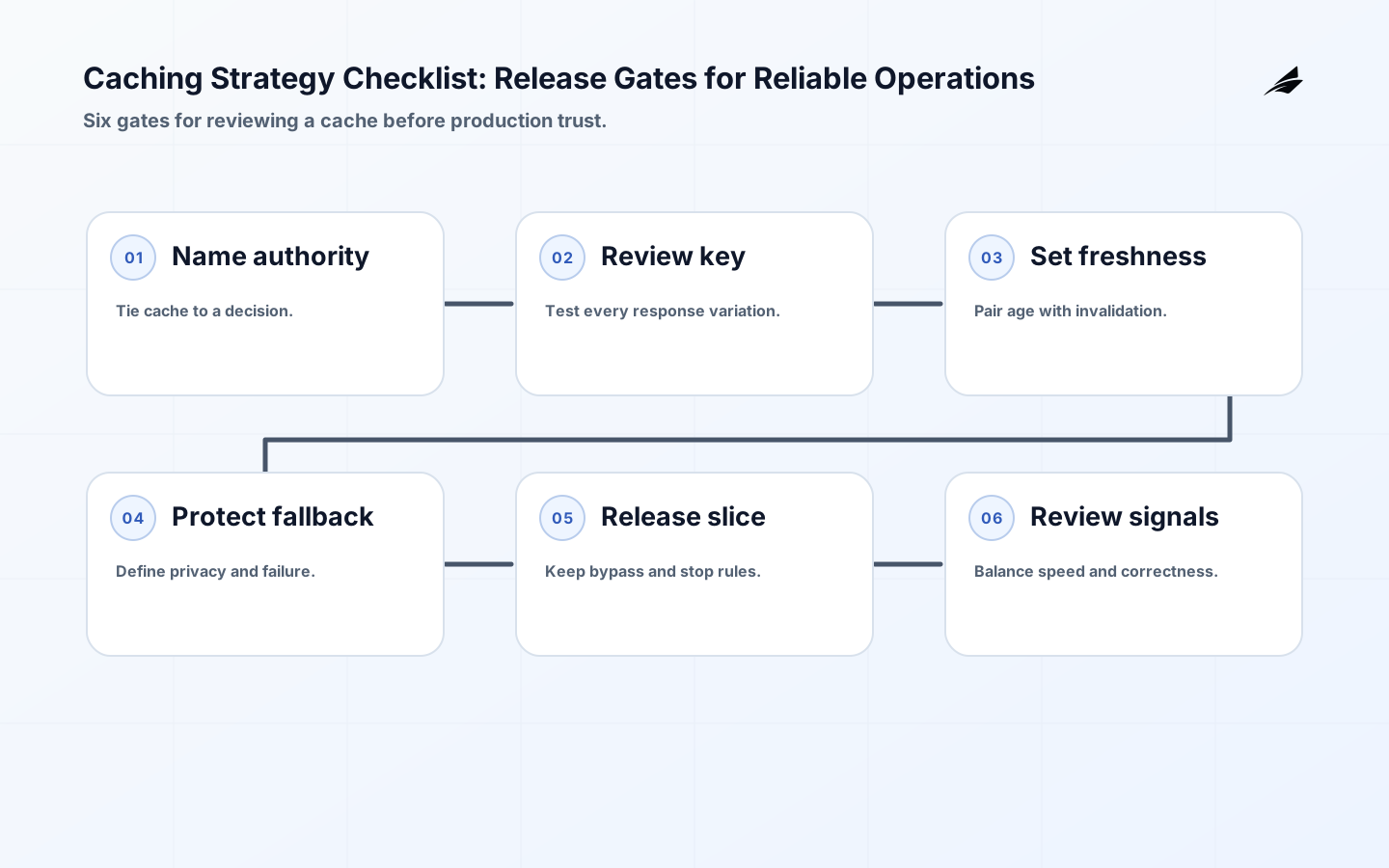
A caching strategy checklist is useful only when it gates a real release decision. Caching can lower latency and origin load, but it also adds a second place where a representation can be old, private, incomplete, or wrong for the next request. For reliable digital operations, review the cache as part of the product boundary: which decision does it support, which record is authoritative, which request dimensions change the answer, and what must happen when the cache cannot prove freshness?
Gate one: name the authority and the consequence

Write the answer in a sentence an operator can use: “This cache accelerates the product catalogue, while price and inventory remain authoritative at checkout.” If the sentence cannot identify the owner and the consequence of an old value, the release is not ready. The HTTP Caching standard defines how caches store and reuse responses, but it cannot decide whether a one-minute-old result is harmless for your workflow or dangerous for your entitlement policy.
| Checklist question | Pass condition | Stop condition |
|---|---|---|
| What decision uses the value? | The journey and user consequence are named. | The cache is justified only by “faster”. |
| Which record wins? | A system and owner are authoritative. | Two stores can disagree without repair. |
| How old may it be? | An age limit is written and tested. | Freshness is an unbounded guess. |
| Who may receive it? | Tenant, role, locale, and cohort variation are known. | A shared key crosses an access boundary. |
| What if it fails? | Bypass, deny, degrade, or review behavior is explicit. | The fallback changes a consequential action silently. |
Gate two: review every cache-key dimension
List the inputs that can change the representation or the right to see it. Include tenant, account, identity, role, locale, feature cohort, request parameters, API or schema version, and content encoding where they matter. The Vary header reference illustrates why a response can be valid for one request and invalid for another when the cache does not retain the relevant variation. Treat the key builder like access-control code: centralize it, test it, and review changes as a boundary change.
Choose where the cache lives and record its visibility. Browser, CDN, gateway, process-local, distributed, and materialized-read caches have different purge and failure behavior. An in-process cache may disappear on restart but avoid cross-tenant sharing; a shared cache can reduce load while increasing the cost of a missing key dimension. The checklist should identify who can read, purge, warm, or bypass each layer and what evidence proves that action.
Gate three: choose freshness and invalidation together
Do not approve a TTL without discussing what happens at expiry. A fixed TTL is appropriate when age is bounded and harmless. Conditional revalidation can reduce response transfer while checking with the origin. Write-triggered invalidation reduces lag but depends on a reliable event path. Versioned keys work well for immutable releases but require retirement. The Cache-Control documentation gives the protocol vocabulary; the release record must state the local promise.
| Freshness choice | Release evidence | Operational owner |
|---|---|---|
| Fixed TTL | Age sample, expiry load, and stale limit. | Service owner. |
| Conditional revalidation | Validator present and 304 path tested. | Origin and edge owners. |
| Write invalidation | Event delivered, delayed, lost, and replayed. | Writer and consumer owners. |
| Versioned key | New version visible and old version retired. | Release owner. |
| Stale on error | Stale age disclosed and excluded from unsafe actions. | Product and operations owners. |
If expiry can create a stampede, document request coalescing, jitter, refresh concurrency, and warm-up. If invalidation can be delayed, add reconciliation against the source of truth. A dashboard showing “cache cleared” is not enough when the value also exists in a browser, edge location, derived read model, or queue. Use the Redis EXPIRE documentation to confirm the mechanics of a TTL, then verify every related copy in the actual product path.
Gate four: protect privacy and failure behavior
Review a cache as a data-handling component. Identify sensitive fields, logs, snapshots, admin tools, and provider access. Set no-store or private behavior where shared reuse is not allowed, and avoid putting secrets or unnecessary personal data into keys. Test a request from a second tenant, an expired role, a changed locale, and a feature-flag transition. A cache that passes the happy path but fails a variation test should not be promoted.
Define the response for an unavailable cache. A public, read-only page may use a stale response or go to the origin. A permission check should re-evaluate or fail closed. A financial action should verify the current authority before committing. Include an operator action: bypass, purge, rebuild, wait, or escalate. Pair the checklist with the REST API contracts checklist when the cached response is part of a client contract, and use the background jobs checklist when refresh or rebuild work runs asynchronously.
Make the cache visible across the workflow rather than treating it as a local performance setting. For an API, record whether a response can be shared, revalidated, or bypassed and make those choices part of the contract. For a worker, record when a refreshed value is safe to publish and how a failed rebuild is retried or reconciled. For a read model, name the source version that produced the value and the signal that says it is behind. This extra evidence lets an operator distinguish a normal cold miss from a broken invalidation path, and it lets a CTO compare the cost of the cache with the cost of the problem it was introduced to solve. Keep the record beside the database schema guide when a new materialized view becomes an operational dependency.
Gate five: release by evidence-bearing slices
Use a limited route, tenant cohort, or percentage of traffic for the first exposure. Keep a bypass and compare cached results with the authority for a representative sample. Record cache hit and miss reasons, age, origin latency, eviction, invalidation lag, error responses, and the volume of simultaneous refreshes. Decide the stop threshold before launch: a cross-tenant mismatch is an immediate stop; a modest hit ratio may be a tuning issue.
If a CDN or edge layer is involved, inspect the full request path rather than only the application cache. CloudFront’s delivery guidance describes edge, regional, cache-miss, and origin behavior; your provider may add policies that alter the relationship between headers and reuse. Verify the actual headers and cache status in a production-like environment, including error responses and dynamic methods.
Gate six: operate from signals tied to a decision
An operations dashboard should help a leader decide whether to expand, contain, or redesign the cache. Watch hit ratio by endpoint, stale age, origin load, invalidation lag, eviction pressure, bypass rate, and errors. Add a business reference or trace link that lets support connect a stale response with the authoritative record without copying sensitive payloads. A metric without a named response is only an observation.
Review the cache after changes to authorization, locale, experiments, schema, or write behavior. These changes can alter the key or invalidation promise even when the cache code is untouched. Keep a short decision record with the owner, scope, accepted age, provider settings, tests, and next review date. Use database schema design in plain language when a new read model becomes part of the authority conversation.
Use the checklist to make tradeoffs visible
A reliable cache is not the one with the most aggressive reuse. It is the one whose behavior remains explainable under a stale read, a miss storm, a delayed invalidation, a changed permission, and a provider outage. Ask product whether the user can interpret age, security whether the data can cross the boundary, engineering whether the key and fallback are testable, and operations whether the path can be disabled and repaired. The checklist should produce a decision, not a meeting about terminology.
Retire a cache when its cost exceeds its benefit or when a better source-of-truth path replaces it. Remove keys, purge procedures, dashboards, credentials, and runbook assumptions together. An unowned cache becomes a hidden dependency even when it delivers no measurable outcome. Record what was learned so the next performance change does not repeat the same ambiguity.
Key takeaways
- Name the authority, user decision, freshness promise, and consequence before approving a cache.
- Review every key dimension that changes representation or permission.
- Pair TTL or validation with invalidation, stampede, and reconciliation behavior.
- Test privacy and failure paths across browsers, edges, services, and derived stores.
- Use production signals and explicit stop actions to decide whether the cache earns expansion.
Frequently asked questions
What is the first gate in a caching strategy checklist?
Name the journey, the user decision, the authoritative record, the maximum acceptable age, the request dimensions that vary the response, and the safe behavior when the cache is unavailable. Without those items, a technology choice cannot be evaluated responsibly.
Which cache failures deserve a release stop?
Stop when a response crosses a tenant or authorization boundary, stale age exceeds a consequential promise, the cache diverges from authority without a repair route, or a miss storm threatens the source system. Other issues may be tuning work, but the threshold should be explicit.
How should a CTO review cache success?
Review correctness and user outcome beside hit ratio, latency, origin load, invalidation lag, eviction, stale serving, bypass rate, and recovery evidence. Ask what decision each signal changes and who owns the action.
Conclusion: use the checklist to protect the fast path
Caching strategy becomes an operational asset when its authority, key, freshness, privacy, fallback, rollout, and stop conditions are written before traffic depends on it. Use the checklist to make those choices testable, then let evidence—not hit ratio alone—decide whether the cache should expand.