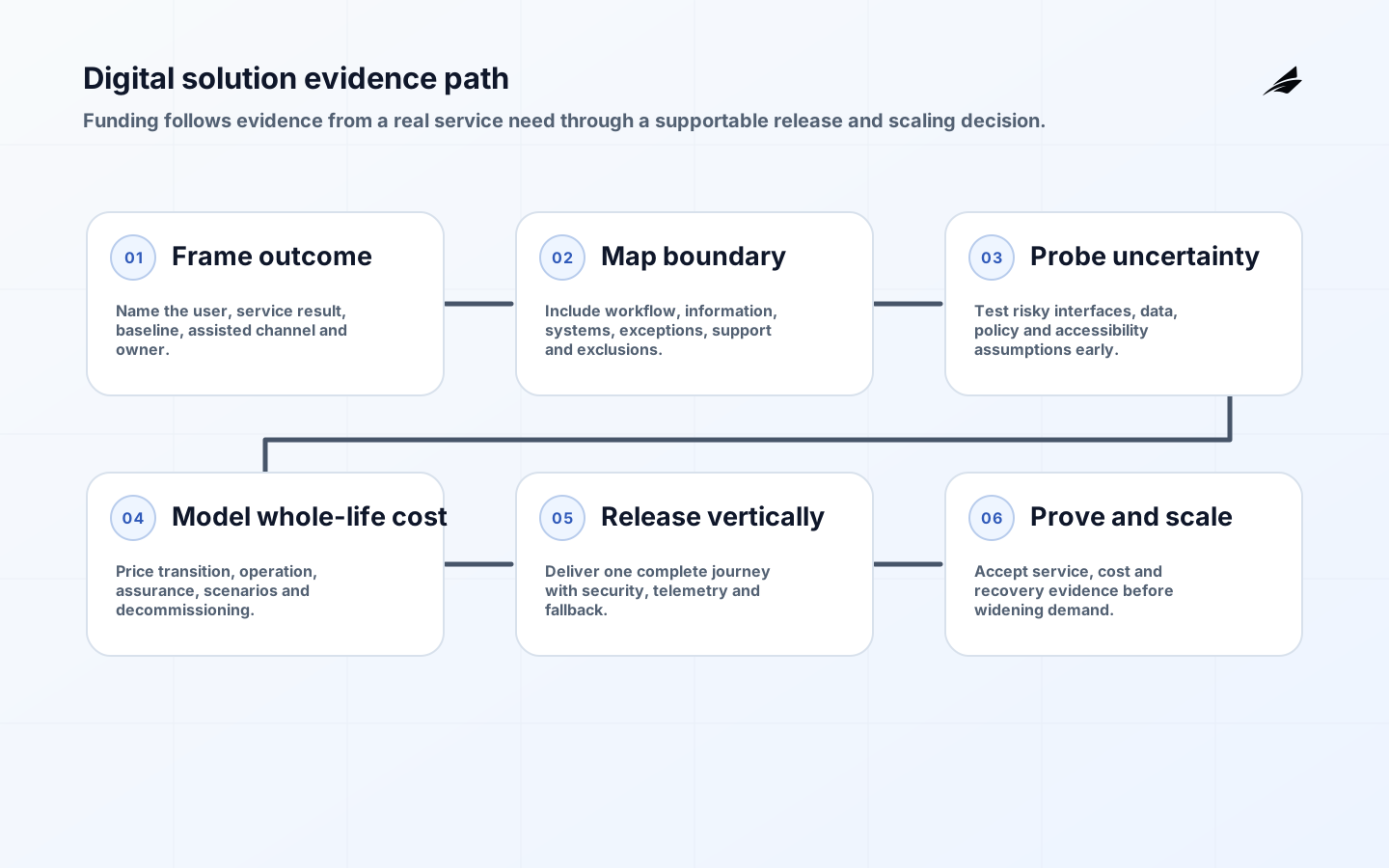
Digital solutions are services, not screens. A customer portal, field application, workflow platform or data product succeeds only when the surrounding policy, people, records, integrations, support and operating controls work together. Teams get unreliable estimates when they price a list of features before they understand demand, exceptions and service ownership. A useful plan starts with the outcome and progressively replaces uncertainty with evidence.
This guide explains how to turn an idea into a defensible scope, cost range, risk register and staged delivery plan. Use it before issuing a request for proposal, funding a product team or rescuing a project dominated by feature debate. The companion digital solutions implementation checklist and digital solutions FAQ continue into execution, while the enterprise digital solutions checklist covers larger organizational dependencies.
Frame the service outcome
Name the user, situation, current friction and observable improvement. “Create a claims portal” is an output. “Allow an eligible claimant to submit complete evidence once and see the next decision within two working days” is an outcome that exposes policy, data and operational questions. Identify people who cannot or will not use the primary channel, staff who resolve exceptions, and downstream owners who depend on the record.
Map the end-to-end service before choosing technology: trigger, identity, eligibility, submission, validation, decision, payment or fulfilment, communication, appeal, amendment, retention and closure. The UK Service Standard is a strong public reference because it emphasizes user needs, joined-up channels, accessibility, multidisciplinary ownership, privacy, security, reliable operation and performance data. Adapt those principles to the organization and jurisdiction rather than copying a delivery ceremony.
Define a release boundary that can operate
Scope a thin vertical service, not isolated interface components. The first release should take one eligible cohort from a real trigger to a completed outcome, including authentication, records, notifications, support, monitoring and recovery. Explicitly list exclusions such as historical migration, multilingual content, offline operation, payment disputes or a second business unit. Each exclusion needs an owner and a safe interim process; otherwise it returns as unplanned work during acceptance.
| Scope layer | Questions to settle | Evidence | Common omission |
|---|---|---|---|
| Users and channels | Who starts, assists, decides and appeals? | Research sessions and service-volume data | Assisted and accessibility journeys |
| Workflow | What states, rules and exceptions exist? | Journey map and decision table | Manual queues and reversals |
| Information | Which source owns each field? | Data inventory and quality sample | Retention and correction |
| Technology | Which interfaces and environments are required? | System map and API probes | Identity and non-production data |
| Operations | Who monitors, supports and recovers service? | Runbook, SLO and rota | Supplier escalation and exit |
Build a whole-life cost model
Estimate ranges by capability and uncertainty, not a single total by feature count. Include discovery, design, content, engineering, integration, migration, security, accessibility, testing, environments, licenses, cloud consumption, training, support, monitoring, incident response, compliance evidence and decommissioning. Separate one-time transition cost from recurring run cost. State assumptions for user volume, data growth, transaction peaks, service hours, retention and supplier rates.
Run three scenarios: expected demand, a credible peak and a downside case with slower integration or poorer data. Add contingency against named uncertainty rather than a flat unexplained percentage. For example, fund a two-week interface probe to replace a broad integration contingency with measured latency, failure behavior and supplier effort. Track cost per completed service outcome alongside total spend so an increase caused by successful adoption is not misread as waste.
| Cost area | Initial cost driver | Recurring driver | Control |
|---|---|---|---|
| Product delivery | Team size, duration and specialist skills | Continuous improvement capacity | Fund outcomes by stage |
| Integration and data | Interfaces, cleansing and migration rehearsals | Schema change and reconciliation | Data contracts and ownership |
| Platform | Environments, setup and licenses | Usage, storage, transfer and support | Budgets, tagging and forecasts |
| Assurance | Threat, privacy and accessibility work | Retesting and evidence maintenance | Automated checks plus scheduled review |
| Operations | Runbooks, training and transition | Support, incidents and resilience tests | SLOs and service ownership |
Make the estimate auditable. For each range, retain the quantity, source, date, confidence and person who can change the assumption. Update the forecast after discovery, an integration probe and the first production cohort rather than defending the original number. Show consumed contingency against the uncertainty it was meant to cover. When scope changes, explain whether the cause is a new outcome, a previously excluded dependency, corrected evidence or poor delivery performance; those causes require different governance responses and prevent every variance from being labeled scope creep.
Choose architecture from constraints
Document the few decisions that materially affect cost and reversibility: buy versus build, system of record, identity boundary, integration style, hosting model, availability target and tenancy. Prefer a modular monolith or managed platform when it meets the need; distributed services are justified by independent scaling, ownership or isolation, not fashion. Use prototypes to test risky assumptions such as legacy write access, offline synchronization or peak document processing.
Design security into defaults. CISA’s Secure by Design guidance places responsibility on technology producers to reduce customer burden. In practice, use least privilege, secure configuration, protected secrets, software dependency controls, tamper-evident audit events and tested recovery. Map risk through the NIST Cybersecurity Framework, but choose controls based on actual threats, legal duties and impact rather than attaching a framework label to an unchanged design.
Make accessibility and privacy acceptance criteria
Accessibility belongs in research, design, content, component selection and testing. Apply WCAG 2.2 at the conformance level required by policy, and combine automated checks with keyboard, screen-reader, zoom, contrast, error-recovery and representative-user testing. Include documents, authentication, timeouts, notifications and third-party widgets. An accessible landing page does not compensate for an unusable identity or payment step.
Build a data map that states purpose, lawful basis or authorization, source, recipients, retention, correction and deletion behavior. Minimize collection and prevent production personal data from becoming a convenient test fixture. The NIST Privacy Framework helps teams connect privacy risk to organizational and system activities, but counsel and privacy officers must identify the applicable law. Test subject or customer requests across exports, caches, analytics and backups, not only the primary database.
Deliver in evidence-based stages
- Explore the problem with users, operational staff, policy owners and real service data.
- Prove the highest-risk assumptions through prototypes, interface probes and data samples.
- Build one complete service path with security, accessibility, telemetry, support and recovery included.
- Release to a bounded cohort with explicit eligibility, feature controls and a fallback channel.
- Compare completion, quality, cost, reliability and user experience with the baseline; fix failure demand.
- Scale only after capacity, supplier support, controls and unit economics hold under observed demand.
Give each stage exit criteria and a funding decision. Discovery exits when the team can explain users, demand, constraints and riskiest assumptions, not when a slide deck is finished. A pilot exits when real users can complete the outcome and operators can support and recover it. Use small releases and fast feedback; the DORA guides connect delivery performance to practices such as loosely coupled architecture, continuous delivery and learning culture without suggesting that one metric or tool guarantees performance.
Assign a benefit owner outside the delivery team and schedule reviews after launch. Compare completion, elapsed time, avoidable contacts, error, accessibility, staff effort, operating cost and reliability with the baseline. Explain changes in demand or policy that affect the comparison. Retire dashboards that do not inform a decision, and keep funding improvement where evidence shows that unresolved failure demand is consuming users' and staff time.
Operate a decision-led risk register
Write risks as cause, event and impact: “Because the legacy vendor allows only nightly exports, eligibility status may be stale, causing incorrect decisions and rework.” Assign an owner, trigger, mitigation, contingency and review date. Track risk retirement alongside feature progress. Escalate when the mitigation depends on an unfunded team or an unsigned supplier commitment. Include adoption, policy, accessibility, data quality, cyber, resilience, vendor concentration and operating-model risks.
Key takeaways
- Define a measurable service outcome across digital, assisted and operational channels.
- Scope a complete vertical journey and give every exclusion an owner and interim path.
- Estimate transition and recurring costs with explicit volume, integration and assurance assumptions.
- Treat security, privacy, accessibility, support and recovery as release work.
- Fund delivery in stages that retire uncertainty and prove operation with real users.
Frequently asked questions
How much does a digital solution cost?
There is no responsible universal price. Cost depends on workflow breadth, integrations, data condition, assurance duties, availability, migration, user volume and operating support. Ask for a range with assumptions, scenario sensitivity and stage gates. A cheap build with unfunded operation or inaccessible journeys is not a low-cost service.
What belongs in a minimum viable release?
The smallest complete path that produces a real outcome for a defined cohort and can be supported safely. It includes error handling, access control, telemetry, content, accessibility, support and rollback. It need not include every segment, channel or historical record, but exclusions need a deliberate fallback.
Should delivery use a product, a vendor or an internal team?
Choose by differentiating workflow, integration complexity, control needs, internal capability, time horizon and exit cost. A product can accelerate standard capabilities; custom work can fit a unique service; a blended team is common. Keep architecture, data, acceptance evidence and operational knowledge under accountable organizational ownership.
Conclusion
A credible digital solution plan makes the whole service visible. It connects user outcomes to a bounded release, exposes assumptions in the cost model, treats assurance and operations as product work, and releases funding as evidence improves. That is how teams replace a speculative feature estimate with a service they can deliver, run and improve.