An outcome-based software contract pays or rewards a supplier for a meaningful result rather than simply for hours consumed. The idea is attractive because it can give the supplier freedom to innovate and connect commercial reward to value. It is also easy to misuse. Outcomes such as conversion, adoption, case resolution, or operating cost depend on buyer policy, users, data, marketing, other systems, and economic conditions as well as software delivery.
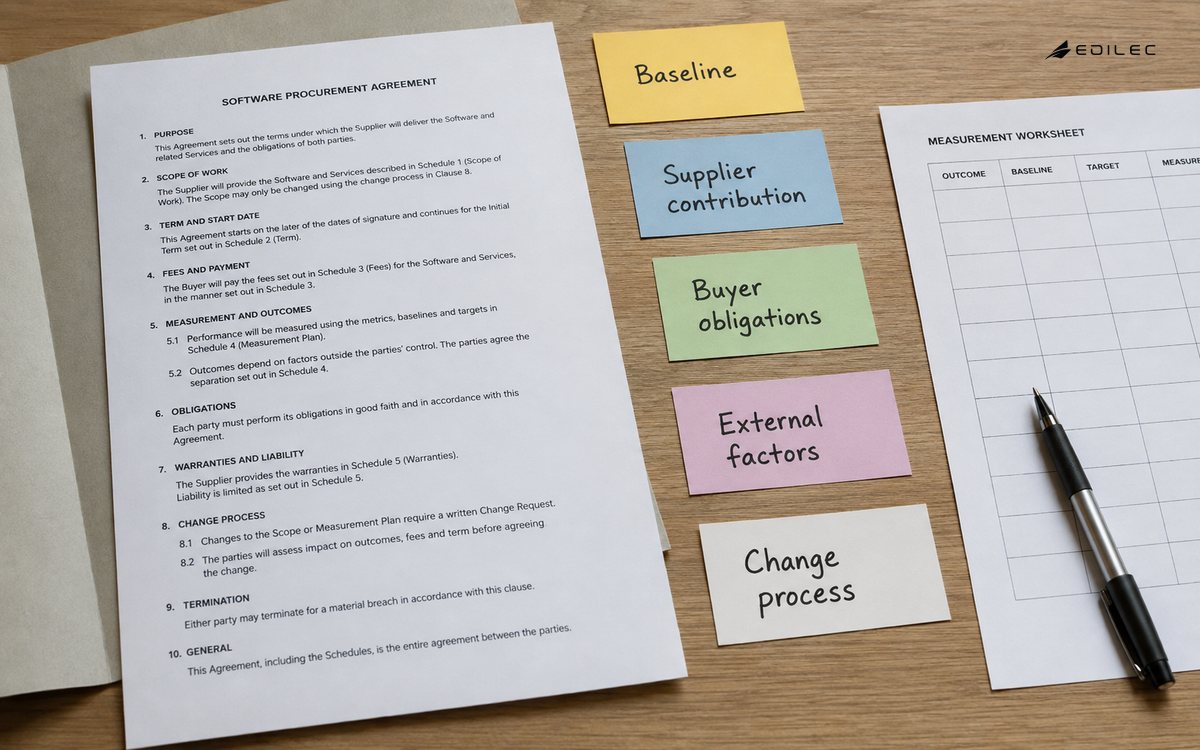
The contract becomes governable when it defines the baseline, affected population, measurement method, supplier contribution, buyer obligations, uncontrollable factors, evidence, acceptance, payment curve, change process, and treatment of failure. Outcome language should narrow ambiguity, not turn every external variable into supplier risk. The strongest arrangements combine outcome direction with accepted software outputs and operational controls.
Separate inputs, outputs, and outcomes before pricing
An input is effort or capacity, such as a specialist day. An output is something delivered, such as a migrated interface that passes specified tests. An outcome is a changed state for users or the business, such as more eligible customers completing that journey. The updated Risk Allocation and Pricing Approaches guidance distinguishes these bases and notes that outcome pricing generally places more risk on suppliers than input pricing because payment is more contingent on results.
Do not specify detailed inputs while claiming the supplier controls the outcome. If the buyer mandates people, tools, architecture, sequence, and daily decisions, it retains significant delivery control. A hybrid is often more honest: a base fee funds minimum capability, milestone payments follow accepted outputs, and a bounded incentive reflects an outcome the supplier can materially influence.
| Basis | Example | Primary evidence | Risk that remains with buyer |
|---|---|---|---|
| Input | Approved engineering capacity | Time, role, availability | Prioritization and integrated delivery |
| Output | Accepted claims API migration | Tests, security evidence, deployed interfaces | Business use and benefits realization |
| Outcome | Higher completion among eligible users | Governed business metric against baseline | External and retained-decision effects |
| Hybrid | Service fee plus milestone and gainshare | Operational, acceptance, and outcome records | Explicitly allocated dependencies |
Define a measurable outcome with a defensible baseline
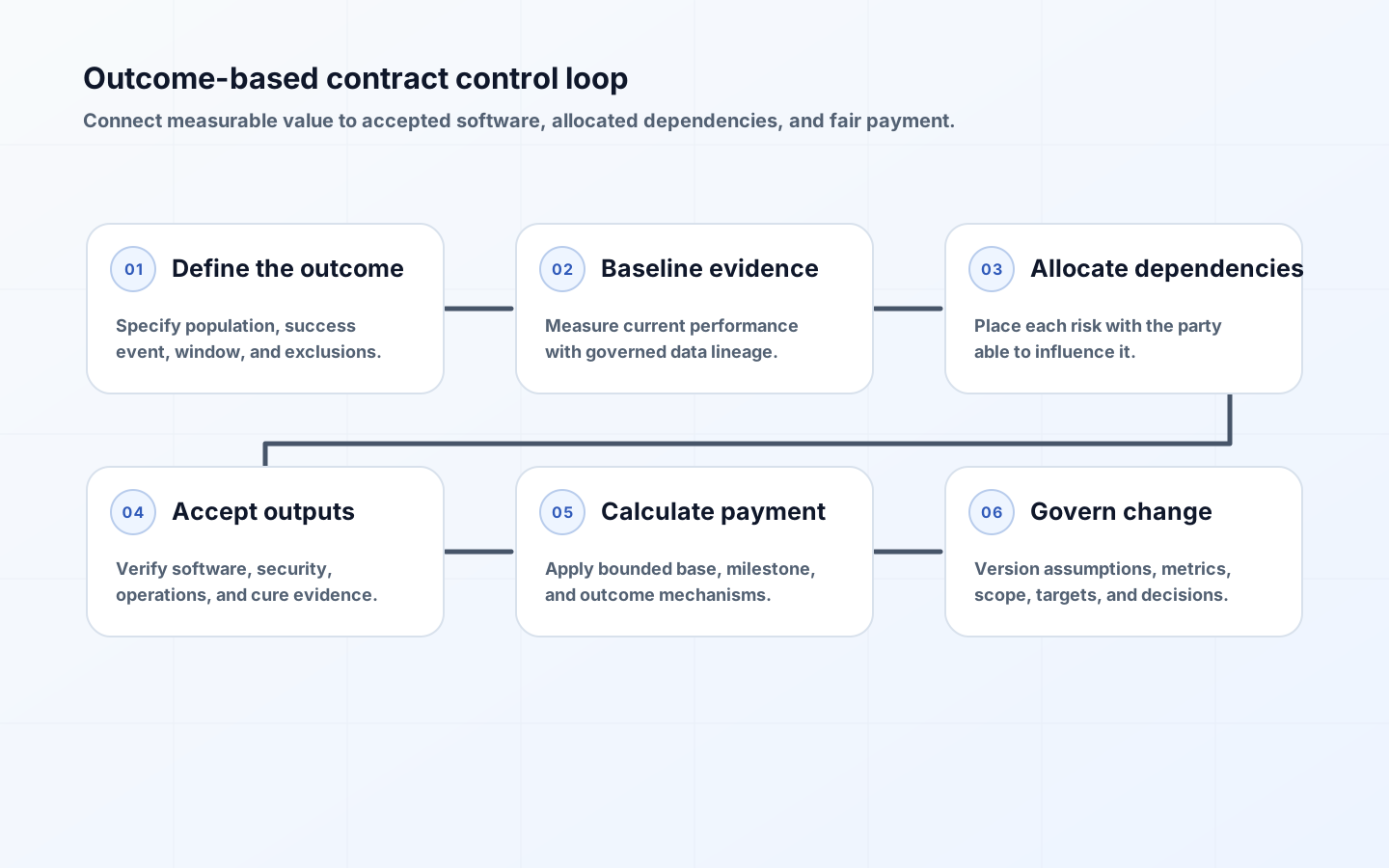
State the decision population, event, success condition, observation window, exclusions, data source, calculation owner, and baseline period. A goal such as reduce onboarding time should become something like: for eligible standard applications submitted in the named channels, increase the share reaching verified activation within two business days, measured from immutable workflow events, compared with an agreed seasonally matched baseline. The parties must still decide target, sample sufficiency, data quality rules, and how manual exceptions count.
Baseline before negotiation where possible. Segment by case complexity, channel, geography, user type, and material policy differences so a vendor cannot improve the headline by diverting difficult cases. Preserve metric definitions and raw lineage. Nominate an independent measurement owner or shared verification process. The outcome must be auditable without giving either party unilateral power to rewrite the denominator after performance is known.
Allocate risk to the party that can manage it
Build a risk allocation matrix before a price model. Typical supplier-controlled risks include its design quality, staffing, code, tests, deployment method, and subcontractor management. Buyer-controlled risks include policy decisions, data correction, access, subject-matter experts, timely approvals, communications, and adoption programs. Shared risks include integration behavior, demand shifts, security response, and transition. External risks may require thresholds, relief events, insurance, indexed price adjustment, or a shared risk pool.
The Sourcing Playbook states that risk should sit with the party best able to manage it and connects payment mechanisms to risk transfer. Applying that principle prevents an apparently aggressive transfer from returning as contingency pricing, reduced quality, disputes, or supplier distress. Risk allocation should be commercially meaningful, affordable, and supported by information and authority.
| Dependency | Owner | Evidence or threshold | If condition fails |
|---|---|---|---|
| Production-quality source data | Buyer | Profile against agreed completeness rules | Rebaseline affected cohort or raise change |
| Journey design and implementation | Supplier | Accepted design, tests, telemetry | Rectify at supplier cost within scope |
| Marketing campaign volume | Buyer | Campaign calendar and eligible traffic band | Exclude abnormal period or adjust target |
| Third-party identity API | Shared | Availability and latency dependency SLO | Apply dependency relief and remediation plan |
| Regulatory rule change | Neither exclusively | Effective date and impact assessment | Use emergency change and price/time adjustment |
Design acceptance around evidence and cure
Outcome measurement is usually too delayed to accept every software increment. Use layered acceptance. Deliverable acceptance confirms functional behavior, security, performance, accessibility, data migration, observability, documentation, and operational readiness. Service acceptance confirms stable operation over a defined period. Outcome verification then determines incentive or at-risk payment after enough evidence accumulates. A release can be technically accepted without guaranteeing that a long-horizon business outcome is already achieved.
Write objective criteria, evidence format, test environment, authorized approver, review window, rejection detail, severity thresholds, cure period, retest, and partial acceptance. Define when deemed acceptance is appropriate and when it is not, especially for latent security or data defects. The UK Contracting for Agile guidance supports outcome-based specifications while emphasizing iterative delivery; acceptance should therefore be frequent enough to expose misunderstanding before it compounds.
Build change control for learning, not obstruction
Outcome contracts still need change because users, regulations, dependencies, and evidence alter understanding. Define who may raise change, minimum impact information, urgent-change authority, assessment time, price and schedule treatment, baseline adjustment, implementation approval, and versioned effective date. Keep a change log linking each decision to affected outcomes, deliverables, assumptions, and tests.
Create tolerance bands for normal variation. Backlog reprioritization within stable capacity may need no contract amendment; a new user population, jurisdiction, regulated decision, or unavailable buyer dependency probably does. Distinguish discovery that clarifies existing scope from a new obligation. Use pre-agreed rates or estimation methods for small changes, and reopen the commercial model when a change alters the risk the supplier is paid to bear.
Shape payment so incentives remain proportionate
Use a payment curve rather than an all-or-nothing cliff when performance is continuous. Set a floor below which no outcome payment accrues, a target, a capped stretch level, and a maximum at-risk amount. Define whether improvements must persist and how later reversals are handled. Avoid incentives large enough to encourage gaming, case exclusion, unsafe releases, or underinvestment in unmeasured qualities.
Separate remedy types. Rework addresses an unaccepted deliverable. Service credit addresses a defined service-level failure. Outcome adjustment changes contingent payment. Indemnity or liability addresses specified loss. Termination protects against sustained or material failure. Prevent double recovery while preserving remedies for distinct harms. ISO's outsourcing guidance emphasizes governance and flexibility throughout the relationship; a commercial mechanism should support correction and collaboration before it turns every variance into a claim.
Govern outcomes with shared evidence and periodic reset
Create one metric dictionary, evidence repository, dependency log, risk register, change record, acceptance register, and payment calculation. Review delivery evidence frequently, operational measures monthly, and business outcomes at a cadence suited to signal latency. Give a named forum authority to approve baseline corrections and another escalation route for disputes. Keep metric stewards independent from the commercial benefit they calculate where feasible.
Test the model before signing by replaying at least six scenarios: buyer approval delay, poor data, demand spike, supplier defect, third-party outage, and regulatory change. Calculate payment and responsibility in each case. If reasonable reviewers reach different results, the mechanism is not ready. The GAO Agile Assessment Guide provides a useful public-sector reference for incremental software evaluation; the contract should make each increment a learning and control point. Record the interpretation agreed during each replay as contract implementation guidance.
Outcome-based contract takeaways
- Distinguish the business outcome from accepted software outputs and paid inputs.
- Baseline a governed population and calculation before setting a target.
- Allocate supplier risk only where the supplier has authority, information, and practical control.
- Use layered technical, service, and outcome acceptance with explicit evidence and cure.
- Let change control preserve learning while versioning scope, baselines, and risk.
- Cap incentives and test for gaming, case selection, unsafe delivery, and double remedies.
- Replay failure scenarios through the payment mechanism before signing.
Outcome-based software contract FAQ
Should a supplier guarantee the business outcome?
Only to the extent that the outcome is defined and within its control. Most business results have shared dependencies, so a hybrid payment with allocated assumptions is usually more defensible than an unlimited guarantee.
Can software be accepted before the outcome is known?
Yes. Accept tested deliverables and operational readiness on prompt evidence, then verify long-horizon outcomes for the contingent portion of payment. Keep warranties and latent-defect rights separate from ordinary acceptance.
When should the outcome baseline change?
Change it only through a governed rule when the population, policy, data, channel, dependency, or external environment changes materially. Preserve the original calculation and effective date so adjustments cannot rewrite past performance.
Conclusion
Outcome contracting works when commercial ambition is matched by measurement discipline. Define the result and baseline, retain technical acceptance, expose dependencies, allocate controllable risk, and let payment respond proportionately to evidence. The goal is not to transfer every uncertainty; it is to create enough shared clarity that both parties can improve delivery without debating the meaning of success after the fact.