RBAC design for internal tools should translate business responsibility into permissions that are understandable, enforceable and reviewable. It should not encode job titles directly into scattered interface checks. NIST’s RBAC model separates users, roles, permissions, operations and objects, with optional hierarchy and separation-of-duty constraints. That model remains a useful foundation, while modern internal tools often add tenant, resource, ownership, risk and environment attributes for decisions that roles alone cannot express safely.
This guide is for product, security and engineering teams designing a new authorization system or untangling accumulated administrator flags. It complements zero trust planning for business applications and data retention policies for business software. Begin with work scenarios and harmful outcomes, then create roles; starting from an organization chart usually produces broad access and rapid role explosion.
Model resources, operations and scope before roles
Inventory protected resources such as customer account, invoice, deployment, report, user, configuration and secret reference. Define operations with business meaning: view summary, export records, approve refund, manage membership, rotate credential or impersonate support. Avoid a single edit permission when actions have different consequences. Add scope explicitly: own records, assigned region, tenant, business unit, environment or all organizations. Permissions should be stable identifiers independent of labels shown in the interface.
Write misuse cases for cross-tenant access, privilege escalation, bulk export, self-approval, dormant access and support impersonation. Classify operations by consequence and identify whether they require stronger authentication, approval, reason, time limit or notification. Define default denial. OWASP recommends validating authorization on every request; hiding a button is useful interface behavior but does not protect the server endpoint, background job or direct API call.
| Element | Example | Design question |
|---|---|---|
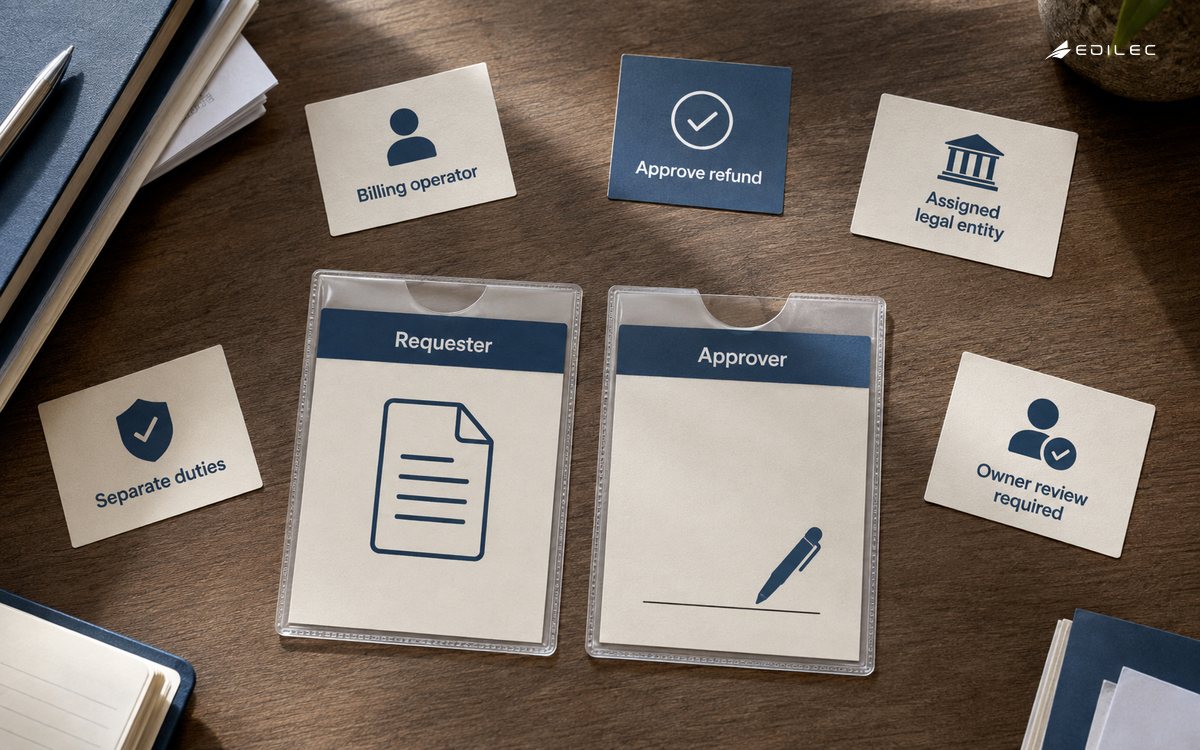
| Resource | Invoice or tenant configuration | What exact object is protected? |
| Operation | Approve refund | What business effect occurs? |
| Role | Billing operator | Which stable responsibility needs it? |
| Scope | Assigned legal entity | Which instances are reachable? |
| Constraint | Requester cannot approve | Which combinations are forbidden? |
Engineer roles from real work scenarios
Interview people who perform and oversee the work. Walk through normal, exceptional and emergency scenarios and record the minimum operations required. Cluster responsibilities that change together and have the same review owner. Separate eligibility for a role from activation during a session where useful. Use readable names and purpose statements, and publish which roles may assign them. A role is a reusable responsibility bundle, not a shortcut for granting a person every permission they once requested.
Use hierarchy cautiously. A senior role should inherit a junior role only when it truly needs every permission; management seniority does not imply operational access. Keep high-consequence capabilities such as impersonation, export, security configuration and role assignment in narrow roles. When combinations produce conflicts, define static separation of duty for assignments or dynamic separation for actions in one transaction. Test these constraints as business invariants.
Combine roles with attributes when context matters
Roles answer which responsibilities a subject has; attributes can answer which tenant, record, time, device or relationship applies. NIST’s ABAC guidance describes decisions using subject, object, operation and environment attributes. A practical hybrid might require the support-agent role and an active assignment to the customer account. Keep attribute sources authoritative and freshness known. Do not make an unverified client claim or editable profile field part of a security decision.
Avoid embedding complex policy independently in every service. Establish a consistent enforcement pattern, shared policy vocabulary and versioning. Services still need local context and must fail closed when policy cannot be evaluated. Cache decisions only within a justified lifetime and invalidate access after role or relationship changes. Record policy version and material inputs in the authorization event without leaking sensitive attributes.
Enforce authorization at every trusted boundary
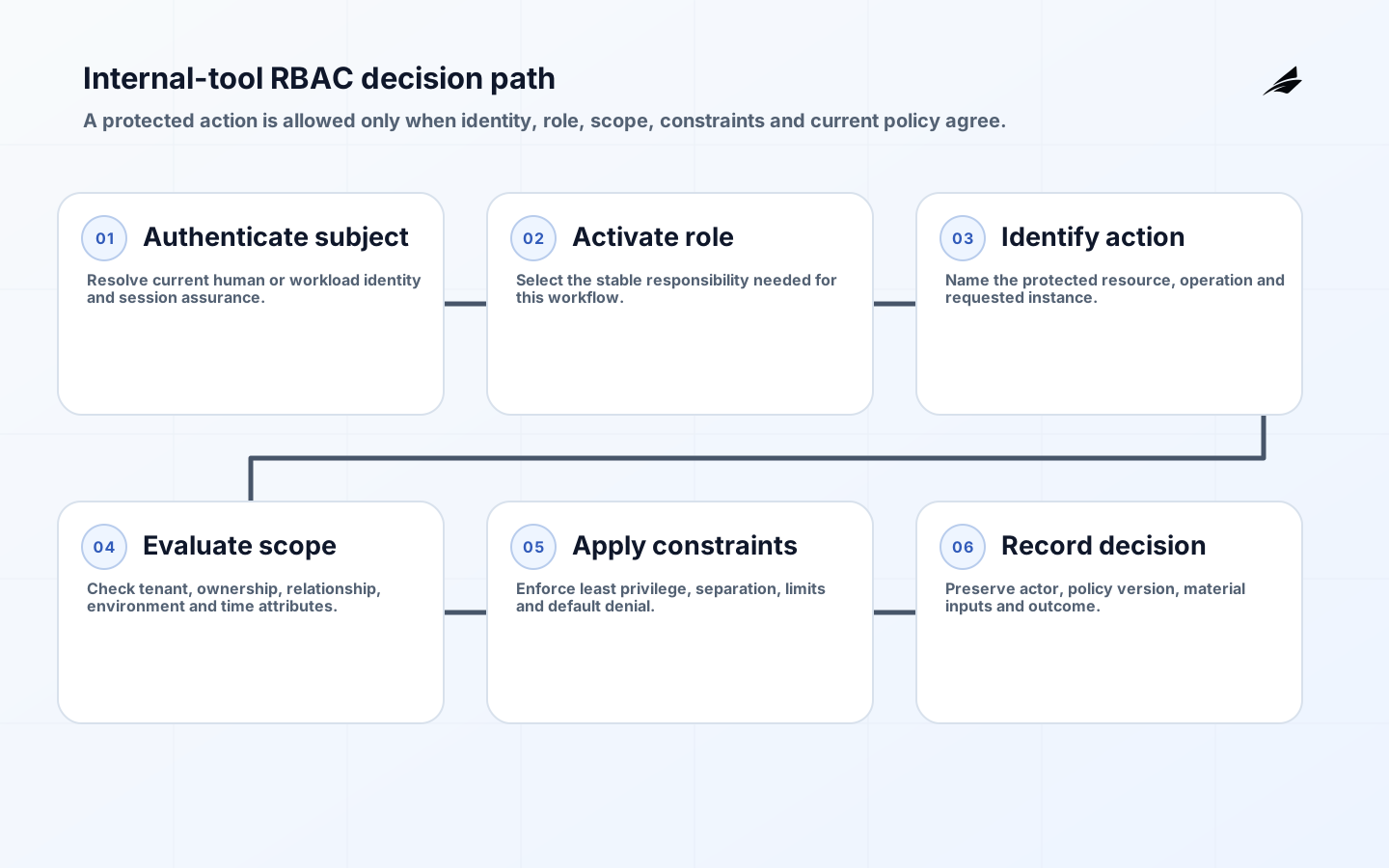
Authenticate the human or workload, resolve current roles and scope, evaluate the requested resource and operation, and enforce the decision on the server. Repeat checks for batch endpoints, exports, webhooks, scheduled jobs and asynchronous consumers. Protect object lookup from insecure direct references by combining identity with resource scope. A service-to-service credential should have its own narrow permissions; it should not inherit the privileges of a generic administrator.
Administrative interfaces need stronger controls because they change the authorization system itself. Restrict who can create roles, attach permissions, assign users and alter constraints. Require reason and approval for high-risk grants, use time-bound access for emergency or vendor support and notify owners of consequential changes. Never rely on shared accounts. Break-glass access should be strongly authenticated, logged, limited, alerted and reviewed promptly after use.
Test denied paths and privilege transitions
Create a permission matrix from resource, operation, role, scope and constraint, then generate positive and negative tests. Test every endpoint, not only pages. Include cross-tenant identifiers, changed assignments, expired access, disabled users, inherited roles, self-approval and race conditions. Property tests can assert that no role outside an allowlist can perform a critical operation. Run tests when policies, routes and data relationships change.
Review effective access, not only direct assignments. Show inherited roles, group membership, attributes, exceptions and service accounts. Give reviewers enough context to judge whether access is needed. Revoke on role change and inactivity according to policy, and measure unowned roles, unused permissions, stale exceptions and failed authorization trends. A quarterly checkbox review cannot compensate for weak joiner, mover and leaver events.
| Review evidence | What it proves | Failure response |
|---|---|---|
| Effective-access report | Current users and inherited privileges | Revoke or correct source |
| Authorization test suite | Protected routes enforce policy | Block release |
| Denied-event trend | Misuse or broken client behavior | Investigate pattern |
| Privileged change log | Who changed roles and why | Escalate unexplained grant |
| Emergency-access review | Break-glass remained bounded | Rotate and remediate |
Migrate legacy permissions without creating a bypass
Inventory existing flags, groups, code conditions and manual practices. Map each to the proposed permission vocabulary and identify accesses that have no legitimate owner. Run old and new decisions in comparison mode where safe, logging disagreements without allowing the new system to silently grant more. Migrate bounded functions, verify denied cases and remove old enforcement code. A permanent dual policy path multiplies ambiguity and attack surface.
Audit records should answer who requested which operation on what resource, under which role and scope, what decision occurred and which policy version applied. Keep application outcome separate from authorization outcome: an allowed request can still fail business validation. Protect and retain evidence according to risk and policy. Provide support teams with understandable denial reasons without disclosing sensitive policy details or the existence of inaccessible records.
RBAC implementation sequence
- Inventory protected resources, operations, scopes and harmful outcomes.
- Derive roles from work scenarios and name assignment owners.
- Add hierarchy, separation and contextual attributes only where justified.
- Centralize policy vocabulary and enforce at every server boundary.
- Test positive, negative, cross-scope and privilege-transition cases.
- Review effective access and retire legacy bypasses with evidence.
Key takeaways
- Define resources, operations and scope before naming roles.
- Derive access from stable responsibilities and least privilege.
- Use attributes for tenant and relationship context without trusting clients.
- Enforce and test every server-side path with default denial.
- Review effective access, exceptions and privileged changes continuously.
Frequently asked questions
How many roles should an internal tool have?
There is no universal number. Use the smallest set that represents stable responsibilities without creating broad access. Role growth should be reviewed for duplication, one-person exceptions and attributes that would express scope more cleanly.
Should administrators bypass authorization?
No unrestricted bypass should be routine. Give administrators explicit narrow capabilities and use reviewed emergency access for exceptional recovery. All consequential actions should remain attributable and policy-controlled.
Should policy live in application code?
Business invariants often remain near the domain, while reusable authorization policy can use a shared engine or library. Whichever design is chosen, keep vocabulary consistent, versions traceable, failures closed and tests comprehensive across services.
Expose authorization safely in the product experience. Disable or omit actions a user cannot perform, but provide a meaningful explanation and request path where access could be legitimate. Do not reveal confidential resource existence in denial messages. Support staff should see the evaluated role, scope and policy reference without receiving a bypass. This reduces repeated access tickets and makes policy defects easier to diagnose.
Define ownership for the permission catalogue. Product owners describe business operations, security establishes constraints, engineering implements enforcement and managers or data owners approve assignment. Changes to a permission’s meaning require migration and review because existing roles may inherit the new capability. Never reuse an old identifier for a broader action merely because the interface label appears similar.
Measure authorization health through stale grants, dormant privileged roles, exception age, denied-event patterns, review completion and policy-test coverage. High denial volume may indicate attack, a broken client or a confusing workflow; investigate context before suppressing it. Avoid using permission count as a success metric, because a small number of broad capabilities can be riskier than a larger precise catalogue.
Plan for machine identities as part of the same model without pretending they are employees. Give each workload an owner, purpose, permitted operations, environment scope, credential method and expiry or review date. Avoid using one integration identity across unrelated jobs. When a service acts on behalf of a user, preserve both identities and decide whether the user’s current permission, the service’s permission or both constrain the action.
Conclusion
Good RBAC makes internal authority visible and maintainable. Start from business operations, separate roles from scope, combine attributes where context matters and deny every path that lacks explicit authorization. With tested enforcement and effective-access review, the permission model can evolve with the organization without turning every new responsibility into another permanent administrator flag.