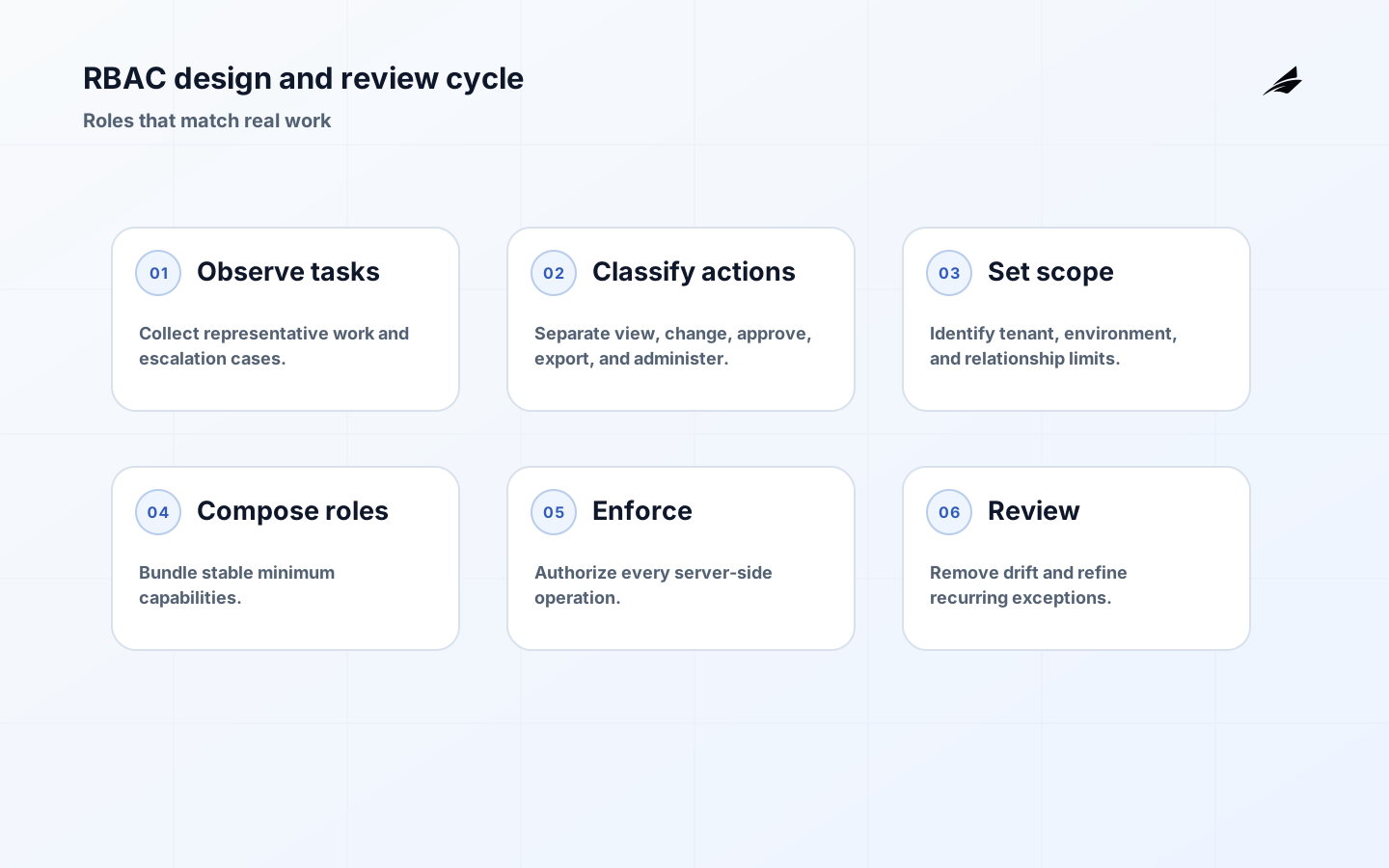
RBAC mistakes and fixes matter because role-based access control becomes the vocabulary through which an organization describes authority. A role should represent a stable responsibility and grant the minimum collection of permissions required to perform it. In practice, teams often begin with job titles, product screens, or a single all-powerful administrator role. Those shortcuts can make the first release easy while creating tangled privileges, brittle exceptions, and uncertain reviews later. Start instead with real tasks: who needs to view, create, approve, export, configure, or administer which resources, in which tenant or environment, and with what limits? That evidence is the raw material for roles that people can explain.
Spot the role design smells early
An RBAC model needs attention when users collect direct grants, a generic administrator role becomes the normal escape hatch, teams cannot state the difference between two similar roles, or routine work requires repeated elevation. Another warning sign is a role that is named after a department but contains unrelated powers accumulated over time. These conditions usually indicate that the model has not separated tasks by impact or that the product's authorization boundaries are too coarse. The answer is rarely to add one more role without investigation. Examine representative work, exceptions, denied requests, and incident findings to learn where the model no longer matches operations.
| Mistake | Why it fails | Practical fix |
|---|---|---|
| Using job titles as permissions | One title can involve different responsibilities, regions, tenants, or approval limits. | Model capabilities and scope, then map job assignments to appropriate roles. |
| One permanent superuser role | It hides high-impact access and makes reviews meaningless. | Separate administration duties; use time-bound elevation for exceptional work. |
| Client-side checks only | A user can call the underlying endpoint or alter a browser request. | Authorize every protected server operation against actor, action, and target. |
| Direct grants as normal practice | They bypass role review and preserve old access after a job change. | Use approved roles; document and expire the rare direct exception. |
Design roles from real work
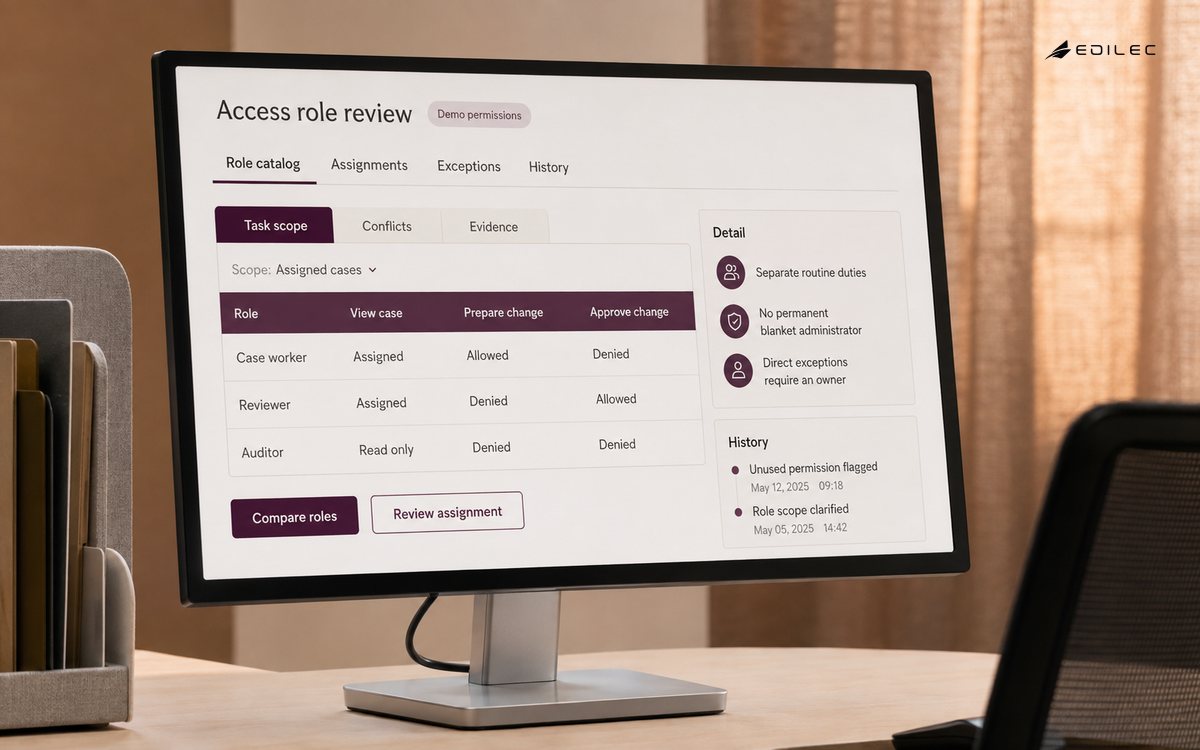
Collect a small set of representative scenarios before drawing a role matrix. Include ordinary tasks, approvals, support escalation, bulk operations, reporting, configuration, and emergencies. Break each into verbs and objects: view invoice, modify subscription, approve refund, export tenant report, manage identity, or rotate integration credential. Then distinguish scope: one tenant, assigned accounts, a region, all customers, or the production environment. Stable groups of tasks may become roles. Where duties conflict, such as requesting and approving a payout change, keep them apart. This process produces a role catalog based on work rather than organizational folklore.
- Write a one-sentence purpose for every role and list the business owner who validates it.
- Keep read, write, approval, export, and administrative capabilities distinct where their consequences differ.
- Attach scope in the authorization decision; a role alone should not silently imply every tenant or record.
- Use roles for recurring duties and separate, expiring grants for a documented exceptional need.
- Review role changes as product changes because a new permission can alter customer and operational risk.
Enforce roles at the real decision boundary
A role assignment is only useful if the running service enforces it. At each protected operation, the server should authenticate the caller, determine the required action, load the target resource and its scope, and evaluate whether the caller's role permits that action there. Do not assume a route, menu, or API gateway rule covers every internal code path. Background jobs, event handlers, data exports, and administrative scripts need the same thinking. Test altered identifiers, changed methods, missing attributes, stale sessions, and attempts to reuse a permission in another tenant. Secure admin panel design illustrates the operational side of these checks.
Handle exceptions with discipline
Exceptions are sometimes necessary during incident response, migration, or a narrowly defined project. They should have a requester, approver, reason, exact capability, target scope, start and end time, and compensating safeguard such as additional logging or independent review. Avoid converting an exception into a new broad role merely because the request is urgent. A recurring exception is useful evidence: perhaps the normal role is missing a legitimate capability, the workflow is too slow, or two teams disagree about authority. Review recurring cases and deliberately redesign the role or process rather than letting private workarounds become hidden policy.
| Review prompt | Healthy result | Action when unhealthy |
|---|---|---|
| Can an owner explain the role? | Purpose, capabilities, scope, and users are intelligible. | Retire, split, or document the role before approving more assignments. |
| Does role use match task need? | Assigned users perform work consistent with the role's purpose. | Investigate dormant privileges and repeated elevation. |
| Are sensitive duties separated? | No single routine role can both initiate and approve a material transaction. | Add workflow approval or separate permissions. |
| Can access be reconstructed? | Assignments, changes, and high-impact use have durable evidence. | Improve event coverage and permission change records. |
Keep RBAC maintainable as the product changes
RBAC design must evolve with integrations, customer tiers, new administrative functions, and organizational changes. Establish a lightweight ownership model: product or business owners define intended duties, engineering owns enforcement, and security or operations reviews high-impact changes. Monitor direct grants, role proliferation, denied requests, emergency elevation, and roles with no recent use. These are signals to inspect, not automatic proof of a problem. The design aim is a small, explainable catalog that supports real work without needing a permanent exception channel. Permission review workflows keeps that catalog tied to lifecycle decisions.
Run a practical operating exercise
For RBAC mistakes and fixes, conduct a role walkthrough with people who actually perform the work. Pick one role that has grown broad and one recurring exception. Ask a user to demonstrate a normal task, a rare but legitimate task, and an action they should never be able to complete. Translate each step into action, resource, scope, and approval requirement, then compare that result with the current permission set. Test the server endpoints directly with an altered identifier and a role missing one required capability. Document whether the problem is an overbroad role, missing scope check, unclear workflow, or an exception that should become an approved limited capability. This exercise produces a defendable role change and teaches teams to look beyond titles and menus when they evaluate authorization.
Add a short review session whenever a team member who needs a rare but sensitive operational capability changes the assumptions behind RBAC design. Bring the role owner, product team, and operations users together and start with the actual request rather than a control label. Trace the request from the authoritative record through identity, configuration, policy, implementation, and the evidence an investigator would use. Ask whether the capability should be a role, scoped workflow, or expiring exception. Then introduce one realistic failure: a delayed directory update, unavailable dependency, stale configuration, unexpected retry, or departure of the person who normally knows the workaround. The group should choose a safe response before the next urgent event forces improvisation. Capture only concrete outcomes: a missing owner, an unclear approval limit, a test that does not reach the enforcement point, a recovery step that is too broad, or an evidence record that cannot be retrieved. Assign each outcome to a person and date, and rerun the same scenario after the change lands. This practice keeps RBAC design connected to daily operations. It also reveals when a process appears complete because a document exists, while the service itself still depends on unwritten knowledge or standing privilege. Over time, retain a small decision history so new team members can understand why the boundary exists and which assumptions must be revisited as the product, vendors, and workforce change.
Key takeaways
- RBAC mistakes and fixes start with observing tasks, actions, targets, and scope before naming roles.
- Do not let broad administrators or direct grants become normal operating practice.
- Enforce role decisions on the server for every protected operation and resource.
- Use time-bounded, attributable exceptions to learn where the model needs refinement.
- Keep role ownership, review, and evidence current as the product changes.
Frequently asked questions
Conclusion
Effective RBAC is not a list of job titles. It is an explicit, tested model of recurring authority that helps people complete real work while limiting unintended reach. Fix the roles that have become vague or overbroad, enforce decisions where actions occur, and use exceptions as evidence for a better design rather than a permanent workaround.