Zero trust planning for business applications replaces broad, location-based trust with explicit decisions about each resource request. It does not mean distrusting employees or buying a single gateway. It means identifying the user or workload, evaluating the requested operation against current policy and context, enforcing the decision close to the resource, and retaining enough evidence to review what happened. The most useful plan therefore starts with business transactions and data, not a network diagram or product shortlist.
This guide is for security architects, application owners and platform teams modernizing internal or customer-facing systems. Pair it with the library's threat-modeling working guide, incident evidence collection plan and data retention design guide so access controls, evidence and lifecycle rules are designed together.
Define the protected outcome and application boundary
Start by naming the business capability that needs stronger control: approving a payment, changing a supplier account, exporting customer records or administering production. Inventory the applications, APIs, background jobs, data stores and third parties that participate in that capability. NIST SP 800-207 focuses zero trust on resources rather than network segments; for an application team, a resource may be an API operation, a record set, an administrative function or a queue consumer. A vague goal such as 'implement zero trust' cannot produce testable acceptance criteria.
Record the authoritative owner for each resource, the sensitivity of its data, allowed subjects, normal access path and recovery path. Include non-human identities, scheduled jobs, integration credentials and support tooling. Many plans cover workforce sign-in but leave service accounts and administrative scripts under long-lived shared credentials. Classify current access by consequence: read, modify, approve, export, impersonate or administer. This creates a migration order based on potential harm instead of technical convenience.
| Planning object | Decision to record | Acceptance evidence |
|---|---|---|
| Business resource | Data, operation and accountable owner | Inventory entry linked to system and owner |
| Subject | Human, device or workload identity | Identity source and lifecycle test |
| Policy | Allowed action, scope and conditions | Versioned rule with allow and deny cases |
| Enforcement point | Where the decision is applied | Request test proving bypass is blocked |
| Evidence | What is logged and retained | Correlated event with review owner |
Establish reliable identity and request context
An authorization decision is only as reliable as the identities and attributes supplied to it. Define how employees, customers, contractors, devices and workloads are enrolled, authenticated, changed and removed. Prefer individual accounts and short-lived workload credentials. Separate routine administration from emergency access, and require stronger authentication when the requested action or observed context warrants it. Device state, location, session assurance and behavior can inform policy, but they should not silently override a clear resource rule.
Treat attributes as governed data. Department, employment status, customer relationship, device compliance and risk scores all have sources, refresh intervals and failure modes. Decide what happens when an attribute is missing or stale. High-consequence actions should fail closed or route to an explicit recovery process; low-risk read access may have a documented degraded mode. Avoid policies that depend on dozens of opaque signals no operator can explain during an access failure.
Design the zero trust policy decision loop
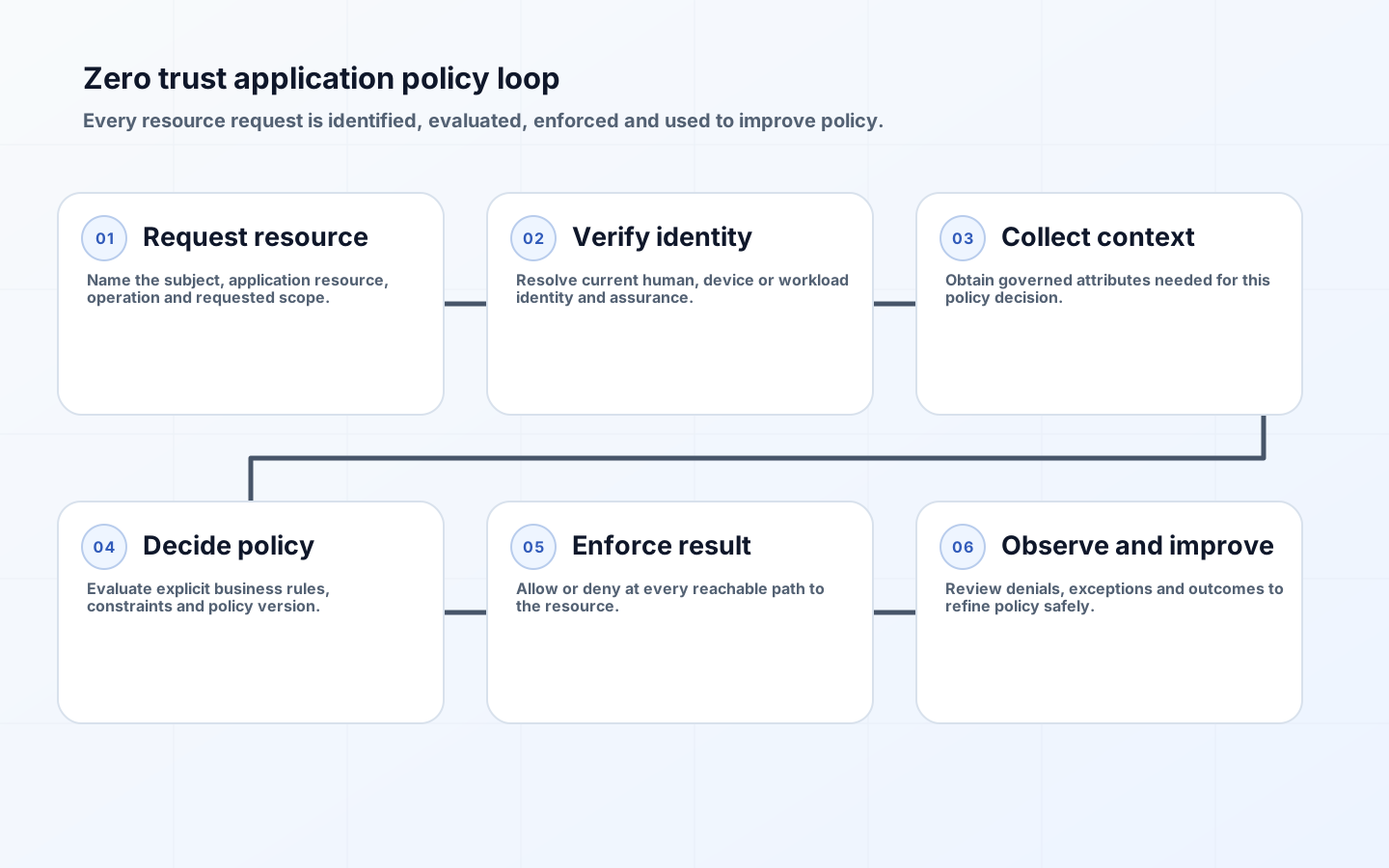
Model each protected request as a loop: identify the subject and resource, collect material context, evaluate versioned policy, enforce allow or deny, observe the result and improve the rule. NIST SP 800-207 distinguishes policy decision and enforcement functions; they may be implemented by an identity-aware proxy, API gateway, service mesh, application middleware or a combination. The architecture matters less than proving that every path to the resource reaches an enforcement point and that application-level rules still protect the business operation.

Write policies in domain language. 'Claims approvers may approve claims assigned to their region below their delegated limit' is reviewable; a pile of group names and route patterns is not. Keep coarse role assignment stable, then add resource and context conditions where they reduce real risk. Server-side enforcement is mandatory for protected actions. User-interface hiding can improve usability, but it cannot be the control. Return denials without exposing sensitive policy details, while giving support staff a correlation identifier and safe explanation.
Apply zero trust to services, APIs and integrations
Service-to-service access needs authenticated workload identity, narrowly scoped authorization and transport protection. Do not infer trust from a subnet, cluster or cloud account alone. Map callers to specific operations and data boundaries, rotate credentials without downtime, and constrain outbound calls as well as inbound traffic. NIST SP 800-207A describes identity-tier and network-tier policies for cloud-native applications; the practical lesson is that a service identity and the requested application action both matter.
Third-party integrations require an explicit contract for identity, scopes, rate limits, retries, revocation and incident notification. Use separate credentials per integration and environment. Validate signed callbacks and protect replay-sensitive operations with timestamps, nonces or idempotency controls as appropriate. When an integration cannot support the target assurance, isolate it behind a broker or compensating workflow instead of granting broad access to the application estate.
Collect decision evidence without creating a privacy problem
Log the subject, resource, operation, decision, policy version, material context category, enforcement point, time and correlation identifier. Avoid storing secrets, complete tokens or unnecessary personal content. Centralize events sufficiently to investigate a transaction across identity, gateway and application layers, and synchronize clocks. Define retention based on incident, audit and privacy needs. Access-decision telemetry should support detection and review, not become an uncontrolled behavioral archive.
Measure denied requests by reason, dormant privileges, emergency access, policy exceptions, stale identities and time to revoke access. A rising denial count may indicate attack activity, but it may also expose a broken workflow or poorly communicated policy. Review signals with application owners who understand the transaction. Alerts should identify an owner and response; dashboards without decisions simply move uncertainty to another screen.
| Signal | What it can reveal | Required follow-up |
|---|---|---|
| Orphaned identity | Account outlived its owner or system | Disable, investigate use and fix lifecycle feed |
| Repeated policy denial | Abuse, stale access or workflow mismatch | Correlate subject, resource and recent changes |
| Emergency privilege use | Exceptional operational need | Review purpose, duration and actions |
| Unenforced route | Control coverage gap | Block path and add regression test |
| Policy exception age | Temporary access becoming permanent | Renew with evidence or remove |
Roll out by resource and prove each control
Begin with one consequential workflow whose identities and owners are understood. Observe current access before enforcement, clean up identity data, write policies, test representative allow and deny cases, and introduce enforcement to a bounded cohort. Keep a documented recovery path so a policy defect does not force teams to disable the control entirely. Migrate connected services only after their workload identities and failure behavior are known.
- Inventory the resource, subjects, paths and present exceptions.
- Define target policy and the evidence needed to approve it.
- Run evaluation in observe-only mode and investigate unexpected decisions.
- Enforce for a small cohort with support and rollback ownership.
- Expand coverage while removing legacy network or shared-account trust.
- Review telemetry, exceptions and policy changes on a fixed cadence.
Acceptance should prove both security and continuity. Authorized users must complete the business transaction; unauthorized and stale identities must fail; service interruptions must not silently grant access; revocation must propagate within the defined window; and evidence must be usable in an investigation. Retire old VPN rules, shared accounts or bypass routes after cutover. Running permanent parallel trust models preserves the original weakness and makes denials difficult to diagnose.
Govern policy changes and exceptions
Treat access policy as production code. Require an owner, peer review, test cases, version history, staged release and a way to compare expected with observed decisions. High-impact changes should run in simulation or observe-only mode before enforcement. Correlate policy releases with denial and support signals so the team can distinguish attack activity from a regression. Emergency changes still need a ticket, bounded duration and retrospective review.
Maintain an exception register with resource, subject, business reason, compensating control, approver and expiry. Review whether each exception reveals a missing role, broken workflow or supplier constraint. Renew only with current evidence. Exceptions that cannot expire should become explicit policy with appropriate governance; hiding permanent access inside a temporary mechanism prevents accurate risk review.
Key takeaways
- Plan around resources and business actions, not trusted network zones.
- Govern human, device and workload identities through their full lifecycle.
- Keep policy explicit, versioned, server-enforced and explainable to operators.
- Use telemetry to review decisions while minimizing sensitive data collection.
- Migrate one bounded workflow at a time and remove the legacy trust path.
Frequently asked questions
Does zero trust eliminate VPNs?
Not automatically. A VPN can still provide transport or administrative connectivity, but network membership should not grant broad application access. Resource-level authentication and authorization remain necessary, and the team should reduce routes whose only control is being inside the tunnel.
Is role-based access control enough?
RBAC is a useful foundation when roles match stable responsibilities. Consequential workflows often also need resource scope, delegated limits, relationship, device or session assurance, and separation-of-duty checks. Add conditions only where their source and failure behavior can be governed.
Which application should be migrated first?
Choose a material but bounded workflow with a named owner, known users and observable transactions. Avoid starting with the entire enterprise identity estate or an obscure low-value system. The first migration should teach the team how to inventory paths, write policy, handle exceptions and prove enforcement.
Conclusion
Effective zero trust planning makes every important application request a deliberate, reviewable decision. Inventory the protected resource, strengthen identity, encode policy in business terms, enforce it on every path and retain proportionate evidence. A phased rollout that removes old bypasses creates measurable risk reduction; a product purchase without resource ownership and operating discipline does not.