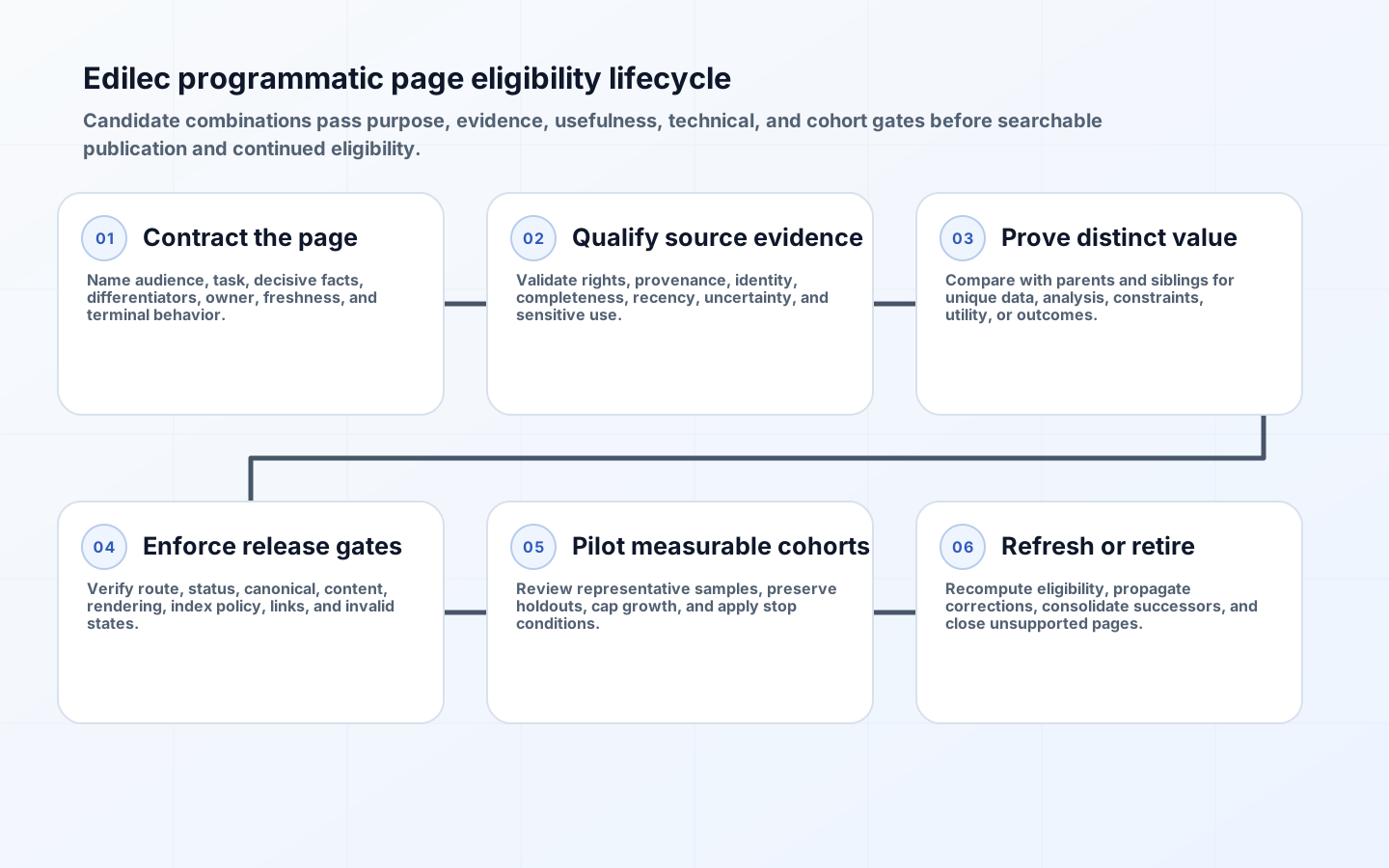
Programmatic SEO quality control decides whether a data-and-template combination deserves to become a public searchable page. Automation can produce useful inventory pages, directories, comparisons, integrations, statistics, or location resources when each page answers a real need with trustworthy, distinct information. The same machinery can create millions of near-duplicates, empty combinations, unstable claims, and orphaned URLs faster than teams can review or retire them.
Google's spam policies define scaled content abuse by purpose: many pages generated primarily to manipulate rankings rather than help users, regardless of whether automation, generative systems, or people created them. Therefore the control is not “AI versus human” or a minimum word count. Build a publishing pipeline that verifies user purpose, source rights and quality, page-level distinct value, technical correctness, ownership, and lifecycle before index eligibility. Scale only after sampled evidence supports the cohort.
Define a page contract for each template and combination
Write the intended audience, task, decision, source entities, required facts, differentiating dimensions, update cadence, owner, and retirement condition. A useful compatibility page might answer whether a specific accessory works with a specific device, show authoritative constraints, explain installation implications, and link to supported products. A page that merely swaps two names into generic prose has no distinct information contract.

Separate candidate generation from publication. The Cartesian product of cities, products, features, industries, and questions is not an inventory. A candidate must pass eligibility rules before receiving a public canonical URL, internal links, or sitemap entry. Keep rejected combinations in internal data with reason codes so teams can improve sources without exposing placeholders. New templates default to no public expansion until gates, capacity, and review plans are approved.
| Field | Question | Acceptable evidence | Reject example |
|---|---|---|---|
| User purpose | What task is completed on this page? | Research, support demand, customer interviews, onsite behavior | A keyword variation with no distinct task |
| Source authority | Who owns each factual claim and update? | Licensed database, first-party operations, documented calculation | Scraped or untraceable values |
| Distinct value | What changes beyond labels? | Unique data, analysis, constraints, availability, examples, or tools | Boilerplate with substituted place name |
| Completeness | What must be present for a satisfying answer? | Required-field and relationship rules by entity class | Page publishes despite missing decisive fields |
| Freshness | When does the answer become stale? | Source event, validity interval, last verified time | No owner or update path for changing claims |
| Lifecycle | When is the URL updated, consolidated, or retired? | State machine with successor and terminal behavior | Permanent 200 page after underlying entity disappears |
Qualify source data, rights, provenance, and freshness
Every displayed fact should map to a source, transformation, owner, observed time, and permission. Validate types, units, ranges, identifiers, relationships, geography, effective dates, and conflict precedence. Data completeness must be semantic: a restaurant page with name and address may still fail if current opening status is the decision-critical fact. Preserve unknown as unknown rather than filling it with generated certainty. Quarantine anomalous records before page creation.
Establish rights to publish and combine the data. Attribution does not cure prohibited reuse, and public availability does not automatically confer a license. Sensitive personal data, inferred traits, safety claims, financial or medical information, and user-generated material need heightened review. Store provenance and page-build snapshot so a correction can identify every affected URL. Define removal and correction service levels with source providers and internal owners.
Gate distinct usefulness rather than superficial uniqueness
Text similarity can find duplicates, but different wording does not create value. Score candidates on task-specific evidence: inventory depth, number and importance of known facts, differentiating relationships, original calculation, local or variant specificity, decision support, source freshness, and clear next actions. Compare the candidate with its parent, siblings, and canonical alternatives. If the same answer works after swapping labels, consolidate into a stronger browsable page.
Use template-specific minimums and hard failures. A comparison needs genuinely comparable entities and normalized attributes; a location page needs an actual service presence or useful local facts; an integration page needs supported capability and version context; a statistics page needs sample, method, period, and uncertainty. Human review should examine representative and adversarial samples, not polish every generated sentence while ignoring an invalid page premise.
Enforce technical and discovery gates before index eligibility
Validate route grammar, canonical identity, status, robots, title, primary heading, visible content, structured data, language, links, performance, and mobile rendering. Invalid or empty combinations return 404 rather than a 200 template shell. Candidates that are useful to logged-in users but not ready for search can remain behind authentication or use an accessible noindex state; remember that crawlers must be allowed to fetch a page to see noindex. Robots blocking is not a de-indexing substitute.
Only passing pages enter XML sitemaps and internal navigation. Build deliberate discovery hubs and related links based on user meaning, not dense cross-link matrices designed to manufacture signals. Cap expansion per cohort and estimate crawler and server cost. Render search-critical content reliably, avoid parameter aliases, and keep pagination finite. A template release must include tests for missing data, duplicates, stale entities, unsupported combinations, and deletion.
| Gate | Pass outcome | Recoverable failure | Hard failure |
|---|---|---|---|
| Purpose and demand | Distinct user task and intended audience | Hold candidate for more evidence | Combination exists only to capture query variants |
| Data | Required facts are valid, sourced, fresh, and licensed | Quarantine until source repair | Fabricated, prohibited, or materially misleading claim |
| Value | Page adds entity-specific evidence or functionality | Consolidate with parent or sibling | Boilerplate substitution or scraped restatement |
| Technical | Stable 200 canonical page with correct index signals | Noindex preview for internal QA | Soft 404, canonical conflict, hidden or crawler-only text |
| Discovery | Meaningful links and sitemap cohort | Publish for users without index eligibility | Orphan expansion or manipulative link pattern |
| Lifecycle | Owner, freshness event, review date, and terminal rule | Time-bound pilot | No correction, update, or retirement path |
Review samples and release in measurable cohorts
Construct a sampling plan across high and low source completeness, rare entities, languages, regions, boundary scores, sensitive claims, and each template branch. Include intentionally invalid records. Reviewers answer a rubric: does the page satisfy its stated task, are decisive facts supported, is uncertainty visible, is it materially distinct, and would a direct visitor find it useful? Record decisions and inter-reviewer disagreement; refine the contract rather than hiding failures with prose edits.
Launch a bounded cohort and preserve a holdout. Monitor crawl demand, index eligibility, canonical selection, impressions, qualified landings, task completion, corrections, complaints, empty-result rate, source freshness, server work, and similarity clusters. Traffic alone is not acceptance: misleading pages can attract clicks. Define stop conditions such as material factual error, unexpected URL growth, quality-review failure, source drift, or disproportionate crawl consumption before scaling.
Operate refresh, consolidation, correction, and retirement
Recompute eligibility when source data, product state, demand, legal scope, or template logic changes. Give each page a last verified time and a next review or event-driven update. Detect pages that lose required facts, inventory, distinctness, or ownership. Temporary loss may trigger noindex or a useful unavailable state according to policy; permanent loss should consolidate to a genuine successor or return 404 or 410. Remove retired URLs from links and sitemaps.
Corrections must propagate from source to every generated page and derived artifact. Maintain a page-impact index keyed by source entity and field. During incidents, stop new publication, identify affected cohorts, withdraw materially harmful claims, rebuild, and verify public output. Periodically challenge successful cohorts against new sibling duplication and user outcomes. A programmatic library is never “finished”; without retirement, even good pages become stale search debt.
Treat generative components as untrusted transformations inside the same pipeline. Constrain them to approved source context, require citations or field lineage in build metadata, and evaluate factual consistency, omission, unsupported certainty, prohibited language, and cross-page repetition on held-out records. A fluent paragraph cannot override a failed data or purpose gate. Version prompts, models, retrieval sources, and post-processing, then shadow-test changes against the current output. Escalate high-consequence topics to qualified review and disable generation when source evidence is insufficient.
Key takeaways
- Define the user task, decisive evidence, source rights, owner, freshness, and retirement rule before generating URLs.
- Keep candidate combinations private until data, usefulness, technical, discovery, and lifecycle gates pass.
- Measure distinct value against parents and siblings; rewritten boilerplate is not useful differentiation.
- Release bounded cohorts with representative review, holdouts, stop conditions, and server-cost monitoring.
- Recompute eligibility and retire pages when source facts, usefulness, or ownership no longer support them.
Frequently asked questions
Is programmatic SEO against search policies?
Automation itself is not the defining issue. Google's scaled content abuse policy focuses on generating many pages primarily to manipulate rankings rather than help users. Useful, original, well-governed pages can be automated.
Does a minimum word count prevent thin pages?
No. A concise tool or data page can be highly useful, while long templated prose can add nothing. Gate the evidence and task outcome, then provide the amount of explanation users need.
Conclusion
Programmatic publishing deserves the same product discipline as any scaled system. Qualify the page premise and data, prove distinct usefulness, enforce technical and lifecycle gates, release in cohorts, and withdraw pages that no longer earn their place. Automation then expands genuinely useful coverage instead of manufacturing a backlog of fragile URLs.