Note: The linked tool example uses synthetic fixtures; no customer use or indexing outcome is claimed.
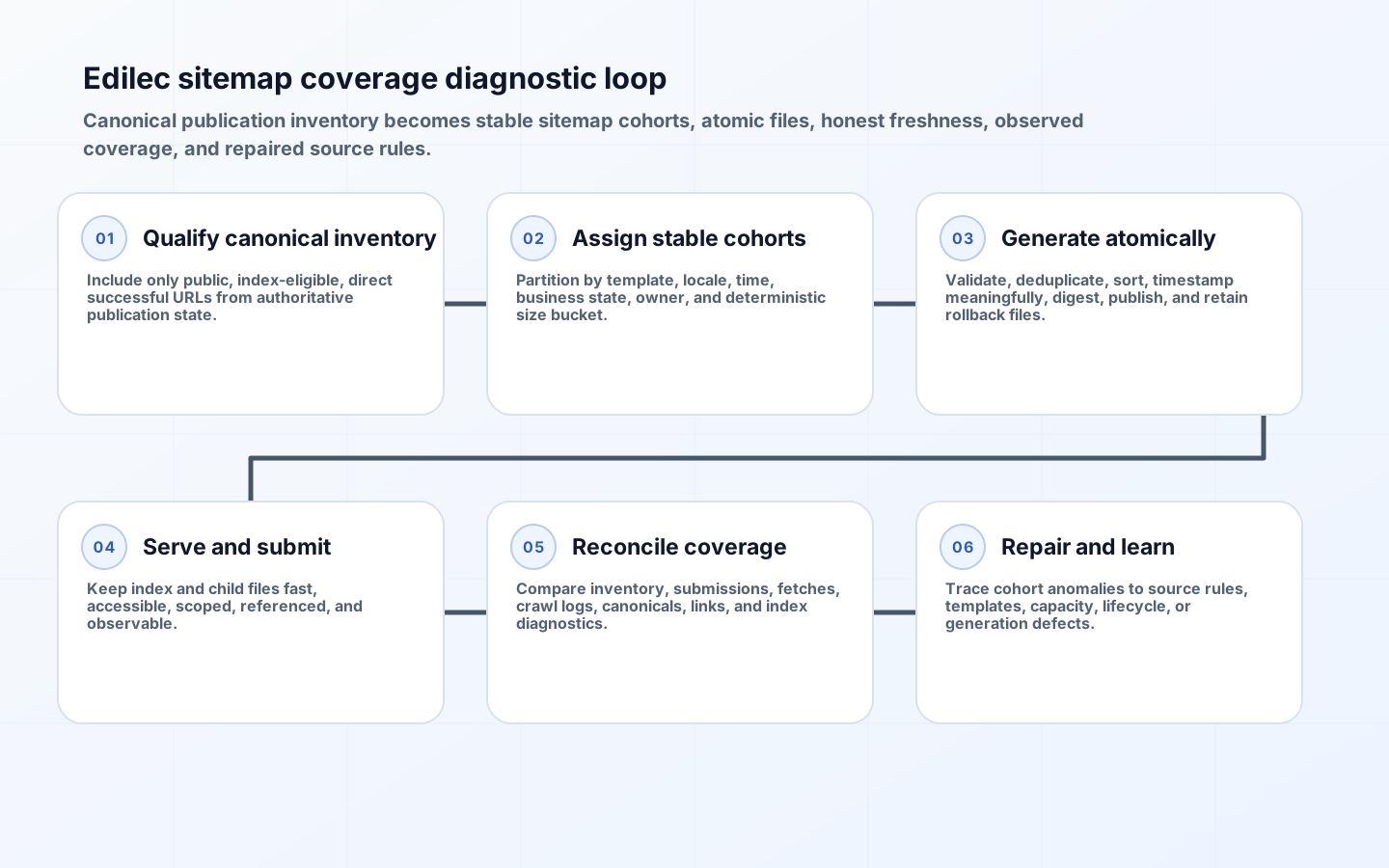
A sitemap partitioning strategy for a large site should do more than stay below file-size limits. A sitemap is a declared inventory of canonical URLs the publisher wants crawlers to discover. When files are divided into stable, meaningful cohorts, submission and indexing differences become diagnostic: teams can see that newly listed products, archived articles, one locale, or one rendering template behaves differently from the rest. Randomly filling files to 50,000 URLs hides that signal.
Google supports sitemap index files and documents a limit of 50,000 URLs or 50 MB uncompressed per sitemap. Those are ceilings, not target batch sizes. Partition well below operational limits when that improves generation, failure isolation, and analysis. Include only canonical, index-eligible URLs with successful expected responses. Sitemaps help discovery and provide a submission signal; they do not guarantee crawling, indexing, or ranking and should not contradict robots, canonical, or lifecycle policy.
Define the sitemap inventory contract
Write eligibility as executable rules. A URL enters the sitemap when its entity is published, public, canonical, index-eligible, available in the relevant market or language, and expected to return a direct 200 response. Exclude search results, tracking parameters, alternate sort states, session URLs, noindex pages, blocked destinations, redirects, errors, and duplicates. Temporary out-of-stock product policy should match page lifecycle rather than a blanket feed rule.
Assign one canonical URL function shared with routing, internal links, hreflang, structured data, and redirects. Give every eligible entity a stable sitemap cohort key and a last meaningful modification time. Maintain evidence for inclusion and exclusion so an operator can explain why a URL is absent. Generation should read from an authoritative publication view, not crawl the website and reproduce whatever accidental URLs it finds.
Choose stable partition dimensions that answer operational questions
Partition first by route or content type because templates, update cadence, and lifecycle differ. Then consider locale, market, publication state, inventory class, or time cohort when those dimensions have distinct owners or failure modes. A news publisher might use publication month for immutable archives and a rolling recent-news file; a marketplace might separate active products by market and seller-quality class. Keep frequently changing URLs away from large static cohorts to reduce regeneration and noisy last-modified data.

A good partition is stable enough for trend comparison. Do not reshuffle all URLs when one file reaches a threshold. Use deterministic buckets based on entity ID range, date, locale, or a stable hash inside a named business cohort. Record partition version when taxonomy changes. For Google, a sitemap index must point directly to sitemap files; it must not contain other sitemap indexes. Search Console reports nested indexes as an incorrect format. An audit tool's ability to traverse nested input does not make that structure valid for Google submission. See the Search Console sitemap error guidance. Keep navigation and ownership understandable, and avoid schemes that an operator cannot map to a product system.
| Dimension | Diagnostic value | Best fit | Risk to manage |
|---|---|---|---|
| Template or route type | Reveals rendering, canonical, and lifecycle defects | Products, categories, articles, profiles | Mixed business states may need a second dimension |
| Locale or market | Exposes translation, availability, and regional routing gaps | International sites | Too many small files and cross-market duplication |
| Publication time | Shows discovery speed for new versus archival content | News, editorial, listings | Moved or republished entities need stable identity rules |
| Business state | Compares active, evergreen, discontinued, or seasonal inventory | Commerce and directories | State changes can cause excessive file churn |
| Stable ID or hash bucket | Bounds file size predictably | Very large uniform cohorts | Low semantic meaning unless nested under a useful cohort |
| Priority owner | Supports incident routing and service accountability | Distributed platforms | Organization changes can destabilize history |
Generate valid files atomically and serve them reliably
Build each file from a versioned inventory snapshot. Normalize and XML-escape URLs, use absolute URLs, enforce host scope, deduplicate, sort deterministically, and calculate counts and a content digest. Write to a versioned object, validate schema and live URL samples, then atomically update the public pointer or index. Never expose a partially written XML document. Preserve the prior generation for rollback and compare additions, removals, and cohort moves before promotion.
Serve sitemap files quickly with correct content type, compression, caching, and availability. A sitemap may be hosted outside a URL path's directory when submitted appropriately, but understand host and scope rules. Keep robots.txt references and Search Console submissions synchronized with current index locations. Redirecting a sitemap URL during a migration may work, yet updating submissions and references to direct final locations simplifies operations. Monitor both index and child-file fetches.
Use lastmod as a truthful change signal
Set lastmod to the time of the last significant page change, not the time the sitemap was regenerated. Significant changes may include primary content, price, availability, event status, or other user-visible facts according to route policy. A footer build number, analytics tag, or unrelated template deployment should not update every URL. If trustworthy modification time is unavailable, omit the field rather than manufacture freshness.
Define field-level events that advance lastmod and test them. Store the resulting value in the canonical publication projection so it remains consistent across generations. Compare lastmod with observed page-change fingerprints and crawler revisit patterns to find stale pipelines. Do not assume a search engine will obey the timestamp; treat honest lastmod as one useful scheduling signal whose value depends on historical accuracy.
Build a partition-level coverage funnel
For each stable child file, retain generated URL count, valid count, publication snapshot, generation time, fetch status, submitted count, discovered or crawled observations, index status samples, organic landing pages, and exclusions by reason. Search Console reports may be sampled, delayed, or grouped, so label data limitations. The objective is comparative diagnosis: a sudden gap isolated to one cohort gives engineering a narrower place to investigate.
Reconcile the declared inventory against live site behavior. Sample direct status, canonical, robots, rendered content, internal inlinks, language alternatives, and structured data. Join logs to see whether crawlers fetch the child file and listed URLs. A high submitted count with little discovery can indicate fetch failure or isolation; crawling without indexing may indicate duplication, quality, canonical, or response issues; indexed URLs absent from the inventory may reveal legacy or generated crawl space.
| Observed pattern | Likely questions | Evidence to inspect | Corrective action |
|---|---|---|---|
| Child sitemap not fetched | Can crawler reach index and child URL? | Status, robots, DNS, cache, index references, submission result | Restore direct reliable access and resubmit if needed |
| Submitted but rarely crawled | Are URLs discoverable, valuable, and fresh? | Internal links, server capacity, duplicate patterns, lastmod history | Improve architecture and remove low-value inventory |
| Crawled but canonical elsewhere | Are URL functions or page templates conflicting? | Rendered canonical, redirects, links, hreflang, parameters | Align all canonical signals and regenerate |
| One template lags indexing | Does the template expose meaningful content and valid status? | Raw and rendered HTML, soft errors, duplication, quality | Fix template contract before increasing submissions |
| Old URLs remain active | Was migration or retirement incomplete? | Redirect map, links, sitemap generations, bot logs | Update references and serve correct terminal behavior |
| Counts oscillate sharply | Is publication state unstable or generation inconsistent? | Source events, eligibility rules, bucket movement, job retries | Stabilize state machine and make generation idempotent |
Operate submission, monitoring, and incident response
Submit top-level indexes through Search Console and use its API where automation adds value. Record API response and current submission state without repeatedly pinging unchanged files. Alert on generation failure, invalid XML, count deltas outside expected ranges, duplicate URLs across incompatible cohorts, fetch errors, stale generations, child files near limits, and live-policy conflicts. Route each alert to the owner encoded in cohort metadata.
During incidents, freeze the last known-good sitemap rather than publishing empty or partial files. A sitemap outage does not remove existing pages from the index, so avoid destructive panic. Repair the source inventory, regenerate, validate, and compare diffs. After platform migrations, run old-to-new URL reconciliation and retain old-host visibility long enough to observe crawler transition. Review partition design quarterly and when templates, markets, taxonomies, or publication systems change.
Keep an inventory reconciliation ledger for every generation. Record entities eligible at source, URLs emitted, validation exclusions, duplicates removed, cohort moves, and unexpected disappearances. Compare those counts with the previous successful build before publication. A stable total can still hide equal additions and removals, so inspect set differences and reason codes. This ledger distinguishes a legitimate catalog retirement from a broken database join and gives incident responders a bounded list of affected URLs without parsing XML under pressure.
Teams that want to make those set differences part of a repeatable release review can inspect the Sitemap Cohort Auditor worked example and run its public MIT-licensed Node.js CLI. The checked-in synthetic example.com before-and-after fixture reports additions, removals, image declarations and policy findings. The tool audits sitemap declarations; it does not fetch every listed page or predict crawling, indexing, traffic or rankings.
Key takeaways
- Include only canonical, public, index-eligible URLs expected to return direct successful responses.
- Partition by stable operational cohorts before using deterministic size buckets.
- Generate and publish files atomically from versioned inventory snapshots with rollback evidence.
- Advance lastmod only for meaningful page changes and omit it when freshness cannot be trusted.
- Use partition trends to diagnose discovery and coverage; a sitemap submission is not an indexing guarantee.
Frequently asked questions
Should every sitemap contain 50,000 URLs?
No. That is a protocol limit, not a target. Smaller stable files can improve fault isolation, regeneration, and cohort diagnostics, provided the index remains manageable.
Does listing a URL guarantee indexing?
No. A sitemap supports discovery and communicates preferred inventory. Crawlers still evaluate accessibility, canonicalization, content, duplication, and other signals.
Conclusion
Large-site sitemaps become valuable when they mirror a governed publication inventory and preserve stable diagnostic cohorts. Honest eligibility, deterministic generation, meaningful partitioning, and live reconciliation turn sitemap indexes from oversized URL lists into an observable interface between product systems and search discovery.