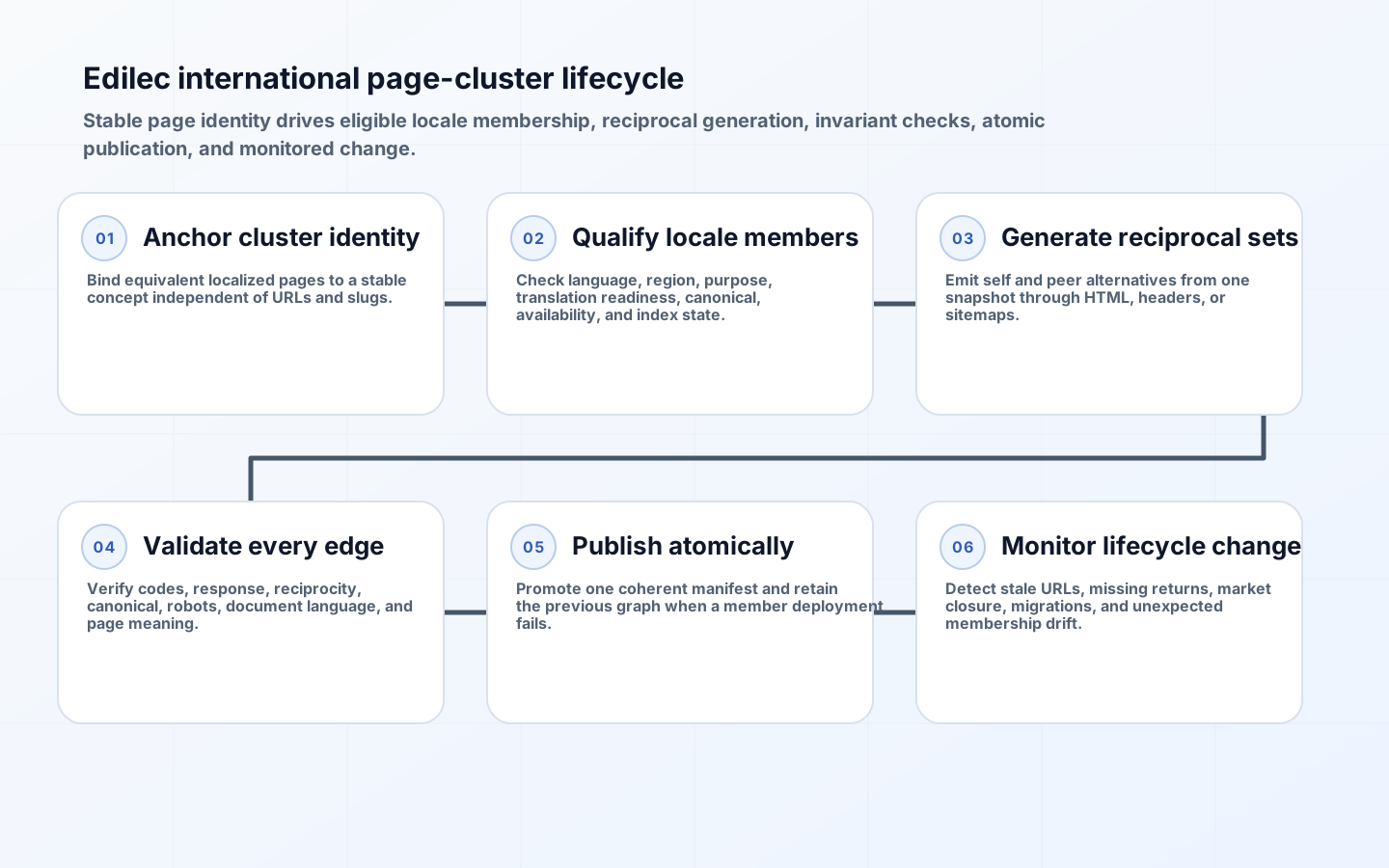
Hreflang at scale is a graph-consistency problem. Every localized URL declares the other eligible versions of the same page, and those declarations must remain reciprocal as products launch, translations lag, markets close, canonicals change, and URLs migrate. Hand-authored tags may work for a small brochure site; a large international platform needs a canonical page-cluster registry, deterministic generation, validation in delivery pipelines, and monitoring against live responses.
Hreflang helps Google understand language or language-and-region alternatives. It does not translate content, guarantee selection, replace canonicalization, or force a ranking outcome. The implementation must first provide distinct crawlable URLs with useful localized content. Then annotations should connect pages that are genuine alternatives. Avoid treating every URL sharing a template as equivalent when assortment, legal eligibility, product identity, or page purpose differs across markets.
Establish locale cluster identity and eligibility
Assign a stable cluster ID to the underlying page concept, independent of any locale URL. A registry row should include route type, business entity, locale, language, optional region, canonical URL, publication state, translation state, index eligibility, equivalent-content status, market availability, and effective dates. The cluster ID survives slug changes. Locale membership changes only through an explicit lifecycle event rather than by guessing from paths.

Define equivalence by user purpose. A French product page and its German translation normally belong together when they describe the same sellable product. A country page with a different model, regulatory offer, or service scope may need a different cluster despite similar text. A language selector, globally routed home page, or unmatched selector page can be an x-default target when it is the appropriate fallback. Do not use x-default as a substitute for a missing language version.
| Page state | Cluster membership | Hreflang action | Canonical posture |
|---|---|---|---|
| Published equivalent translation | Eligible | Include self and every other eligible alternate | Self-canonical in its locale |
| Translation in review | Not yet public or indexable | Exclude until content and response are ready | No public canonical claim |
| Source-language fallback shown at locale URL | Conditional and usually temporary | Exclude if it is not meaningfully localized; avoid duplicate locale shells | Consolidate or noindex according to product policy |
| Market-specific offer for same core product | Eligible only if purpose remains equivalent | Use language-region code and include appropriate alternatives | Self-canonical market URL |
| Different product or legal service | Separate cluster | Do not connect merely because template or slug matches | Canonical within its own identity |
| Global selector or unmatched default | Fallback node | May use x-default in each eligible cluster | Self-canonical if it is a valid standalone page |
Model language, region, and document language correctly
Use supported language codes and add a region only when the page is specifically targeted. A language-only alternate such as English can serve broad English users; English for Canada and English for the United Kingdom can coexist when offers differ. A country code by itself is not a language. Normalize casing for consistency, validate codes against an approved registry, and reject invented market abbreviations. Script subtags may be useful in supported cases where writing system matters.
The HTML lang attribute and hreflang solve related but different problems. W3C guidance recommends declaring the language of text processing on the html element, supporting accessibility, typography, and language-sensitive behavior. Hreflang identifies localized URL alternatives for search. Keep both accurate. A page targeted to French-speaking Canada might declare an appropriate document language while also participating in fr-CA alternatives; do not infer one field blindly from a commerce market code.
Generate complete reciprocal annotations from one registry
Choose one delivery method per operational context: HTML link elements, HTTP Link headers for non-HTML resources, or XML sitemap annotations. Google treats the methods as equivalent, and using all three adds synchronization burden without an inherent benefit. Large sites often favor sitemaps because page templates stay smaller and cluster output can be generated centrally; HTML may be simpler when route rendering already has authoritative locale membership.
For a cluster of N eligible URLs, every member should list all N members, including itself. The generator sorts locales deterministically, emits fully qualified URLs, and applies the same eligibility snapshot to every member. In a sitemap, each URL entry includes identical alternate children for the cluster. Partition output to stay inside sitemap limits and preserve stable diagnostics. Never generate reciprocal tags from each locale's independently lagging database; that creates asymmetric graphs during deployment.
Validate syntax, reciprocity, canonical, and response invariants
Validation should begin before publication. Check that each cluster has unique locale codes, one URL per locale, valid absolute HTTPS URLs, no fragments, approved hosts, and no duplicate serialized targets. Fetch every alternate and verify successful response, index eligibility, intended canonical, document language, cluster ID, and content identity. Confirm that a destination returns an equivalent page rather than a redirect to a selector, consent wall, unavailable market, or generic home page.
Reciprocity means every eligible member points back. Self-reference means each page names itself. Canonical coherence means a localized URL does not declare alternatives while canonicalizing to another language, except under a deliberate and well-tested consolidation policy. A redirecting hreflang target should be updated to the final URL. Treat conflicting canonical, noindex, robots block, 404, redirect chain, or authentication requirement as a failed cluster edge.
| Gate | Check | Failure example | Release response |
|---|---|---|---|
| Registry | Unique locale, stable cluster ID, approved equivalence | Two en-GB URLs in one cluster | Reject data change |
| Syntax | Supported code and absolute URL | Country-only code or relative target | Fail generation |
| Reciprocity | Every member includes self and all peers | German page omits return link to French | Hold cluster publication |
| Transport | Final target returns expected success response | Alternate redirects through locale chooser | Publish final destination instead |
| Index policy | Target is crawlable and index-eligible | Alternate is noindex or blocked | Exclude or correct target state |
| Canonical | Target canonical agrees with locale URL | Canadian URL canonicalizes to US page | Resolve identity policy before release |
| Meaning | Pages remain genuine alternatives | Same slug now represents a different product | Split cluster and regenerate |
Handle partial translation, launch, migration, and retirement
Do not predeclare a locale that returns a placeholder, automatic redirect, thin source-language copy, or 404. Publish the new member when localized content, canonical, response, links, and quality checks pass, then regenerate the complete cluster atomically. During a staged launch, the existing members continue to list only currently eligible peers. Users can still access a language selector without claiming a nonexistent equivalent.
For URL migrations, update canonical URLs, internal links, redirects, and hreflang from the same mapping. Avoid clusters that mix old and new URLs longer than necessary. When a market closes, determine whether an equivalent successor exists. Redirect only when intent is preserved; otherwise remove the member, regenerate peers, and return an appropriate absent status. Keep historical cluster records so analysts can distinguish expected removals from production defects.
Monitor live clusters and search outcomes
Run scheduled sampling and full registry audits. Join registry state with sitemap output, live headers and HTML, response codes, canonical targets, robots directives, translation status, and internal links. Track eligible clusters, valid edges, missing return links, redirects, noindex targets, cross-language canonicals, stale URLs, and clusters whose membership changed unexpectedly. Prioritize by traffic, revenue, legal importance, and number of affected peers.
Search outcomes are diagnostic rather than direct control. Review international landing-page mismatches, wrong-region impressions, abrupt locale coverage changes, and crawling patterns alongside implementation evidence. Some selection differences are expected because search engines consider user context and may choose another version. Investigate systematic patterns, not individual examples alone. Give localization, SEO, and platform teams shared ownership and a common cluster identifier in incident records.
Make publication transactional at the cluster level. Generate a candidate manifest, fetch and validate all members, compare it with the current manifest, and publish annotations only after required checks pass. If one locale deployment fails, retain the previous coherent set or exclude the new member everywhere; do not leave half the cluster on a new graph. Record the manifest digest in page or sitemap build metadata so an operator can connect a live defect to its exact registry snapshot and redeploy the last known-good graph without reverting unrelated translated content.
Key takeaways
- Represent localized alternatives as versioned clusters with stable identity and explicit membership.
- Connect only pages that satisfy the same user purpose; similar templates do not establish equivalence.
- Generate complete self-referential and reciprocal annotations from one authoritative snapshot.
- Validate response, index policy, canonical, document language, and content identity, not syntax alone.
- Regenerate clusters atomically through translation launches, migrations, market closure, and retirement.
Frequently asked questions
Should localized pages canonicalize to the main language?
Normally, genuine localized alternatives are self-canonical and connected with hreflang. Canonicalizing them to one language can conflict with the claim that each URL is a distinct eligible version.
Must every global page have every locale?
No. A cluster may contain only the eligible versions that actually exist. Each included member should list the same current set, including itself; missing translations should not be represented by placeholders.
Conclusion
International annotations remain reliable when they are generated from product data rather than edited as page decoration. Define equivalent page clusters, publish only ready members, enforce complete graph invariants, and monitor live delivery. That turns hreflang at scale into a tractable data-quality system even while markets and URLs continuously change.