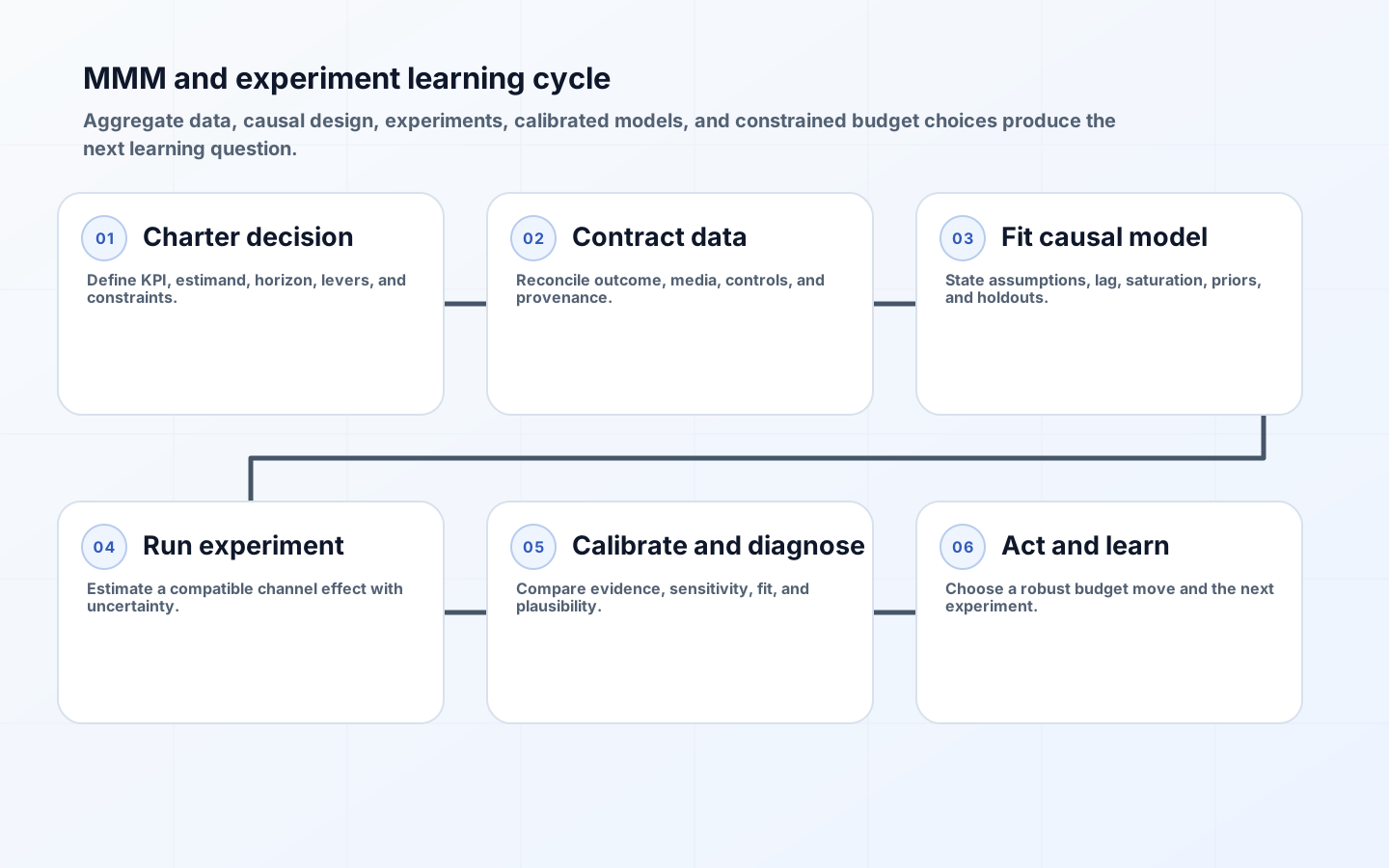
Marketing mix modeling with experiments creates a measurement system rather than a replacement attribution report. MMM uses aggregate variation over time and, where available, geography to estimate channel contribution, lag, saturation, and return. Incrementality experiments create stronger causal evidence for a bounded intervention. Combining them lets experiments inform model assumptions and lets the model identify where another experiment would most improve a budget decision.
The approach is privacy-durable because it can operate on aggregated media, outcome, and contextual data instead of requiring a complete user-level path. It is not assumption-free. Media allocation responds to expected demand, channels move together, measurement definitions drift, and experiments may cover only selected markets or periods. Governance must therefore preserve data definitions, uncertainty, diagnostics, and the limits of every recommendation.
Define the decisions and estimands
Start with budget decisions: which channels can change, over what horizon, within which contractual, inventory, brand, or regional constraints? Define the outcome, such as incremental revenue, qualified demand, subscriptions, or contribution margin. State whether the desired estimand is channel contribution at historical spend, return on investment, marginal return near current spend, or expected outcome under a future allocation. Those quantities are related but not interchangeable.
Set decision cadence and materiality. A quarterly allocation process may not need daily refresh, while a volatile market may need scenario updates between full refits. Name accountable marketing, finance, data science, and channel owners. Agree how uncertainty affects action: a narrow no-regret reallocation, a learning budget, or no change. A model should not recommend spend in a channel that operations cannot actually scale.
Build an aggregate data contract
| Data family | Required contract | Key risk | Control |
|---|---|---|---|
| Outcome | Definition, timing, geography, adjustments | Revenue restatement or channel leakage | Finance reconciliation and version |
| Media | Spend, exposure, reach or frequency by channel | Inconsistent taxonomy and fees | Source mapping and completeness checks |
| Controls | Demand, price, distribution, holidays, promotions | Controlling for a mediator or omitting a confounder | Causal review and provenance |
| Experiments | Treatment, estimand, period, markets, estimate, error | Mismatch with modeled channel effect | Calibration eligibility review |
| Constraints | Minimums, maximums, commitments, inventory | Infeasible optimization | Finance and channel sign-off |
Use one time grain and a stable geographic mapping where possible. Retain raw source values, normalized values, exchange rates, tax treatment, agency fees, and adjustment versions. Separate spend from impressions and reach because they answer different questions. Flag missing weeks, platform restatements, tracking changes, acquisitions, stockouts, and unusual promotions. Backfilling a smooth zero can create false variation and should be visible to the modeler.
Write the causal design before fitting
Diagram plausible causes of both media and outcome. Seasonality, product demand, pricing, distribution, competitor activity, and promotions can confound channel effects. A control should precede or influence both treatment and outcome; variables caused by media can absorb the effect being estimated. Paid search is especially sensitive to underlying demand. Meridian documentation, for example, supports query-volume controls to account for organic interest.
Choose national or geographic models based on variation and data quality, not preference. Geographic data can provide more information but introduces market heterogeneity and local measurement errors. Model lagged carryover and diminishing response using defensible ranges. Set priors transparently and run alternatives. A flexible fit that matches history can still give implausible channel decomposition if channels are highly correlated.
Run experiments for decisions and identification
Prioritize experiments where the model is uncertain, spend is material and adjustable, and a feasible treatment can generate detectable variation. Geo experiments, conversion lift tests, and randomized holdouts answer different questions. Pre-register outcome, population, treatment, exclusion, analysis, duration, and stopping rules. Check contamination, concurrent campaigns, spillover, and whether treatment changed spend, exposure, or both.
An experiment estimate must align with the model quantity before calibration. Match channel definition, KPI, geography, time window, spend range, and increment. A short promotion-period lift may not represent annual average ROI. Keep estimate uncertainty, not only the point result, and retain experiments that contradict expectations. Failed or inconclusive experiments still improve the design if their implementation and power limits are documented.
Calibrate with compatible evidence
Experiments can inform priors or calibration targets, but they should not be treated as flawless labels. Evaluate internal validity, external validity, and overlap with the modeled period. Meridian supports custom ROI priors using past experiments and an ROI calibration period, while its documentation cautions that a period-specific calibration does not necessarily improve overall ROI estimation. Preserve the uncalibrated fit for comparison and record every calibration choice.
| Evidence relationship | Action | Interpretation | Next step |
|---|---|---|---|
| Model and experiment agree | Narrow decision range cautiously | Triangulated evidence | Test another spend range |
| Experiment higher than model | Check calibration and context | Model may absorb effect or experiment may be local | Review controls and external validity |
| Experiment lower than model | Limit aggressive allocation | Confounding or saturation may remain | Run holdout or alternative market test |
| Both uncertain | Reserve learning budget | Decision evidence is weak | Improve variation and data |
| Several experiments conflict | Model heterogeneity explicitly | Effects vary by period, market, or execution | Segment causes before pooling |
Diagnose fit, inference, and business plausibility
Check sampling convergence, posterior behavior, residual patterns, holdout prediction, sensitivity to priors, control selection, lag assumptions, and channel grouping. Meridian recommends training and test splits as an optional guard against overfitting. Predictive fit is necessary but not proof of causal correctness. Examine whether baseline, channel contributions, response curves, and carryover make sense to channel and finance experts without forcing the model to match their beliefs.
Run placebo and stability tests where feasible. Shift media timing, exclude unusual periods, change geographic aggregation, and compare model specifications. Report credible or uncertainty intervals for contribution, ROI, marginal ROI, and scenarios. Do not rank channels by point estimate alone when intervals overlap. A model with wide uncertainty can still guide a small robust decision; it should not justify a precise forecast or a dramatic reallocation.
Turn response curves into constrained scenarios
Optimization uses estimated response curves, so it inherits their assumptions and uncertainty. Define fixed-budget, increased-budget, reduced-budget, and channel-constraint scenarios. Include contractual minimums, inventory, audience saturation, creative capacity, brand requirements, and ramp limits. Meridian's scenario-planning documentation distinguishes historical optimization from future budget planning and notes that future conditions require assumptions. Label optimized output as a scenario, not a guaranteed result.
Compare the proposed plan with current allocation, a simple benchmark, and robust alternatives across posterior draws or sensitivity cases. Prefer changes that perform acceptably under several plausible models. Reserve budget for exploration in channels with decision-relevant uncertainty. Finance should validate margin and cash assumptions, while channel owners validate executable spend ranges. Record the approved allocation and the reasons for deviating from the mathematical optimum.
Operate a recurring learning cycle
Publish a model card with data window, KPI, channel mapping, controls, priors, experiments, diagnostics, limitations, code and data versions, owner, and intended decisions. Automate data checks and reproducible fitting, but require analytical review before release. Monitor source revisions, taxonomy drift, business regime changes, prediction error, and whether actual spend leaves the supported range. Refresh when decision needs or data generation change, not only on a calendar.

After budgets move, compare executed versus planned spend, outcomes, and assumptions. Select the next experiment based on uncertainty and decision value. Do not judge the model solely by whether aggregate revenue rose; market conditions also changed. Track forecast calibration, experiment agreement, decision adoption, realized constraints, and learning delivered. Maintain a champion model and qualified alternatives rather than allowing one library or vendor to become unquestioned truth.
Set a reproducibility package for every released model: immutable input snapshot, transformation code, environment, random seeds where relevant, fitted objects, diagnostics, experiment references, scenarios, and approval record. Restrict granular source data while giving reviewers enough aggregate evidence to challenge assumptions. Independent reruns should reproduce published summaries within defined numerical tolerance. If a platform update changes results, compare versions before replacing the decision baseline. Record the approved comparison.
Key takeaways
- Define the budget decision and causal estimand before collecting channel reports.
- Build reconciled aggregate outcome, media, control, experiment, and constraint contracts with versioned provenance.
- Use experiments to inform compatible model quantities and preserve uncertainty and contradictions.
- Evaluate causal assumptions and business plausibility alongside convergence and predictive fit.
- Optimize constrained scenarios, choose robust changes, and feed execution results into the next experiment and model refresh.
Frequently asked questions
Does MMM replace attribution? It answers aggregate channel and budget questions, not an individual's path. User-level attribution may still support journey diagnostics, but it should not be treated as complete causal measurement.
How many years of data are required? There is no universal number. Required history depends on time grain, geographies, channel variation, seasonality, structural changes, and model complexity. More stale data can hurt rather than help.
Should every experiment calibrate the model? No. Use only experiments whose channel, KPI, treatment, period, population, and spend range correspond to the modeled quantity and whose implementation is credible.
Conclusion
Privacy-durable measurement comes from repeated triangulation. Aggregate models organize broad historical variation; experiments strengthen selected causal claims; constrained scenarios turn evidence into reversible budget choices. When data, assumptions, uncertainty, and decisions remain linked, MMM becomes a learning system that can improve even as identifiers and advertising platforms change.