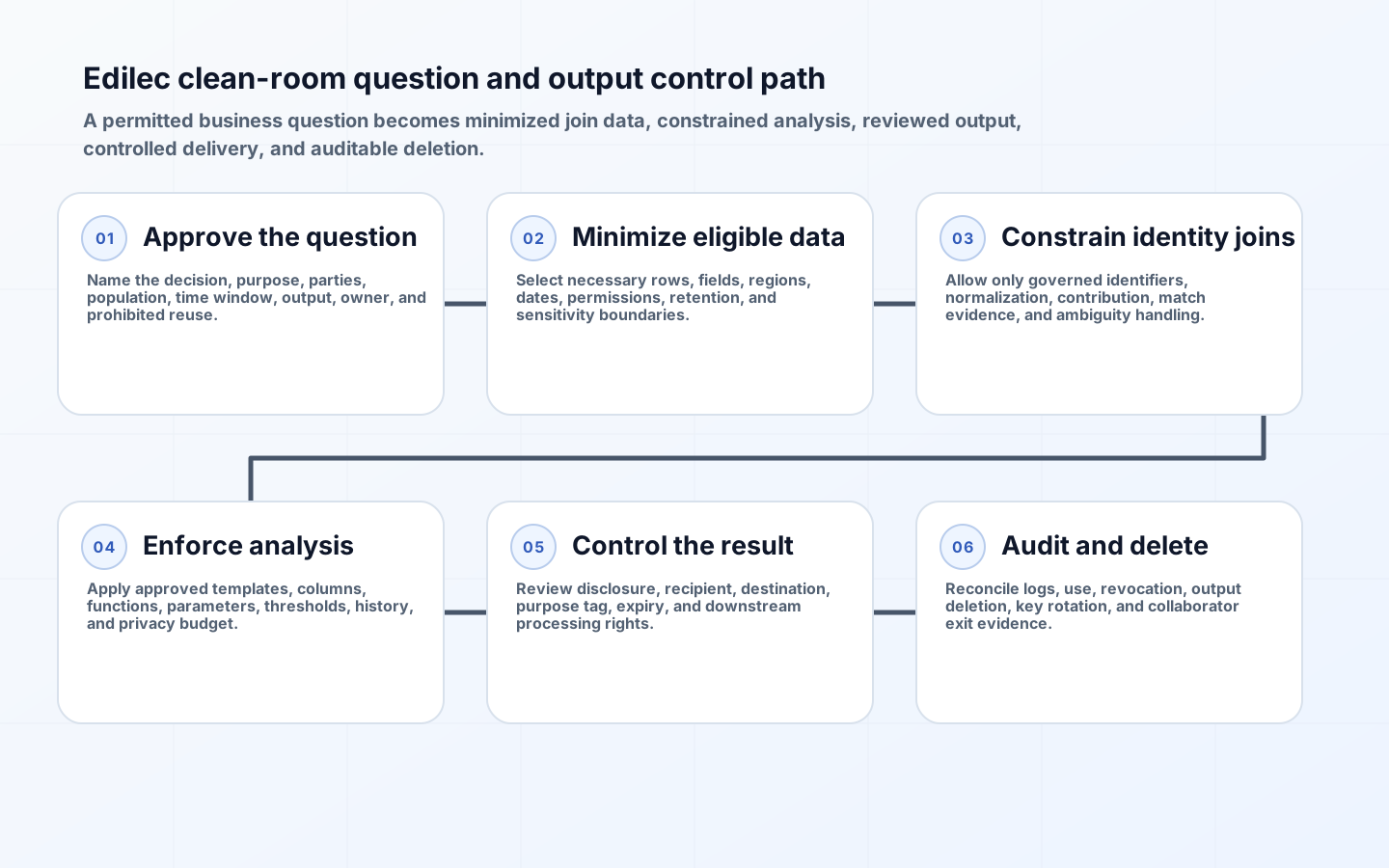
Marketing data clean room architecture should begin with a narrow collaboration decision: which parties may answer which business question using which data, and what may leave the controlled environment. It is not simply a protected place to upload customer tables. A platform can restrict SQL, isolate storage, or suppress small groups, yet still permit a harmful purpose, a revealing sequence of queries, an unauthorized activation list, or an output that becomes identifying when combined with other information.
A defensible design therefore treats the analytical question, data rights, join semantics, output policy, and review evidence as one contract. Start with aggregate measurement or planning questions that have named decisions and owners. Add audience activation only when row-level output is genuinely necessary and contractually permitted. The clean room should reduce exposure, but it does not replace privacy impact assessment, collaborator due diligence, retention limits, access governance, or scrutiny of re-identification risk.
Contract approved questions before exposing data
Write each use case as a question contract before selecting a vendor. For example: “What incremental conversions, aggregated by campaign and week, occurred within 30 days of an eligible impression?” is testable. “Explore customer behavior” is not. The contract names the decision, participating controllers or processors, legal basis or permission, eligible populations, time window, approved join keys, dimensions, measures, minimum group size, output recipient, retention, and prohibited secondary use. It also states whether repeated runs consume a privacy budget or require review.

Separate measurement, planning, enrichment, and activation because they need different controls. Aggregate measurement may permit counts and sums while prohibiting row output. Overlap planning may reveal only cohort sizes above a threshold. Enrichment or activation can produce person- or device-level rows and therefore deserves narrower fields, recipients, expiry, and downstream enforcement. AWS documents aggregation, list, and custom analysis rules with different query and result controls; that distinction is a useful evaluation lens even when another platform uses different names.
| Question class | Minimum inputs | Permitted output | Primary control | Evidence to retain |
|---|---|---|---|---|
| Campaign measurement | Eligible exposure and conversion events with governed time semantics | Counts, rates, or value by approved campaign dimensions | Approved aggregation and minimum group threshold | Query version, input snapshots, suppressed rows, recipient |
| Audience overlap | Two consent-eligible membership sets and compatible join identifiers | Overlap size and bounded descriptive segments | Join-column allowlist and thresholded aggregates | Population definitions, match rate, threshold configuration |
| Reach and frequency | Exposure events, campaign identity, bounded person or household key | Frequency distribution in coarse buckets | Restricted dimensions and contribution bounds | Deduplication rule, bucket definition, privacy parameters |
| Activation | Approved source audience and destination-compatible identity | Short-lived destination list with minimal fields | List rule, recipient allowlist, expiry and purpose tag | Export authorization, row count, destination receipt, deletion |
| Custom science | Versioned datasets required by a reviewed method | Only outputs named in an approved template | Immutable template plus independent review | Code digest, parameters, logs, disclosure review |
Minimize identity and join surface
The join layer often carries the greatest sensitivity. Hashing an email address does not make it anonymous: the input space may be guessable, matching remains the purpose, and the resulting identifier can still single out a person. Decide whether matching occurs on direct identifiers, party-specific tokens, a neutral identity service, private set intersection, or another privacy-enhancing technique. Document normalization rules, salt or key custody, collision behavior, household ambiguity, and whether either collaborator can reuse the token outside the collaboration.
Measure match quality rather than celebrating match rate. Report eligible records, syntactically valid identifiers, duplicates, matched records, unmatched records, one-to-many joins, and records excluded by consent or geography. A high overlap can indicate good coverage, but it can also reveal an unexpectedly broad identity graph or duplicate expansion. Cap contribution so one individual with many devices or transactions cannot dominate a result. Do not expose raw join keys to analysts unless the approved question requires them.
Enforce query and output controls together
Input isolation is only one layer. Enforce who can submit analysis, which tables and columns can participate, permitted joins, allowed functions, row contribution, dimensions, output thresholds, destination, and post-processing. Prefer reviewed parameterized templates for recurring decisions. Parameters should be typed and bounded: a campaign identifier may be selectable from an allowlist, while arbitrary predicates or date windows can recreate unrestricted exploration. Version templates so approval applies to exact logic, not a mutable name.
Thresholds prevent obvious small-cell disclosure but do not stop differencing. An analyst might query nearly identical populations and subtract results to infer a small group. Defenses include query history review, overlapping-query detection, coarser dimensions, contribution bounds, rate limits, sticky noise, or formal differential privacy with an explicit privacy-loss budget. These controls trade precision and flexibility for protection. Validate them with adversarial query sequences, not just one acceptable report.
| Layer | Control question | Failure test | Operational response |
|---|---|---|---|
| Membership | Are roles and recipients least-privileged and time-bounded? | Former analyst or collaborator credential attempts access | Revoke centrally, alert, and review historical access |
| Data | Are only necessary rows, columns, regions, and dates available? | Template references a prohibited sensitive attribute | Reject before execution and record policy rule |
| Query | Can logic escape the approved analytical shape? | Nested or parameterized query reconstructs arbitrary SQL | Fail closed and require a new reviewed template |
| Result | Can small groups or repeated differences disclose individuals? | Run adjacent cohorts and subtract outputs | Suppress, coarsen, consume privacy budget, or deny |
| Export | Can results move only to approved people and systems? | Attempt download or alternate cloud destination | Block export, alert data owner, preserve evidence |
| Lifecycle | Are tables, outputs, logs, and keys deleted on schedule? | Collaboration ends while derived audience remains active | Disable destinations, delete artifacts, obtain attestation |
Design the collaboration operating model
Assign accountable roles: a business sponsor owns the decision; each data owner approves use of its data; privacy and legal reviewers assess purpose and terms; an analytics owner maintains query logic; a platform owner configures technical controls; and a result owner governs downstream use. No single collaborator should silently broaden an approved question. Changes to columns, identities, recipients, geography, retention, or query logic should trigger a proportionate re-review.
Logs need enough detail to reconstruct activity without becoming a new copy of sensitive data. Capture collaboration identity, actor, role, query or template digest, parameters, input dataset versions, policy decision, execution time, rows scanned, suppressed outputs, result recipient, export event, and deletion. Restrict log access and retention. Reconcile platform logs against contracts and destination receipts; a successful query with no recognized business decision is an exception, not usage success.
Evaluate vendors with evidence, cost, and exit tests
A commercial comparison should use a small set of representative question contracts and hostile tests. Ask vendors to demonstrate denial, not only successful analysis. Can a table owner restrict join columns? Which collaborator can create or approve templates? How are minimum aggregation and repeated queries enforced? Can row-level outputs be disabled? Where do data, keys, logs, and temporary results reside? How are regional boundaries, customer-managed keys, private connectivity, incident response, and administrator access handled? Which controls apply to machine-learning jobs as opposed to SQL?
Model total operating cost: data preparation and identity services, ingestion or cross-cloud transfer, compute, platform licenses, privacy engineering, template review, collaborator onboarding, monitoring, investigations, and deletion. Test exit by revoking a member, exporting logs and configurations, deleting configured tables and outputs, rotating keys, and recreating a critical analysis elsewhere. A proprietary query interface or identity namespace can create more lock-in than storage does.
Pilot with disclosure and decision-quality tests
Run a pilot on synthetic or carefully minimized data before production. Prove a complete path: approve the question, prepare eligible records, match, execute, suppress, review, deliver, use the result for a named decision, and delete on schedule. Seed edge cases such as duplicate identifiers, tiny cohorts, late consent revocation, one user with extreme transaction volume, missing campaign metadata, a prohibited field, and an unauthorized export destination.
Acceptance measures should cover privacy and utility together. Track policy denials, unresolved disclosure tests, match ambiguity, suppressed-result rate, reconciliation differences, query latency, analyst effort, cost per recurring decision, downstream activation expiry, and evidence completeness. An answer that is safe but too delayed or unstable for the decision is not useful; an accurate answer without enforceable use boundaries is not acceptable. Record the tradeoff rather than weakening controls invisibly.
Key takeaways
- Approve precise questions, data rights, joins, outputs, recipients, and retention as one versioned contract.
- Treat hashed identifiers as linkable personal data unless a rigorous assessment establishes otherwise.
- Combine query restrictions with output thresholds, repeated-query defenses, export control, and downstream expiry.
- Test denials, differencing, revocation, deletion, and collaborator exit before relying on successful dashboard demos.
- Judge the clean room by safer decisions and complete evidence, not by data volume or raw match rate.
Frequently asked questions
Does a data clean room make customer data anonymous?
Not automatically. Isolation, hashing, aggregation, or encryption can reduce exposure, but identifiability depends on data, outputs, auxiliary information, and attack paths. Assess the whole collaboration and apply purpose, minimization, access, disclosure, and lifecycle controls.
Should a marketing clean room allow row-level activation?
Only for an approved purpose that genuinely requires it. Use minimal columns, an allowlisted recipient, purpose metadata, short expiry, consent eligibility, and deletion confirmation. Aggregate-only collaboration is usually easier to govern.
Is a minimum cohort threshold enough?
No. Thresholds address small cells but may not stop differencing or repeated-query attacks. Depending on risk, add history-aware controls, contribution bounds, coarsening, rate limits, or properly configured differential privacy.
Conclusion
A trustworthy clean room is a governed analytical service. Its architecture starts with approved questions and follows the data through identity, computation, disclosure control, delivery, use, and deletion. Select the platform that can enforce those boundaries, prove denials, and preserve audit evidence at an acceptable operating cost. That is a stronger commercial test than asking whether customer rows remain in separate accounts.