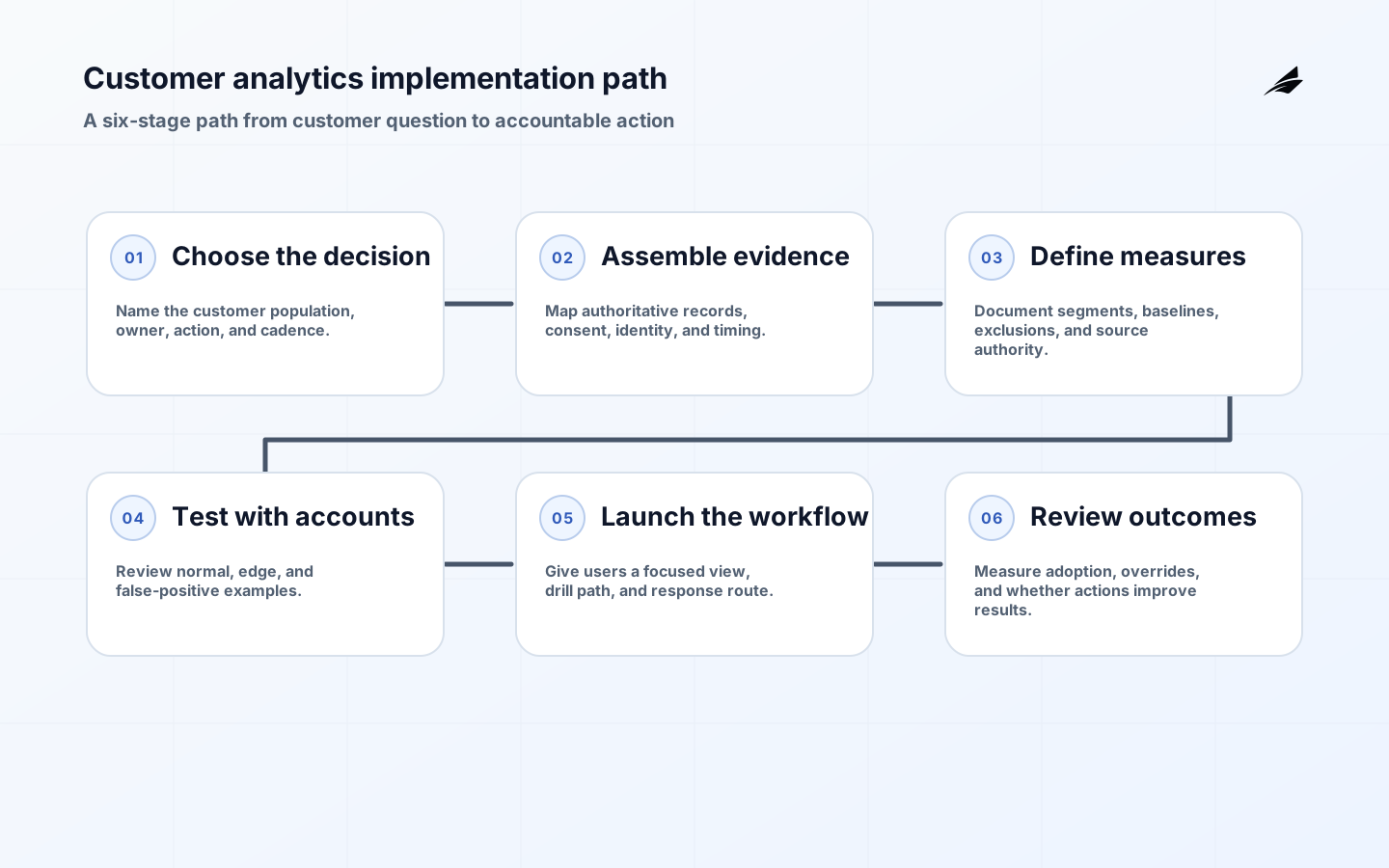
A customer analytics implementation checklist should begin with the decision a team is trying to improve, not a broad request for a customer dashboard. Teams may want to understand adoption, service risk, retention, campaign response, or account health, and each question carries different populations, timing, permitted data, and actions. The implementation work turns that question into a measurable and governed data product. Use the customer data visibility guide, service-delivery analytics checklist, and event analytics notes as nearby context, while keeping this article focused on the customer decision. Specify what a customer means in the analysis, which events and records are authoritative, how measures are tested, and how a reader should respond to a signal.
Name the customer decision before the population
Write a decision statement with a named audience: “Which active accounts should the success team contact this week?” is clearer than “show customer health.” Define the eligible population, exclusions, action owner, and horizon. A customer may be a paying account, a workspace, a person, or a household depending on the question; conflating those units creates misleading counts and interventions. Establish the baseline before building a score or segment. A team cannot judge whether a new insight helps if it has not recorded the current workflow, response time, and outcome it is trying to improve.
- Name the decision, owner, action, and review cadence.
- Define customer, account, user, and subscription units for the use case.
- Record inclusion, exclusion, and eligibility rules in the metric definition.
- Set a baseline for the current process and expected improvement.
- Confirm what data is permitted for the intended purpose.
Join customer records without hiding their authority
Customer analytics usually combines records that were created for different operational purposes: contracts, product events, support cases, invoices, and marketing interactions. Keep the authority boundary clear. A product event may be strongest for feature use, while an invoicing system remains authoritative for payment status. Preserve event and effective dates, source identifiers, and match rules so a reader can inspect a surprising segment. Customer data visibility provides the broader operating model for assembling permissioned context without pretending every relationship is certain. Data Governance and Management Profile offers a governance reference for authority and permitted use; What is data architecture? helps frame the relationship between sources, models, and consumers.
| Question area | Useful evidence | Definition check |
|---|---|---|
| Adoption | Qualified product events and eligible active accounts. | What action counts, in which time window? |
| Service risk | Open cases, severity, entitlement, and response status. | Which cases are included and when are they current? |
| Retention | Contract status, renewal horizon, and observed use. | Which entity owns the renewal and what counts as active? |
| Campaign response | Consent-aware audience and attributable outcomes. | What exposure and attribution rule applies? |
Challenge a segment with real account cases
A segment is a claim about a group, so test it with people who know representative accounts. Inspect false positives, exclusions, late data, and identity conflicts. For a churn-risk queue, compare a sample against recent account history and ask whether the recommended action is appropriate. Use structural checks for required fields, valid statuses, unique keys, and relationship integrity; dbt data tests is useful for codifying these checks in transformation models. Keep a route for users to flag a result that is technically valid but operationally unhelpful. Google Analytics user identity provides a concrete identity-resolution reference for account and user joins.
- Review sampled accounts across normal, edge, and excluded cases.
- Test required fields, valid categories, keys, and source freshness.
- Compare segment counts against a clear baseline after each material release.
- Display source time and known limitation beside time-sensitive outputs.
- Capture overrides and investigate whether a definition or process needs revision.
Put the signal into an accountable customer rhythm
Begin with one team and one recurring review where the signal can lead to a documented action. Give the team a compact view, a drill path, and a response policy rather than a large exploratory dashboard. Track whether people use the signal, how many cases they override, and whether the action improves the intended outcome. Analytics for service delivery is useful for designing this feedback loop. The Microsoft governance guidance also supports assigning ownership and controls proportionate to the content’s importance.
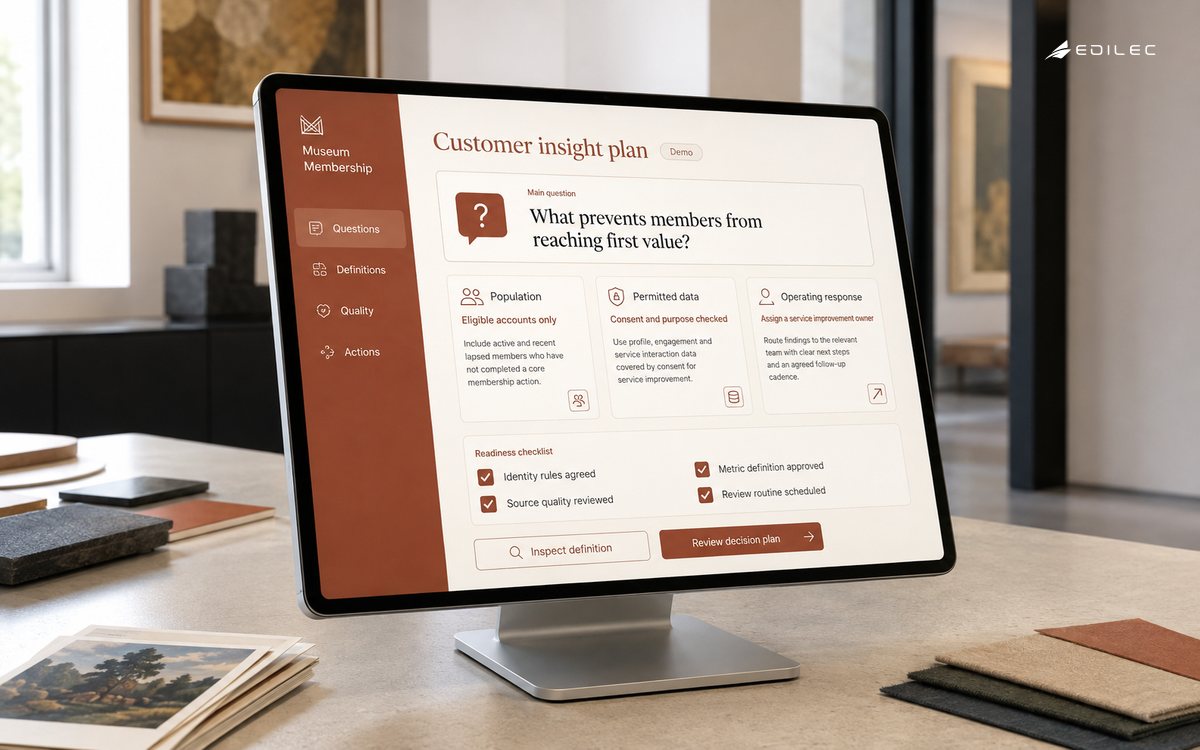
| Launch checkpoint | Question | Decision |
|---|---|---|
| Definition review | Can users explain the metric and population? | Release only after owner approval. |
| Data readiness | Are sources current enough for the review? | Warn, hold, or use an approved limitation. |
| Action route | Who acts on a flagged customer and how? | Assign a queue owner and escalation policy. |
| Outcome review | Did the signal improve the chosen decision? | Refine, expand, or retire the measure. |
A practical customer analytics example
A customer-success team may want a weekly list of accounts that merit a proactive conversation. Start with the operational decision: which accounts should be reviewed, and what action can the team take? The first implementation can use a small set of transparent signals, such as a material decline in qualified product use, an unresolved high-severity case, and an approaching renewal. For each signal, define the eligible account population, time window, source authority, and what an account manager should inspect before contacting the customer. The output is a review queue, not an automatic verdict about customer intent.
Testing should involve accounts the team already knows. Compare the proposed queue with recent customer history and ask whether each inclusion is understandable, timely, and actionable. An account with a usage decline may be intentionally dormant after a seasonal project; an account with an open case may have already received an approved remediation plan. These observations do not invalidate analytics. They reveal the context that needs to be captured through exclusions, annotations, or a better drill path. Record why a recommendation was overridden so the next iteration learns from operational reality rather than only from aggregate accuracy.
Measure the implementation against the decision, not only engagement with the dashboard. Track whether the queue is reviewed on schedule, whether actions are recorded, how long it takes to investigate a flagged account, and whether the selected outcome improves over the established baseline. Do not infer causality from a small number of accounts; use the data to guide careful improvement. Over time, the team may add a validated signal or retire one that consistently produces noise. This controlled evolution preserves trust because users can see how the model changes and why.
- Name the operational decision, customer population, response owner, and expected review cadence.
- Define the source authority and time window for every signal used in a queue.
- Test customer and account identity rules against real mergers, transfers, and shared relationships.
- Review proposed segments with account teams before using them for outreach or escalation.
- Show freshness, known limitations, and a governed record-level drill path to users.
- Capture overrides with a reason so operational knowledge improves the next release.
- Measure queue review, investigation time, action completion, and outcome against a baseline.
- Separate descriptive segmenting from automated decisions that require additional safeguards.
- Limit access to the fields necessary for the stated customer purpose and user role.
- Version metric and segment changes so historical interpretation remains transparent.
Keep the first workflow deliberately human. A queue can prioritize investigation, but the person responsible for the account should review the evidence and record the action or reason for no action. That record closes the loop between analytics and customer work. It also produces better data for improvement: a recurring “not applicable” reason may reveal a population error, a missing exclusion, or an operational condition that should be modeled. Starting with supported human judgment avoids overstating what the initial data product can know while making the implementation useful from its first review.
Key takeaways for customer analytics implementation
- Start with a permitted decision and a precise customer population.
- Keep source authority, identity rules, and timing inspectable.
- Test segments with real account cases before operational use.
- Measure whether the signal improves the action, not just dashboard activity.
Customer analytics questions before launch
What should we implement first? Pick one recurring decision with an accountable team and observable outcome. Do we need a single customer profile first? No. Build the minimum governed evidence needed for the first use case, while preserving relationships and source authority. How do we know a segment is useful? Review precision and operational usefulness with people who know the accounts, then compare the resulting action with a baseline. Who can see the data? Access should follow role, purpose, sensitivity, and applicable policy, not curiosity or convenience.
Conclusion: keep customer signals answerable
Customer analytics becomes valuable when it helps a defined team make a better, permitted decision and gives that team enough evidence to challenge the result. Assemble only the data required, preserve source and identity context, test the metrics with realistic cases, and operate the first release in a real cadence. This checklist keeps the work grounded in outcomes while building the data quality and governance habits that let customer insight expand responsibly.
A customer analytics implementation is ready for its next use case when the first team can explain the population, source authority, timing, permission, signal, and response without relying on the person who built it. Keep a small sample of accepted, excluded, and overridden accounts with the review decision. That evidence helps the next team understand both what the segment can say and where it must stop.
Before using a customer segment in a recurring account review, compare it with known accounts across normal, late, merged, and excluded cases. Record the source state, reviewer, action taken, override reason, and outcome window. If users cannot tell why an account appeared or how to challenge it, pause the rollout and repair the definition or drill path before adding more data.
Customer analytics should distinguish identity resolution from permission to use the resulting signal. Define the subject, consent state, retention period, source confidence, and correction path before joining events across devices or systems. Test an ordinary customer journey and an ambiguous one, such as a shared device or deleted account. The useful outcome is not a larger profile; it is a decision whose evidence and permitted use can be explained to the customer-facing team.