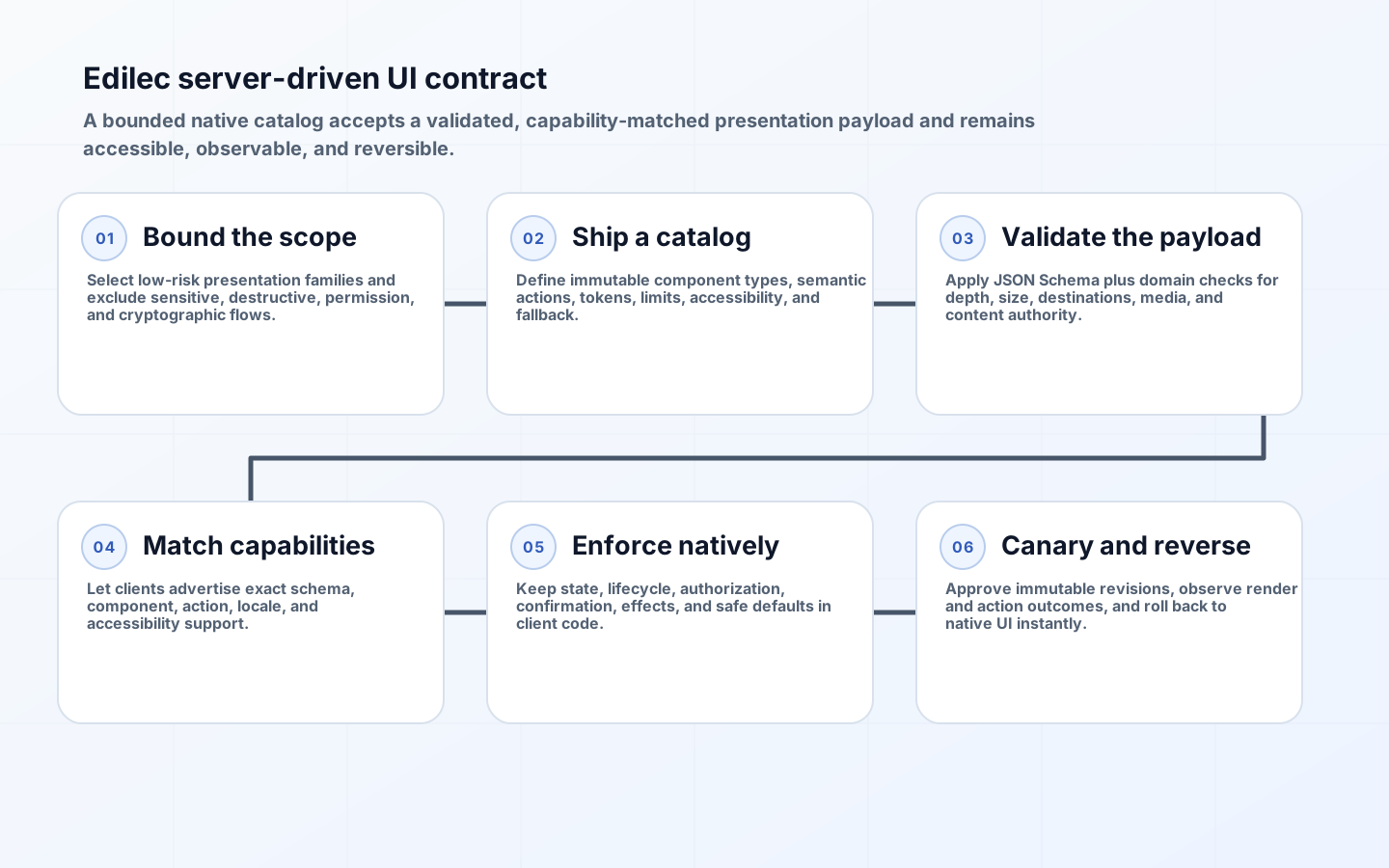
Server-driven UI mobile architecture lets a backend choose from app-shipped components and compose approved screens without waiting for a store release. It can accelerate merchandising, onboarding, and low-risk experiments. It should not let a server download arbitrary executable behavior, bypass native permissions, or redefine the app's safety-critical business rules. The client remains the authority for what it can render and what actions it will perform.
The durable model is a constrained presentation protocol. Native clients own components, accessibility semantics, navigation enforcement, secure actions, state transitions, and fallback. The server owns content, allowed composition, and experiment selection. A versioned schema joins them. Once that boundary is explicit, speed comes from a reusable catalog rather than from moving an entire application into remote JSON.
Choose a narrow scope with explicit exclusions
Start with screen families where presentation changes frequently but core rules are stable: product collections, informational onboarding, campaign modules, settings explanations, or form layout over an owned validation model. Keep authentication ceremonies, payments, consent capture, destructive account actions, device permissions, cryptographic operations, and regulated disclosures in audited native flows unless a formal risk review proves the remote model preserves every obligation.
| Concern | Server may choose | Client must own | Reason |
|---|---|---|---|
| Presentation | Approved component, content, order, spacing token | Rendering, layout limits, platform adaptation | Prevents arbitrary code and broken UI |
| Navigation | Named destination and public parameters | Allowlist, authentication, authorization, back behavior | Stops route injection |
| Actions | Semantic intent such as add-to-cart | Validation, idempotency, confirmation, API call | Keeps business effects trustworthy |
| Experiment | Variant identifier and eligible composition | Enrollment persistence, exposure event, kill switch | Preserves measurement and rollback |
| Accessibility | Content labels and reading intent | Semantics, focus, scaling, contrast, reduced motion | Platform behavior must remain testable |
Design a bounded component and action contract
Give each component an immutable type, supported property versions, required and optional fields, size constraints, allowed children, accessibility requirements, analytics semantics, and fallback. Use design tokens rather than arbitrary colors, fonts, dimensions, or URLs. Define semantic actions such as openProduct, submitAddress, or dismissMessage; never send script, selector, class name, SQL-like expression, or raw API request from the server.
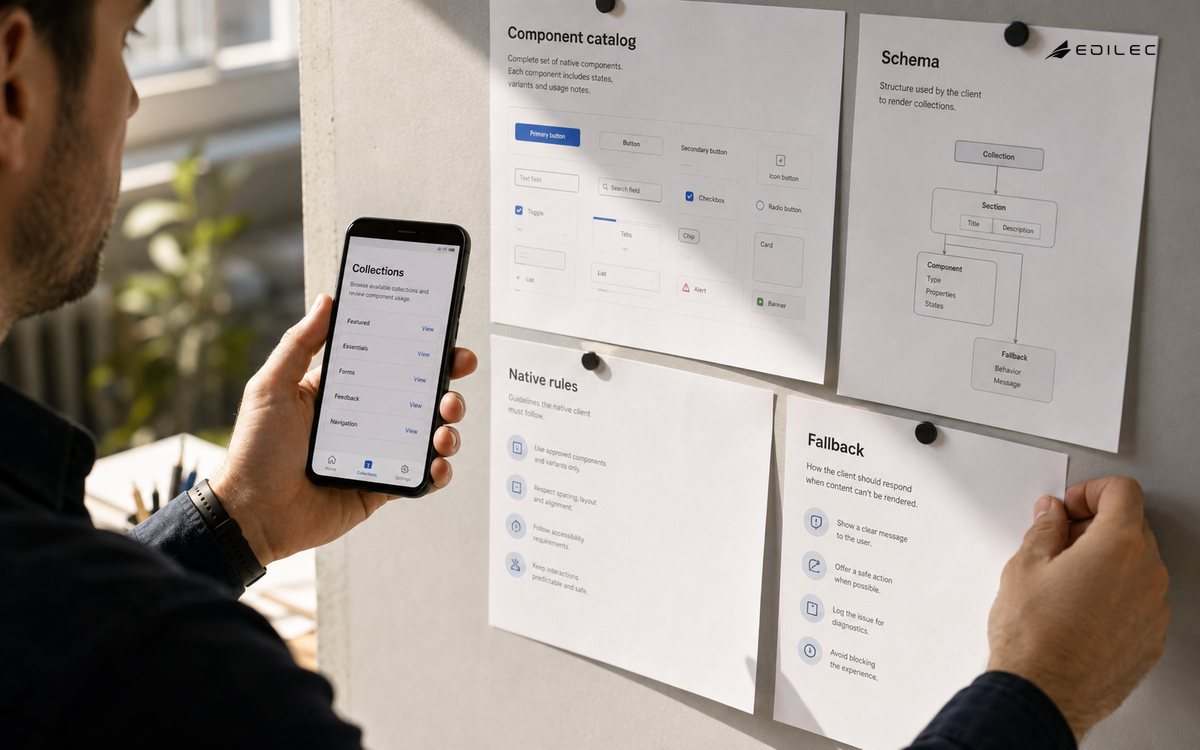
Represent the payload with a formal schema. The JSON Schema specification provides vocabularies for structure and validation, but schema validity alone does not establish semantic safety. Add domain checks for depth, node count, text length, cyclic references, image hosts, destination allowlists, and mutually exclusive properties. Validate on publication and again on-device because caches, intermediaries, or rollout errors can still deliver an unexpected document.
Negotiate capabilities instead of guessing from app versions
The client should send a compact capability set derived from code it actually contains: schema generations, component versions, actions, locale, accessibility modes, and relevant platform features. The server selects a representation within that set and returns the chosen contract version, payload ID, revision, expiry, and experiment identity. Do not use an app build number as the only proxy; branches and platform implementations can support different component subsets.
Make additive evolution the default. New optional properties need safe defaults, new components require a fallback or eligibility gate, and old semantics must not be silently repurposed. For a break, add a new component or schema generation and serve both until old clients leave the support window. Keep the last-known-good payload and a native skeleton so an incompatible or unavailable server does not produce a blank launch screen.
| Condition | Client response | Telemetry | Customer outcome |
|---|---|---|---|
| Known schema and components | Render after domain validation | Payload and component success | Intended screen |
| Unknown optional property | Ignore according to contract | Compatibility counter | Normal supported screen |
| Unknown component with fallback | Render declared safe fallback | Fallback reason and payload revision | Reduced but useful screen |
| Invalid action or destination | Disable element or replace module | Security validation failure | No unsafe effect |
| Payload unavailable or expired | Use bounded last-known-good or native default | Cache age and fetch failure | App remains operable |
Preserve native state, lifecycle, and accessibility
Remote payload is an input to UI state, not the state manager. Android's UI layer guidance recommends a clear state-production pipeline and unidirectional flow: state moves to UI and events move back to a state holder. Apply the same discipline on both platforms. Form values, pending actions, focus, navigation, and recoverable errors need owned state that survives configuration changes or process recreation as appropriate.
Every catalog component needs accessibility acceptance criteria before release: dynamic type or font scaling, screen-reader name and role, focus order, touch target, contrast, reduced motion, localization expansion, right-to-left layout, keyboard behavior, and error announcement. Apple's Human Interface Guidelines remain the platform baseline. A remote authoring preview cannot replace tests with native assistive technologies because final semantics are produced by client code.
Operate publication as a production deployment
Separate authoring, validation, approval, and serving. Preview exact payloads against every supported client capability profile. Require two-person approval for high-reach changes, record a diff and owner, canary by stable cohort, and provide one-click rollback to a known revision. Configuration services such as Firebase Remote Config can distribute parameters and conditions, but a UI payload still needs its own schema registry, content controls, and rendering observability.
Measure payload fetch and validation, render success, fallback reason, component exposure, action completion, layout overflow, accessibility smoke results, crashes by payload revision, and business outcomes. Bound cardinality: identify payload and component revisions without attaching customer data or full content to events. Correlate a bad result to both client build and payload revision. A global kill switch should force the native default without requiring the remote service to return a complex document.
Bound payload security, rendering cost, and content risk
Treat payload authors and upstream content systems as untrusted relative to the app runtime. Limit document bytes, tree depth, children per node, image dimensions, embedded text, action count, and recursive references before allocating UI objects. Fetch media only from reviewed HTTPS hosts, reject executable formats, and apply normal content-security and moderation controls. A syntactically valid payload can still cause memory pressure, infinite navigation, misleading consent copy, or an inaccessible action wall.
Set render budgets per screen family and collect them in prepublication tests: parse time, validation time, node count, first meaningful content, layout passes, image bytes, memory, and interaction latency on the oldest supported devices. Cap nested lists and avoid server-controlled animation loops. If a component breaches its budget, publication should fail or substitute a bounded fallback. This protects low-end devices and stops a content author from creating a performance incident without changing app code.
Separate copy approval from schema approval. Regulated statements, prices, terms, and consent language may require provenance, effective dates, locale review, and immutable evidence even when the component structure is safe. Store content revision and authority alongside payload revision, and make rollback preserve the exact approved combination. A technical rollback to an older payload must not reintroduce expired legal text or withdrawn offers.
Authoring permissions should follow component risk. A content editor may change text and an approved image; a product operator may reorder low-risk modules; only a platform owner may activate a new action or destination class. Preview data must be synthetic, and production audience rules need review for discrimination, consent, and accidental exclusion. Record who published what to which cohort and why, then expose that history to incident responders without granting them unrestricted content-editing rights.
Keep payload delivery independent from the transactional API. Use authenticated publication, immutable revisions, bounded caching, and a well-defined offline policy. If the UI service is unavailable, the app should continue critical native journeys rather than retrying aggressively. A server-driven landing page should never become a single point of failure for account recovery, payment confirmation, or access to already downloaded customer content.
Key takeaways
- Use server-driven UI for bounded presentation variation, not arbitrary executable logic.
- Ship a finite native component and semantic-action catalog with strict domain validation.
- Negotiate explicit capabilities and preserve additive schema evolution across installed clients.
- Keep state, authorization, confirmation, lifecycle, and accessibility behavior in owned client code.
- Canary payload revisions, observe fallbacks, and make rollback to a native default immediate.
FAQ
Is server-driven UI the same as remote configuration?
Remote configuration usually selects scalar parameters or flags. Server-driven UI supplies a structured presentation document. The latter has a larger compatibility, validation, accessibility, and observability surface, even when a configuration product helps select the payload.
Can it avoid every app-store release?
No. New components, native capabilities, security changes, SDK updates, and platform adaptations still require binaries. The system changes how existing approved capabilities are composed; it should not be treated as downloaded code or a way around review obligations.
What happens when the schema must break?
Introduce a new generation, advertise it as a separate capability, and serve old and new representations concurrently. Remove the old generation only after the corresponding client support window closes and telemetry confirms no dependent clients remain.
Conclusion
Server-driven UI is safest and fastest when it behaves like a typed presentation protocol. A finite catalog, explicit capabilities, native state and action ownership, accessible components, and reversible publication let product teams change composition quickly while retaining the guarantees customers expect from installed software.