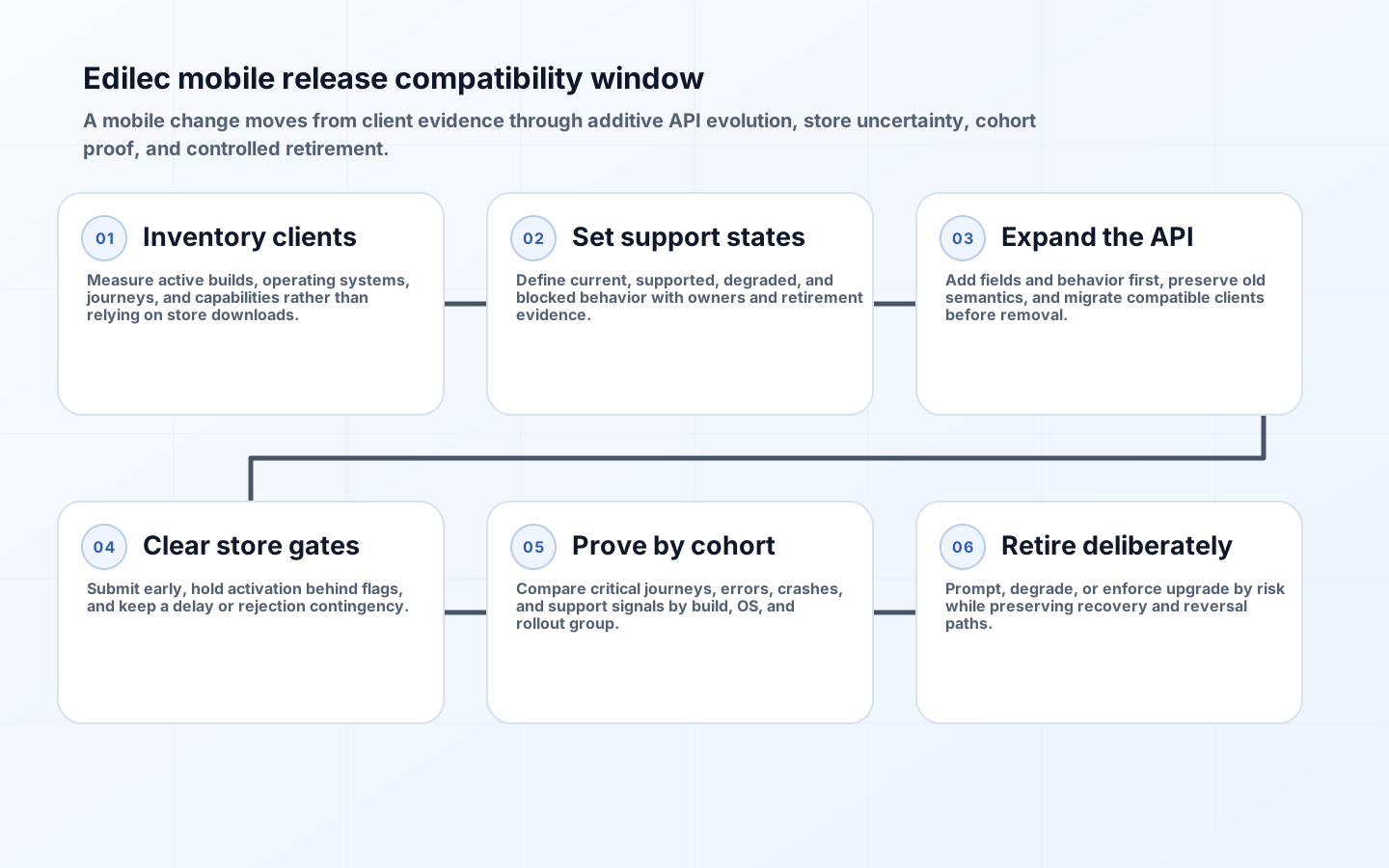
Mobile app release compatibility is the discipline of keeping real customer journeys working while several client builds coexist. A backend can deploy in minutes; an iOS or Android update must be packaged, reviewed, distributed, downloaded, and opened. Some users update automatically, some wait for weeks, and managed devices may remain on an older operating system. Treating a store submission as an atomic half of a coordinated deployment therefore turns ordinary delay into an outage.
The practical answer is not to freeze the API. It is to define a compatibility window, make server changes tolerant of old clients, expose capabilities explicitly, and separate release, rollout, and enforcement decisions. Store controls reduce exposure but cannot retrieve code already installed. A reliable plan starts with the oldest supported client and ends with measurable retirement, not with the newest build passing review.
Define the client support contract before changing the API
Inventory active app versions by platform, operating-system range, API behavior, and meaningful journey, using privacy-preserving telemetry rather than download counts alone. Define three states: current, supported, and blocked. Current receives the newest experience. Supported remains functionally safe but may not receive every enhancement. Blocked cannot continue because of a security defect, legal requirement, or removed server capability. Publish who can move a version between states and what evidence is required.
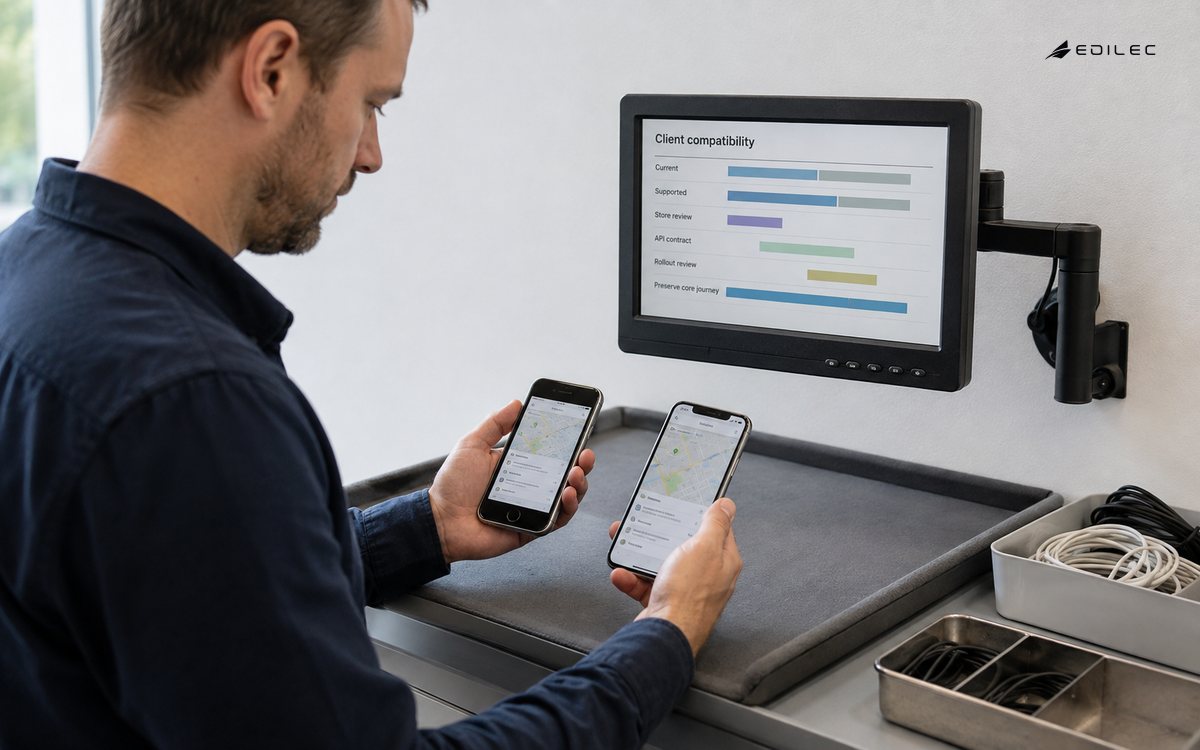
Use a server-calculated capability document such as minSupportedVersion, latestVersion, feature capabilities, maintenance state, and an optional upgrade message. Version comparison must use platform build identifiers with explicit ordering, not lexical comparison of marketing versions. Cache the last valid document so a configuration outage does not lock users out. Sign or authenticate configuration responses, and never let a client-provided version determine authorization.
| Client state | Server obligation | Client behavior | Exit condition |
|---|---|---|---|
| Current | Support all contracted endpoints and enabled capabilities | Use newest flows and report release health | Superseded by a proven update |
| Supported | Preserve required fields, semantics, and safe fallbacks | Hide unsupported features and continue core journeys | Usage falls below retirement threshold or risk changes |
| Degraded | Keep critical read or recovery paths available | Explain limitation and offer update without trapping work | Update installed or temporary incident ends |
| Blocked | Return a machine-readable upgrade requirement only where unavoidable | Preserve sign-out, export, support, and accessibility paths | A compatible build is installed |
Sequence API and client changes with expand, migrate, and contract
For a breaking data change, expand first: add the new server field or endpoint while retaining the old contract. Release clients that understand both forms and prefer the new one. Observe adoption and successful use, then migrate server-side producers. Contract only after every supported client has stopped relying on the old form. HTTP semantics in RFC 9110 reinforce that method, representation, status, and header meaning form a contract; changing only a URL version does not make a semantic break safe.
Prefer additive request and response evolution. Old clients should ignore unknown response members; servers should supply defaults for omitted new request members. Do not repurpose an enum value, narrow a numeric range, or change null into absence without a compatibility path. When behavior truly must diverge, route by an explicit capability or API generation with an owner and retirement date. Device model, user agent, and app version are poor substitutes for declared capability because they entangle unrelated changes.
Plan store review and release as independent lanes
Apple requires a build and required metadata before submission, and the app is not sent until the team completes the submission workflow described in App Store Connect help. Approval timing is an uncertain input. Submit a compatibility build before the backend needs it, hold server activation behind a flag, and make the old app safe if review is delayed or rejected. Include reviewer credentials and reachable test services so an avoidable review issue does not consume the contingency window.
On Google Play, separate internal, closed, open, and production tracks. Managed publishing can hold approved changes until the team chooses to publish, but it does not turn two stores into one transaction. Maintain a release ledger containing build, API assumptions, configuration changes, database migrations, review state, rollout cohort, owner, and rollback action. The backend deployment should be reversible without requiring a new mobile binary.
| Gate | Evidence | Decision owner | Failure response |
|---|---|---|---|
| Compatibility | Contract tests for oldest supported and candidate clients | Mobile and API leads | Keep expanded server contract |
| Store readiness | Accepted build or explicit delay contingency | Release manager | Hold feature activation |
| Canary | Crash-free sessions, journey success, API errors, support signals | Product and SRE | Halt exposure and disable feature |
| Expansion | Stable cohort comparison across OS and device classes | Release owner | Pause at current percentage |
| Retirement | Negligible safe-client dependency plus approved risk case | Product, security, support | Extend window or enforce upgrade |
Roll out by cohort and observe customer outcomes
Apple supports manual, automatic, and phased release choices, including a seven-day phased update described by App Store Connect. Google Play staged rollouts expose an update to a selected percentage and allow a rollout to be halted, but users already on the build remain there, as the staged rollout guidance makes clear. Neither control replaces server-side feature flags, because a bad binary may already be installed.
Measure by app build and platform: launch success, crash and ANR rate, authentication, checkout or other critical journey completion, backend error class, latency, configuration fetch, and update-prompt outcomes. Compare candidate cohorts with the previous build while accounting for country, OS, and acquisition differences. Define stop conditions before release. A broad metric such as total sessions can hide a complete failure on one OS generation or only after a cold start.
Design upgrade prompts and forced upgrades as risk controls
Use optional prompts first: explain the user benefit, deep-link to the correct store listing, allow deferral, and preserve the task in progress. Escalate to a persistent prompt only when the unsupported version creates material operational cost or risk. Force an upgrade only when continued use is demonstrably unsafe or impossible. A blanket launch-time block can strand a traveler with poor connectivity, prevent access to receipts, or trap a user whose device cannot run the new OS.
Provide an emergency mode for read-only access, data export, support contact, account recovery, and sign-out where feasible. Test store-unavailable, offline, parental-control, enterprise-management, and incompatible-device states. Make enforcement server-reversible and scoped by platform and version range. Record the approving risk owner, start time, affected population, support script, and removal criterion; a minimum-version flag is a production control and deserves the same auditability as a deployment.
Test asymmetric deployment and retirement scenarios
Build a compatibility test matrix from server generation against every supported client contract, not only candidate client against current backend. Replay recorded, sanitized requests from older builds; run contract fixtures for optional fields, unknown enums, missing capabilities, expired sessions, clock skew, and repeated writes; and verify that feature-disabled clients still complete core tasks. Include database migration states during rollout because a server rollback may encounter data written by newer code.
Exercise retirement in a staging simulation with production-like version distribution. Confirm that an old client receives a stable machine-readable response, upgrade links resolve in every storefront, deferred work is preserved, and support can identify the affected build. Review the version histogram after weekends, holidays, and enterprise update cycles before enforcement. A low daily session share can conceal a material population that returns monthly for invoices, benefits, or regulatory reporting.
Finally, test the emergency reversal: lower the minimum version, disable the new capability, restore the compatible server representation, and confirm blocked clients recover without reinstalling. That rehearsal separates a reversible policy control from a binary defect that needs a corrective release.
Key takeaways
- Assume several mobile builds will coexist; a store review is never an atomic deployment primitive.
- Expand the API, migrate compatible clients, measure adoption, and contract only after the support window closes.
- Keep binary rollout, server feature exposure, and minimum-version enforcement independently reversible.
- Measure critical journeys by build, OS, and cohort, with stop conditions agreed before release.
- Reserve forced upgrades for material risk and preserve recovery, support, and accessibility paths.
FAQ
How many mobile versions should an API support?
Choose a time- and risk-based window from observed adoption, release frequency, regulated obligations, and device support. A fixed number is easy to state but misleading when one release stays active far longer than another. The contract should name support duration, the journeys guaranteed, and the evidence needed for retirement.
Should every request include the app version?
Include immutable build identity for observability and compatibility diagnostics, but do not use it as authorization. Route semantic differences through explicit API generations or capabilities. Validate and normalize the value at the edge so uncontrolled version labels do not fragment metrics.
Can a mobile release be rolled back?
Distribution can be halted and a corrective release can follow, but installed binaries remain. Design rollback around server flags, compatible APIs, and disabling risky functions. Treat a store action as exposure control, not remote code removal.
Conclusion
A dependable mobile release is an overlap plan. When the support contract, additive API sequence, store contingencies, cohort evidence, and upgrade policy are explicit, teams can keep shipping backend and client changes without gambling customer access on review timing. The oldest supported client is part of production until evidence and an accountable decision say otherwise.