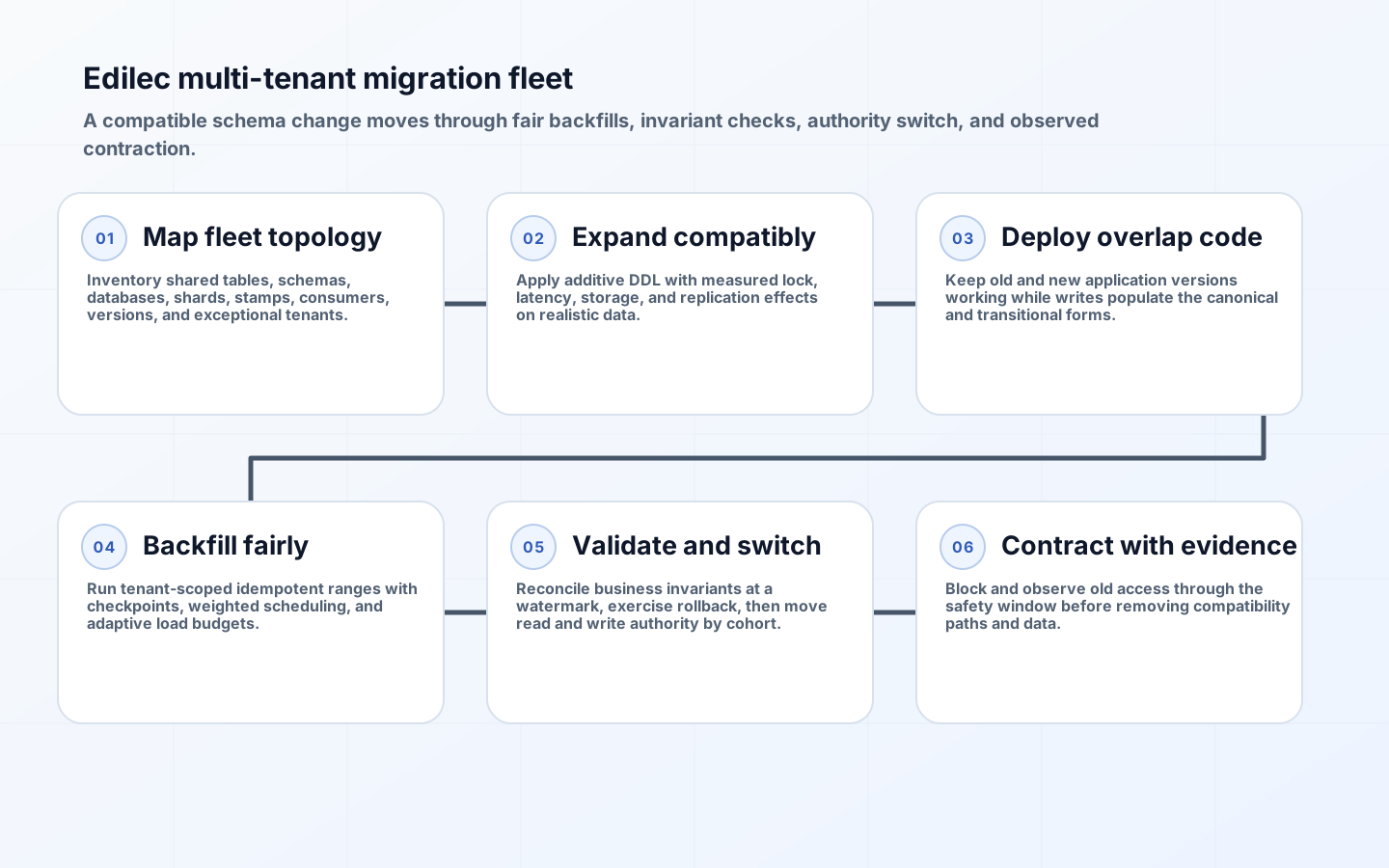
A multi-tenant database migration is a fleet operation even when every tenant shares one physical database. One schema statement can affect all accounts at once; a backfill can let the largest tenant monopolize I/O; and a destructive cleanup can strand an application instance or dedicated tenant database still on an older version. Zero downtime therefore means maintaining service through a controlled compatibility window, not pretending every change is instantaneous.
The reliable pattern is expand, migrate, verify, switch, and contract. New and old application versions coexist while data moves. Every stage has a measurable entry condition, tenant-scoped progress, load budget, and rollback action. The migration is complete only when all relevant tenants, readers, writers, jobs, and replicas have crossed the boundary and the old path has no observed use.
Inventory the tenant and database topology
Classify each storage boundary: one shared schema with tenant keys, schema-per-tenant, database-per-tenant, sharded pools, regional stamps, or hybrids. Record tenant placement, application version, schema version, engine version, size, traffic class, contractual window, residency, replication topology, and restore target. Azure's multitenant storage guidance recommends automated schema deployment, tracking the schema version used for each tenant, maintaining backward compatibility with at least one prior schema, and sequencing destructive changes across releases.
| Topology | Main advantage | Migration hazard | Control |
|---|---|---|---|
| Shared tables | One schema operation | Lock or bad query affects every tenant | Online DDL review, global canary, strict load budget |
| Schema per tenant | Logical separation | Thousands of repeated operations drift or stall | Fleet orchestrator with per-schema state |
| Database per tenant | Strong isolation and rollback unit | Long tail of versions and credentials | Cohorts, automated inventory, bounded parallelism |
| Sharded tenant pools | Scalable operational groups | Hot shards and uneven tenant sizes | Shard-aware concurrency and heavy-tenant lanes |
| Regional deployment stamps | Residency and blast-radius boundaries | Cross-region version skew | Regional gates with global compatibility contract |
| Hybrid estate | Placement matches customer needs | Assumptions differ by cohort | Topology-specific runbooks under one state model |
Find every consumer before changing a column: interactive services, worker versions, stored procedures, views, exports, BI queries, support scripts, CDC connectors, caches, replicas, and customer integrations. Search code and query logs, then assign an owner. A dependency that cannot be identified cannot safely receive a contract deadline. Database compatibility is an end-to-end property, not merely an ORM migration passing in staging.
Design the compatibility window
Express the transition as a matrix. Application N must work with schema S; application N+1 must initially work with S and S+1; rollback of N+1 must remain valid after expansion and partial backfill. Define read precedence when both old and new representations exist, writer behavior, null semantics, defaults, constraint enforcement, and how a row's migration state is determined. Avoid deploying code that requires a new column before that column exists everywhere it may run.
Expansion should be additive and fast: add nullable columns, new tables, indexes built with the engine's online mechanism, or constraints introduced without immediately scanning old data where supported. PostgreSQL's current ALTER TABLE documentation notes that lock levels vary, many forms default to an ACCESS EXCLUSIVE lock, and validating a previously added constraint can avoid blocking concurrent updates. Treat exact DDL behavior as engine- and version-specific; test it on production-scale copies.
Orchestrate expand, backfill, switch, and contract
| Stage | Allowed behavior | Evidence to advance | Rollback |
|---|---|---|---|
| Expand | Old code remains authoritative | DDL completed, lock and replication health acceptable | Remove unused additive object if safe |
| Compatible write | New code writes old plus new or canonical plus projection | Write errors zero, parity sampled, old readers healthy | Disable new write path |
| Backfill | Idempotent workers migrate bounded ranges | Coverage, lag, mismatch, and load within thresholds | Pause workers; transformed rows remain readable |
| Read switch | Cohorts prefer new representation with fallback | Tenant journey and invariant checks pass | Return cohort to old read |
| Write switch | New representation becomes authority | No old-only writers, queue drained, rollback path tested | Temporarily dual-write or restore old authority by plan |
| Contract | Old object becomes inaccessible then removed | Observed zero use through full safety window | Redeploy compatibility object before irreversible drop |
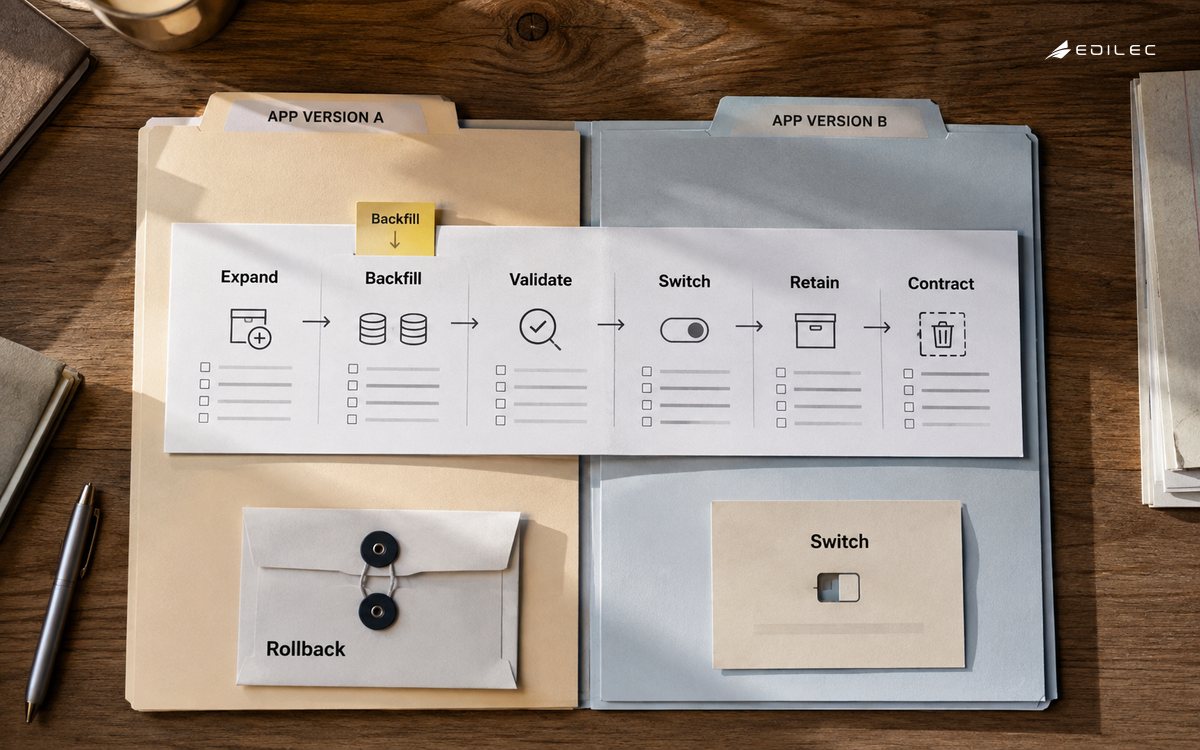
- Register a migration definition with immutable code version, target scope, prerequisites, and safety budgets.
- Expand one topology cohort and observe locks, CPU, I/O, replica lag, error rates, and latency.
- Deploy backward-compatible application code before changing read authority.
- Backfill through tenant-aware work units with checkpoints and idempotent updates.
- Validate business invariants and exercise rollback on a completed canary cohort.
- Progressively switch reads and writes, then block old access before destructive contraction.
Evolutionary database design treats schema and data changes as version-controlled migration artifacts deployed with application changes. The Evolutionary Database Design guidance also emphasizes coordinating multiple application versions and migrations. For a SaaS fleet, add a durable orchestrator state machine: pending, eligible, expanding, backfilling, validating, switched, contracting, complete, paused, or failed. Do not infer completion from a deployment job returning success.
Build tenant-aware, resumable backfills
Partition work first by placement and tenant, then by stable primary-key ranges or time windows. Store a checkpoint containing migration ID, tenant, range, source watermark, attempt, rows examined, rows changed, checksum, and terminal status. Make the transformation idempotent with a predicate such as update only when the target is absent or older than the source version. Avoid offset pagination because concurrent writes and deletions can skip or repeat records.
Fairness matters. Use weighted queues so many small tenants continue progressing while large tenants receive bounded slices. Cap workers by database, shard, region, and tenant. Feed back replica lag, lock waits, buffer pressure, latency, and error rate to reduce concurrency automatically. Schedule heavy customers separately when their size or contract justifies it. A global rows-per-second target can look healthy while one shard is saturated and a long tail never finishes.
Validate business invariants, not only row counts
Compare counts and checksums at a shared watermark, but also test domain truth: every active subscription has one current entitlement set; invoice totals equal line and tax components; foreign references resolve; tenant ownership never changes; timestamps preserve ordering; and encrypted or redacted fields retain policy. Sample exact records, reconcile aggregates by tenant and time, and store mismatch categories so repairs are reviewable.
AWS DMS data validation guidance describes row comparisons between source and target and warns that validation consumes source, target, and network resources. The same operational lesson applies to in-place migrations: validation is workload. Budget it, delay comparisons until replicas or projections reach the watermark, and never treat temporary replication lag as evidence of corruption without retry rules.
Engineer rollback before the first cohort
Rollback is stage-specific. Before the write switch, disable new reads and writes while keeping additive structures. During backfill, pause workers; do not erase useful compatible data. After write authority changes, rollback may require a reverse projection, event replay, or forward fix rather than restoring a database backup. A fleet-wide restore is rarely an acceptable response to one faulty transformation because it discards unrelated tenant writes.
Contraction is deliberately slow. Instrument accesses to the old column, table, endpoint, or event field. Revoke application permissions or replace the object with a compatibility view that emits unmistakable alerts. Wait through the longest rollback, billing, reporting, job, and customer-integration cycle. Then remove old writers, readers, dual-write code, fallbacks, indexes, and data. Back up according to policy, but do not call backup availability a tested logical rollback.
Operate the migration with fleet evidence
A migration dashboard should answer which tenants are eligible, active, paused, failed, validated, switched, and complete; which topology and software versions they use; how old the oldest checkpoint is; which invariant mismatches remain; and whether safety budgets are binding. Alert on stalled cohorts and rising long-tail age, not only failed jobs. Require an owner and reason for every manual skip, and expire exceptions.
Progressive cohorts should represent risk dimensions: internal tenants, low-volume shared tenants, a high-volume tenant, each region, each shard generation, dedicated databases, and special contractual configurations. A random one-percent canary may miss the largest table or rare topology. Hold between stages long enough to observe scheduled jobs and replicas. The objective is evidence across variance, not a ceremonial percentage rollout.
Key takeaways
- Model migration as a durable tenant fleet state machine, even for a shared database.
- Keep old and new application versions compatible throughout an explicit window.
- Use additive DDL first and verify engine-specific locking on production-scale data.
- Partition backfills by tenant and placement, with idempotent work and adaptive load controls.
- Validate business invariants at a shared watermark and retain repair evidence.
- Prove stage-specific rollback before switching authority; contract only after observed zero use.
Multi-tenant database migration FAQ
Is dual-write always required?
No. A database trigger, generated projection, change stream, or write to one canonical representation plus asynchronous materialization can be safer. If application dual-write is necessary, define ordering, partial-failure recovery, idempotency, and reconciliation. Two uncoordinated writes are not atomic merely because they occur in one request handler.
Should every tenant have the same schema version?
That is the steady-state goal for a standardized SaaS product, but controlled skew is normal during rollout. Record it explicitly and bound the supported window. Permanent tenant-specific schema forks multiply testing and security risk; model customization as data or extension contracts where practical.
Does zero downtime mean zero risk?
No. It means preserving agreed service availability and correctness while changing the system. Online DDL can still create locks, backfills can create load, and compatible code can contain logic errors. Progressive scope, safety budgets, observability, and rehearsed rollback reduce that risk.
Conclusion
A no-downtime tenant migration succeeds by tolerating controlled version overlap and making every transition observable. When topology, compatibility, backfill fairness, invariant validation, rollback, and contraction are explicit, database evolution becomes routine fleet engineering instead of a synchronized leap across every customer.