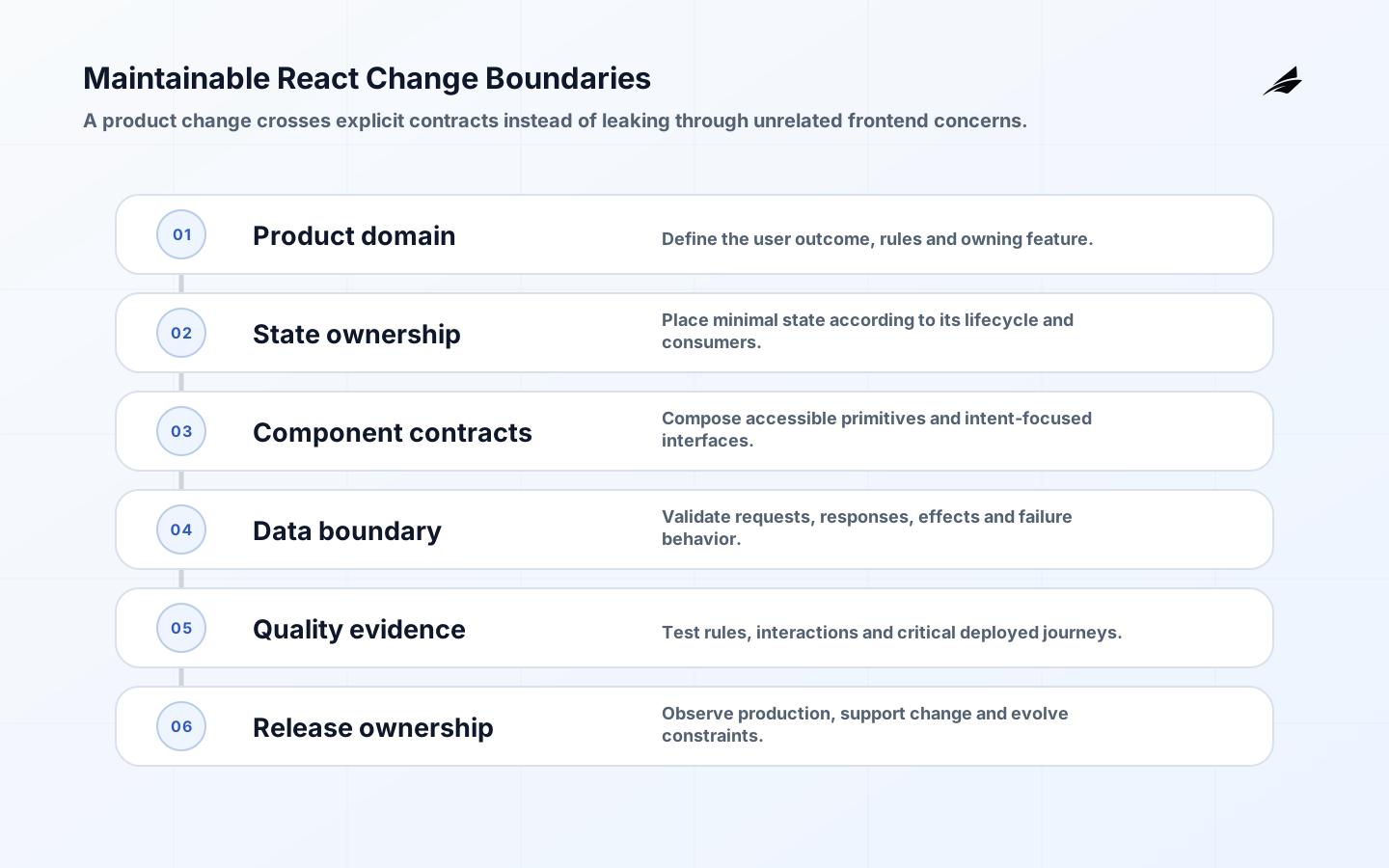
A maintainable React application lets a team change business behavior without first untangling accidental coupling. React supplies a component and state model, but maintainability comes from decisions around domain boundaries, ownership, data fetching, errors, accessibility, testing and releases. Growing companies feel the cost when every feature touches global state, duplicated logic drifts between screens, or only one engineer understands how a customer task moves through the interface.
This guide treats maintainable react applications: architecture and team practices for growing companies as a set of decisions that can be reviewed and tested. The aim is not to prescribe one vendor or promise a universal result. It is to help business and technical owners define boundaries, preserve evidence, expose failure behavior and decide when the work is ready to expand.
Organize by domain responsibilities
Group code around stable business capabilities and user journeys rather than only technical file types. Components should expose clear inputs and events while domain rules live in testable modules independent of rendering.
Define boundaries for shared design primitives, product features, API clients, authentication and application shell. Limit import direction so a reusable package does not secretly depend on one feature.
| State category | Likely owner | Common mistake |
|---|---|---|
| Local interaction | Leaf or nearby component | Moving every toggle into a global store |
| Shared UI workflow | Closest common feature owner | Duplicating state in sibling components |
| Server data | Query or data-access layer | Copying responses into unrelated client state |
| Navigation | URL and router | Hiding shareable filters in memory |
| Durable preference | Explicit persistence boundary | Reading storage throughout render code |
Review a proposed change and count the unrelated areas it must touch. High fan-out signals misplaced ownership or a missing contract, not an automatic need for more abstraction.
Turn "Organize by domain responsibilities" into a working control by naming one accountable owner, one maintained artifact and one review forum. The exit standard for this part of maintainable react applications: architecture and team practices for growing companies is concrete: Review a proposed change and count the unrelated areas it must touch. High fan-out signals misplaced ownership or a missing contract, not an automatic need for more abstraction. For this part of the system, name the accountable owner, supporting evidence, exception route, and next measurable check.
Give each piece of state one clear owner
Keep state minimal: do not store values that can be derived during render, duplicate the same entity in competing stores, or represent contradictory booleans when one explicit status will do.
Place transient interaction state near the component that uses it. Lift shared state to the closest responsible owner, and treat server data, URL state, form state and durable client preferences according to their different lifecycles.
Test reset and preservation behavior around keys, navigation and identity changes. Verify that switching tenant or record cannot leave a form bound to stale state.
Turn "Give each piece of state one clear owner" into a working control by naming one accountable owner, one maintained artifact and one review forum. The exit standard for this part of maintainable react applications: architecture and team practices for growing companies is concrete: Test reset and preservation behavior around keys, navigation and identity changes. Verify that switching tenant or record cannot leave a form bound to stale state. Within this part of the system, name the accountable owner, supporting evidence, exception route, and next measurable check.
Design component contracts for comprehension
Separate accessible primitives from domain components and page composition. Props should express intent, avoid impossible combinations and keep side effects explicit through callbacks or dedicated hooks.
Prefer composition over giant configuration objects that turn one component into many hidden modes. Extract an abstraction after repeated, stable similarity appears, not merely because markup looks alike once.
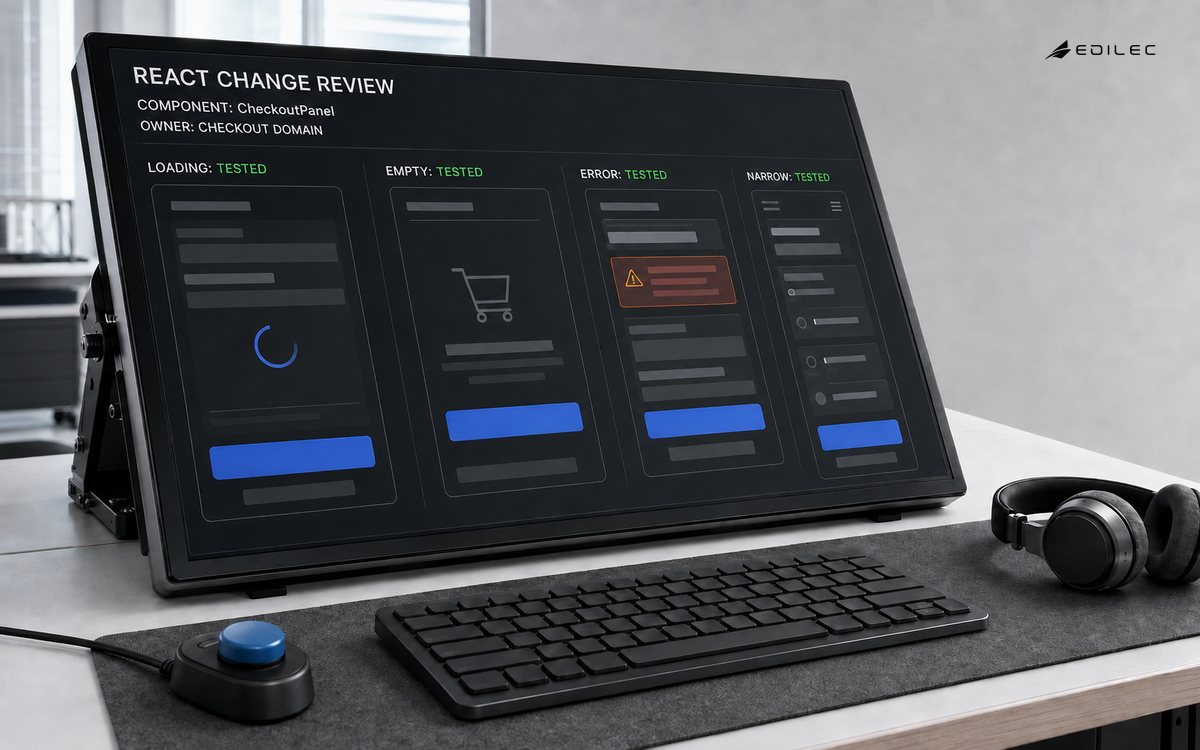
Turn "Design component contracts for comprehension" into a working control by naming one accountable owner, one maintained artifact and one review forum. The exit standard for this part of maintainable react applications: architecture and team practices for growing companies is concrete: Use focused examples or stories for states such as loading, empty, error, disabled, long content and narrow layout. Review contract changes as API changes within the frontend. When implementing this design choice, name the accountable owner, supporting evidence, exception route, and next measurable check.
Control data flow and side effects
Centralize request construction, response validation, cancellation, authentication handling and error translation. Components need meaningful domain states rather than raw transport details.
Use effects to synchronize with external systems, not to derive ordinary render data. Keep mutation ownership visible, invalidate or update caches deliberately, and define behavior for race conditions and optimistic failure.
Test slow, reordered, duplicated and rejected responses. A loading spinner that never resolves is an operational bug, not a cosmetic edge case.
Turn "Control data flow and side effects" into a working control by naming one accountable owner, one maintained artifact and one review forum. The exit standard for this part of maintainable react applications: architecture and team practices for growing companies is concrete: Test slow, reordered, duplicated and rejected responses. A loading spinner that never resolves is an operational bug, not a cosmetic edge case. Before releasing this data handoff, name the accountable owner, supporting evidence, exception route, and next measurable check.
Build a layered quality strategy
Unit-test pure domain rules and reducers, integration-test components around user behavior, and reserve end-to-end tests for critical journeys and deployment confidence. Avoid assertions tied to incidental markup.
Include static typing, linting, dependency review, accessibility checks and production observability in the delivery path. None replaces exploratory review with representative users and devices.
Track flaky tests, escaped defects, slow suites, bundle changes and unhandled errors. Quality tools are useful when they shorten confident change, not when they maximize counts.
Turn "Build a layered quality strategy" into a working control by naming one accountable owner, one maintained artifact and one review forum. The exit standard for this part of maintainable react applications: architecture and team practices for growing companies is concrete: Track flaky tests, escaped defects, slow suites, bundle changes and unhandled errors. Quality tools are useful when they shorten confident change, not when they maximize counts. While operating this evaluation, name the accountable owner, supporting evidence, exception route, and next measurable check.
| Quality layer | Best evidence | Avoid |
|---|---|---|
| Type and lint | Invalid contracts caught before runtime | Treating warnings as a substitute for tests |
| Unit | Domain rules and state transitions | Testing implementation trivia |
| Component integration | User-visible states and actions | Mocking every child and hook |
| End to end | Critical journey across deployed boundaries | A huge brittle suite for every variation |
| Production | Errors, performance and support context | Collecting telemetry without ownership |
Make ownership and change review explicit
Document local conventions, architecture decisions and setup paths close to code. Assign maintainers to domains and shared packages, but keep review distributed enough that knowledge can move.
Use pull requests to inspect behavior, accessibility, contracts, tests and operational effect. Schedule small refactors inside feature work when they reduce immediate risk; do not wait for a mythical rewrite window.
Onboard a new engineer through a real small change and note every hidden dependency. Receiver experience is a strong audit of maintainability.
Turn "Make ownership and change review explicit" into a working control by naming one accountable owner, one maintained artifact and one review forum. The exit standard for this part of maintainable react applications: architecture and team practices for growing companies is concrete: Onboard a new engineer through a real small change and note every hidden dependency. Receiver experience is a strong audit of maintainability. When changing this part of the system, name the accountable owner, supporting evidence, exception route, and next measurable check.
Evolve the application through measured constraints
Set practical budgets for bundle size, interaction responsiveness, error rate and supported browsers based on the product. Upgrade dependencies in small, observable increments with release notes and rollback.
Track architectural exceptions and give them review dates. A temporary direct import or duplicated rule may be reasonable under pressure if ownership and removal conditions remain visible.
Plan modernization by user journey or domain boundary, keeping production releasable throughout. Large rewrites should require evidence that incremental change cannot responsibly meet the goal.
Turn "Evolve the application through measured constraints" into a working control by naming one accountable owner, one maintained artifact and one review forum. The exit standard for this part of maintainable react applications: architecture and team practices for growing companies is concrete: Plan modernization by user journey or domain boundary, keeping production releasable throughout. Large rewrites should require evidence that incremental change cannot responsibly meet the goal. During support for this part of the system, name the accountable owner, supporting evidence, exception route, and next measurable check.
Key takeaways
- Organize the frontend around domain ownership and stable import boundaries.
- Keep state minimal and assign a single owner appropriate to its lifecycle.
- Use clear component contracts and extract abstractions only from stable repetition.
- Test behavior across pure logic, components, critical journeys and production.
- Make accessibility, documentation and upgrade ownership part of routine delivery.
Frequently asked questions
Does a growing React app need a global state library?
Only when multiple distant consumers need shared client state whose lifecycle is not better handled by the URL or a server-data tool. Start from ownership and update patterns, then choose the smallest suitable mechanism.
How large should a React component be?
Line count is a weak rule. Split when responsibilities, state lifecycles, reuse needs or testing boundaries become clearer. A longer cohesive component can be easier to maintain than many fragments with obscure coordination.
Should the team rewrite an old React application?
Prefer incremental modernization when boundaries can be introduced around valuable journeys. A rewrite needs evidence that constraints cannot be addressed safely in place, plus migration, parity, data and rollback plans.
What documentation matters most?
Keep setup, domain boundaries, data contracts, state ownership, architecture decisions, release procedures and known exceptions current. Documentation should help a new maintainer make and ship a real change.
Conclusion
Maintainable React code is not code that never changes; it is code whose ownership and consequences remain legible while it changes. Domain boundaries, minimal state, explicit effects, behavioral tests and accessible component contracts give a growing team that legibility. Improve the structure alongside product work, measure the friction maintainers actually encounter, and keep the application releasable while its architecture evolves.