An API deprecation strategy must make retirement measurable. A release note and a future date do not prove that consumers know who owns the migration, can use the replacement, or have stopped sending consequential traffic. The operating unit is the consumer relationship: identity, owner, use case, volume, criticality, migration blocker, evidence, and deadline. Standard HTTP signals improve discoverability, but telemetry and accountable outreach are what turn intent into a controlled sunset.
RFC 9745 defines the Deprecation response header and a link relation for deprecation information. RFC 8594 defines Sunset, which signals when a resource is expected to become unresponsive. These are related but not interchangeable. Deprecation says clients should stop depending on the resource; Sunset communicates expected unavailability. Neither header alone promises a replacement, identifies every consumer, or authorizes shutdown without governance.
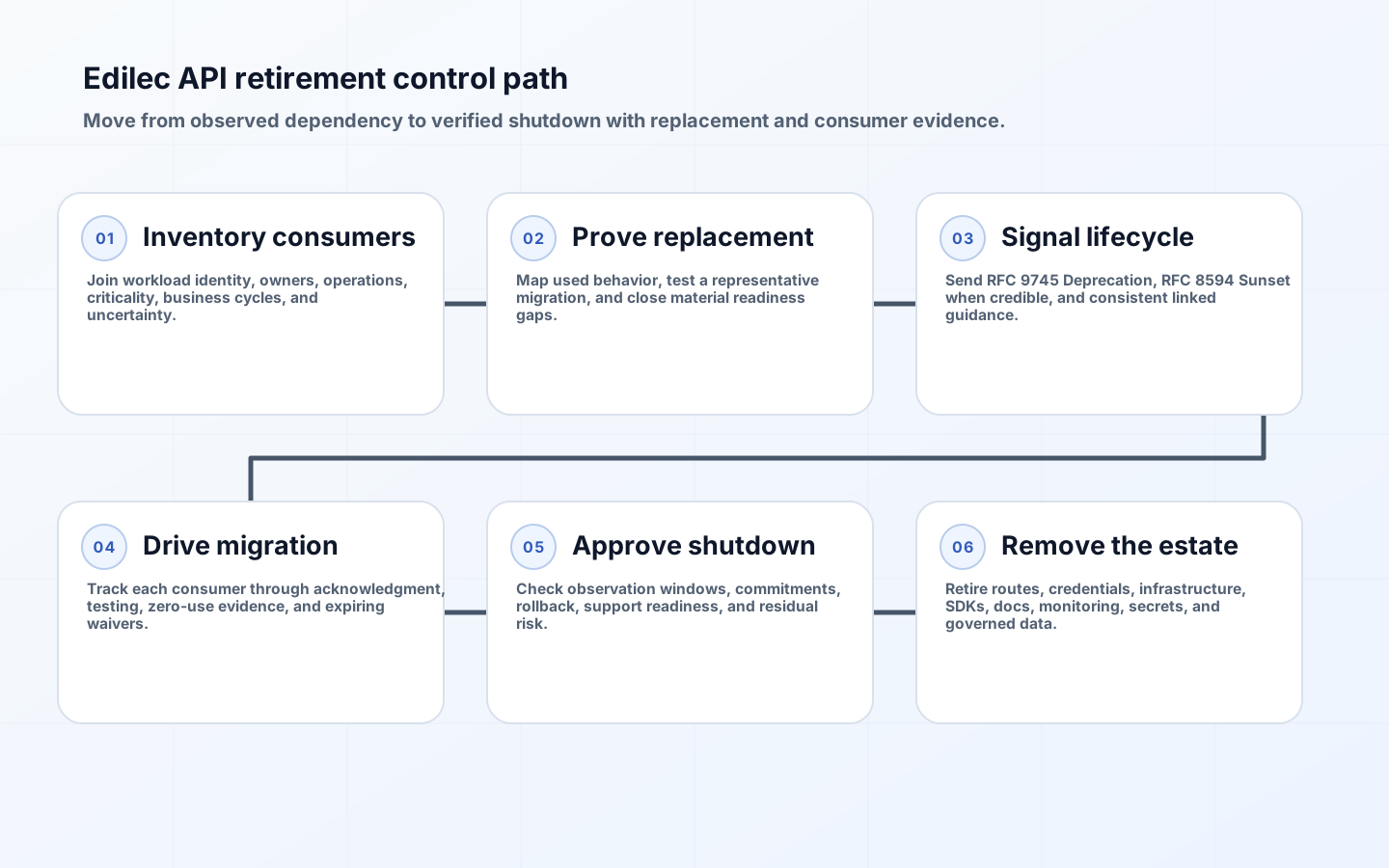
Build the six-stage retirement control path
Identify consumers before announcing a date. Prefer authenticated client or application identity over IP address, user agent, or human account. Join gateway logs, service telemetry, issued credentials, developer-portal registrations, contracts, support records, integration catalogs, and repository searches. Record uncertainty: shared credentials, NAT, batch traffic, and delegated calls can hide distinct workloads. Fixing identity is part of retirement work, not a reason to call unknown traffic inactive.
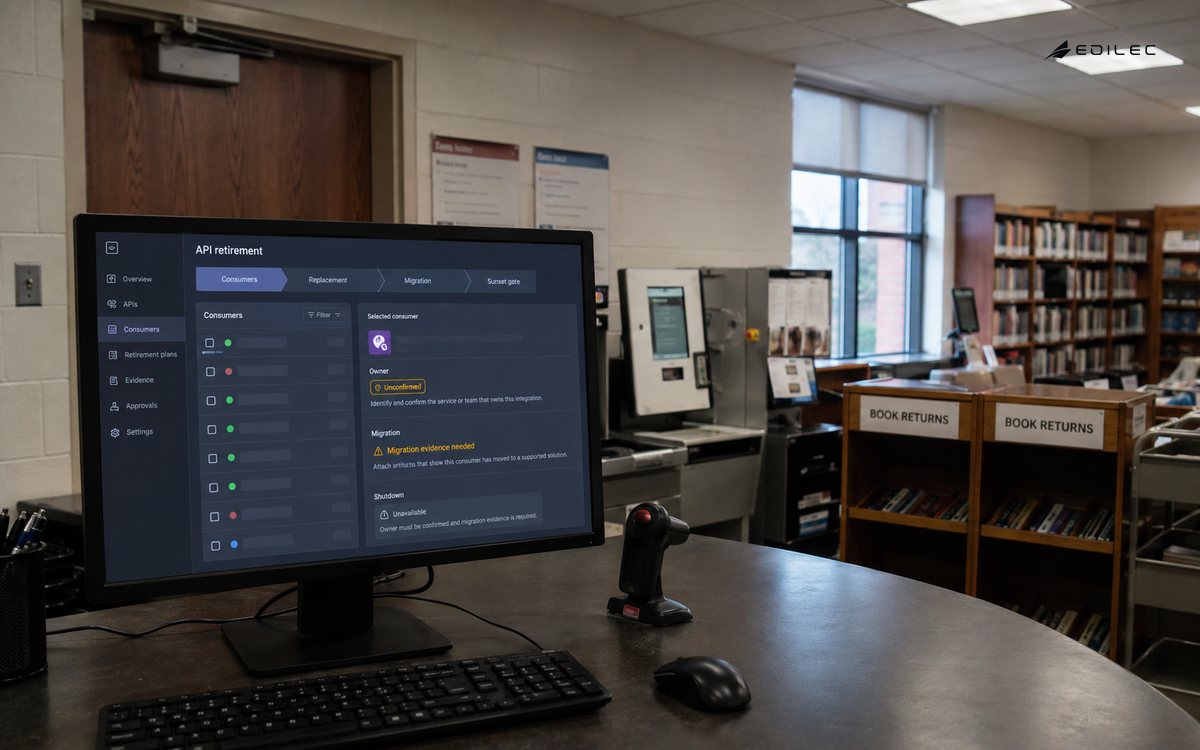
Create one migration record per consumer and API surface. Name business owner, technical owner, operation usage, data sensitivity, peak schedule, dependency criticality, replacement, migration state, last confirmed contact, and target exit. Distinguish calls that prove dependency from health checks, retries, scans, or abandoned credentials. A consumer with one monthly settlement call can be more important than a test client making a million requests.
| Evidence | What it reveals | Blind spot | Control |
|---|---|---|---|
| Authenticated client ID | Stable application-level usage | Shared or rotated credentials | Require workload-scoped identity and owner metadata |
| Gateway or service logs | Operations, status, timing and volume | Sampling and retention gaps | Preserve retirement metrics for the full window |
| Distributed traces | Downstream call path and initiating service | External and batch consumers may be absent | Join with portal and contract records |
| Developer portal | Registered owner and subscribed product | Registration can be stale | Require periodic ownership confirmation |
| Repository search | Known code references and generated clients | Vendored binaries and runtime configuration | Treat as supporting, not definitive, evidence |
| Commercial/support records | Customer commitments and escalation path | Technical identity may not map cleanly | Link account to observed client IDs |
Prove replacement readiness before starting the clock
A replacement needs functional parity for the retiring use cases, not feature-by-feature resemblance. Map every used operation and behavior to the new path, including authentication, authorization, pagination, errors, rate limits, idempotency, webhooks, SDKs, regions, data residency, and support. Document intentional differences and migration transforms. If no replacement exists because the capability is ending, state that plainly and give consumers a business off-ramp rather than describing removal as an upgrade.
Run a representative migration before broad announcement. Measure build changes, data reconciliation, performance, operational support, rollback, and time. Publish examples and test environments that reflect the production contract. The deprecation window should start only when ordinary consumers can migrate; announcing while the replacement is undocumented or materially incomplete spends the window without reducing dependency.
Define replacement acceptance in consumer terms. A platform team may consider a new endpoint complete because every old operation has an analogue, while a consumer still lacks equivalent batch limits, service-account permissions, regional availability, webhook behavior, or test fixtures. Record these gaps against observed use cases and assign delivery dates. Where replacement behavior is intentionally different, give clients a deterministic translation guide and a reconciliation method so they can prove that business outcomes remain correct.
Use Deprecation and Sunset signals correctly
Send Deprecation on the affected responses according to RFC 9745 and include a Link with the deprecation relation to stable migration information. The header can communicate that deprecation is in effect or scheduled. Do not invent incompatible boolean strings when the standard uses a structured date form. Apply signals at the correct scope: endpoint, version, or resource. Test behavior through gateways and caches so headers are neither stripped nor added to unaffected APIs.
Send Sunset only when there is a credible unavailability date. It uses an HTTP date and should not imply that service is guaranteed until that instant. Link to policy or migration details where useful. Keep portal banners, SDK warnings, account messages, release notes, and direct outreach consistent with the headers. Machine-readable signals help observant clients; they do not replace contractual notice or accessible communication.
| Channel | Audience | Best use | Evidence |
|---|---|---|---|
Deprecation header | Runtime clients and tooling | Signal current or scheduled deprecation | Header observation by client and gateway |
Sunset header | Runtime clients and tooling | Communicate expected unavailability date | Conformance test and production sample |
| Deprecation link | Developers and automation | Stable policy, replacement and dates | Published page version and access logs |
| Direct owner outreach | Known high-impact consumers | Confirm plan, blockers and accountability | Acknowledgment and migration record |
| Portal and SDK notices | Developers during maintenance | Reach users outside live traffic path | Versioned notice and SDK release |
| Contractual notice | Commercial customers | Meet agreed communication duties | Approved delivery record |
Operate migration as a portfolio
Segment consumers by criticality, complexity, and control. Internal low-risk consumers can establish the migration playbook. High-volume or revenue-critical customers need named support and early capacity tests. Long-tail unknown traffic needs identity remediation and broad signals. Review the portfolio weekly with counts by state: not contacted, acknowledged, planned, testing, partially migrated, complete, waived, and unknown. Percent traffic alone can hide one blocking consumer.
Give consumers evidence they are finished: zero deprecated calls for a defined observation window across normal business cycles, replacement traffic and outcomes reconciled, old credentials or routes removed, and rollback plans updated. Watch seasonal and disaster-recovery paths. A consumer that is quiet for seven days may still run at month end or only during incident failover.
Govern exceptions without creating permanent legacy service
A waiver should identify consumer, exact surface, business reason, risk, compensating controls, owner, approved expiry, and next review. Require evidence that the replacement gap is real and assign an owner to close it. Price or support implications may be appropriate where contracts allow, but do not surprise customers. Waivers should remain visible in retirement reporting rather than changing the public sunset silently.
Separate a short extension from cancellation. If a systemic replacement defect blocks many consumers, reset the plan transparently and repair readiness. Repeated individual exceptions may reveal missing capability, weak identity, or inadequate sponsorship. Use that evidence to improve the replacement or decide consciously to operate the old API as a supported product with an honest cost model.
Rehearse and enforce the shutdown gates
Before final shutdown, use progressively stronger controls where appropriate: warnings, lower nonproduction availability, blocked creation of new credentials, test-environment removal, or allowlisted production access. Avoid arbitrary degradation that corrupts customer workflows. A dark-read or deny simulation can identify unexpected dependencies without changing results. Publish freeze periods and on-call coverage around enforcement.
A shutdown approval should require replacement readiness, complete consumer disposition, expired or approved waivers, observed zero use for the chosen window, support preparation, rollback mechanics, and executive ownership of residual risk. Make rollback time-bound; instantly restoring the old route without correcting consumer state can recreate ambiguity. Preserve the retired implementation and data only according to security, records, and recovery policy.
Verify retirement and remove the hidden estate
After traffic stops, remove routing, DNS, gateway policies, credentials, certificates, queues, schedules, SDK publication, documentation defaults, monitoring, deployment pipelines, secrets, and data stores. Update threat models and incident runbooks. A disabled endpoint whose credentials and infrastructure remain active is not fully retired. Keep a minimal audit record with approvals, dates, consumer evidence, and disposition of data.
Monitor attempted calls after shutdown and route them to a clear, safe response where policy permits. Investigate by consumer identity; do not simply reopen service for every attempt. Compare cost, security exposure, and operational load before and after retirement to validate the outcome. Feed missed identities and replacement gaps into the next lifecycle plan.
Key takeaways
- Inventory consumers by workload identity, owner, use case, criticality, and observed operations.
- Start the retirement window only after the replacement works for real use cases.
- Use RFC 9745 Deprecation and RFC 8594 Sunset as distinct machine-readable signals.
- Track migration by consumer state and business cycle, not traffic percentage alone.
- Make waivers scoped, owned, approved, and expiring.
- Retire credentials, routes, infrastructure, documentation, data, and runbooks after shutdown.
API deprecation strategy FAQ
What is the difference between Deprecation and Sunset?
Deprecation signals that clients should move away from a resource; Sunset signals when it is expected to become unavailable. A resource can be deprecated before a firm sunset exists. Use both only when each statement is true.
Is zero traffic enough to shut down?
Not by itself. The observation window must cover normal cycles and recovery paths, unknown traffic must be resolved, consumer owners must confirm disposition, and contractual or policy duties must be met.
How long should a deprecation window be?
Choose it from consumer migration effort, release cadence, criticality, contractual commitments, replacement readiness, and business cycles. A universal number ignores the actual dependency and may be either wasteful or unsafe.
Conclusion
API retirement becomes enforceable when every dependency has identity, ownership, evidence, and a disposition. Standard headers make lifecycle state visible in the protocol; replacement parity, direct communication, migration telemetry, expiring waivers, and shutdown gates make it operational. That combination removes obsolete interfaces without treating consumers as an afterthought or leaving an undocumented legacy estate running indefinitely.