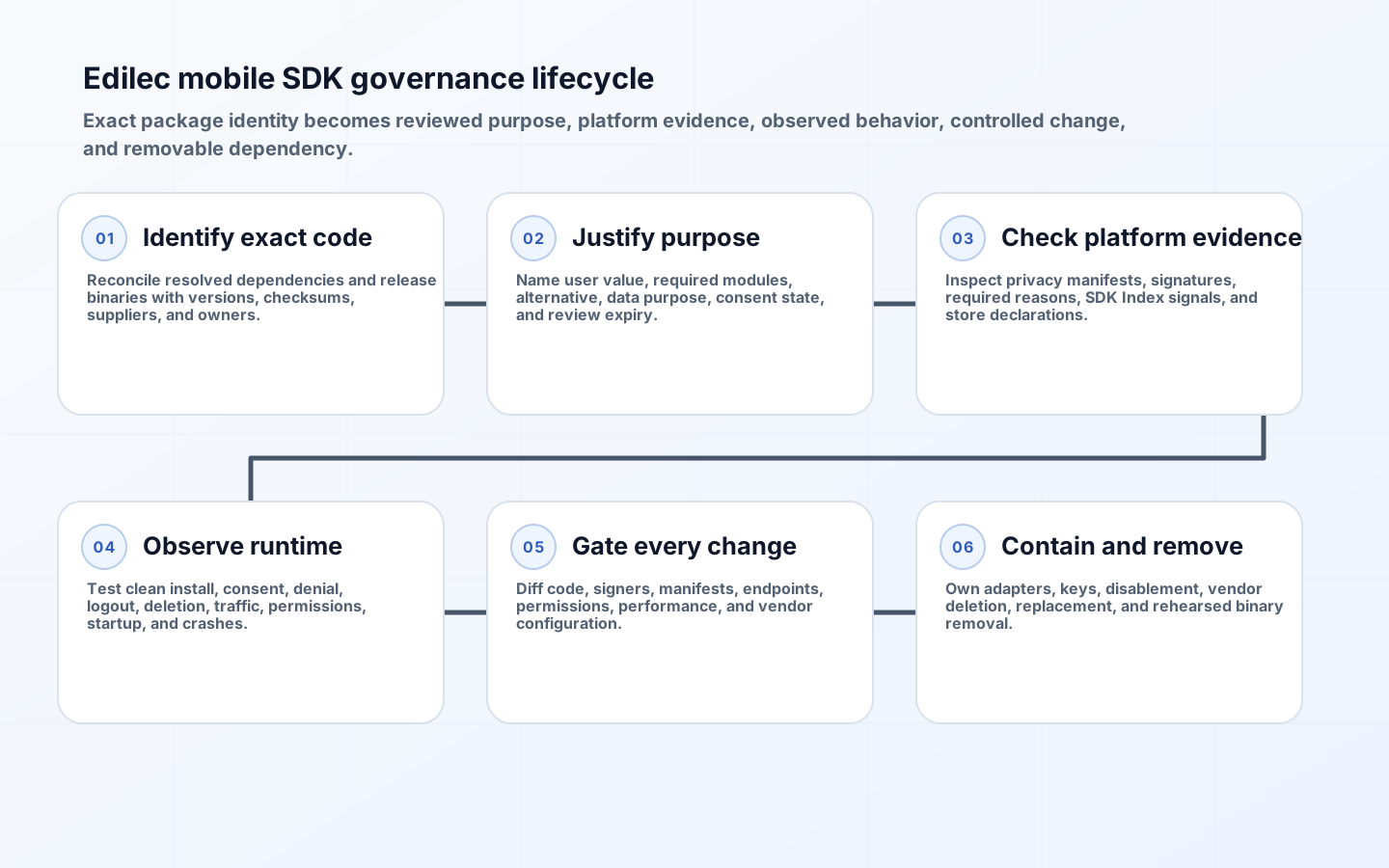
Mobile SDK governance controls code that enters an app with its own release cadence, network behavior, permissions, data model, and policy consequences. A package may reduce delivery time, yet also initialize before consent, expand the binary, degrade startup, introduce native crashes, or change store disclosures. The publisher remains accountable for the assembled app even when a vendor wrote the code.
A legal questionnaire at procurement is not enough. Teams need a versioned inventory, admission evidence, runtime verification, update gates, production monitoring, and a practical exit route. The unit of review is the exact module and version configured in the shipping artifact, including transitive dependencies and optional features, not the vendor's product name.
Build an inventory from the release artifact
Generate a software inventory in CI from resolved dependency graphs and the compiled iOS archive or Android App Bundle. Record supplier, package coordinates, version, checksum, license, introduction owner, business purpose, platforms, transitive packages, permissions, native code, network domains, initialization point, data categories, consent dependency, and removal alternative. Reconcile declared inventory with binary scanning so vendored frameworks and repackaged libraries are not invisible.
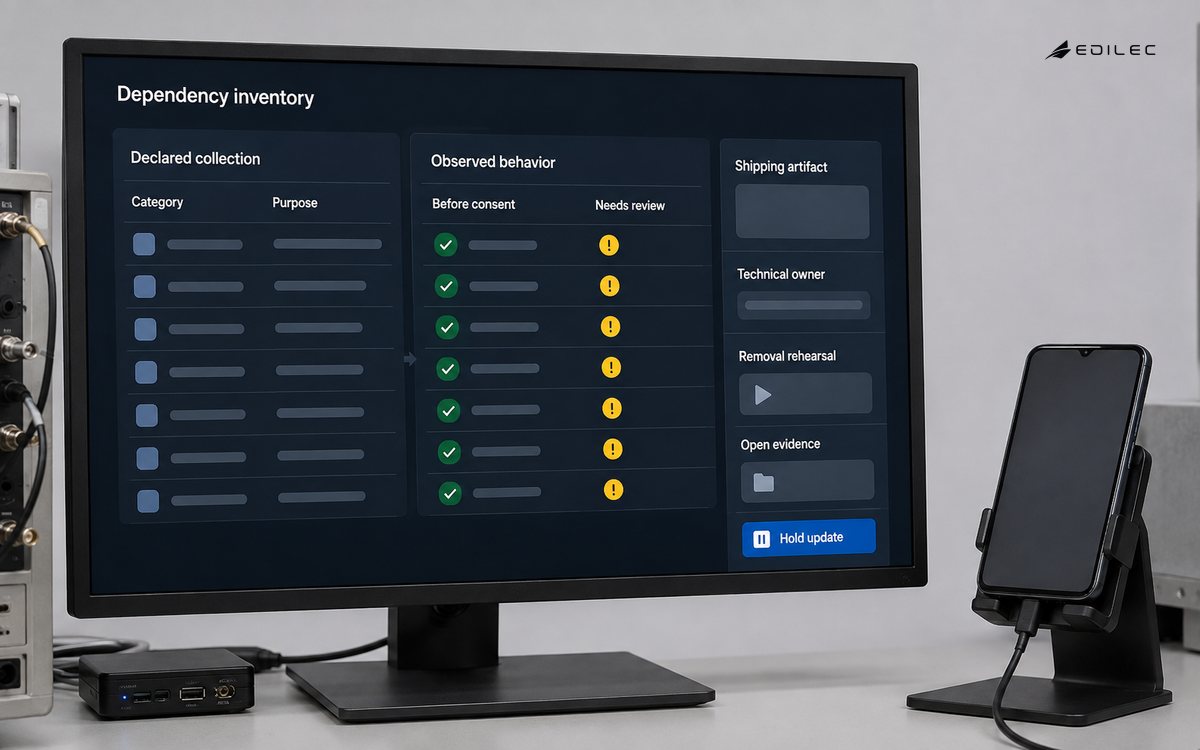
Assign one product owner and one technical owner. The product owner justifies continued collection and vendor use; the technical owner handles updates, incidents, and removal. Time-bound every exception. Feed vulnerability, vendor deprecation, store warning, permission, binary-size, and runtime endpoint changes into a review queue. An SDK inventory is useful only when a release can be traced back to the exact evidence that approved its contents.
| Field group | Required evidence | Why it matters | Review trigger |
|---|---|---|---|
| Identity | Coordinates, version, checksum, supplier, signature | Distinguishes the reviewed code from a similarly named package | Any resolved-version or signer change |
| Purpose | Feature owner, user value, alternative | Prevents unused collection from becoming permanent | Feature retirement or ownership change |
| Data | Types, purposes, recipients, retention, consent | Supports accurate store and privacy disclosures | Endpoint or behavior change |
| Device access | Permissions, required-reason APIs, background work | Reveals platform-sensitive behavior | Manifest or entitlement delta |
| Operations | Startup cost, crashes, network, kill switch, removal plan | Makes ongoing cost and containment visible | Threshold breach or incident |
Verify Apple privacy manifests and SDK signatures
Apple's third-party SDK requirements list commonly used SDKs that require a privacy manifest and, for binary dependencies, a signature in specified submission cases. Xcode combines manifests into a privacy report, and signature validation helps detect a change of SDK developer. Neither mechanism proves that collection is necessary, disclosed correctly, or harmless; they are evidence inputs, not approval.
Inspect every PrivacyInfo.xcprivacy file and the merged report. Apple's privacy-manifest reference covers collected-data types and required-reason API categories. App Store Connect rejects invalid manifest structures, and covered required-reason APIs need approved reasons that match actual functionality. Compare declarations with symbols, call paths, configuration, consent state, and observed traffic. Escalate a missing or surprising reason to the package owner rather than copying a convenient code.
Verify Google Play SDK and Data safety evidence
The Google Play SDK Index exposes signals such as permissions, version adoption, reliability or safety notices, and links to provider Data safety guidance for many commercial SDKs. It is a screening resource, not a complete registry. Absence from the index is not approval, and provider guidance must be reconciled with the modules and configuration actually enabled in the app.
Google's Data safety instructions place responsibility on the app developer for data handled through third-party libraries and SDKs. Map each transmission to collection, sharing, purpose, optionality, encryption, and deletion behavior. Re-run the mapping when a vendor adds an endpoint or default module. Store declarations should be generated from controlled evidence where possible, then reviewed by privacy and product owners before submission.
| Review area | Accept evidence | Warning sign | Control |
|---|---|---|---|
| Necessity | Specific user capability and measured need | Duplicate analytics or speculative use | Prefer platform API or existing provider |
| Privacy | Data map matches runtime observation and consent | Collection before choice or vague purposes | Gate initialization and minimize fields |
| Security | Maintained package, verified origin, response process | Opaque binary or abandoned dependency | Pin version and define replacement deadline |
| Performance | Budgeted startup, size, memory, network, battery | Eager initialization and background polling | Lazy-load optional modules |
| Exit | Documented data deletion and replacement interface | Vendor types spread through application code | Wrap behind an owned adapter |
Test runtime behavior instead of trusting declarations
Run clean-install tests before consent, after denial, after acceptance, after logout, and after account deletion. Capture DNS and network destinations in a controlled environment; inspect payload categories without retaining unnecessary personal data. Exercise backgrounding, reinstall, ad-limiting settings, regional configuration, child or enterprise profiles, and offline behavior. Compare the new version with the approved baseline for permission prompts, startup spans, binary size, crashes, threads, storage, and battery-sensitive work.
A vendor can legitimately vary behavior by configuration, platform, or remote flag, so keep tests scenario-based. Block release when an SDK transmits before the required user choice, requests an unexplained permission, bypasses certificate or network policy, or changes an essential endpoint without review. Add a remote disable only when it truly stops initialization and transmission; confirm that disabling does not crash call sites or leave queued data to send later.
Govern updates, incidents, and removal
Classify updates by evidence delta rather than semantic-version label. A patch can change collection, signing, endpoints, or embedded dependencies. CI should produce a review diff covering resolved graph, binary symbols, permissions, entitlements, privacy manifests, network domains, licenses, vulnerability findings, size, and test results. Fast-track a version only through a documented emergency lane with a named approver and retrospective evidence.
Wrap vendor APIs behind a narrow owned interface and keep business identifiers separate from vendor identifiers. Document how to stop collection, export or delete vendor-held data, rotate keys, remove server callbacks, and ship an app without the SDK. Rehearse removal for high-impact packages. During an incident, the team must know whether server-side disablement is sufficient or whether installed code requires an urgent binary update.
Control consent, identifiers, and vendor data lifecycle
Model SDK startup as an explicit state machine: unavailable, configured without collection, consent pending, enabled for approved purposes, disabled, and deletion pending. Consent should govern both initialization and downstream server forwarding where relevant. If the SDK creates an identifier before consent, determine whether that creation itself is collection or storage requiring control. Reset or separate identifiers when the user logs out so data from different accounts on one device is not joined accidentally.
Test deletion end to end. Removing local SDK storage does not delete events already sent, vendor profiles, queued uploads, server callbacks, or exported audiences. Document the vendor API, contractual response time, verification evidence, and behavior when the vendor is unavailable. Data retention and purpose changes need the same review as code changes because a stable binary can produce a materially different privacy outcome through server-side configuration.
Apply least privilege to SDK credentials and consoles. Use separate keys by app and environment, restrict package or bundle identity where the provider supports it, keep server secrets out of the binary, rotate on ownership change, and alert on unexpected origin or volume. Vendor console roles, export access, audience creation, and remote configuration can alter customer impact without an app release, so include them in access reviews and audit collection.
Procurement terms should support the technical controls: change notification, vulnerability handling, subprocessors, data location, deletion, incident cooperation, end-of-life notice, and export on termination. Contract language cannot make an unsafe implementation safe, but missing obligations can prevent the team from investigating or removing one. Reassess the package when the supplier is acquired, changes its service boundary, or moves a previously local feature to cloud processing.
Review dormant SDKs as aggressively as active ones. Code behind a disabled feature can still initialize, remain vulnerable, increase binary attack surface, or reappear through configuration. Remove it when its approved purpose ends.
Key takeaways
- Inventory exact resolved SDK versions and reconcile the dependency graph with the release binary.
- Treat privacy manifests, signatures, SDK Index signals, and vendor disclosures as evidence, not delegated accountability.
- Observe runtime behavior before and after consent, denial, logout, and deletion.
- Gate every update on an evidence diff, even when the vendor labels it a patch.
- Own a narrow adapter, remote containment path, and tested removal plan for every high-impact SDK.
FAQ
Is an SBOM enough for mobile SDK governance?
No. An SBOM improves component identity, but it usually does not express business purpose, consent timing, runtime endpoints, collected fields, store declarations, startup cost, or removal readiness. Link component identity to those operational and privacy records.
Does an iOS privacy manifest prove compliance?
No. It standardizes declarations and required reasons. The app publisher still needs to verify that the assembled app behaves consistently with those declarations, that collection is necessary, and that user-facing disclosures and consent are accurate.
How often should SDKs be reviewed?
Continuously for automated signals and at every resolved-version change, configuration change, store-policy change, new data use, incident, or ownership change. Add a periodic portfolio review to remove packages whose business purpose has expired.
Conclusion
A mobile SDK is an operating dependency inside a regulated distribution artifact. Governance works when exact code identity, declared purpose, platform evidence, observed behavior, update control, and exit readiness stay connected. That lifecycle lets teams benefit from specialist packages without surrendering knowledge of what their app does.