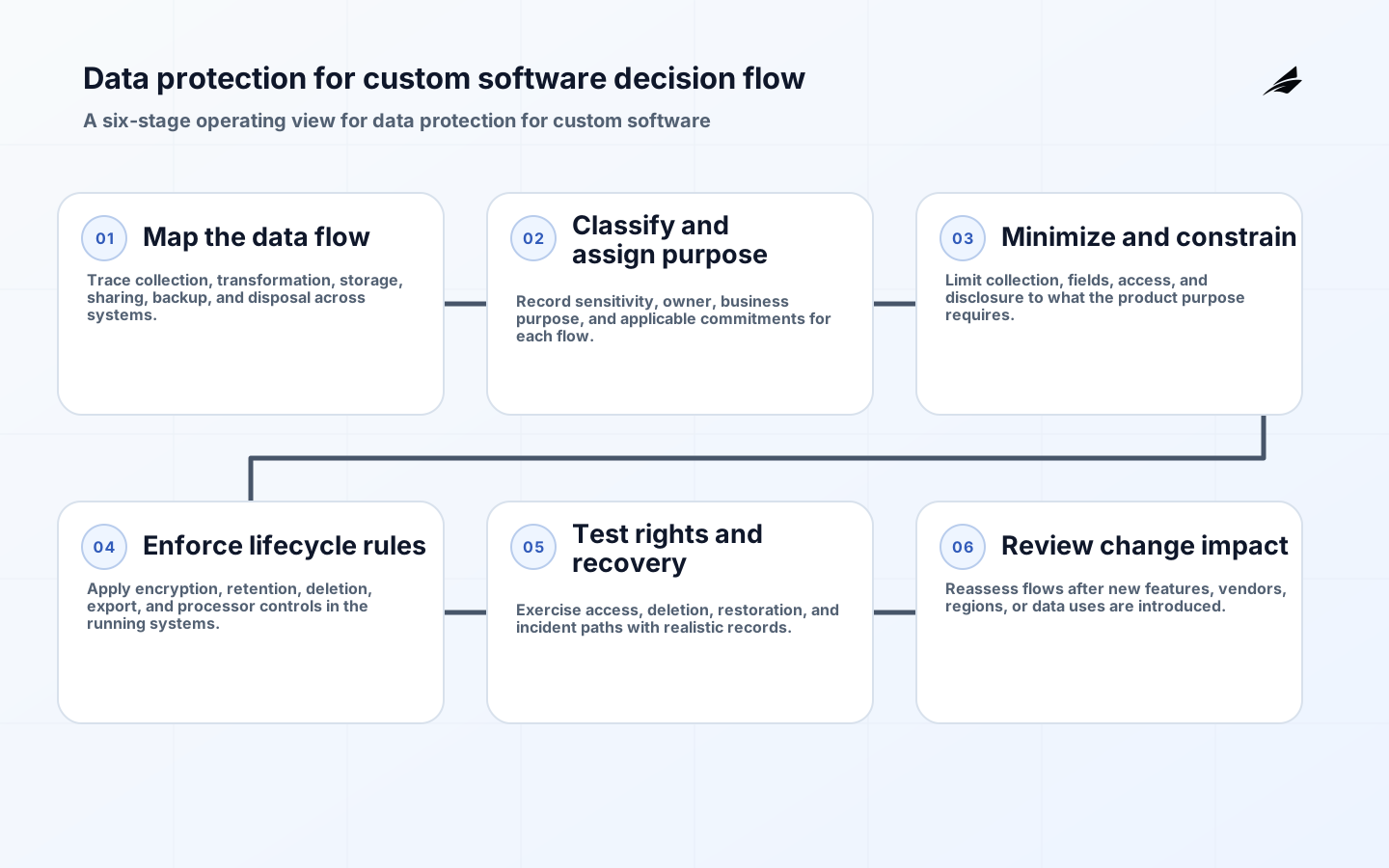
What Enterprise Teams Should Know About Data Protection for Custom Software is an operating problem, not a procurement label. The practical goal is to use and protect personal, confidential, and regulated information in a way that matches the product purpose, customer commitments, and the consequences of misuse or loss. That goal gives a team a useful starting boundary: identify the people and systems that can make the relevant decision, the resources that would be harmed by a mistake, and the conditions under which the service should refuse, pause, or escalate. For a growing organization, the first version should be deliberately narrow. Choose one recurring workflow, name its owner, and make its normal, denied, and exceptional paths visible. That creates a control people can actually operate instead of a policy that becomes urgent only after a customer question or an incident.
Start with the protected outcome for data protection for custom software
The protected outcome for this work is to use and protect personal, confidential, and regulated information in a way that matches the product purpose, customer commitments, and the consequences of misuse or loss. It is helpful to write that outcome before selecting a platform feature or assigning tasks. Then map the assets involved: identity profiles, customer documents, transaction records, analytics events, support attachments, backups, exports, and third-party processors. Ask what a legitimate actor needs to accomplish, what an unsafe or mistaken actor could do, and which decision point can prevent the bad result. This approach keeps the scope grounded in business behavior. It also reveals dependencies such as human approval, identity data, third-party services, background jobs, and support processes that may otherwise be missed because they sit outside the visible application screen.
| Planning area | Decision to make | Useful evidence |
|---|---|---|
| Protected outcome | State how the team will use and protect personal, confidential, and regulated information in a way that matches the product purpose, customer commitments, and the consequences of misuse or loss. | Named accountable owner and written scope. |
| Material assets | Locate identity profiles, customer documents, transaction records, analytics events, support attachments, backups, exports, and third-party processors. | Current service and dependency map. |
| Risk boundary | Define which actions need an explicit decision, additional verification, or a refusal path. | Normal, denied, and exception cases. |
| Review trigger | Set changes that require the design to be revisited. | Dated cadence and escalation route. |
Assign ownership and decision authority
Responsibility should be attached to decisions, not just departments. For data protection for custom software, the business owner accepts the operating outcome and the technical owner maintains the enforcement and evidence path. Reviewers, support staff, and on-call responders need bounded authority: they should know which action they may take immediately, which one needs approval, and who can accept residual risk. Separate the requester of an exception from the person who approves it where the impact is material. A simple responsibility record is usually enough when it includes the owner, decision, authority limit, evidence location, and next review date. Ambiguity here is expensive during a late release or urgent customer escalation.
- Name one accountable owner for the data protection for custom software outcome and a technical owner for each enforcement point.
- Record the approved path, refusal path, and the person permitted to accept a time-bounded exception.
- Use authoritative identity, inventory, configuration, or workflow records rather than private spreadsheets.
- Make emergency actions attributable, narrowly scoped, and automatically expiring where the platform permits it.
- Treat material changes in people, integrations, data use, or service design as review triggers.
Design an enforceable decision point
Write the rule as observable behavior. In this case, maintain a living data-flow view, collect only what an approved purpose needs, and enforce access, retention, and disclosure rules at the services that handle the data. Keep the decisive check as close as possible to the protected resource or business operation. A client-side message, training reminder, or upstream ticket can support the process, but it cannot be the only barrier when a direct request can bypass it. Be explicit about trusted inputs, their freshness, and the safe behavior when they are absent. Teams cannot explain where a field originated, which services replicate it, who can export it, or how deletion and retention decisions reach downstream systems. The right failure behavior depends on the operation: refusing a destructive change can be appropriate, while a noncritical read may be queued or served in a constrained mode. Make that choice before urgency narrows the options.
Create evidence people can use
Evidence is useful when it helps a colleague reconstruct a decision without guessing. For data protection for custom software, retain data classification, purpose, source, processor, access decision, retention rule, deletion or export event, and approved exception. Do not collect secrets, full credentials, or unnecessary personal content merely because storage is inexpensive. Instead, preserve proportionate context that connects the request, resource, decision, and outcome. Protect the record from casual alteration and make retrieval practical for the people who investigate issues. A regular sample exercise is more revealing than a claim that logging or reporting exists: choose a recent change, follow the record through the service, and note missing context, inaccessible storage, ambiguous timestamps, or handoffs that require personal memory.
| Operational checkpoint | What to verify | Pause or escalate when |
|---|---|---|
| Coverage | Each material decision has a real service, workflow, or platform control. | A high-impact path has no owner or effective enforcement point. |
| Evidence quality | Records contain data classification, purpose, source, processor, access decision, retention rule, deletion or export event, and approved exception. | A reviewer cannot reconstruct a material action. |
| Exception handling | Exceptions are specific, attributable, compensating, and time-bounded. | An exception has no expiry, approval, or follow-up owner. |
| Recovery readiness | The team can restore the needed capability and validate the result. | The response relies on an untested manual workaround. |
Test normal, denied, and degraded paths
A credible implementation includes negative and degraded-path tests. Exercise a legitimate request, then use the wrong role, wrong tenant, expired approval, stale context, malformed input, unavailable dependency, or an attempted bypass. Confirm the system refuses or constrains the action at the intended boundary, and confirm that the result reaches the evidence trail. Also rehearse the recovery condition: a processor is unreachable, a deletion workflow is delayed, or encryption and key access cannot be validated. A tabletop exercise can clarify people and communications; a small technical test exposes whether access, runbooks, backups, configuration, and dependencies work together. Record the gap as a concrete change with an owner, rather than leaving it as a lesson people are expected to remember.
Measure control health, not activity
Ticket counts and completed training may provide context, but they do not show whether data protection for custom software is protecting the intended outcome. Use a small number of measures tied to observable behavior. One suitable measure is the share of high-risk data flows with an identified owner, documented purpose, enforceable retention treatment, and tested access or deletion path. Pair the measure with a qualitative sample: take a recent decision and inspect the request, enforcement, evidence, exception handling, and recovery assumptions from end to end. This keeps the discussion focused on the quality of the service rather than a dashboard that rewards volume. When a measure worsens, ask whether the cause is a real exposure, a changed workflow, weak ownership, or a blind spot in the measurement itself.
Prepare for change and recovery
Resilience means choosing behavior before a disruption. Treat an unreachable processor, a delayed deletion workflow, or unvalidated encryption and key access as a design input, not an edge case to defer. Decide whether the safe response is refusal, read-only access, a bounded queue, or a narrow emergency route, and make the answer different only when the business consequence justifies it. Keep emergency access distinct from ordinary access, record every use, and remove it promptly. Protect the ability to observe and restore the workflow as carefully as the live path. After a recovery exercise, capture what took longer than expected and turn the finding into an owner, date, and verifiable change.
Use the data protection for custom software operating flow
The operating flow brings the important handoffs into one reviewable sequence: name the outcome, establish the facts the decision needs, enforce the rule, preserve evidence, respond to failure, and improve the next cycle. Discuss it with the people who perform the work rather than only with the people who approve the policy. Their examples expose gaps between intended behavior and the service an operator can rely on. For adjacent design choices, see data-protection planning for cloud migration. The purpose is not to make every workflow identical; it is to ensure that important deviations are deliberate, owned, and visible.
Key takeaways
- Data protection for custom software works when the protected outcome, owner, and decision boundary are explicit.
- Place enforcement where the service can actually refuse an unsafe action.
- Keep proportionate evidence that connects a request to its outcome without retaining unnecessary sensitive content.
- Make exceptions narrow, attributable, compensating, and time-bounded.
- Practice a realistic failure and recovery scenario before a dependency or incident forces improvisation.
Frequently asked questions
Conclusion
Data protection for custom software becomes dependable when it is attached to a real business outcome and practiced as an operating routine. Keep the first scope narrow, make authority and enforcement clear, preserve evidence people can retrieve, and choose recovery behavior before pressure arrives. The practical next step is to trace one recent high-impact decision end to end: what was requested, which asset was affected, who or what acted, which rule applied, what record remains, and how the team would recover if part of the system failed. Wherever the answer is uncertain, assign an owner and improve that specific handoff.