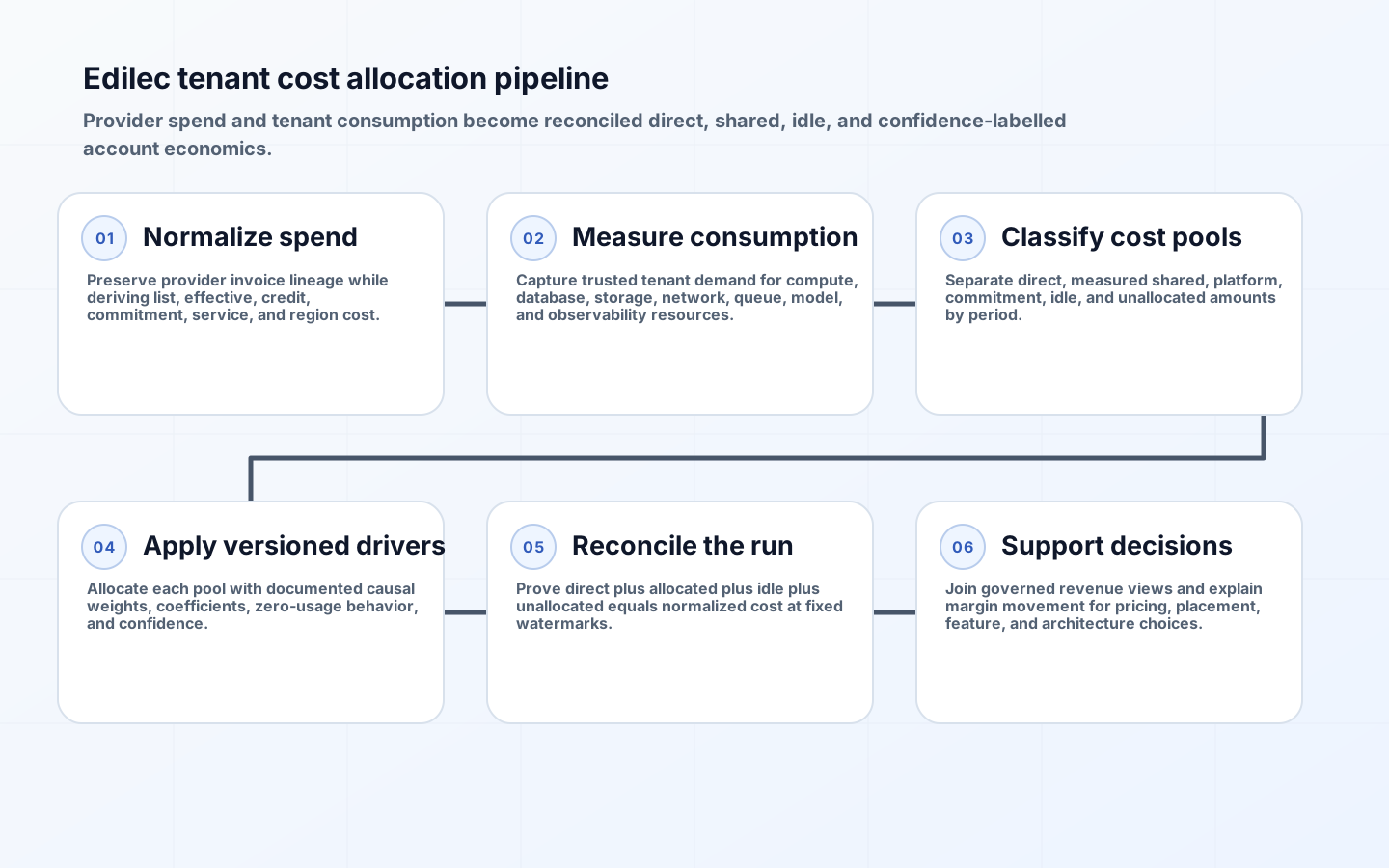
SaaS tenant cost attribution connects pooled infrastructure spend to the accounts and product behaviors that cause it. A cloud bill rarely contains a tenant ID for shared compute, databases, caches, queues, observability, or platform teams. Dividing all spend by active customers is easy, but it hides expensive workloads and assigns idle capacity to light users without explaining the rule. Useful account-level margins require causally meaningful drivers and visible uncertainty.
The model should support decisions, not manufacture accounting precision. Finance determines which costs belong in official gross margin under company policy. The engineering allocation model provides operational cost-to-serve evidence for pricing, architecture, support, and placement decisions. Label direct, allocated, estimated, and unallocated amounts so readers know what the number can support.
Define the cost scope and business unit
Choose a reporting grain such as tenant-month, account-day, workspace-month, or contract-period and define the account hierarchy. Decide which technology costs are in scope: cloud usage, SaaS vendors, observability, support tooling, network egress, committed-discount adjustments, platform labor, and shared corporate overhead. Keep several views if different decisions need different scopes rather than forcing one overloaded metric.
| View | Included cost | Primary decision | Important caution |
|---|---|---|---|
| Marginal serving cost | Variable resources that rise with use | Overage price and abuse control | Excludes reserved headroom and fixed platform |
| Technical cost to serve | Direct and allocated production technology | Architecture and tenant placement | Not an official financial margin by itself |
| Fully loaded service cost | Technology plus approved support and platform labor | Segment economics and packaging | Allocation choices dominate small accounts |
| Contract contribution view | Approved service cost against contracted revenue | Renewal and sales guardrails | Needs finance-owned revenue treatment |
| Feature unit cost | Cost assigned to workflow or capability | Roadmap and optimization | Shared journeys can be double-counted |
| Capacity planning view | Used plus idle and forecast commitments | Purchase and scaling decisions | Should not be charged blindly to customers |
The FinOps Foundation defines Unit Economics as bringing technology spend together with the value created and recommends metrics tied to organizational decisions. For SaaS, useful denominators can include tenant, active seat, transaction, workflow, storage unit, model token, or revenue. Cost per tenant is a starting lens; cost per meaningful product unit explains why two tenants differ.
Build reconciled cost and consumption ledgers
Normalize provider billing into a cost ledger with billing period, provider, account, service, resource, region, usage quantity, list cost, effective cost, credits, taxes where relevant, commitment allocation, tags, and invoice lineage. Preserve the raw bill and transformation version. The normalized total must reconcile to the approved billing scope before tenant allocation starts. Unknown or late provider adjustments remain visible rather than being spread silently.
Create a separate consumption ledger from application and platform telemetry. Every record needs tenant, service or feature, resource dimension, quantity, time bucket, source, and quality status. Propagate trusted tenant context through requests, jobs, queues, storage, model calls, and exports. Do not place tenant ID on unconstrained metric labels if cardinality would destabilize observability; aggregate in logs, traces, billing events, or a dedicated metering pipeline.
Classify direct, shared, idle, and unallocated cost
| Cost class | Example | Preferred rule | Fallback |
|---|---|---|---|
| Direct tenant resource | Dedicated database or model endpoint | Assign actual effective cost | None; fix resource ownership metadata |
| Measured pooled variable | Compute, queries, object operations | Allocate by resource-weighted consumption | Domain proxy with confidence label |
| Shared service | Control plane, cache, observability | Allocate by causal demand driver | Equal or revenue-weighted only if approved |
| Reserved capacity and idle | Minimum nodes, committed baseline | Show separately; allocate by capacity policy | Proportional used capacity with explicit caveat |
| Platform overhead | Shared gateways, security tooling | Stable driver such as workload count or usage | Approved fixed pool rule |
| Unallocated | Missing tags or consumption | Keep visible and assign owner | Temporary pro rata bucket, never hidden |
AWS's SaaS Lens pool isolation guidance notes that pooled infrastructure improves efficiency but makes tenant cost tracking harder and calls for granular instrumentation. That instrumentation should follow each resource's cost function. Database CPU seconds, rows scanned, bytes stored, model tokens, queue requests, egress bytes, and task duration are usually more causal than generic API request count.
Calculate allocations with explicit formulas
For cost pool p and tenant t in period d, calculate an allocation weight from the approved driver, then assign pool_cost × tenant_weight / total_weight. Define behavior when total weight is zero and when telemetry coverage is incomplete. For a database pool, a composite weight might combine normalized CPU time, I/O bytes, storage byte-hours, and backup bytes using coefficients derived from the service bill or controlled experiments. Publish coefficients and version changes.
Avoid double allocation. If a dedicated tenant database cost is assigned directly, exclude it from the pooled database cost. If observability vendor charges are already embedded in a platform fee, do not add them again. Reconcile the sum of direct, shared, idle, and unallocated results to normalized spend by period and service. Store allocation runs immutably with input watermarks and model version so historical margins do not drift when a formula changes.
Treat shared, idle, and commitment economics separately
Idle cost can be strategic headroom, failure-domain redundancy, minimum service footprint, forecasting error, or waste. Assigning it to current users in proportion to consumption may obscure the operational decision that created it. Report it as a separate pool and choose a policy: platform overhead, tier reservation, region overhead, or allocated capacity. This distinction helps engineering optimize utilization without making a low-traffic tenant appear inherently unprofitable.
Commitment discounts also require policy. Effective provider cost may reflect reserved capacity or negotiated commitments purchased for a portfolio. Allocate benefit according to finance and FinOps policy, such as eligible usage, actual coverage, or a central portfolio pool. Keep list-cost and effective-cost views so teams can distinguish architectural efficiency from procurement benefit. A tenant's margin should not swing merely because a central commitment was purchased on a different day without an explained model.
Operate a reliable attribution pipeline
- Ingest and normalize provider bills while preserving invoice and adjustment lineage.
- Ingest tenant consumption with coverage, freshness, and source-quality indicators.
- Map resources and services to direct, shared, idle, platform, or unallocated pools.
- Run versioned allocation formulas at a closed period and record input watermarks.
- Reconcile allocated totals to normalized cost and quarantine material differences.
- Join approved revenue and contract dimensions only in governed margin views.
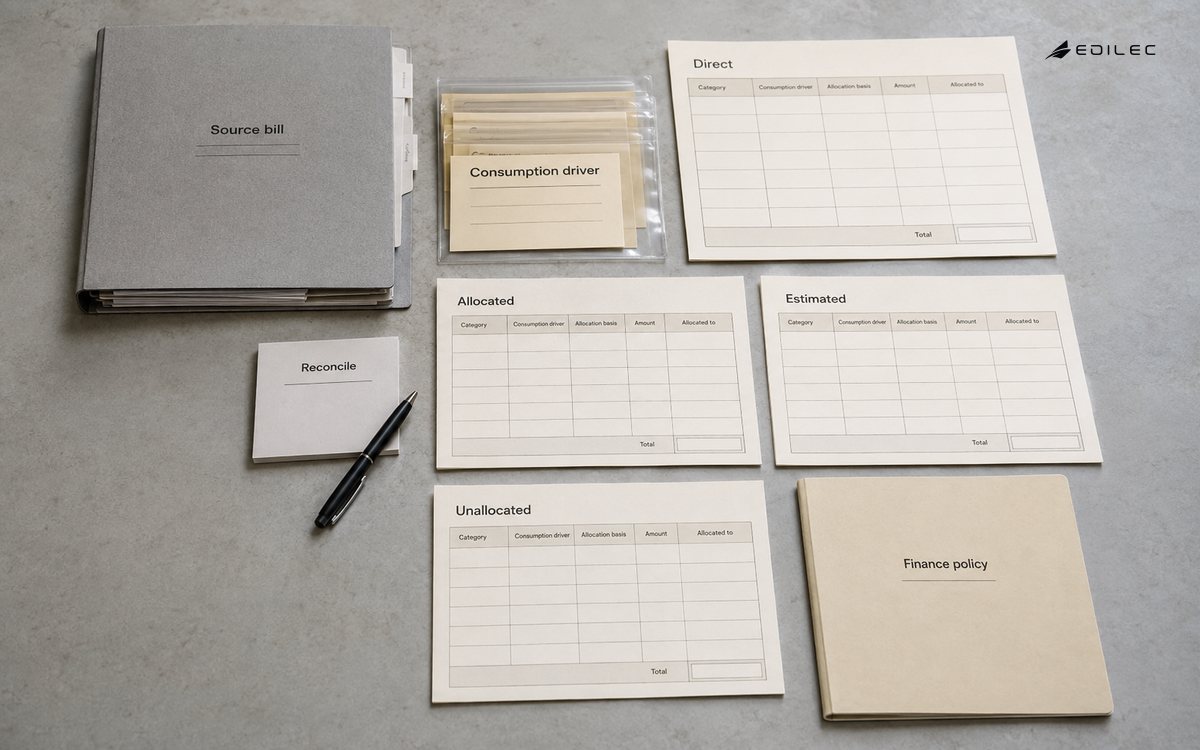
The FinOps Allocation capability emphasizes assigning technology costs using metadata and hierarchy so stakeholders can understand and act. In a SaaS product, resource metadata alone is insufficient for pooled services; application context supplies the tenant dimension. Join through controlled identifiers and effective intervals because tenants move between shards, regions, and tiers over time.
Measure attribution quality and confidence
Track percent of spend direct, causally allocated, proxy allocated, idle, and unallocated; telemetry coverage by service; late cost and usage; reconciliation difference; allocation volatility; and model age. Attach a confidence grade at service and tenant level. A customer with a dedicated database and complete model-token events can have higher confidence than one dominated by an uninstrumented shared search cluster.
Validate with controlled experiments and architecture events. Move a test tenant's workload, increase a known usage dimension, or isolate an expensive job and confirm cost response. Compare aggregate allocated trends with provider service trends. Investigate sudden margin changes through a waterfall: revenue, direct cost, consumption, coefficient, idle policy, discounts, and data quality. Do not let teams optimize against a number whose movement cannot be explained.
Turn cost evidence into product decisions
Use distributions, not only averages. Show median and tail cost per account, tier, region, workload, and feature. An expensive tenant may be profitable because its contract and usage pricing match cost; a small tenant may be costly because of support or a fixed dedicated footprint. Combine cost with service quality so savings do not reward throttling that violates the offer.
Decision examples include introducing a billable high-cost export, changing an unbounded search workflow, moving a tenant to a dedicated stamp, adjusting included model tokens, funding cache work, renegotiating a region-specific contract, or retiring a feature whose cost exceeds value. Keep account-level data access restricted: cost and margin information is commercially sensitive and should not become a broadly visible operational label.
Key takeaways
- Define the cost scope, account hierarchy, period, and decision before choosing formulas.
- Reconcile normalized provider cost before allocating it to tenants.
- Build tenant consumption evidence using causal resource drivers and trusted context.
- Keep direct, shared, idle, commitment, platform, and unallocated costs visible.
- Version formulas and retain immutable runs so historical results remain explainable.
- Publish confidence and use margin distributions with service quality, not simplistic rankings.
SaaS tenant cost attribution FAQ
Should shared costs be allocated by revenue?
Revenue can be an approved financial allocation basis for some overhead, but it does not explain infrastructure causality. Use consumption drivers for engineering decisions and retain a separate finance view where revenue weighting is appropriate. Mixing both without labels makes optimization misleading.
Can cost per tenant ever be exact?
Direct dedicated resources can be close to exact within billing semantics. Pooled services require allocation assumptions, and provider bills include discounts and delayed adjustments. The goal is reconciled, stable, decision-fit evidence with quantified confidence, not fictional precision.
Should customers see their attributed cost?
Usually they should see contracted usage and charges, not internal cost or margin. Internal allocation models can change and include sensitive procurement information. Customer reporting should come from billing meters and the agreement, while internal teams use cost attribution to improve packaging and architecture.
Conclusion
Account-level economics become useful when spend, consumption, allocation policy, and confidence are traceable. A reconciled cost ledger, tenant-aware telemetry, causal drivers, explicit idle treatment, immutable model runs, and decision-focused views reveal where SaaS architecture creates or erodes margin without pretending every shared cent is directly observable.