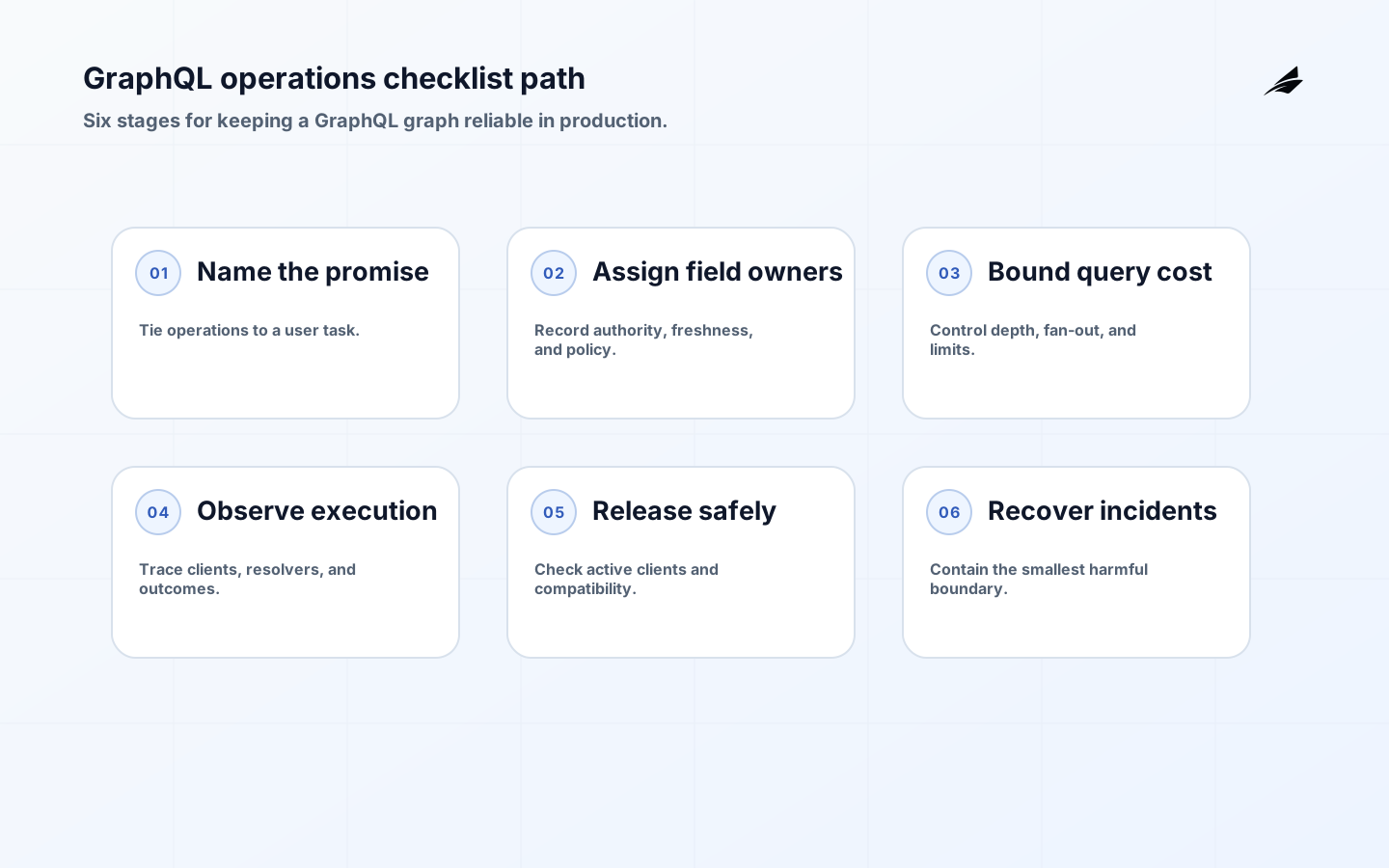
GraphQL tradeoffs do not disappear after a schema is published. In reliable digital operations, the graph is a live execution surface: a query may fan out across services, a field may reveal data that another role must not see, and a mutation may return before an asynchronous process has reached a durable result. A checklist is useful only when it names the owner, evidence, and action behind each control. This guide focuses on operating a graph after the first client exists. It covers query shape, resolver ownership, cost limits, authorization, caching, telemetry, incremental safelisting, release review, and the incident questions that let a team decide whether to expand, contain, or redesign.
Name the graph’s promise and its expensive paths
Write down what the graph should make better: a case worker assembles a complete record without six screens, a mobile client receives only the fields it needs, or several product surfaces share a typed domain contract. Then list the operations that could be expensive or consequential. A query that traverses organization, users, projects, and audit history may be acceptable for a support role once a day and unsafe as an unrestricted public operation. The GraphQL specification defines the language and execution model, but your team must supply the workload budget, role policy, and recovery behavior. Attach each operation to a client, owner, expected latency, and business outcome.
| Checklist area | Decision to record | Signal to review |
|---|---|---|
| Promise | Which task or client does the graph improve? | Task completion and payload or call reduction. |
| Cost | Which query shapes can exhaust resources? | Depth, breadth, fan-out, and execution time. |
| Authority | Which service or record decides each field? | Owner, source, and freshness. |
| Recovery | What can a user or operator do after a partial result? | Pending, retry, reconcile, or escalation state. |
Assign ownership at field, resolver, and operation boundaries
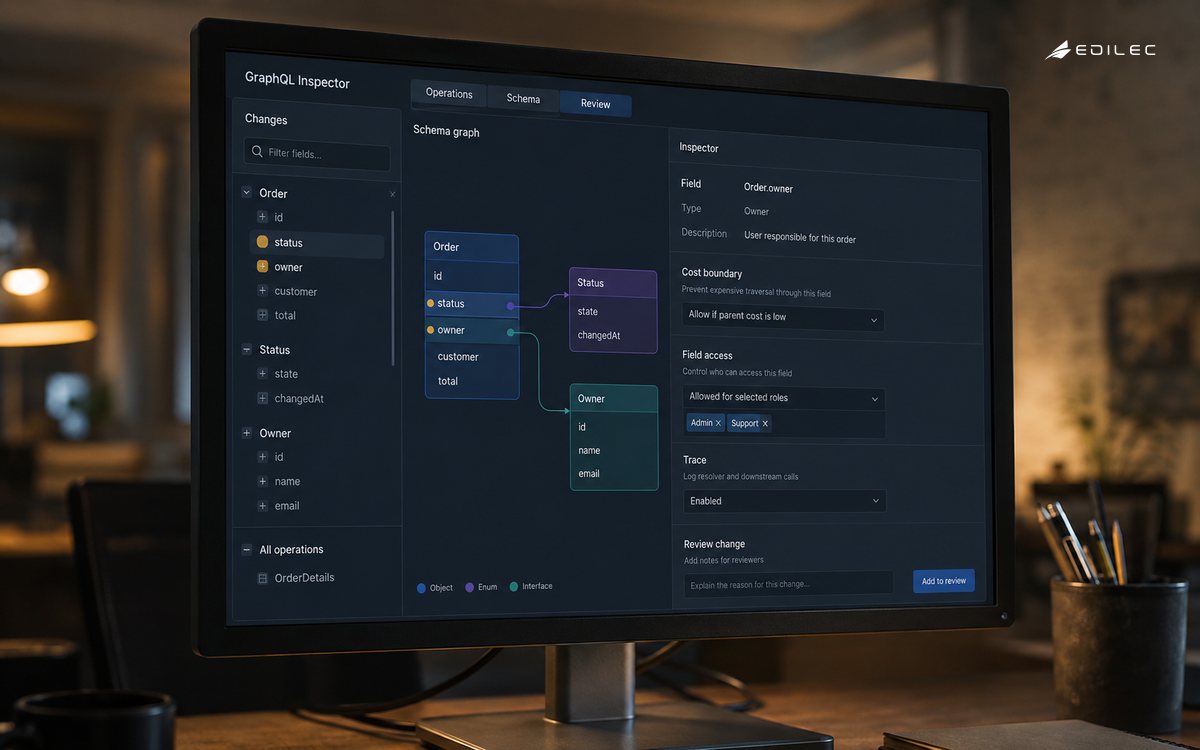
A graph can look unified while its data and policies remain distributed. Give each type and field an owner who can explain its source, authorization rule, freshness, and failure mode. Make resolver boundaries visible in traces and code review. If a field combines several services, document whether it is a computed view, a cached projection, or an authoritative value. A new field should arrive with a client use case, a cost estimate, a permission test, and a deprecation plan if its source is unstable. The owner is accountable for keeping those facts true after a service or schema refactor, not only for merging the initial pull request.
Keep nullability, errors, and mutation status honest
Nullable data is not a complete error model. A field may be absent because it does not exist, is not permitted, is stale, or failed to load. Define the difference where the client needs to make a decision, using stable error categories and safe status fields rather than relying on a missing value to carry several meanings. For mutations, distinguish accepted, processing, completed, rejected, and unknown outcomes. A response with data and errors can be useful for a read, but it should not cause a client to show a false success for an action whose durable result is still uncertain.
Enforce query cost before the graph becomes a bottleneck
The operating checklist should include limits for document length, depth, aliases, list cardinality, pagination, resolver time, and downstream calls. Rate limits alone do not protect a graph when one valid query can trigger an expensive cascade. GraphQL performance guidance discusses batching, caching, and pagination; the GraphQL Foundation’s Security Resources add practical pointers for limiting flexible operations. Combine those techniques with a workload budget and a way to reject or defer an operation that exceeds it. Measure cost by operation and client, not only by endpoint, because GraphQL’s single endpoint can hide very different execution paths. Keep a representative worst-case query in load tests and review it when a field adds another relationship.
Use the OWASP GraphQL Cheat Sheet as a security review anchor for input validation, access control, introspection exposure, error detail, and denial-of-service risk. The controls should be enforced at the point where they can prevent harm. A gateway can reject an over-large document, but a resolver still needs field-level authorization. A schema registry can show that a field exists, but it cannot decide whether this user may read this record today. Keep those responsibilities testable and separate.
| Operational risk | Control to implement | Evidence that matters |
|---|---|---|
| Expensive shape | Depth, breadth, pagination, timeout, and cost limits. | Rejected operation count and worst-case traces. |
| N+1 fan-out | Batching or a bounded read model. | Downstream calls per operation and p95 latency. |
| Field exposure | Field or object authorization with negative tests. | Denied-field events by role and client. |
| Untrusted traffic | Rate limits, validation, and optional operation safelisting. | Operation identity, caller, and policy result. |
| Error leakage | Safe categories and redacted details. | Client-facing error samples and security review. |
Make caching and telemetry explain the graph
Cache only when the authority, freshness, and invalidation rule are explicit. A response containing records from several services may not share one safe lifetime. Prefer stable identifiers and field-level or operation-level policies that a team can explain. Measure cache hit rate with origin latency and stale-result incidents; a high hit rate is not a win if it serves an obsolete permission or price. Trace operation name, client, schema version, resolver duration, downstream call count, and error category while redacting sensitive variables. The goal is to reconstruct why a user saw a result and which service made it expensive or incomplete.
Keep a baseline for common operations and review outliers after schema changes. A field that looks cheap in isolation may become costly when nested under a list or requested by a new client. Alert on aged work, error spikes, authorization denials, and resource saturation tied to operation identity. Use an owner and a stop rule: disable a client operation, lower a limit, roll back a schema change, or route the workflow through a safer projection. A dashboard without a response policy is only a historical report.
Adopt operation safelisting in stages when the client set is known
For first-party clients, registered operations can reduce the set of executable queries and improve request handling. Apollo’s persisted query safelisting guidance describes an incremental path: observe unknown operations, register trusted operations, enable rejection of unregistered work, and eventually require operation identifiers where that fits the client fleet. The exact product and router choices vary, but the operational lesson is general: use audit mode to discover what is really in use, communicate the migration window, and keep a rollback or compatibility route. Safelisting does not replace field authorization, input validation, or limits for a registered operation that is still too expensive.
Review schema changes as production changes
A schema check should cover more than whether the new document parses. Compare field usage, nullability, enum values, authorization rules, query cost, cache behavior, error categories, and downstream ownership. Add a field with a known client journey, run compatibility tests against active operations, and set a deprecation date before removing anything. If a resolver changes from a local table to a remote service, expect latency and failure behavior to change even when the GraphQL type is identical. The A Field Guide to GraphQL Tradeoffs for Growing Teams, Frontend Performance Checklist for Reliable Digital Operations, and Authentication Flows Checklist for Reliable Digital Operations provide adjacent context for client, platform, and boundary review.
Give incident responders a graph-specific checklist
When a graph incident starts, identify the operation, client, schema version, caller, variables that are safe to inspect, affected resolver, downstream dependency, and durable business result. Determine whether the problem is an expensive valid query, a missing authorization check, a stale cache, an incompatible field change, or a dependency outage. Contain the smallest boundary that reduces harm: reject a query shape, disable a field, reduce a client’s rate, bypass a broken cache, or pause a mutation. Then reconcile the business records; a 200 response or a GraphQL error does not by itself prove that a mutation did or did not complete.
- Keep operation identity and client context in traces without logging secrets or sensitive variables.
- Maintain a field and resolver owner map that incident responders can use without reading the whole codebase.
- Store a business reference for consequential mutations and make pending or ambiguous status visible.
- Test containment controls in a staging or audit mode before relying on them during an incident.
- After recovery, convert the root cause into a changed limit, authorization test, cache rule, schema contract, or runbook.
GraphQL operations takeaways
- Operate the graph as an execution system with workload budgets, field owners, and honest mutation states.
- Use cost limits, batching, pagination, rate controls, and safe errors as separate layers.
- Make authority and freshness visible for every field that crosses a service or cache boundary.
- Adopt safelisting and schema evolution in measured stages with active-client evidence.
- Give responders an operation-to-outcome path so containment and reconciliation are possible under pressure.
GraphQL operations FAQ
Which GraphQL limit should we set first?
Start with the limit that protects the most consequential resource for your actual workload: commonly document size, depth, list pagination, execution time, or downstream call count. Establish a baseline from real operations, add a representative worst-case query to tests, and watch rejected requests and user outcomes. A limit without an owner and tuning process will either become a silent outage or be disabled when it is needed.
Does operation safelisting replace authorization?
No. Safelisting controls which operations may execute, while authorization decides which caller may read a field or perform a mutation against a specific record. A trusted operation can still request data the current user should not see, and a registered query can still be too expensive without cost controls.
What should support see when a GraphQL mutation is ambiguous?
Support should see a safe business reference, current durable status, last known transition, and the next action such as wait, retry, reconcile, or escalate. Avoid exposing internal resolver errors or asking support to infer completion from an HTTP status. The product should model pending and unknown outcomes when the underlying work can continue after the request ends.
Conclusion: keep GraphQL flexible at the edge and accountable underneath
Reliable GraphQL operations depend on making flexibility bounded and observable. Name the promise, assign field and resolver owners, protect query cost, enforce authorization close to the data, and keep cache and error behavior honest. Roll out safelisting and schema changes with evidence from active clients, then give responders a way to trace an operation to its durable business result. The graph earns its place when it helps teams serve varied clients without making performance, authority, and recovery invisible.