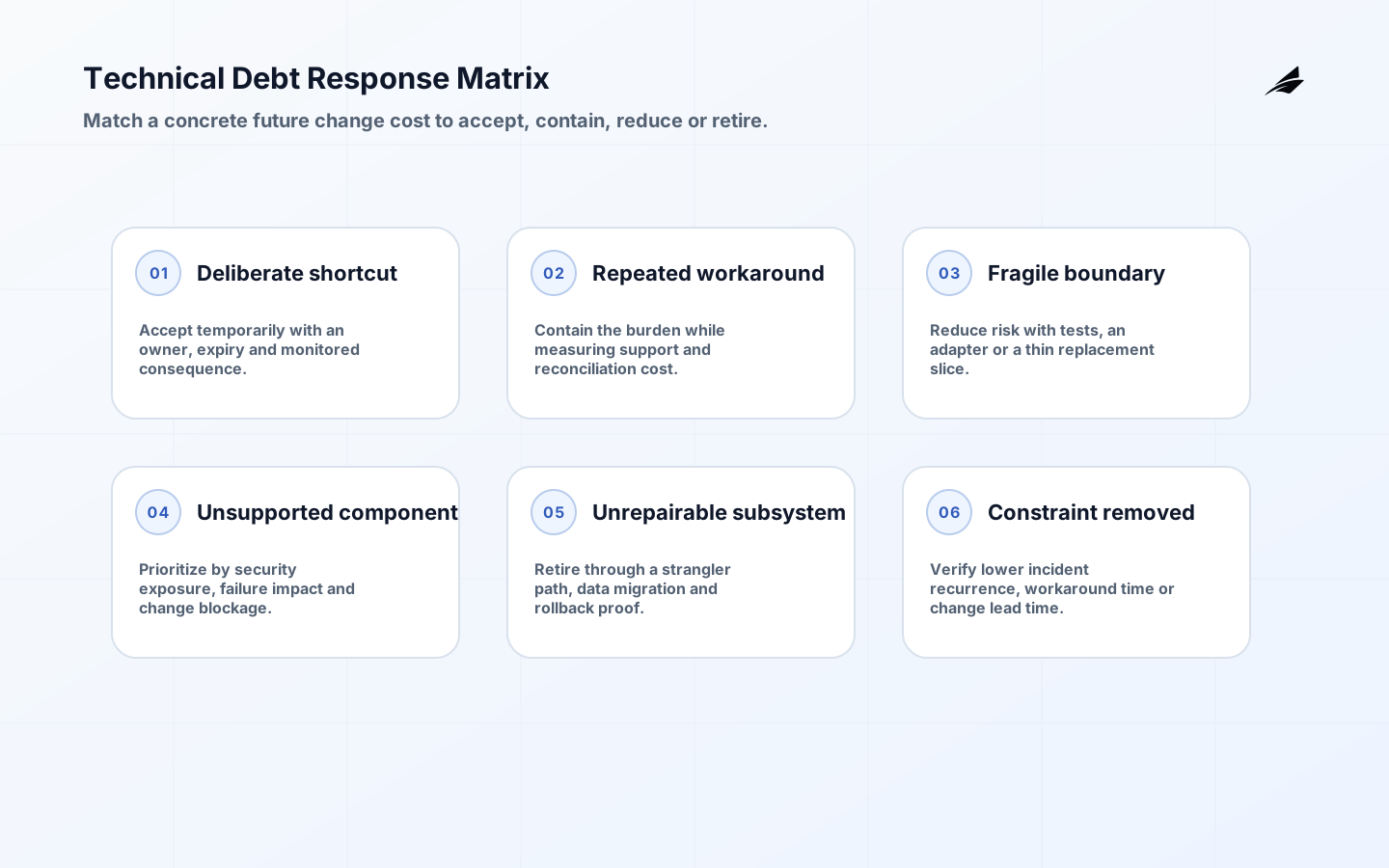
Technical debt becomes useful language when it describes a concrete future cost: a fragile release process, a module nobody can safely change, an unsupported dependency, or a data repair that repeats every month. It becomes unhelpful when it means 'anything we dislike.' Leaders need a connection between a technical condition and a business consequence, such as slower lead time, higher incident risk, missed security support, or an inability to launch a product change.
Make technical debt an explicit operating decision
Classify the debt before estimating it. Some debt is deliberate and time-bound, such as a temporary adapter during a migration. Some is accidental, such as duplicated authorization logic that diverges between services. Martin Fowler's Technical Debt Quadrant is a helpful way to separate prudent, deliberate tradeoffs from reckless or inadvertent ones. The classification is not a moral judgment; it determines whether the next step is documentation, containment, redesign, or removal.

| Decision | Question to answer | Useful evidence |
|---|---|---|
| Debt claim | What condition causes which consequence? | Evidence-linked item |
| Priority | Why act now rather than later? | Risk, recurrence, and leverage |
| Response | Contain, refactor, migrate, or retire? | Bounded plan and owner |
| Exit proof | What shows the cost is removed? | Test, rehearsal, or metric change |
Define the technical debt contract and boundaries
Write a debt item as a testable claim: condition, affected capability, consequence, evidence, owner, and next decision date. 'Rewrite the billing service' is a project label, not a debt item. 'The billing service cannot deploy independently because its migration job locks the shared database for 20 minutes; this blocks weekly pricing changes' is a claim a team can investigate. The NIST Secure Software Development Framework supports the broader practice of integrating risk management throughout development rather than treating it as a final review.
- Describe the technical condition and the specific work it makes costly or unsafe.
- Classify the item as deliberate, accidental, contained, or growing.
- Attach evidence from incidents, lead time, support work, or lifecycle notices.
- Name an owner and a date for the next funding or removal decision.
- Define an exit condition that can be tested or observed.
- Review completed work to confirm the expected constraint is gone.
Build and roll out technical debt in a bounded slice
Prioritize by risk and leverage. Fix debt that repeatedly blocks valuable work, creates a security or reliability exposure, or reduces the ability to detect and recover from failure. Pair a reduction task with a product change when they share a boundary: adding a new payment method is a rational time to isolate payment-provider logic. Establish a measurable exit condition, such as deletion of a legacy pathway, a passing migration rehearsal, or a reduced deployment dependency.
| Failure mode | Guardrail | Signal to monitor |
|---|---|---|
| Vague backlog | Items have no observable consequence | Condition-and-impact template |
| Rewrite reflex | Scope grows before risk is understood | Characterization and boundary experiments |
| Invisible workaround | Staff absorb cost outside tracking | Support and incident evidence |
| Expired shortcut | Temporary path becomes permanent | Decision date and lifecycle check |
Operate technical debt with evidence
Keep the debt register small and active. Review aging items, recurrence in incidents, time spent on workarounds, unsupported component exposure, and the lead time of changes in affected areas. A large inventory with no decisions is a museum of anxiety. Use incident reviews to add evidence, but avoid treating every incident as proof that a full rewrite is justified.
Make technical debt tradeoffs explicit
A rewrite can be appropriate when interfaces, runtime support, and operational model are all beyond repair, but it is the highest-risk debt response. Often a strangler boundary, characterization tests, a data migration rehearsal, or a deployment improvement removes the limiting risk sooner. The software modernization playbook expands on these choices for older systems.
A concrete example keeps the design grounded. A team may keep an old pricing engine because replacing it would delay a launch. That is deliberate only if the temporary adapter has an owner, date, boundary tests, and known cost. When it blocks every pricing change and generates manual repairs, the evidence has changed and the decision should be revisited. Use the example to identify the authoritative record, expected outcome, failure that changes it, and operator who must choose the next action. That turns an architectural claim into a reviewable slice of production behavior.
Use characterization tests before altering poorly understood code. Capture current outputs for representative inputs, edge cases, and known defects, then decide which behavior is contractual and which should change. Add deployment and recovery rehearsals when debt is operational rather than algorithmic. Keep evidence with the change: a reproducible command, expected telemetry, and a note about the failure being exercised. Checks should state the capability being protected, not merely mirror implementation details.
The service owner owns the condition, while product and finance partners assess consequence and sequencing. Security or risk owners should join when a component is unsupported or exposed. Without a named decision-maker, everyone may agree an item matters while nobody can trade it against current work. Agree on a review cadence and escalation route before the first exception arrives. The aim is a timely decision by someone with the right context, not a large committee or a static policy nobody can apply.
Reduce a risky constraint in reversible steps: introduce a boundary, divert a low-risk caller, compare results, and remove the old path after measured stability. Reserve full rewrites for situations where incremental containment cannot satisfy critical invariants at acceptable cost. Publish entry and exit criteria for each step, including the condition that stops expansion. A narrow rollout gives a better learning loop because intended and observed behavior can be compared while scope remains correctable.
Track the cost that motivated the work: deployment lead time, failed-change recovery, manual reconciliation hours, vulnerable-component exposure, or incident diagnosis time. Do not report debt points closed as success; the constrained capability must become easier or safer to change. Ask what action each signal would justify. A metric without an owner, threshold, or practical response is not useful observability; a smaller trusted set is stronger during a release or incident.
Keep the register connected to roadmap and incident review. Retire claims with no evidence, split large claims into testable constraints, and record why a conscious shortcut was extended so the next team inherits a decision rather than a mystery. Include this in dependency review, planning, and incident follow-up so it does not depend on one person's memory. Clear notes should cover normal operation, known limits, emergency authority, and recovery evidence.
Before treating a plan as ready, turn it into a small review exercise. Use one recurring workaround to test whether the proposed reduction removes the cause rather than merely automating the symptom. The exercise should name an owner, expected evidence, and a concrete result that would cause the team to pause. It is intentionally more demanding than a demo: demonstrations often assume ideal data and a cooperative dependency, while real confidence comes from showing that the boundary responds predictably when assumptions fail. Store the result with the relevant change record so the next engineer can repeat the check rather than reconstruct its purpose from an old ticket.
Failure rehearsals are a practical way to protect operational knowledge. Ask a maintainer to reproduce the constraint from the debt record and to show the exit evidence after the change. The person running the rehearsal should use ordinary documentation and permitted tools, not private memory or administrator shortcuts. Note the time needed to detect the condition, make a decision, and verify recovery. Those observations often reveal a missing identifier, unclear authority, or unsafe default before an incident turns the same omission into customer harm. Feed the learning back into tests, runbooks, and the next release rather than treating the exercise as a one-time audit.
Change needs a decision record as well as code or configuration. Record funding decisions, deferred risks, and expiry dates so future planning can distinguish a conscious tradeoff from forgotten work. Include the scope, assumption, approval authority, observable success condition, rollback or correction route, and date for reconsideration. This discipline keeps temporary controls from becoming invisible permanent architecture. It also gives product, operations, security, and engineering a common artifact for resolving tradeoffs, which is far more useful than asking each group to infer intent from dashboards, implementation details, or an incomplete support history.
When the same constraint appears in several teams, decide whether it is local debt or a platform capability gap. Shared observability, deployment tooling, identity, or data contracts may offer more leverage than repeated service-by-service repairs. The decision should still name the adopters and migration cost; a platform is not a debt-reduction outcome unless it removes a specific recurring constraint.
Key technical debt takeaways
- Debt is a constrained-change cost, not a general dislike of old code.
- Concrete evidence makes prioritization possible.
- Deliberate shortcuts need an expiry and monitoring.
- Pairing debt work with product change can reduce migration cost.
- A rewrite is one option, not the default answer.
- Exit conditions prevent debt reduction from becoming endless activity.
Technical debt FAQ
Is all technical debt bad? No. A conscious shortcut with a monitored expiry can be a rational investment. How do founders fund it? Tie work to revenue risk, support cost, security exposure, or delivery speed, then choose a bounded outcome. Can a backlog label manage debt? Only if each item has evidence, ownership, and a decision date.
Conclusion: make technical debt dependable
Technical debt management is an operating habit of making future change costs visible and actionable. Keep claims concrete, choose reductions that unlock real work, and verify that the constraint has actually been removed.