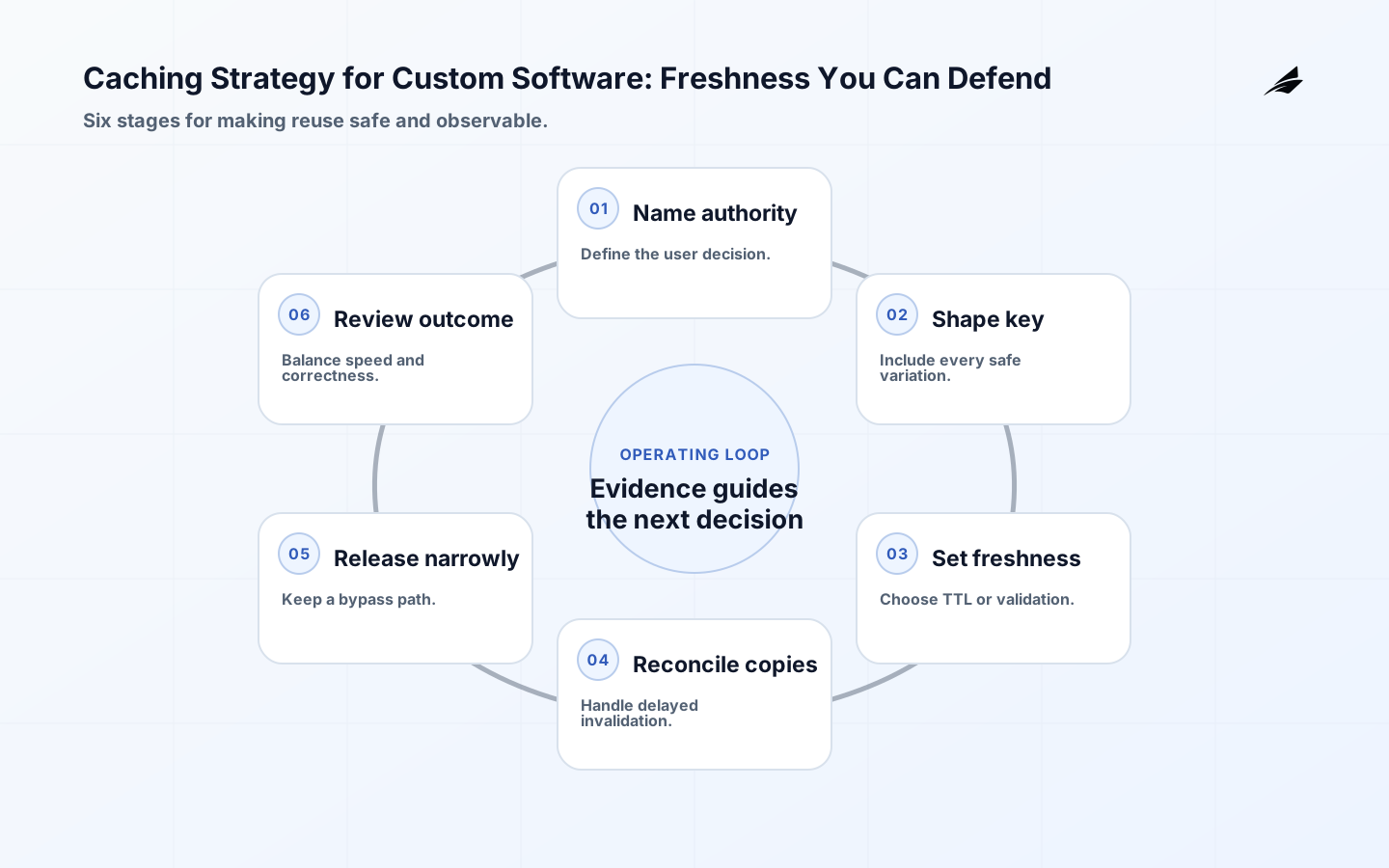
A caching strategy is a correctness decision with a performance benefit attached. Reusing a response can reduce origin work and make a screen feel immediate, but the reused value is only useful while its age, audience, and meaning remain acceptable. A catalogue description, a tenant permission, a live inventory count, and a fraud decision do not share one safe time-to-live. Treat each cached path as a promise: what may be reused, for whom, for how long, and what the system does when freshness cannot be proven.
Begin with the decision the cached value supports

Map the journey before selecting a cache product. Identify the actor, request variation, authoritative record, permitted age, consequence of staleness, and fallback when the cache misses or fails. A product detail page might tolerate a short delay in showing a changed description. Checkout price and inventory should come from the service that owns the transaction, even if the product page uses a cached summary. The HTTP Caching standard defines protocol semantics; the product still has to choose the acceptable freshness window.
| Path | Freshness promise | Authority | Safe fallback |
|---|---|---|---|
| Public content | Minutes or longer if changes are infrequent. | Published content store. | Serve cached response and show no action state. |
| Tenant dashboard | Bounded age with tenant and role variation. | Tenant reporting store. | Read authority or show last-updated time. |
| Inventory view | Short age for orientation only. | Inventory service. | Refresh before committing an order. |
| Permission decision | Current at the point of action. | Access policy and identity state. | Deny or re-check; never use a stale allow. |
| Reference data | Versioned release freshness. | Approved reference dataset. | Use previous version only if the decision permits it. |
Design the key as part of the data boundary
A cache key must vary on every input that can change the representation or the permission to see it. That may include tenant, user role, locale, feature cohort, API version, query parameters, and content encoding. The MDN caching guide explains why a cache associates a stored response with a request and why Vary can be essential. A key that ignores an authorization dimension is not an optimization bug; it is a data-isolation defect.
Choose the cache location with the same care. A browser cache, shared HTTP cache, CDN, in-process map, distributed key-value store, and materialized read model offer different visibility and invalidation controls. The closer a cache is to the user, the more important it is to understand who can receive the response. The closer it is to a database, the more important it is to bound stampedes, eviction, and dependency failure. Keep the key construction in one tested place rather than letting each caller invent its own variation.
Make freshness a visible contract
Choose between a time-to-live, revalidation, write-triggered invalidation, versioned keys, or a combination. A TTL is simple when age is the main requirement. A write-triggered event can reduce staleness but introduces delivery and ordering failure. An ETag or Last-Modified validator can avoid sending an unchanged body while still checking with the origin. The Cache-Control reference is a useful starting point for separating browser and shared-cache behavior through directives such as max-age, s-maxage, private, no-store, and stale-if-error.
| Freshness method | Good fit | Risk to control | Evidence |
|---|---|---|---|
| Fixed TTL | Age is predictable and harmless. | Expiry stampede or unacceptable stale window. | Observed age and miss load. |
| Conditional request | The origin can validate cheaply. | Validators omitted or inconsistent. | 304 rate and origin latency. |
| Write invalidation | A known write must be visible quickly. | Event lost, delayed, or out of order. | Invalidation lag and reconciliation. |
| Versioned key | Content is immutable or release-versioned. | Old keys remain accessible or costly. | Key retirement and storage use. |
| Stale on error | Read-only content can survive a dependency outage. | Stale data influences a consequential action. | Stale age and user disclosure. |
A cache policy should describe what happens when the system cannot refresh. A dashboard may show a last-known timestamp and let an operator request a direct refresh. A permission cache should fail closed or invoke a trusted policy path. For a catalog, serving a slightly old description may be fine while serving an old price is not. Write the fallback in the interface contract so support staff do not have to infer it from a graph during an incident.
Treat invalidation as a distributed workflow
Invalidation crosses boundaries, which makes it a small distributed system. A product update may change the database row, publish an event, clear a read model, evict a CDN object, and reach browsers that still hold a representation. Each step can be delayed. Use a durable outbox or equivalent publication path when a write must produce an invalidation, make consumers idempotent, and run a reconciliation job that compares authoritative versions with cached versions. For a TTL-based cache, the Redis EXPIRE documentation is a reminder that setting an expiry is a concrete key operation, not proof that every related copy has disappeared.
Protect the expiry boundary from stampedes. Add jitter, coalesce concurrent misses, warm only measured keys, and cap refresh concurrency. Do not allow a cache miss to turn into an unbounded fan-out of database queries. When a response is public and edge-cached, inspect the provider behavior as well; CloudFront expiration guidance distinguishes origin headers, distribution TTLs, conditional refresh, and stale serving. Your runbook should say which layer is authoritative when the layers disagree.
Release the first cache in a narrow, observable slice
Instrument before expanding. Select one route with high read volume and limited consequence, keep a bypass to the origin, and compare cached and uncached results for a representative sample. Record key dimensions, hit and miss reason, age, origin latency, eviction, error responses, and the number of requests merged into one refresh. Test cold start, dependency outage, invalidation loss, tenant changes, permission changes, and an application restart. The first release should be easy to disable without deleting the authoritative path.
Pair the change with a simple operational note: who owns the key policy, who can purge or bypass it, what threshold stops the rollout, and how a support person identifies a stale result. Link it to the background jobs guide when asynchronous refresh is involved, the event-driven systems guide when invalidation depends on a broker, and the error handling checklist when a miss or stale response changes the recovery route. The cache should be a documented capability, not a mystery layer that only the original implementer can inspect.
Judge the outcome with correctness and load together
Monitor more than hit ratio. Break signals down by route, tenant class where appropriate, key version, status, age, and dependency. Review origin load during expiry, refresh failures, invalidation lag, eviction pressure, stale responses served during an outage, and requests that bypassed the cache. A high hit ratio can hide a cache that returns the wrong representation; a lower ratio may be acceptable if the origin path is healthy and the cached result is only used for safe orientation.
Set decision thresholds before the dashboard becomes busy. For example, a team may stop a rollout when an authorization mismatch appears, when stale age exceeds a documented promise, or when a miss storm exhausts the database budget. Review the user outcome too: fewer seconds on a page are not a success if users see contradictory order state or support tickets increase. Keep a business reference or request identifier that joins the interface, origin record, invalidation event, and operator action without putting sensitive payloads into the cache key or logs.
Avoid the caching traps that make ownership unclear
Common failures include caching a response before understanding its audience, using one TTL for unrelated data, clearing only the local process cache, and treating a purge button as an invalidation design. Another trap is caching errors or empty results for so long that a temporary dependency problem becomes a durable user experience. Define whether negative responses may be reused, how long, and what event should remove them. Review locale, experiment, and permission changes as key-design changes, not as future cleanup.
Also resist adding a cache to compensate for an unbounded query or an unhealthy source of truth. If the database call is too expensive, first inspect the query shape, index, data model, or read path. A cache can reduce the frequency of a bad operation while making the eventual correction harder to see. Keep a bypass and a rebuild path so the team can learn whether the cache is solving the underlying problem or merely concealing it.
Key takeaways
- Define the user decision, source of truth, acceptable age, and privacy boundary before choosing a cache technology.
- Include tenant, role, locale, representation, and experiment dimensions in the key when they affect the result.
- Select TTL, revalidation, invalidation, versioning, or stale serving according to the consequence of old data.
- Make invalidation idempotent, observable, and reconcilable across every copy.
- Release narrowly and pair hit ratio with correctness, age, origin load, and recovery signals.
Frequently asked questions
What should a caching strategy define first?
Define one journey and its authoritative record. Then write the maximum acceptable age, the request dimensions that vary the response, the invalidation or validation method, and what the user sees when the cache is unavailable. This creates a testable contract before a library or provider is selected.
Is a higher cache hit ratio always better?
No. A high hit ratio may mean that a response is being reused too broadly or for too long. Review hit ratio beside data correctness, response age, authorization variation, origin load, and the actions users take after seeing the response.
When is stale data acceptable?
Stale data is acceptable when the product explicitly accepts the age and it cannot make a consequential decision without a fresh authority check. Display or record the observation time when it changes how a user should interpret the result.
Conclusion: make caching strategy defensible
A durable caching strategy makes reuse explainable. It names the authority, key, freshness promise, invalidation path, privacy boundary, and fallback before performance pressure turns those questions into an incident. Start with a safe read path, measure both speed and correctness, and let evidence decide whether the cache deserves a wider role.