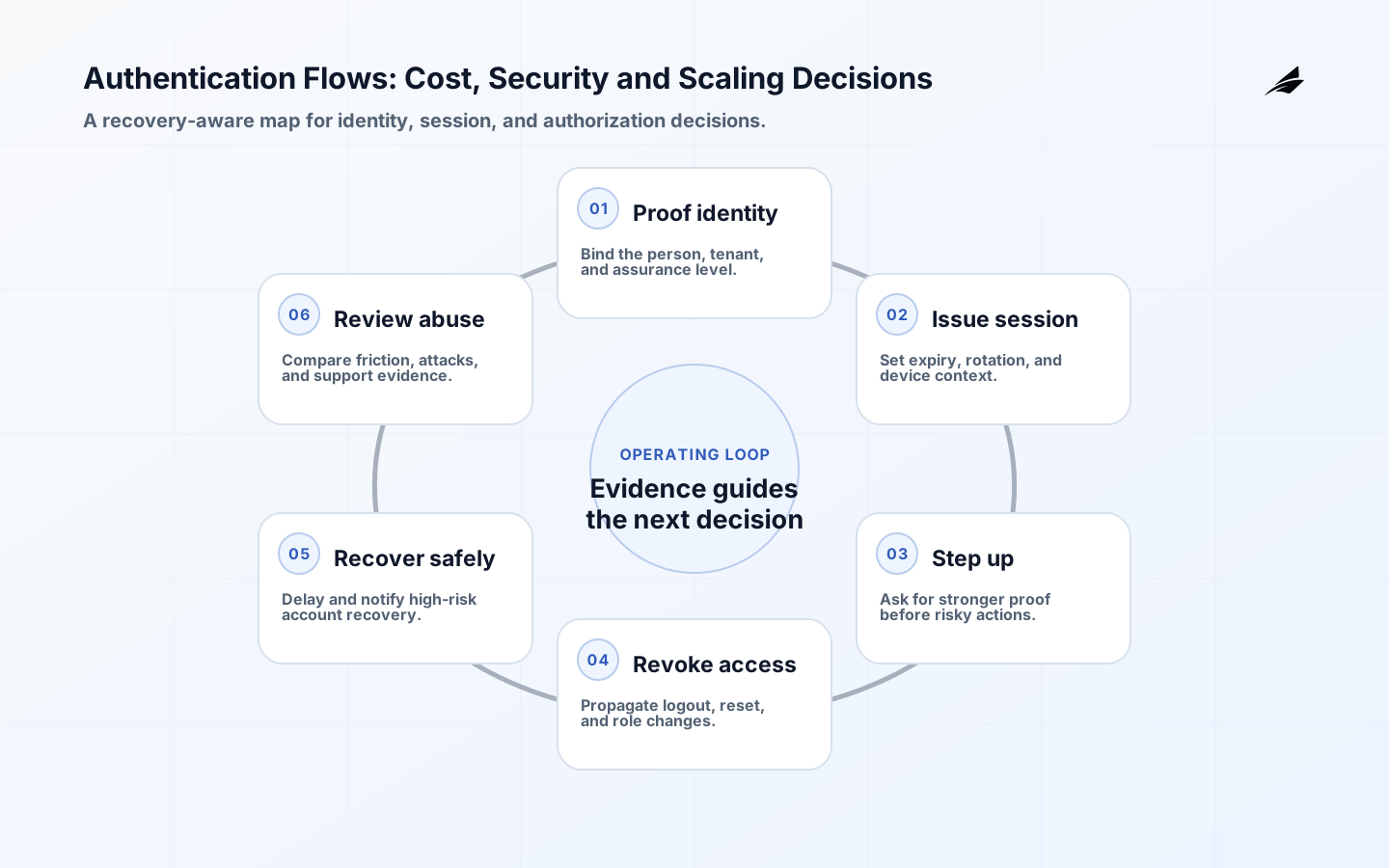
Authentication flows are the sequence through which a service establishes an identity, chooses an appropriate authenticator, creates a session, and later rechecks trust when risk changes. They should be designed separately from authorization: proving who a subject is does not decide whether that subject may view a record or approve a payment. The OWASP Authentication Cheat Sheet provides practical guidance on that distinction and on protecting sensitive accounts. The architecture question is not simply 'tokens or cookies?' It is what assurance a specific action needs, how sessions are contained, what recovery costs users and operators, and how the system responds to a compromised or changed credential.
Model identity, session, and authorization separately

Identity is the account or subject record. Authentication binds a present user or system to that identity using a credential or authenticator. A session carries that result across requests. Authorization evaluates the active identity, tenant, role, relationship, resource, and action. Keeping these concepts separate prevents dangerous shortcuts such as trusting a role claim without current policy, or treating a long-lived bearer token as the whole security model. State the session's issuer, audience, expiry, revocation behavior, and storage boundary. State the authorization decision's inputs and audit requirements. This gives database schema design a clear set of facts to store without turning credentials into ordinary application data.
| Choice | Strength | Operating cost |
|---|---|---|
| Server-managed session | Central revocation and compact browser credential handling. | Requires session storage, lifecycle monitoring, and careful horizontal scaling. |
| Signed access token | Can reduce per-request session lookup for bounded use cases. | Revocation, audience control, key rotation, and claim freshness require explicit design. |
| Federated identity provider | Moves credential lifecycle to a specialist and can support enterprise sign-in. | Introduces redirect, outage, tenant mapping, and support dependencies. |
| Passkeys/WebAuthn | Can provide phishing-resistant public-key authentication. | Needs enrollment, recovery, device-change, and accessibility paths. |
Select assurance by action, not by fashion
A newsletter preference and a bank-account change do not need the same proof. Classify actions by impact: account recovery, payout destination, privilege elevation, export of sensitive data, and administrative changes often require reauthentication or a stronger factor. The Web Authentication specification describes public-key credentials that can reduce phishing risk, but no factor removes the need for recovery and support design. Avoid forcing a universal high-friction step for low-risk work; it leads to workarounds and abandoned flows. Instead, record the assurance level achieved, the risk event that triggers a new challenge, and the safe fallback when an authenticator is unavailable.
- Use a dedicated account-recovery path with stronger checks, delay or notification where appropriate, and an auditable outcome.
- Require current credentials or an additional factor before changing password, email, payout, or privileged settings.
- Keep service identities separate from human identities and prohibit their interactive use.
- Model tenant selection and delegation explicitly after sign-in; an authenticated user may act in several contexts.
- Test enrollment, lost device, revoked access, and suspicious-login flows with real support staff.
Protect the session lifecycle
A session identifier is effectively a credential for its lifetime. The OWASP Session Management Cheat Sheet emphasizes secure transport, cookie attributes, regeneration after privilege changes, and server-side handling of sensitive session meaning. Use TLS throughout the session, set Secure and HttpOnly cookie attributes where cookies carry the session, choose an appropriate SameSite policy, and avoid putting reusable secrets in URLs or browser storage accessible to arbitrary scripts. Rotate or regenerate the session after login and privilege changes. Define idle, absolute, and renewal timeouts based on the service risk, then make expiry understandable so users can complete important work safely.
| Lifecycle event | Required behavior | Evidence |
|---|---|---|
| Successful authentication | Create a new session and bind it to the verified identity and context. | Creation event, assurance method, and privacy-safe device or client context. |
| Privilege change | Regenerate or reissue the credential and invalidate stale authority. | Old session rejection and a traceable elevation decision. |
| Risk event | Challenge, limit, or terminate according to policy. | Detection signal, chosen response, and user notification when appropriate. |
| Logout or expiry | Invalidate server state or reject credentials predictably. | Subsequent requests fail safely and active-session views update. |
Design for scale without losing control
Authentication load is bursty: a workforce sign-in at the start of a day, a consumer campaign, or an identity-provider outage can change demand quickly. Separate static asset capacity from credential verification, session lookup, token validation, notification, and recovery queues. Rate-limit abuse without locking out legitimate users, and make limits observable by tenant, source, and failure category. NIST's session guidance is useful for anchoring transport and session requirements; local policy determines exact timeouts and assurance. Cache only data whose staleness cannot grant or retain access incorrectly. When identity is external, design a controlled outage mode: which sessions continue, which actions stop, and how operators communicate the state.
Make consent, notification, and privacy decisions part of the flow rather than a separate account-settings project. Users need understandable signals when a new credential is enrolled, recovery details change, a privileged session begins, or an unfamiliar device is used. Administrators need a carefully scoped way to investigate those events without being able to impersonate users casually. Retain only the event data required for security, support, and legal obligations, with a documented access policy. These details matter at scale because a vague message creates support load, while an over-detailed message can expose information to an attacker. Design the notification as a security control with its own audience and threat model.
For machine-to-machine authentication, use the same discipline with different actors. Give each workload its own identity, narrow scopes, rotation process, and accountable owner. Do not reuse a human administrator credential in a scheduled job because it is convenient. Record which service requested a token, which audience accepted it, and how an emergency revocation will be propagated. These details determine whether an incident can be contained without stopping unrelated operations or leaving teams guessing which integration owns a credential.
Document the boundary between authentication telemetry and product analytics. Security events need enough context to detect abuse and restore access, while routine analytics should not become an unbounded shadow record of sign-in behavior. Set retention, access, and redaction rules before dashboards make that data broadly attractive. Periodically test that support and security teams can answer legitimate questions with the data retained, and cannot retrieve secrets or unrelated account information merely because a user had trouble signing in.
Observe abuse and user friction
Measure successful authentication, challenge completion, recovery completion, suspicious attempts, locked accounts, session revocation, and time to restore legitimate access. Segment by application, tenant, and flow, but never log secrets, raw tokens, or unnecessary personal data. Alerts should distinguish a provider outage, a deployment regression, credential stuffing, and an individual account issue. Review support contacts after changing a factor or timeout; an apparent security success can be a usability failure that pushes users toward unsafe shared accounts. Connect these signals with error-handling practices, because a secure flow still needs user-safe, operator-useful failure messages.
- Rehearse an identity-provider outage, mass session revocation, and a compromised administrator account.
- Monitor step-up and recovery abandonment as closely as successful login volume.
- Rotate signing keys and secrets with overlap, ownership, and rollback procedures.
- Expose an active-session and device-management view when the threat model warrants user control.
- Review authorization after authentication changes; a stronger login does not correct overbroad permissions.
Key takeaways
- Authentication, session management, and authorization are connected but distinct controls.
- Select assurance and reauthentication according to the consequence of the action.
- Treat session IDs and reusable tokens as credentials with rotation, expiry, and revocation behavior.
- Scale sign-in and recovery as operational systems with explicit outage choices.
- Measure abuse and legitimate-user friction so security controls remain usable and trustworthy.
Authentication flows FAQ
Are tokens safer than sessions? Neither format is inherently safer; the risk depends on issuance, storage, expiry, validation, revocation, and how the application uses the credential. Should every user have MFA? Stronger authentication is particularly important for high-impact accounts and actions, but rollout needs recovery and accessibility planning. Can we store tokens in local storage? Treat browser-accessible storage carefully because script execution on the origin can expose its contents; session cookie designs often reduce that exposure when configured well. How long should sessions last? Choose idle and absolute limits from risk, user workflow, and the ability to reauthenticate safely.
Conclusion
Authentication flows work when they establish enough confidence for the action without leaving users or operators stranded when conditions change. Model identity, session, and authorization separately; protect the lifecycle; and rehearse recovery as seriously as sign-in. That creates a system that can scale trust rather than merely issue credentials.
Choose assurance by authentication risk
For a small customer portal, start with a server-managed session in an HttpOnly, Secure and appropriately scoped cookie. Keep the session record opaque and store the account, tenant, authentication time, assurance level and revocation state on the server. This gives support a bounded way to terminate a session after a device is lost. A signed token can be useful at a service boundary, but it should not become an excuse to put mutable authorization in a browser-readable payload. Decide the boundary from the action and the operator who must be able to stop it.
| Decision | Choose first when | Evidence to keep |
|---|---|---|
| Boundary | The outcome has one accountable owner. | Named owner, input and success condition. |
| Fallback | A dependency can be slow, unavailable or wrong. | Visible state, retry rule and escalation path. |
| Change | The system will learn or scale after launch. | Migration, review cadence and stop condition. |
Price recovery, session, and assurance controls
Cost appears in more places than identity-provider fees. Count enrollment support, password-reset abuse, session-store capacity, key rotation, incident response and the extra test matrix for every client. A passkey rollout may reduce phishing exposure while increasing recovery design work for lost devices. Federation can shorten credential operations while adding redirect, tenant-mapping and dependency-outage paths. Put each cost beside an owner and a measurable service expectation rather than treating it as an abstract security premium.
Use an assurance ladder for actions. Reading a low-risk dashboard may use an existing session; changing a payout account should require recent authentication and a stronger authenticator; exporting a tenant-wide dataset may require a second approval and an audit event. The ladder should be explicit in policy code and in the interface. It should also survive role changes: when privilege increases, rotate the session and re-evaluate authorization instead of trusting the old session context.
Verify sign-in under disruption
At scale, watch session creation rate, active sessions, revocations, failed challenges, recovery completion and authentication latency by region. Load-test the unhappy paths: an identity provider is slow, the session store is unavailable, a key is rotated, or a user opens two recovery attempts. A graceful system makes the state visible and gives the user a safe next step. It does not retry a sensitive mutation silently or leave support guessing whether a credential is still valid.
| Signal | Healthy question | Action when it drifts |
|---|---|---|
| Outcome | Did the intended business result happen? | Inspect examples and pause unsafe scope. |
| Reliability | Can the path recover from delay or duplication? | Use retry, replay or manual review controls. |
| Ownership | Can a named person explain the current state? | Route the exception and update the runbook. |
Authentication design connects most directly to monorepo structure when shared packages carry identity code, database schema design when identities and sessions persist, and background jobs when recovery or notification is asynchronous. Use those links to trace a specific dependency rather than broaden the sign-in scope.
A sound authentication release proves one journey end to end: the assurance decision is explicit, session state is recoverable, and support can explain a denial or recovery event. Expand only when those records remain trustworthy during ordinary traffic and provider disruption.