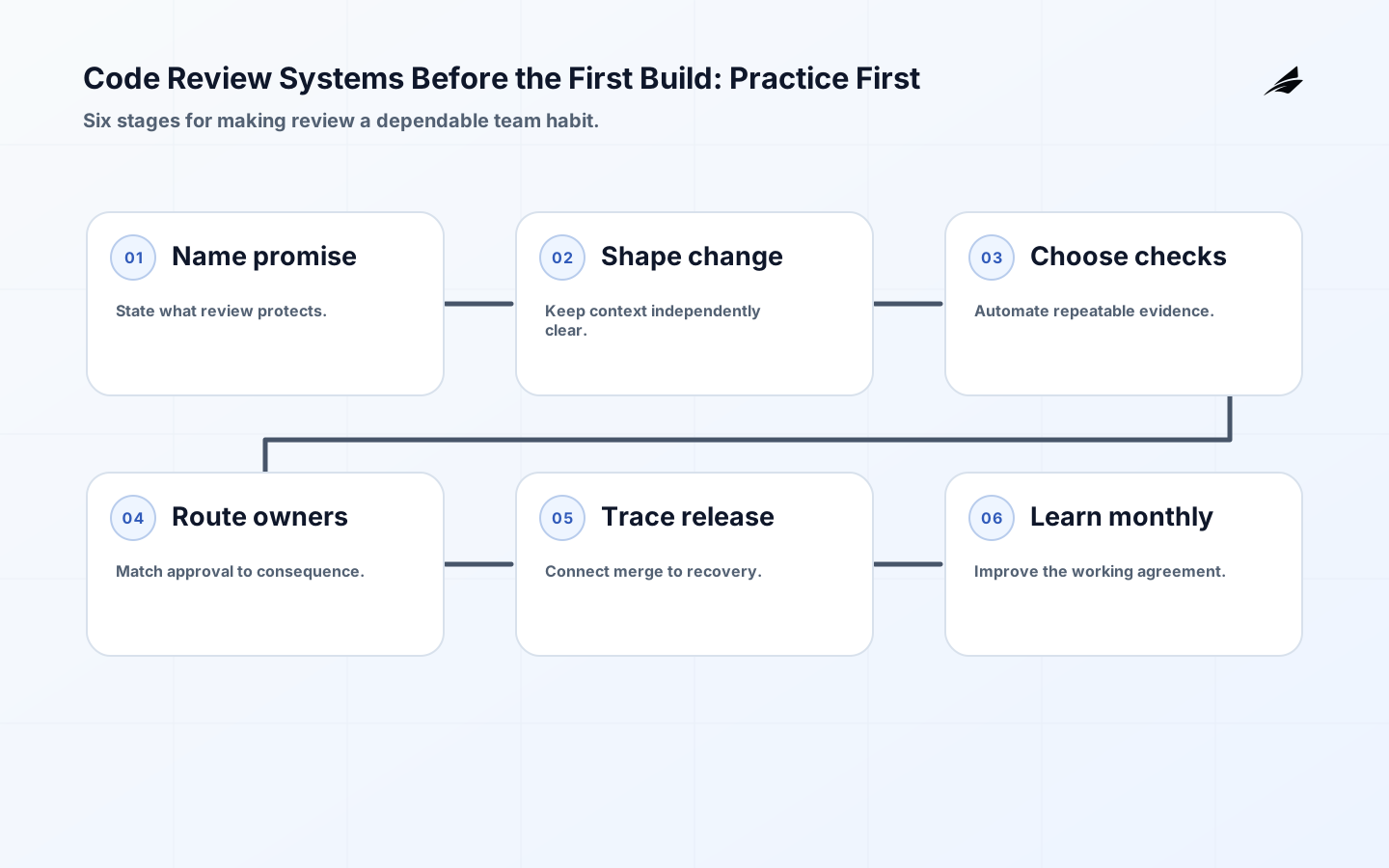
Code review systems are an early architecture decision for a software team. The first repository teaches authors how large a change should be, reviewers what counts as evidence, and maintainers who may merge a risky path. If those habits are left to the tool’s defaults, the team may later discover a queue of oversized pull requests, approvals without ownership, or checks that fail so often that everyone ignores them. Decide the practice first: what must be caught, who decides, how fast feedback should arrive, and what the team will learn after the change is live.
Make the review purpose explicit
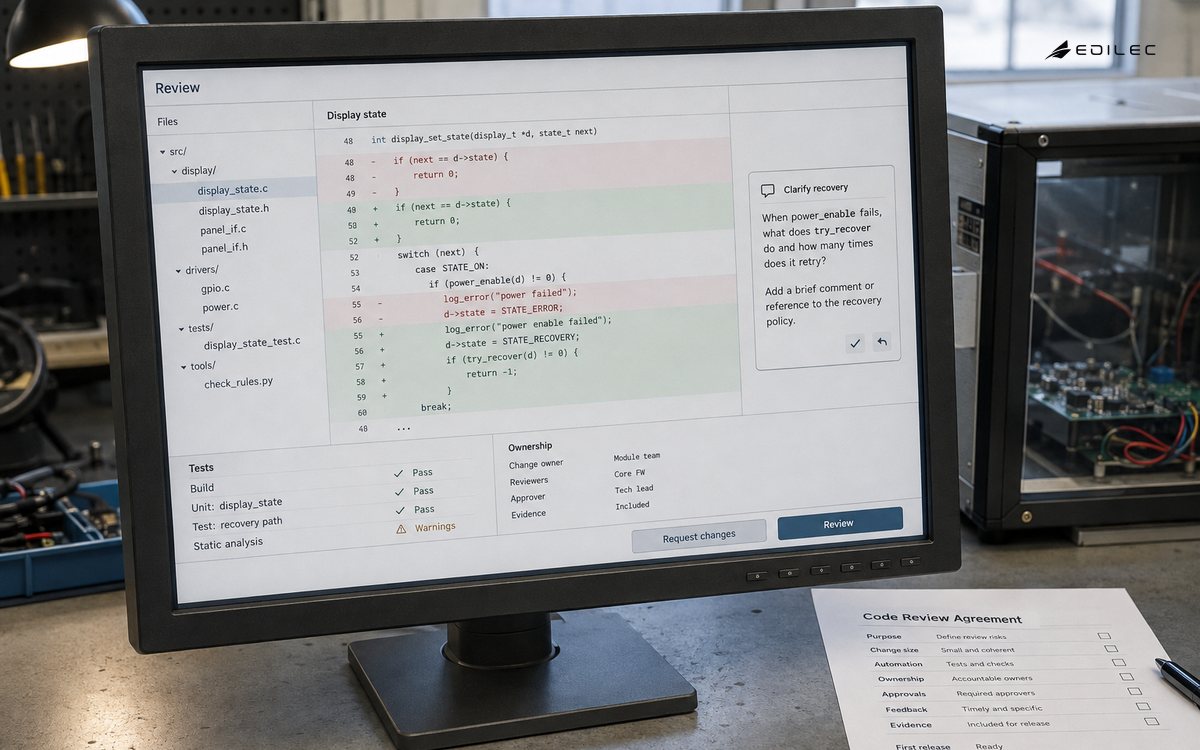
Write a one-sentence review promise for the product. It might be: every change to customer data keeps tenant isolation and a tested recovery path; or: each change should make the codebase easier to understand while preserving the user outcome. The GitHub review model offers statuses such as comment, approve, and request changes. Those statuses are useful only when the team agrees what each one means in its own repository.
| Before the first build | Decision to record | Evidence later |
|---|---|---|
| Review target | Correctness, safety, design, operability, or a combination. | Sampled review questions and escaped defects. |
| Change unit | What can be independently understood and released? | Change size and rollback history. |
| Automation | Which facts should a machine verify? | Check reliability and meaningful failures. |
| Ownership | Who reviews paths and accepts exceptions? | Code-owner coverage and response time. |
| Learning | Which post-merge signals will change the practice? | Incidents, rework, and improvement records. |
Choose a change unit that preserves context
Make the first team agreement about scope, not line count alone. A change should have one purpose, a description of the user or system behavior, the tests that establish it, and the rollout or rollback note if the consequence is material. The Google guidance on small changes emphasizes self-contained changes and the fact that reviewers do not share the author’s full context. That is a design constraint: the review should carry enough context without requiring a private meeting for every change.
A small change can still be high risk. Keep a permission migration, data transformation, and compatibility reader together when separating them would hide the invariant. Conversely, do not bundle a broad formatting sweep with an authorization feature because the signal becomes hard to see. Define exceptions in the agreement and explain the reason in the change. This makes review size a decision rather than a superstition.
Design the automated evidence path
Select checks by the failures they can detect. Formatting and linting remove mechanical noise. Type and contract checks catch mismatched boundaries. Unit and integration tests establish behavior. Security and dependency checks identify a different class of risk. A deployment preview can show configuration or migration impact. Every required check should have an owner, a useful failure message, and a policy for flakes and emergencies. If the team cannot explain what a green check proves, it should not be treated as a release gate.
- Run fast, deterministic checks before slow or environment-dependent checks.
- Keep tests close to the behavior they protect and make failure output actionable.
- Treat flaky checks as work that reduces confidence, not as harmless background noise.
- Use a contract check for the boundary where another team or service depends on the change.
- Record a deliberate exception when an urgent change bypasses normal evidence.
Make reviewers accountable without creating a bottleneck
Assign ownership by code area, domain decision, and operational consequence. A product team may review behavior while a platform or security owner reviews a boundary. The GitLab approval guidance shows how approval rules can distinguish reviewer categories and required owners. Use that capability to route attention where it matters, not to require a long approval chain for every file.
Set a first-response expectation and a fallback when the owner is unavailable. A required reviewer who cannot respond turns a safety control into a delivery outage. Rotate secondary owners, make the ownership file visible, and review it when teams or paths change. The Gerrit overview describes code review as both quality control and knowledge sharing; preserve that second function by allowing more people to learn the path without making every person a required gate.
| Change risk | Minimum review shape | Extra evidence |
|---|---|---|
| Low consequence | One context-rich review and automated checks. | Expected behavior and focused test. |
| Domain logic | Domain owner plus relevant implementation review. | State and invariant examples. |
| Data or access | Named owner required before merge. | Negative tests, migration or rollback plan. |
| External contract | Consumer or contract owner involved. | Compatibility sample and deprecation plan. |
| Emergency | Fast accountable approval with follow-up review. | Reason, scope, expiry, and post-incident check. |
Set the tone for feedback before the queue forms
A new team learns what matters from the first review comments. Require comments to explain the risk or reasoning, and label optional polish so authors can separate it from a blocker. Technical facts, an established style guide, and product or security requirements deserve different language. The Google review standard favors continuous improvement over perfection and provides an escalation path when consensus fails. Adopt that principle early so disagreement does not become personal or indefinite.
Ask authors to respond with a change, an explanation, or a linked decision. Ask reviewers to close a thread when the concern is addressed and to create a follow-up when it belongs elsewhere. A review should leave a future reader with a record of the important tradeoff, not a pile of ambiguous comments. If the same question appears repeatedly, convert it into a test, template prompt, or design guidance.
Connect approval to how the product reaches users
Before the first production merge, decide how flags, migrations, staged traffic, and rollback work. A reviewer needs to know whether the change can be exposed gradually and what signal stops it. An approved code path may still fail because of data volume, a provider setting, or a client that was not in the test environment. Record the deployment owner and verification steps in the review when the change affects a real user journey.
Use the repository system to preserve links among change, checks, deployment, and incident. Do not use a required approval as a substitute for a rollback plan. Conversely, do not make every change wait for a full operational review if it cannot affect the production path. The right amount of process follows consequence. The code review systems working practice provides a useful companion when the initial agreement becomes a daily operating model. Pair it with the technical debt decision guide when review rules are compensating for an unstable boundary, and with the test strategy guide when evidence needs a stronger home.
Measure the first month for learning
Set a baseline for review wait time, change size, check duration, rework after review, escaped defects, rollback frequency, and owner concentration. Do not turn the baseline into a universal target before understanding the work. A quick review can be good, or it can be a rubber stamp. A longer review can reflect a complex but important decision, or it can signal an unavailable owner.
Review a sample with the team after the first release cycle. Which review questions found real defects? Which checks were noise? Which changes were too large? Did authors know whom to ask? Could someone outside the original group explain why a decision was made? Use those observations to adjust the agreement, not just to score individuals. The first-build practice is a hypothesis about how the team learns.
Avoid tool-led process and approval theater
Tools provide useful primitives, but their default workflow is not your engineering policy. A green merge queue does not show that the user outcome is correct. A code-owner request does not guarantee that the owner had time or context. A template does not guarantee that the rollback can be executed. Make the important promise explicit and inspect whether the system produces the evidence needed to support it.
Also avoid overfitting the process to a large organization. A small team can have a lightweight, high-trust practice with clear owners and strong tests. The risk is not fewer forms; the risk is an unspoken exception that only one founder can approve. Document enough to make the decision repeatable, then add controls when production evidence says the current path is insufficient.
Key takeaways
- Decide what review must protect before selecting a pull request or merge request tool.
- Use focused change units that carry the context a reviewer needs.
- Make automated checks deterministic, meaningful, and owned.
- Route consequential changes to accountable owners with a workable fallback.
- Measure the practice after release and turn repeated questions into better controls.
Frequently asked questions
What should a team decide before choosing a review tool?
Define the review risks, change unit, automated evidence, ownership, approval meaning, turnaround expectation, emergency exception, and post-merge learning signals. Then choose a tool that can express those decisions without hiding them.
How many reviewers should a new team require?
Use the smallest number that matches consequence and ownership. Add a domain or security owner where the change can affect that boundary, but do not confuse more approvals with more understanding.
Should code review block every merge?
Required review is appropriate for defined high-consequence paths. Lower-risk work can use lighter review if checks and ownership remain clear. Every exception should be attributable and reviewed later.
Conclusion: build the review habit deliberately
Code review systems shape the quality and speed of every later change. Start with a clear promise, focused units, useful automation, accountable routing, and a way to learn from production. The tool can then support a practice that the team understands rather than becoming the practice by default.