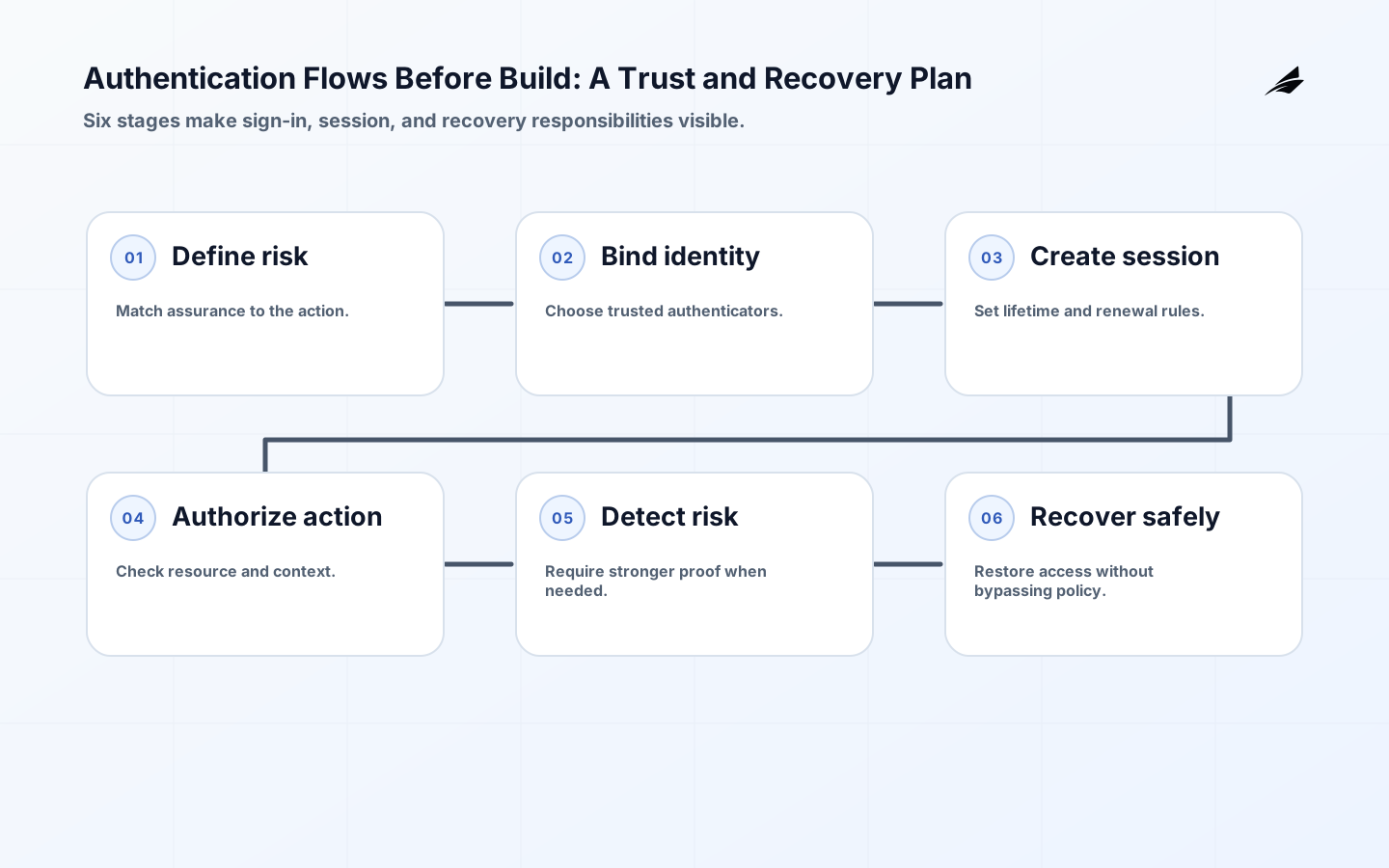
Authentication flows become an engineering decision before the first endpoint, screen, queue, or migration exists. The useful question is not whether a team can adopt a familiar identity provider. It is whether a person can invite a colleague, sign in from a new device, approve a sensitive change, lose a factor, and regain access with a result they can trust. That requires explicit choices about authority, state, session lifetime, recovery, and evidence. A polished sign-in screen hides these questions briefly; production users and support teams uncover them quickly.
Begin with one representative journey and trace it beyond the happy path. For a customer administrator approving a new payment destination, name the actor, the account and tenant, the authenticator, the session, the authorization decision, the high-risk step, and the evidence that a support agent can later inspect. The REST API contracts guide is a useful companion because protected endpoints still need clear input and outcome contracts. This guide focuses on making authentication flows defensible before implementation choices become dependencies.
Define what authentication proves and what it does not
Authentication establishes that a claimant controls one or more authenticators associated with an account or identity. It does not by itself grant every application permission, prove that an email address is a safe account key, or decide whether a current action is allowed. Write the boundary in plain language: which identity service or provider is trusted, which identifiers are stable, which account-linking rule applies, what the application stores, and where authorization begins. Keep support impersonation, background jobs, and machine credentials inside their own policies rather than hiding them in a sign-in check.
NIST’s digital identity guidance separates identity proofing, authentication, federation, authenticator management, and relying-party decisions. That separation is useful for custom software even when the product is not a government system. A team may accept a federated assertion for sign-in while still owning tenant membership, local session, high-risk reauthentication, and deprovisioning. Record the trust boundary before comparing providers, because the same provider can be safe or unsafe depending on issuer selection, redirect handling, claim mapping, and application authorization.
| Boundary question | Decision to record | Failure if omitted |
|---|---|---|
| Who is trusted? | Allowed issuer, verifier, or identity source. | An unexpected authority can create sessions. |
| Which identity is stable? | Issuer-plus-subject or another documented key. | Accounts can merge or split incorrectly. |
| What is local? | Session, tenant membership, role, and audit record. | Provider claims become stale application policy. |
| What is high risk? | Sensitive action, factor, and reauthentication rule. | A stolen session can approve too much. |
| Who can recover? | Self-service, alternate factor, or reviewed support path. | Recovery becomes the weakest login path. |
Model authenticator, session, and recovery states

A sign-in interface is one view of a state machine. Useful states include invited, enrollment-pending, challenge-required, authenticated, session-active, step-up-required, locked, recovery-pending, suspended, and deprovisioned. Each transition should have an initiating event, an authority, an expiry, and a safe failure. An invitation should become unusable after acceptance; a recovery token should be single-use; and an account suspended by an administrator should not remain active in a long-lived session merely because the browser has not refreshed.
Model interruptions deliberately. A browser may close during a second-factor challenge, a provider may return an error after the user has authenticated, a role may change while a session is open, or a support agent may revoke an authenticator while a background job is pending. The application needs a durable record for transitions that matter and a clear answer to what the user sees next. This is where the database schema guide helps: state, event, and relationship records should be designed for the questions operations will ask later.
| State | Entry condition | Safe next step |
|---|---|---|
| Invited | An authorized person created an invitation. | Verify scope, expiry, and recipient before binding. |
| Challenge required | Policy asks for another authenticator. | Keep the session limited until success. |
| Session active | Required authentication and checks passed. | Enforce resource authorization on every action. |
| Recovery pending | Normal authenticator is unavailable. | Hold high-risk changes until stronger proof. |
| Suspended | Risk, admin action, or eligibility changed. | Reject protected actions and notify the owner. |
Choose protocol controls that match the browser and provider
For redirect-based authorization, use exact redirect URI matching, protect the transaction against request forgery, and bind the authorization code to the client with PKCE where applicable. RFC 9700 states that authorization servers must support PKCE and that public clients must use it; it also warns against arbitrary redirect targets and weak validation. These controls are not optional polish. A loose redirect or a code that can be replayed can undermine an otherwise strong authenticator. Configure the provider and the application together, then test the denied and mismatched cases.
If several providers or tenants are supported, defend against mix-up by binding the response to the expected issuer and transaction. Validate issuer, audience, redirect state, nonce where the identity layer uses it, code verifier, token type, time window, and signature according to the protocol. Do not accept a token because a library parsed it successfully. Record the validation result without storing reusable secrets, and keep the local session as the application’s controlled representation of successful authentication.
- Register exact redirect URIs and reject arbitrary forwarding destinations.
- Use PKCE and a transaction-bound state or nonce according to the protocol.
- Validate issuer, audience, token type, time, and signature before session creation.
- Keep provider claims separate from local authorization and tenant membership.
- Test provider errors, replayed codes, mismatched issuers, and expired responses.
Treat the session as a security boundary
A session is not the same thing as an identity assertion. It is a time-bounded application record that carries the result of authentication into later requests. OWASP recommends unpredictable, meaningless session identifiers, protected cookie exchange, server-side expiration, and renewal after privilege changes. Rotate the session when an anonymous visitor becomes authenticated, when a role or privilege changes, and after a high-risk reauthentication. Destroy the old session rather than allowing two identifiers to represent the same authority indefinitely.
Set idle and absolute timeouts based on the action and risk, then enforce them server-side. Provide a visible logout that invalidates the server-side session, not only a browser cookie. Keep session logs useful but do not place raw session IDs in them; correlate with a salted hash or another non-reusable reference. If a user changes a password, adds a trusted device, or completes recovery, decide which other sessions and background activities must be revoked. The session management guidance gives the implementation detail; the product must still choose the right policy for its users.
Make recovery at least as deliberate as sign-in
Recovery is an authentication flow, not a support shortcut. OWASP recommends a consistent response for existing and non-existing accounts, uniform timing, cryptographically safe single-use tokens, expiration, and rate limits. Decide what proof is required to restore access and whether that proof is strong enough for the account or action being recovered. A recovery flow that lets a person change the email, password, or multi-factor device after answering a weak profile question has silently lowered the assurance of the entire system.
Separate recovery from immediate privilege restoration when risk is high. Create a pending state, notify existing channels, require an alternate authenticator or reviewed evidence, and delay sensitive changes until the policy is satisfied. Support overrides need a reason, scope, approver, and expiry; they should not expose secret answers or let an agent copy a credential into a note. NIST’s authenticator guidance emphasizes invalidating compromised authenticators promptly and offering a controlled alternate path. The product should make that path understandable without revealing whether an account exists to an attacker.
Keep authorization close to the protected action
Authentication answers who or what has proved control of an authenticator. Authorization answers whether that subject may perform this action on this resource now. Enforce the latter at the server boundary where the side effect occurs, using current tenant membership, resource ownership, role or policy, and the assurance required for the operation. Do not rely on a hidden button, a route name, or a role claim that was copied into a session months ago. If the action changes billing, access, or data retention, consider a step-up ceremony and an explicit transaction record.
Use a policy table that product, engineering, and support can read. For a payment destination, specify who can propose, who can approve, what second factor is needed, which notification is sent, and what happens if membership changes between proposal and approval. The GraphQL trade-offs guide is relevant when a flexible query layer exposes many fields: identity does not remove the need for field- and action-level authorization. Make the decision explainable and test it with denied cases as seriously as successful ones.
Release in evidence-bearing increments
Start with one user journey and a small cohort. Instrument enrollment success, challenge failure, recovery requests, session creation and renewal, revoked authenticator use, denied authorization, and support overrides. Review error messages and response timing for account enumeration. Test the full provider boundary in a controlled environment, including rotated keys, provider outage, clock drift, duplicate callbacks, and a session that remains open after a membership change. A production-ready flow is one that operations can observe and explain, not just one that passes a browser demo.
Roll out stronger controls with a recovery plan. If adding phishing-resistant authentication, offer an enrolled alternate path and document the support process before enforcement. If changing session lifetime, measure abandoned work and reauthentication friction alongside security signals. If replacing a provider, maintain the old issuer only for a defined migration window and record account-linking decisions. The field guide to authentication flows can help extend the journey across teams, but the first release should remain narrow enough to rehearse.
- Document identity, session, authorization, and recovery as separate responsibilities.
- Test exact redirects, PKCE, issuer binding, token validation, and callback errors.
- Rotate sessions after authentication and privilege changes.
- Require stronger proof for recovery and sensitive actions.
- Log lifecycle events without storing reusable session or authenticator secrets.
- Roll out by cohort with a supportable alternate path and explicit stop conditions.
The recommendations here are grounded in inspected primary guidance: OWASP Authentication Cheat Sheet, NIST SP 800-63B Authentication Assurance Levels, RFC 9700 OAuth 2.0 Security Best Current Practice, OWASP Session Management Cheat Sheet, OWASP Forgot Password Cheat Sheet. These sources define assurance and recovery controls; this guide applies them to a trust journey that must remain understandable under stress.
Takeaways for authentication flows before build
- Define exactly what authentication proves and what local authorization still decides.
- Model invitation, challenge, session, recovery, suspension, and deprovisioning states.
- Use current redirect, PKCE, issuer, audience, nonce, and token validation controls.
- Rotate and expire sessions at privilege and risk boundaries.
- Make recovery and support overrides evidence-based, scoped, and auditable.
- Release one journey with telemetry, denied-path tests, and a stop condition.
Questions to settle before implementing an authentication flow
Should every user see the same authentication flow?
Not necessarily. The flow can vary by risk, account type, provider, device, or action, but the policy should be explicit and the server must enforce the resulting assurance. Variation should not create an unreviewed low-assurance route to a high-impact operation.
What is the difference between authentication and authorization?
Authentication verifies control of an authenticator or identity assertion. Authorization evaluates whether the authenticated subject may take a particular action on a particular resource in the current context. Keeping them separate prevents a successful sign-in from becoming blanket access.
How should a team test account recovery?
Test lost password, lost second factor, expired token, repeated requests, account enumeration, support review, existing sessions, notifications, and restoration of access. Confirm that each path uses the required proof and leaves evidence that an operator can inspect without seeing secrets.
Conclusion: design identity as an operating journey
Authentication flows are dependable when identity, sessions, authorization, recovery, and support behavior agree. Define the trust boundary, model the states, use current protocol protections, require evidence at risky transitions, and release one journey with observable failure paths. That foundation lets a custom product add providers and factors without changing the meaning of access by accident.