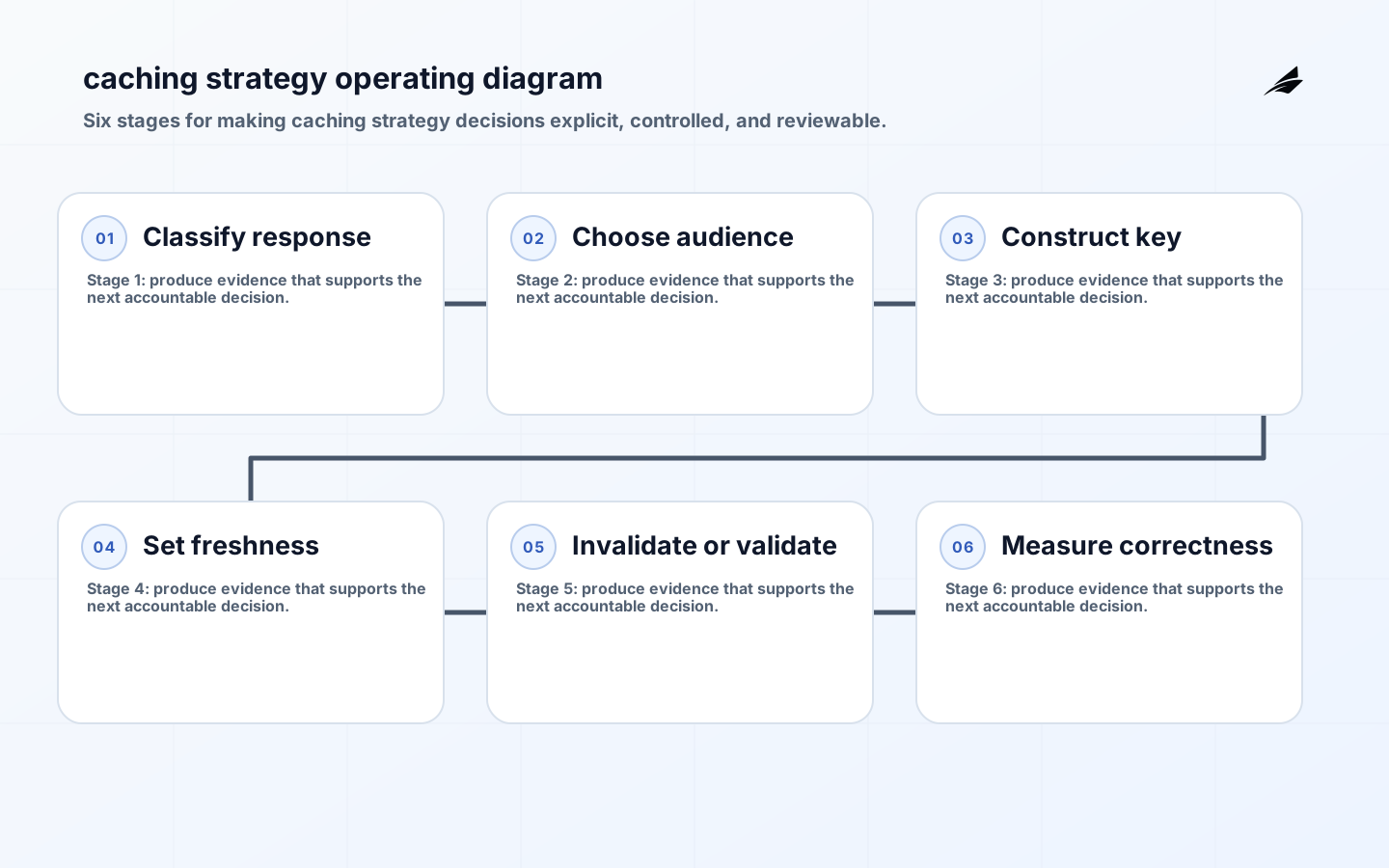
Caching strategy determines whether a change remains understandable when people, clients, and systems behave imperfectly. This guide focuses on a practical operating question: what decision must the system support, what boundary makes the decision reliable, and what evidence tells the team it is still working? The goal is not fashionable architecture. It is a design that engineering, product, support, and security can explain when the normal path, the edge case, and recovery all arrive together.
Make the cache boundary explicit

A caching strategy is a correctness decision disguised as a performance feature. Before choosing a CDN, browser directive, or Redis key, identify the authoritative record, acceptable freshness, audience, and consequence of a prior value. A cache is safe only when the team can say when it is created, who may receive it, how it becomes invalid, and what happens when it is unavailable. HTTP cache directives must express business meaning, not a generic speed target.
| Decision area | Question to settle | Evidence to keep |
|---|---|---|
| Authority | Where is current value decided? | Named source |
| Freshness | How old may it be? | TTL or validation |
| Audience | Who may receive it? | Public or private scope |
| Invalidation | What makes it unsafe? | Purge or version event |
Design for meaning, not just implementation
Classify data by volatility, sensitivity, and scope. Public immutable assets can use versioned URLs and broad caching; a tenant dashboard needs a private scope keyed by identity and permission context. Price, stock, and authorization data may need validation, very short freshness, or no shared cache. Design keys from every input that changes the response, including locale, tenant, feature state, and representation version. A missing key dimension can become data exposure.
- Name source and staleness.
- Classify sensitivity and audience.
- Include every varying input in keys.
- Set TTLs and invalidation deliberately.
- Test writes and permission changes.
- Monitor age and fallback.
Build the controls into delivery
Place freshness behavior near the boundary that owns it. Emit deliberate Cache-Control and validator headers; set bounded TTLs, protect popular misses with coalescing or stale refresh, and monitor eviction. Do not cache denied access, exception payloads, or mutable shared data without a stated reason. For write-through, invalidation events, or background refresh, preserve a version or result so operators can distinguish expected staleness from failure.
| Failure mode | Why it occurs | Practical control | Signal to review |
|---|---|---|---|
| Stale critical data | TTL exceeds tolerance | Validation or short TTL | Age at serve |
| Cross-user leak | Key omits permission | Scope-aware key | Partition audit |
| Stampede | Popular miss overloads origin | Coalescing | Origin concurrency |
| Cache outage | Origin path is weak | Fallback test | Fallback latency |
Operate with signals that lead to action
Measure hit rate with miss reason, origin latency, cache age, eviction, key cardinality, invalidation delay, and stale-serving events. High hit rate can hide a cache that never refreshes; low hit rate may be correct for personalized data. Connect metrics to page latency and correctness. Security review needs cache partitioning and headers because a shared personalized response is more serious than a slow origin request.
Release in a bounded, reversible sequence
Enable a cache for a narrow route or cohort first, compare its output against the source, and test writes, permission changes, expiry storms, cluster failure, feature changes, and rollback. Keep the origin path healthy: cache is not capacity planning. Change TTL and purge behavior through reviewed configuration so an emergency adjustment does not become an unexplained permanent policy.
Make the tradeoffs explicit
Longer retention improves origin protection but enlarges the stale window. Aggressive invalidation improves freshness but adds coordination risks. Per-user caches reduce exposure but lower reuse. Choose according to the harm of being late or wrong. The frontend performance guide places cache choices alongside rendering and interaction work.
The implementation details here are grounded in HTTP Caching, HTTP Caching Guide, Redis Keyspace, Web Security Testing Guide. Consult these authoritative references when a protocol, platform, or control needs product-specific confirmation.
A concrete review starts when a tenant permission changes while browser and edge caches hold a prior response. For caching strategy, trace that situation from the initiating action to the final user-visible outcome. Name the records, policy decisions, dependency calls, and handoffs that affect the result. The aim is to expose assumptions that otherwise remain hidden behind a framework default or a vague integration boundary. The review should leave the source of truth, cache key dimensions, audience, and freshness limit. That is more useful than a broad diagram because a maintainer can verify it during delivery and after a release. For this part of the system, name the accountable owner, supporting evidence, exception route, and next measurable check.
Turn the design into an executable exercise. Include a permission change, expiry storm, cache failure, and feature change. Record the expected state, safe response, telemetry, and accountable next action for each case. A demonstration where every dependency cooperates does not establish recovery behavior. The result should distinguish an expected exception, a defect, and a condition that pauses rollout. Keep the evidence near the relevant change so a new engineer can repeat the check without rebuilding the reasoning from a ticket or private memory. Within this part of the system, name the accountable owner, supporting evidence, exception route, and next measurable check.
For operations leaders working on caching strategy, this operating decision should connect interface contracts, state changes, dependency behavior, authorization, and recovery to evidence an accountable owner can inspect. Instrumentation must answer an operating question. Review latency, completion, failure category, recovery time, and the change in user outcome that matters for this boundary. Compare a release with a baseline and add release or configuration annotations to the timeline. Counts and percentiles become operationally useful only when an owner knows what threshold calls for investigation, rollback, traffic control, or a customer update. This discipline prevents reliable signals from becoming graphs whose interpretation depends on who is on call. In this plain-language review, move beyond the operating decision only after the owner can show the accepted result, the exception path, and the signal for another review.
In caching strategy, operations leaders should make the relationship between interface contracts, state changes, dependency behavior, authorization, and recovery explicit and reviewable. Plan for a failure that looks reasonable at first: an apparently successful local change can invalidate an assumption held by a client, an operator, or a downstream system. The practical control is an explicit rule, observable condition, and recovery route. Decide how the team detects the condition, limits harm while evidence is gathered, and proves correction. A recovery plan must name the affected user state, authoritative record, and responder; otherwise it is only a hopeful description of normal behavior. This plain-language review should close the operating decision only when the result, unresolved exception, and next review condition are recorded.
Governance should create a timely decision rather than a meeting about terminology. For caching strategy, record scope, assumptions, approval authority, success condition, rollback or correction method, and date to reconsider. This is particularly important when a compatibility layer, exception, or operational limit survives longer than expected. A short decision record lets product, engineering, support, and security resolve a future tradeoff from common evidence instead of incomplete recollection. While operating this part of the system, name the accountable owner, supporting evidence, exception route, and next measurable check.
A dependable caching strategy design makes interface contracts, state changes, dependency behavior, authorization, and recovery visible to the owner responsible for this operating decision. Before expanding scope, run a small rehearsal with someone who did not build the change. Ask them to locate the relevant identifier, find the documented owner, interpret the expected signal, and explain recovery using ordinary approved tools. Note where the path is slow or unclear. The rehearsal reveals missing context, unsafe defaults, and vague escalation authority while the team can still correct them. Feed the outcome into tests, runbooks, and the next release review so operational knowledge remains shared. The next step in this plain-language review is justified when the team can trace the accepted outcome, the fallback route, and the owner of follow-up.
Validate caching strategy through a complete operating case
Use this plain-language guide to validate caching strategy with one complete operating case before widening the scope. Operations leaders should trace one representative user action across the interface, application service, persistence layer, background work, and visible customer result. Begin with the initiating request, identity and tenant context, accepted state transition, dependency response, and correlation record, cross each policy and dependency boundary, and finish in a durable state that a customer or operator can recognize. Record the expected state at every handoff, who may change it, and which evidence proves that the next step was justified. This walkthrough gives product, engineering, security, and support a shared acceptance case instead of allowing each team to assume that another layer owns the transition. Use representative roles, realistic timing, and the constraints that exist during an ordinary operating day.
The plain-language guide should also test a second caching strategy case that deliberately challenges the design. Include a repeated request, incompatible payload, delayed dependency, partial write, or authorization disagreement. The purpose is not to demonstrate that every dependency always succeeds; it is to prove that the service can stop safely, preserve useful evidence, and expose the next responsible action. Review contract version, state transition, status family, retry decision, trace identifier, and customer-visible result together so the team can distinguish a policy refusal from bad input, a software defect, a delayed dependency, or an operator decision. A useful result is specific enough for a support or incident owner to act without reconstructing the entire journey from unrelated logs and messages.
Turn both cases into release evidence for caching strategy. Keep the input conditions, expected states, observed result, decision owner, and unresolved exceptions in one reviewable record. Define the recovery action in advance: restore a defensible business state, reconcile partial work, make the next owner visible, and verify the customer outcome. Re-run the same cases after a material policy, interface, data, model, infrastructure, or entitlement change so that improvements do not silently weaken an earlier control. For this plain-language guide, readiness means that the normal path is usable, the failure path is understandable, and ownership remains visible after launch rather than ending when implementation work is declared complete.
- Choose one representative caching strategy journey and state the customer or operator result in plain language.
- Capture the initiating request, identity and tenant context, accepted state transition, dependency response, and correlation record as evidence, with a named owner for each consequential handoff.
- Exercise a repeated request, incompatible payload, delayed dependency, partial write, or authorization disagreement before broader exposure and verify that the safe state is visible.
- Review contract version, state transition, status family, retry decision, trace identifier, and customer-visible result after release and assign every unresolved exception to a person and date.
Key caching strategy takeaways
- Name source and staleness.
- Classify sensitivity and audience.
- Include every varying input in keys.
- Set TTLs and invalidation deliberately.
- Test writes and permission changes.
- Monitor age and fallback.
Caching strategy FAQ
Is invalidation always needed? No: immutable versioned assets can expire naturally; mutable data often needs invalidation, validation, or short freshness. Can authenticated data be cached? Only with private scope and an authorization-aware key. Does hit rate prove success? No; assess freshness, reuse, and user outcome together.
Conclusion: make caching strategy dependable
A good caching strategy makes freshness, audience, and failure behavior explicit. Reuse only what is safe to reuse, and verify cache rules under the changes users actually make.