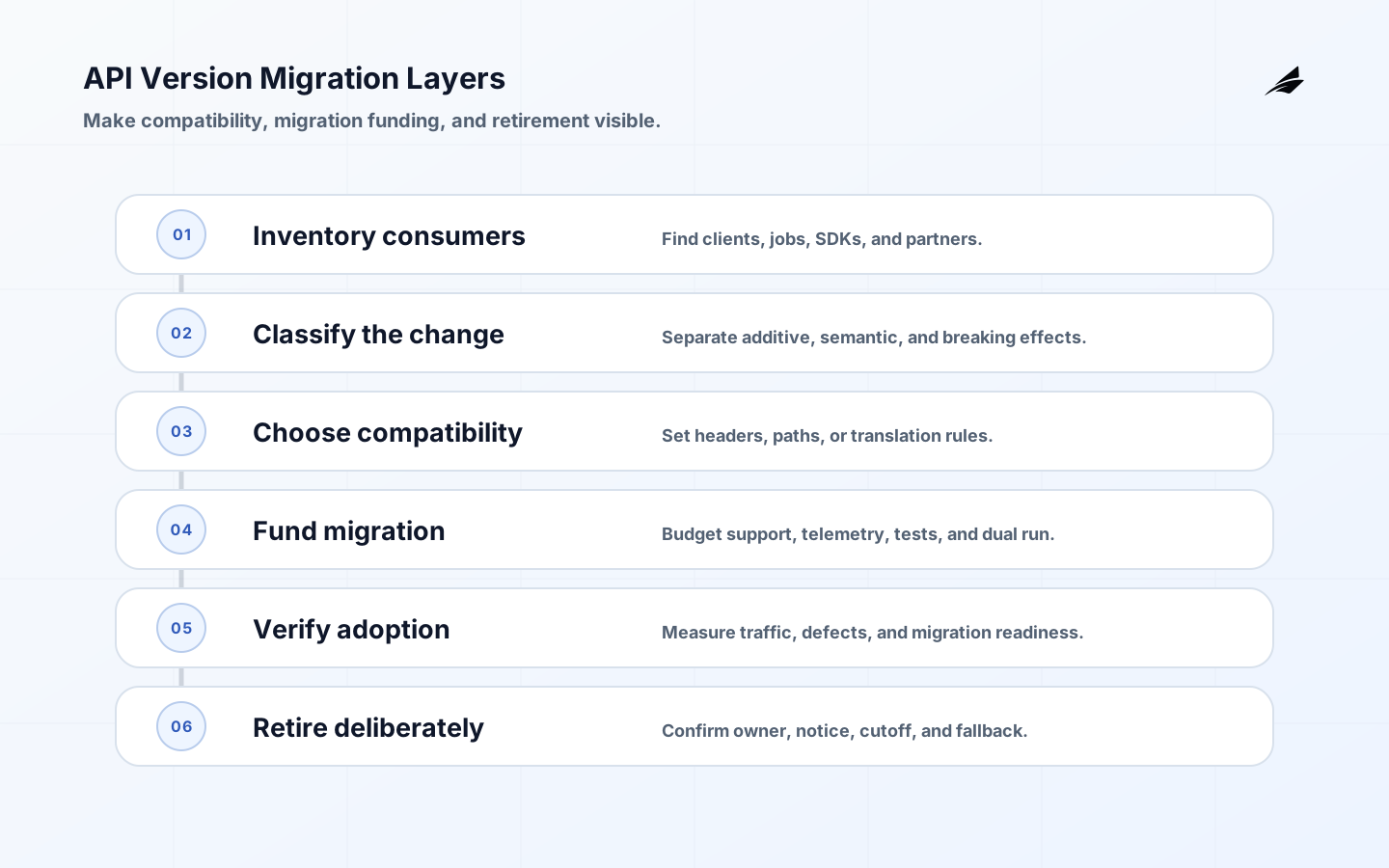
How CTOs Should Think About API Versioning
API versioning is not a tool choice made in isolation. For API versioning governance, it is a way to make a business outcome dependable when normal work meets delay, ambiguity, change, or failure. For CTOs, the central decision is whether to change an interface only after deciding whether consumers can safely continue, migrate, or need a parallel contract. For API versioning governance, that decision should be visible before implementation begins: name the user or system that starts the work, the accountable owner of the outcome, the evidence that proves success, and the boundary where a person must intervene. The useful result is not a more elaborate diagram. For API versioning governance, it is a service people can explain, support, and improve under ordinary pressure.
Make the API versioning decision explicit
Write the decision as a short operational statement, then test it against real examples from partner integrations, mobile clients, internal services, and public developer platforms. In this case, the team should change an interface only after deciding whether consumers can safely continue, migrate, or need a parallel contract. The unit of work is a contract; its trigger is a proposed semantic change to a request, response, behavior, or guarantee; and its meaningful states are draft, published, compatible, deprecated, sunset, or retired. For API versioning governance, this removes a recurring source of expensive debate: engineers, operators, and product owners can distinguish a requested action from a completed outcome. For API versioning governance, it also gives support staff a practical answer when they need to explain what happened, why it happened, and what will happen next.
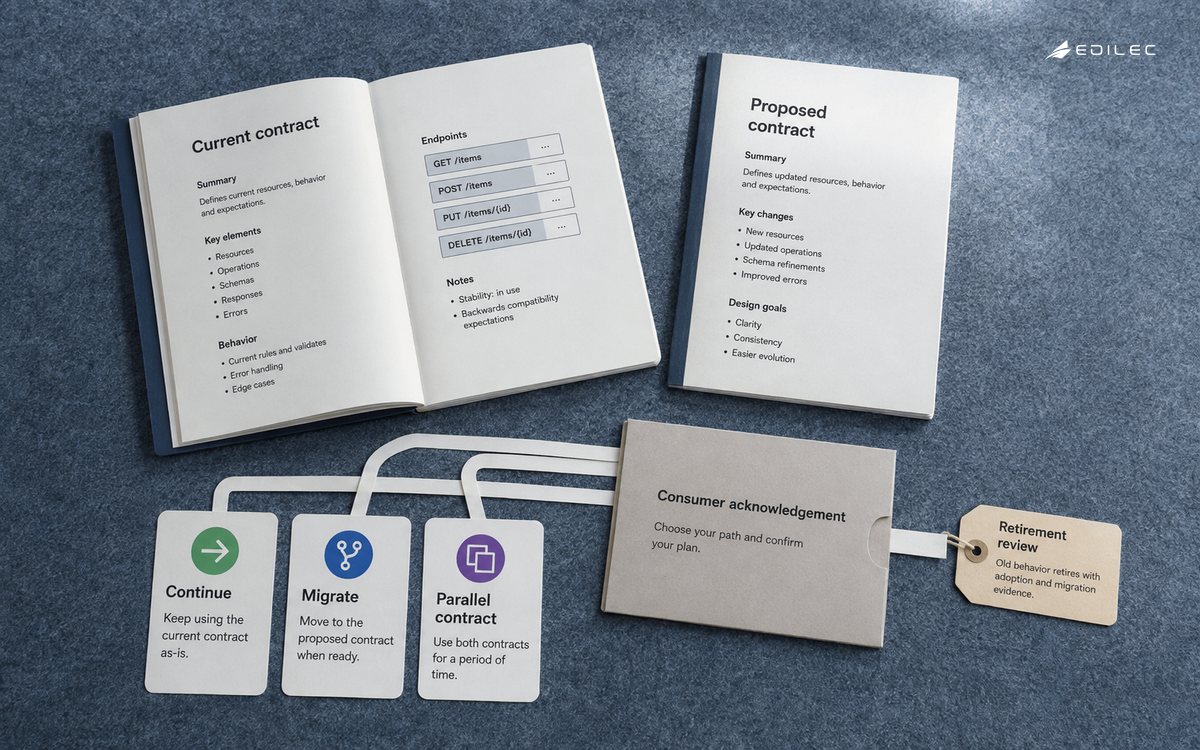
The non-negotiable rule is that every supported consumer can discover the contract it is using and a workable migration path. For API versioning governance, treat that as a product rule, an implementation constraint, and an operational check. RFC 9110: HTTP Semantics and OpenAPI Specification are useful references because they describe concrete delivery or interface guarantees rather than vague aspirations. Their lesson is not to copy a platform pattern wholesale. For API versioning governance, it is to make the guarantee your own system gives explicit, including what it does when the happy path is interrupted.
| Decision element | Question to settle | Evidence to keep |
|---|---|---|
| Outcome | What does a successful contract mean to the business? | Named owner, completion condition, and user-visible result |
| Boundary | When is a contract accepted, changed, or refused? | Input validation, authorization rule, and state transition |
| Failure | How will the team handle calling a breaking behavior change a patch because the URL did not change? | Classification, recovery action, and escalation owner |
| Observation | Which signal will show healthy operation? | Consumer adoption by version, deprecated-call volume, migration lead time, and contract-related incidents |
Map version state across consumers
Model the contract as something with history, not as a mutable line on a dashboard. The state sequence draft, published, compatible, deprecated, sunset, or retired should have allowed transitions, an effective time, and a responsible actor or service. For API versioning governance, a transition should record the relevant input, the rule or contract version used, and a correlation identifier that links it to adjacent work. For API versioning governance, this is deliberately modest: it does not require an event-sourcing rewrite or a new control plane. For API versioning governance, it does require the team to preserve enough context to reconstruct a consequential decision without relying on memory, chat messages, or an unsearchable log stream. Pair that record with TypeScript architecture guidance when version boundaries cross shared implementation layers.
Ownership must survive organizational boundaries. For API versioning governance, product owns the intended user and business behavior; engineering owns the implementation and technical safeguards; operations owns the alert and recovery procedure; the service owner decides which trade-offs are acceptable. Google API versioning reinforces the value of explicit structure or repeatable checks, while Azure API design best practices supports carrying useful context across system boundaries. For API versioning governance, when these responsibilities are implicit, a change can appear harmless in one component while creating an unowned obligation somewhere else.
| Model concern | Practical design choice | Review question |
|---|---|---|
| Identity | For API versioning governance, use a durable identifier for the ${c.unit} and its related business record. | Can a support person find the same case across systems? |
| State | Make legal transitions explicit and reject or park ambiguous inputs. | Does each state tell the user and operator what comes next? |
| Authority | Bind approval and access checks to the requested action. | Who may change this state, and who may correct it later? |
| History | Retain actor, time, reason, and correlation context. | Could the team explain this outcome six weeks later? |
Make retirement safe during ordinary incidents
A reliable API versioning capability assumes that calling a breaking behavior change a patch because the URL did not change will occur. For API versioning governance, design the response before a customer, operator, or downstream service depends on it. For API versioning governance, classify failures into correctable input, policy refusal, transient dependency trouble, and unexpected faults; the classification determines whether the next move is to retry, request correction, compensate, or escalate. Automated retries need a ceiling and a reason. For API versioning governance, manual recovery needs a narrow permission, a visible queue, and a record of the corrective decision. Otherwise a fast workaround becomes an invisible second workflow.
For API versioning governance, start with the operating signals that answer a decision, not every metric available from a framework. Consumer adoption by version, deprecated-call volume, migration lead time, and contract-related incidents should be reviewed alongside a small sample of completed and failed cases. For API versioning governance, a rising retry rate can indicate a dependency regression; a growing oldest-item age can indicate missing capacity or a poisoned input; an unusually quick completion can reveal a skipped control. For API versioning governance, pair quantitative signals with a runbook that says who acknowledges, how they investigate, when they pause the path, and how they communicate an affected outcome. This is where API versioning becomes a managed service rather than a launch artifact.
Fund migration slices with adoption evidence
The first release should prove one high-value path in partner integrations, mobile clients, internal services, and public developer platforms, including its unhappy path. Publish compatibility rules before the first external consumer, then test real consumer contracts and time-bound deprecations. For API versioning governance, keep the interface, policy, and supporting instrumentation close enough that one team can learn from the same production evidence. For API versioning governance, a broad platform promise often hides the highest-risk decision behind a later phase; a focused release makes assumptions testable and creates a usable recovery route before volume rises.
Use change review to ask four questions: what business behavior is changing, which contract states or contracts are affected, how will the team observe the new behavior, and how will it reverse or compensate if wrong? Compare the migration decision with event-driven systems in production when asynchronous delivery is part of the boundary, but keep version ownership and event ownership explicit. For API versioning governance, record the answer alongside the delivery change so it remains useful after the original implementers move on.
Fund migration as part of the product
API versioning is a capacity decision as much as a routing decision. Every supported version consumes test coverage, observability, incident knowledge, documentation, and on-call attention. Before approving a new version, quantify which consumers need time, what data transformation is required, and how long dual behavior will run. If the organization cannot fund that work, the honest choice may be to improve the existing contract without a new public version.
Classify the proposed change before picking a version boundary. Renaming a field, tightening an enum, changing default pagination, altering authorization, and changing the meaning of a successful response have different consumer risks. A route such as /v2 may communicate a boundary, but it does not make a behavior change safe by itself. The release record should state the old invariant, the new invariant, and the proof that consumers can move.
For a billing API, adding an optional response field is usually easier to absorb than changing a currency from a number to a formatted string. A new version is still not sufficient if the old version remains reachable without a retirement plan. Instrument both versions, publish a migration example with real edge cases, and alert on old-client usage before announcing a date. Use a canary or opt-in cohort when the consequences of interpretation are material.
Retirement needs a decision owner and a stopping condition. Define the minimum recent traffic, confirmed consumer migrations, support communication, and exception process required before removal. Preserve the last contract and migration evidence for incident analysis. A version that is technically disabled but still referenced in runbooks, SDKs, or partner material is not fully retired; remove the operational dependency as well as the endpoint.
API versioning takeaways
- Start with the outcome: change an interface only after deciding whether consumers can safely continue, migrate, or need a parallel contract.
- Treat every supported consumer can discover the contract it is using and a workable migration path as a checkable service rule.
- Model contract state and ownership before adding automation or interface detail.
- Design recovery for calling a breaking behavior change a patch because the URL did not change; do not rely on an informal workaround.
- Review consumer adoption by version, deprecated-call volume, migration lead time, and contract-related incidents with real cases, not in isolation.
- Expand only after one path can be observed, supported, and corrected.
Good API versioning work is disciplined decision-making. For API versioning governance, make the promised outcome, ownership, state transitions, and recovery path concrete; test them with ordinary and uncomfortable cases; then use production evidence to improve the next release. That approach gives CTOs a system that can change without becoming mysterious. For a further perspective on sustainment, see the related practical guide.
Frequently asked questions
When is a new API version justified?
When a change cannot be made compatible for existing consumers and the impact warrants a separate support window. Document the consumer impact and migration cost before creating the version.
Should versioning use a URL or a header?
Choose the boundary that makes selection, observability, caching, documentation, and support clear for the actual consumers. Consistency and an explicit retirement process matter more than the location of the version marker.
How long should an old version live?
Long enough for known consumers to migrate and for evidence to show stable use of the new behavior, subject to contractual or regulatory commitments. Set the window from observed dependency risk, not habit.
Conclusion
A governable API versioning decision connects consumer impact, migration capacity, compatibility evidence, and retirement ownership. Set that path before releasing new behavior, then use observed adoption and exceptions to decide the next safe change.