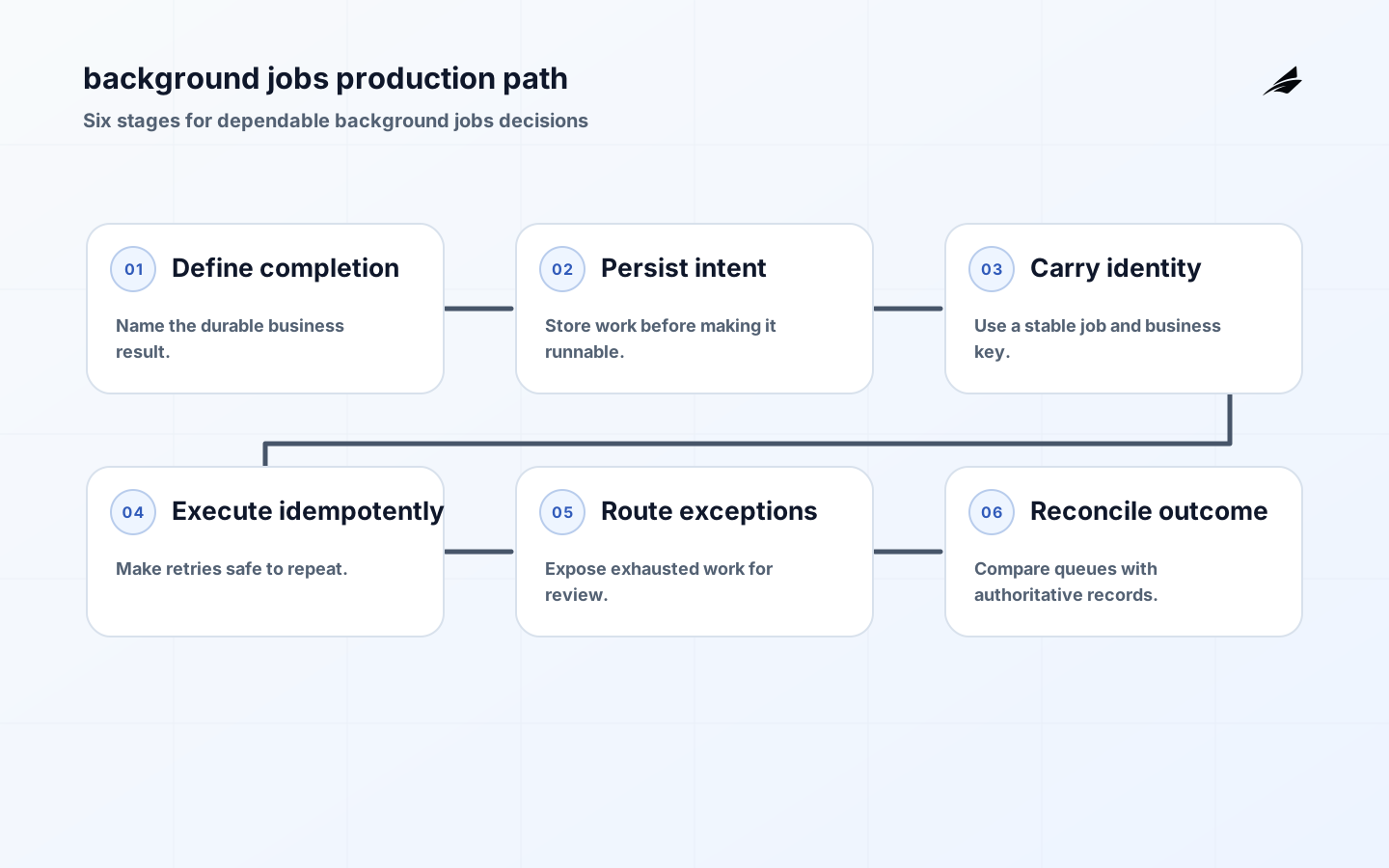
Background jobs become a production concern when slow or retried work reaches a durable outcome without holding a user request open or hiding failures. In a prototype, a happy-path demonstration can hide choices about ownership, ambiguity, and recovery. In production, those choices become part of the product contract. This guide treats background jobs as a practical operating decision: define the boundary, make ordinary and failure behavior observable, release in a bounded way, and use evidence from real work to improve it.
Define the background jobs production boundary
Start by writing what asynchronous work outside the request path is responsible for and what it is not. For this topic, the boundary includes enqueueing, payload identity, retries, idempotency, scheduling, dead-letter handling, and reconciliation. That list is not bureaucracy. It lets a product owner, developer, reviewer, and support teammate see where a request changes hands and who decides an exception. The useful question is not “can the technology do this?” but “what promise can we keep when input is incomplete, a dependency is late, or the same action arrives twice?”
| Decision area | Question to settle | Evidence to retain |
|---|---|---|
| User outcome | What task must remain dependable? | slow or retried work reaches a durable outcome without holding a user request open or hiding failures |
| Authority | Which system or rule is decisive? | Named owner and source of truth |
| Failure path | What happens when the normal path breaks? | a worker succeeding after its retry window while an operator has already manually repeated the same business action |
| Recovery | Who can reconcile a disputed result? | Runbook and accountable team |
Make background jobs behavior explicit
A specification is useful when it removes interpretation at a handoff. The first production slice should be one job with a durable identifier, bounded retry policy, idempotent handler, observable queue, and an operator recovery procedure. Describe normal input, rejected input, delayed work, and uncertain completion in examples that a test can execute. Kubernetes Jobs and Amazon SQS at-least-once delivery provide the underlying protocol or platform guidance; the local product still has to state its own meaning, data authority, and escalation route. Do not let a client infer important behavior from incidental implementation details.

Treat the observable result as more important than the internal sequence. A user may not care which service ran first, but they need a reliable answer about whether the action was accepted, pending, completed, or needs correction. Capture a stable request or business identifier at the boundary. It is the thread that allows an engineer to trace a problem, an operator to reconcile it, and a customer-facing teammate to provide a truthful status without exposing sensitive internals. For background jobs, that identifier must connect the product-facing status to the specific record or trace used to verify the outcome.
Design background jobs for the unhappy path
The case to design first is a worker succeeding after its retry window while an operator has already manually repeated the same business action. Avoid solving it with a vague catch-all or a manual spreadsheet. Decide which conditions are expected and correctable, which can be retried, which need a compensating action, and which require review. A timeout does not prove failure; a duplicate delivery does not necessarily mean duplicate intent; a successful transport response does not always prove that a durable business outcome occurred. These distinctions prevent a polished interface from overstating certainty.
- Write the background jobs normal path in terms of a business result, not a framework callback.
- Give every durable action a stable identifier that support staff can search.
- Validate permissions and input before an irreversible side effect where possible.
- Return a safe, actionable status instead of exposing implementation details.
- Bound automatic retry work and make exhausted work visible to an owner.
- Exercise the reconciliation path with realistic records before broad release.
Choose background jobs controls that fit the risk
| Risk condition | Control | Signal to watch |
|---|---|---|
| Ambiguous input or state | Validate at the appropriate boundary and preserve the rejected reason. | Validation failures and correction time |
| Repeated or delayed work | Use stable identity, idempotent handling, and bounded retries. | Duplicates, retries, and aged work |
| Dependency failure | Set time limits, fallback behavior, and escalation ownership. | Latency, failure rate, and queue age |
| Unauthorized or unsafe access | Apply least privilege and keep an audit record close to the action. | Denied access and anomalous use |
Controls should answer a concrete failure, not decorate an architecture diagram. The technical references Amazon SQS dead-letter queues and PostgreSQL Transaction Isolation are valuable because they make a team confront details that otherwise remain implicit. Translate that guidance into repository checks, configuration, runbooks, and review questions that match the system's risk. A regulated approval action, for example, needs stronger audit and recovery evidence than an anonymous read of public content.
Deliver background jobs in a bounded first release
Release the smallest valuable path that still includes production responsibilities. For background jobs, that means implementing one job with a durable identifier, bounded retry policy, idempotent handler, observable queue, and an operator recovery procedure, then proving the surrounding controls with representative data and real roles. Prefer additive changes, feature flags, parallel verification, or a reversible migration where the technology permits them. A narrow release is not an unfinished product when it clearly handles the journey it promises and exposes the evidence required to decide what should expand next.
Operate background jobs with evidence
Instrument background jobs so that an alert or dashboard prompts a decision. Track queue depth, oldest-message age, execution duration, retry count, duplicate suppression, dead-letter volume, and business completion lag. Pair system telemetry with a business indicator: an operation can be technically successful while a customer still cannot complete their task. Set owners and review thresholds in advance. If a measure crosses a threshold, someone should know whether to pause rollout, correct data, communicate with affected users, or open a deeper investigation.
Production evidence should also expose assumptions that were reasonable at launch but no longer hold. New clients, different traffic patterns, policy changes, or an expanded product line can turn a local shortcut into a reliability risk. Review a small set of representative records after releases, including an unhappy path. That habit catches semantic drift early and keeps background jobs connected to actual work rather than a static document.
Implementation checkpoints for background jobs
| Checkpoint | What good evidence looks like | Decision enabled |
|---|---|---|
| Contract or model | Examples cover ordinary, invalid, delayed, and repeated work. | Whether the interface is intelligible |
| Ownership | A product and technical owner can explain the exception path. | Whether support can act without guesswork |
| Release | Rollback, migration, or containment steps are written and tested. | Whether change can be bounded |
| Observation | Signals distinguish request activity from durable outcome. | Whether to expand, fix, or stop |
Use adjacent engineering material only when it moves the reader toward the next useful decision. What Changes When Test Strategy Moves into Production, What Changes When Monorepo Structure Moves into Production, Caching Strategy Decisions That Matter before the First Build, and How CTOs Should Think About API Versioning offer related context on architecture and delivery. The link is not a substitute for examining representative data, permissions, and failure paths in the system at hand. A credible decision about background jobs comes from both the published guidance and the evidence collected in the product.
Key background jobs takeaways
- Background jobs are a promise about behavior under normal and abnormal conditions.
- Start with one outcome, a named authority, and a stable record identifier.
- Make expected failure states understandable to users and actionable for operators.
- Choose controls in proportion to the consequence of a wrong or missing outcome.
- Release narrowly enough to observe actual behavior and retain a recovery option.
- Use queue depth, oldest-message age, execution duration, retry count, duplicate suppression, dead-letter volume, and business completion lag to decide the next improvement rather than relying on anecdote.
Frequently asked questions about background jobs
| Question | Answer |
|---|---|
| When is background jobs ready for production? | When a bounded user journey has an explicit contract, permission checks, observable outcomes, and a tested recovery route. Feature completeness alone is not enough. |
| What should the team measure first? | queue depth, oldest-message age, execution duration, retry count, duplicate suppression, dead-letter volume, and business completion lag. Start with measures that reveal user consequence as well as technical activity. |
| How do we avoid overengineering? | Protect the risks that can materially harm users or records in the first journey, then use production evidence to justify broader controls. |
Conclusion: make background jobs operable
Background jobs earn their place in production when they make work more predictable for users and more diagnosable for the team responsible for it. Define a promise that can be tested, build the unhappy path alongside the happy path, and give operations a way to see and repair uncertain outcomes. The next step is not a larger platform plan. It is a small, owned release that demonstrates slow or retried work reaches a durable outcome without holding a user request open or hiding failures.