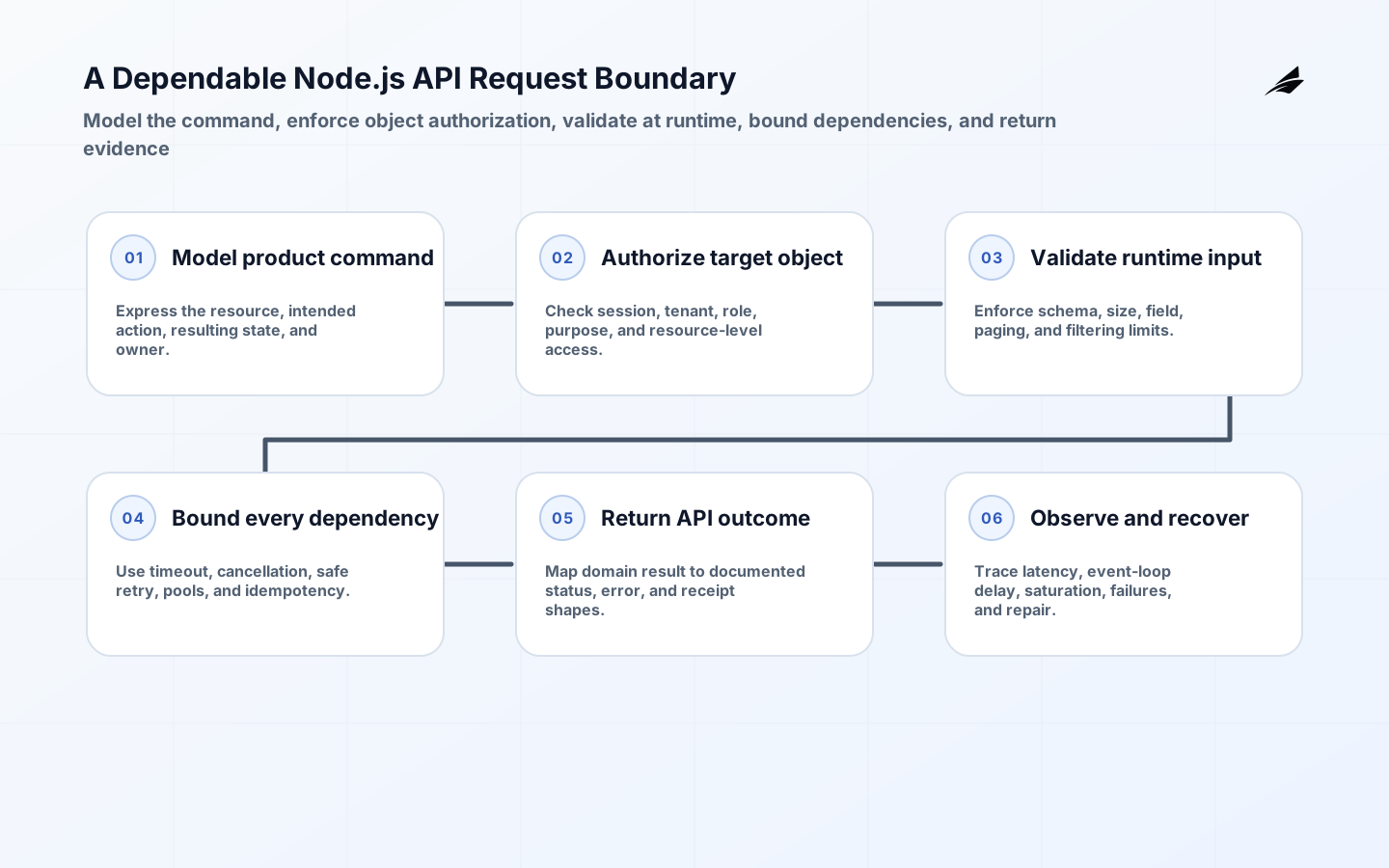
Node.js APIs are product boundaries: they decide which action is available, which identity may perform it, what response a client can rely on, and what happens when dependencies are slow or unavailable. Node's asynchronous I/O model can serve many concurrent operations efficiently, but it does not remove work that blocks the event loop, slow database calls, or unbounded third-party requests. A product team should therefore define the user outcome and operating constraints before selecting a framework or endpoint shape.
Make Node.js APIs an explicit operating decision
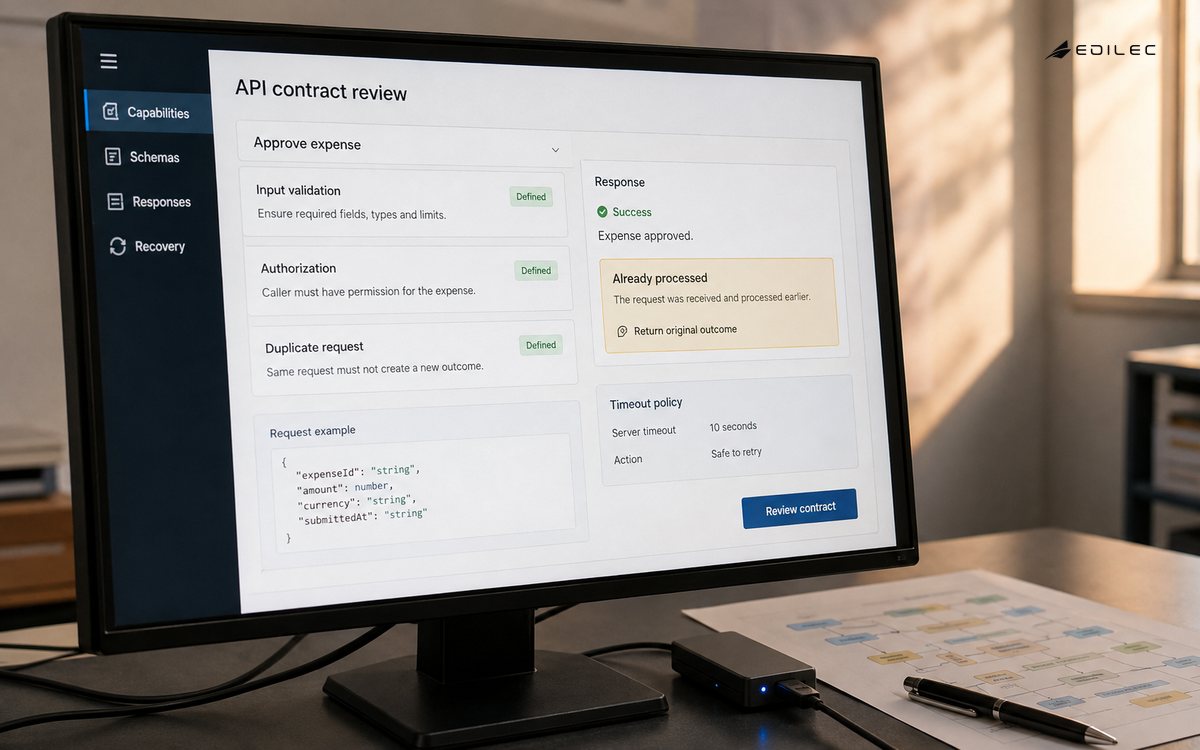
Begin with resources and commands that match real capabilities. An API for approving an expense should communicate authorization, validation, idempotency, and the resulting state, not simply expose table-shaped CRUD. RFC 9110 provides the HTTP semantics that clients and intermediaries expect. Use those semantics consistently, then document the application-specific rules with an OpenAPI contract.
| Decision | Question to answer | Useful evidence |
|---|---|---|
| Capability boundary | What user outcome does this endpoint provide? | Named command or resource contract |
| Authorization | Who may act on which object? | Object-level decision test |
| Dependency limit | How long may an outbound call take? | Timeout and fallback policy |
| Operational signal | What proves the API is serving safely? | Latency, delay, and error dashboard |
Define the Node.js APIs contract and boundaries
Every endpoint needs input limits, authentication and authorization behavior, status and error shapes, paging or filtering rules, timeout expectations, and audit requirements. Validate parsed JSON before it reaches domain code; schemas describe intent but runtime validation protects the boundary. The OpenAPI Specification lets humans and tools discover an API's interface, while the OWASP API Security Project highlights why object-level authorization and asset inventory must be verified in the implementation.
- Describe the user capability and the authority required to perform it.
- Publish request, response, error, paging, and idempotency rules.
- Validate untrusted input and authorize the target object before domain work.
- Set timeouts, limits, and retry behavior for every dependency.
- Keep CPU-heavy work out of latency-sensitive request handlers.
- Monitor latency, event-loop delay, errors, and resource saturation by endpoint.
Build and roll out Node.js APIs in a bounded slice
Keep handlers thin: parse and authenticate the request, call a domain service, translate a known outcome to a response, and attach structured telemetry. Bound every outbound call with a timeout, cancellation or abort signal where supported, retry policy based on idempotency, and resource limits. Offload CPU-intensive transformations to a worker or separate service; synchronous compression, image processing, or large JSON work in the request path can delay unrelated users by blocking the event loop.
| Failure mode | Guardrail | Signal to monitor |
|---|---|---|
| Blocked event loop | CPU work delays unrelated requests | Worker boundary and delay monitoring |
| Unsafe retry | Timeout repeats a side effect | Idempotency key and outcome record |
| Object exposure | Authenticated user accesses another record | Object-level authorization test |
| Dependency cascade | Slow provider exhausts request capacity | Timeout, limit, and fallback |
Operate Node.js APIs with evidence
Track latency by endpoint and dependency, event-loop delay, memory growth, rejected promises, database pool saturation, rate-limit events, and authorization failures. Logs need request IDs and outcome categories without leaking credentials or personal data. Define health checks that distinguish a process that is alive from one that can safely serve its critical dependencies; otherwise automated restarts can mask a downstream outage.
Make Node.js APIs tradeoffs explicit
A single API can move quickly early on, but it needs internal modules and explicit contracts before every feature shares one handler layer. Split a service when ownership, scaling, release, or trust boundaries demand it, not as an automatic response to file count. The API versioning guide is the next step when a Node API serves clients that cannot update in lockstep.
A concrete example keeps the design grounded. A customer requests the same invoice twice after a mobile network timeout. If a route creates an invoice on each POST without an idempotency record, a harmless retry becomes a financial defect. If it stores the key and outcome with the operation, it can return the first result while allowing recovery. Use the example to identify the authoritative record, expected outcome, failure that changes it, and operator who must choose the next action. That turns an architectural claim into a reviewable slice of production behavior.
Test oversized and malformed bodies, object-level authorization, timeout and cancellation of an outbound provider, repeated idempotency keys, provider errors, process restart during a request, and CPU-heavy inputs. Load tests should include slow dependencies because an API fast against a local database may exhaust sockets under waiting work. Keep evidence with the change: a reproducible command, expected telemetry, and a note about the failure being exercised. Checks should state the capability being protected, not merely mirror implementation details.
Product owns the capability and client promise; API engineers own contract and handler behavior; domain owners own business rules; platform teams own runtime guardrails; security owns review of identity and exposure. This division separates bad requests, invalid transitions, and capacity problems during incident response. Agree on a review cadence and escalation route before the first exception arrives. The aim is a timely decision by someone with the right context, not a large committee or a static policy nobody can apply.
Release a new endpoint with explicit limits, structured telemetry, and a rollback-compatible contract. Start with a controlled client or feature flag, watch dependency saturation and authorization failures, then expand. Do not increase a timeout blindly when a provider is slow; extra waiting can reduce capacity for every endpoint. Publish entry and exit criteria for each step, including the condition that stops expansion. A narrow rollout gives a better learning loop because intended and observed behavior can be compared while scope remains correctable.
Use percentiles and error categories by endpoint, event-loop delay, memory trend, open connections, database pool wait, rate-limit rejections, and downstream timeout rate. Connect them to request IDs and business outcome so a latency regression can be understood in product terms. Ask what action each signal would justify. A metric without an owner, threshold, or practical response is not useful observability; a smaller trusted set is stronger during a release or incident.
Keep runtime versions, dependencies, routes, and permissions in an inventory reviewed with releases. Rehearse dependency outage and credential rotation. A stable Node API is one whose maintainers can explain limits, change a route safely, and recover a caller without rediscovering architecture under pressure. Include this in dependency review, planning, and incident follow-up so it does not depend on one person's memory. Clear notes should cover normal operation, known limits, emergency authority, and recovery evidence.
Before treating a plan as ready, turn it into a small review exercise. Use a repeated POST and a deliberately slow provider response to verify that idempotency, timeout, and capacity limits preserve the intended business outcome. The exercise should name an owner, expected evidence, and a concrete result that would cause the team to pause. It is intentionally more demanding than a demo: demonstrations often assume ideal data and a cooperative dependency, while real confidence comes from showing that the boundary responds predictably when assumptions fail. Store the result with the relevant change record so the next engineer can repeat the check rather than reconstruct its purpose from an old ticket.
Failure rehearsals are a practical way to protect operational knowledge. Ask an on-call engineer to follow a request ID through logs, dependency calls, and the stored outcome without exposing protected request data. The person running the rehearsal should use ordinary documentation and permitted tools, not private memory or administrator shortcuts. Note the time needed to detect the condition, make a decision, and verify recovery. Those observations often reveal a missing identifier, unclear authority, or unsafe default before an incident turns the same omission into customer harm. Feed the learning back into tests, runbooks, and the next release rather than treating the exercise as a one-time audit.
Change needs a decision record as well as code or configuration. Record endpoint limits and deprecation decisions beside the API contract so clients and operators share the same expectations during change. Include the scope, assumption, approval authority, observable success condition, rollback or correction route, and date for reconsideration. This discipline keeps temporary controls from becoming invisible permanent architecture. It also gives product, operations, security, and engineering a common artifact for resolving tradeoffs, which is far more useful than asking each group to infer intent from dashboards, implementation details, or an incomplete support history.
Capacity planning belongs in endpoint design. Decide what traffic burst, payload size, dependency wait, and concurrency level the service is expected to handle, then test the limits and return a controlled response beyond them. This is kinder to clients than letting queues, sockets, or memory fail unpredictably, and it gives operations an explicit scaling or shedding decision.
Key Node.js APIs takeaways
- An API is a product and security boundary, not a database facade.
- HTTP semantics need application-specific contract details.
- Runtime validation is essential for parsed input.
- Authorization must apply to the target object as well as the session.
- Timeouts and idempotency determine safe failure behavior.
- Event-loop and dependency signals reveal operational limits early.
Node.js APIs FAQ
Is Node.js suitable for APIs? Yes, especially for I/O-bound workloads, provided blocking work and dependency limits are handled deliberately. Should each route query the database directly? Usually no; a domain boundary makes authorization, transactions, and tests clearer. Are status codes enough for errors? No. Provide stable error codes and safe messages that let clients recover without exposing internals.
Conclusion: make Node.js APIs dependable
Reliable Node.js APIs make a product capability explicit and operable. Bound inputs and dependencies, keep business rules out of transport handlers, and use runtime signals to improve the service before users discover its limits.