A design systems architecture earns adoption when it makes repeated product decisions safer to change. This guide connects tokens, components, accessibility, documentation, and governance to the real work of shipping interfaces. It is written for teams deciding what belongs in a shared system, what should remain local, and how to prove that reuse improves a customer journey instead of merely producing a larger package.
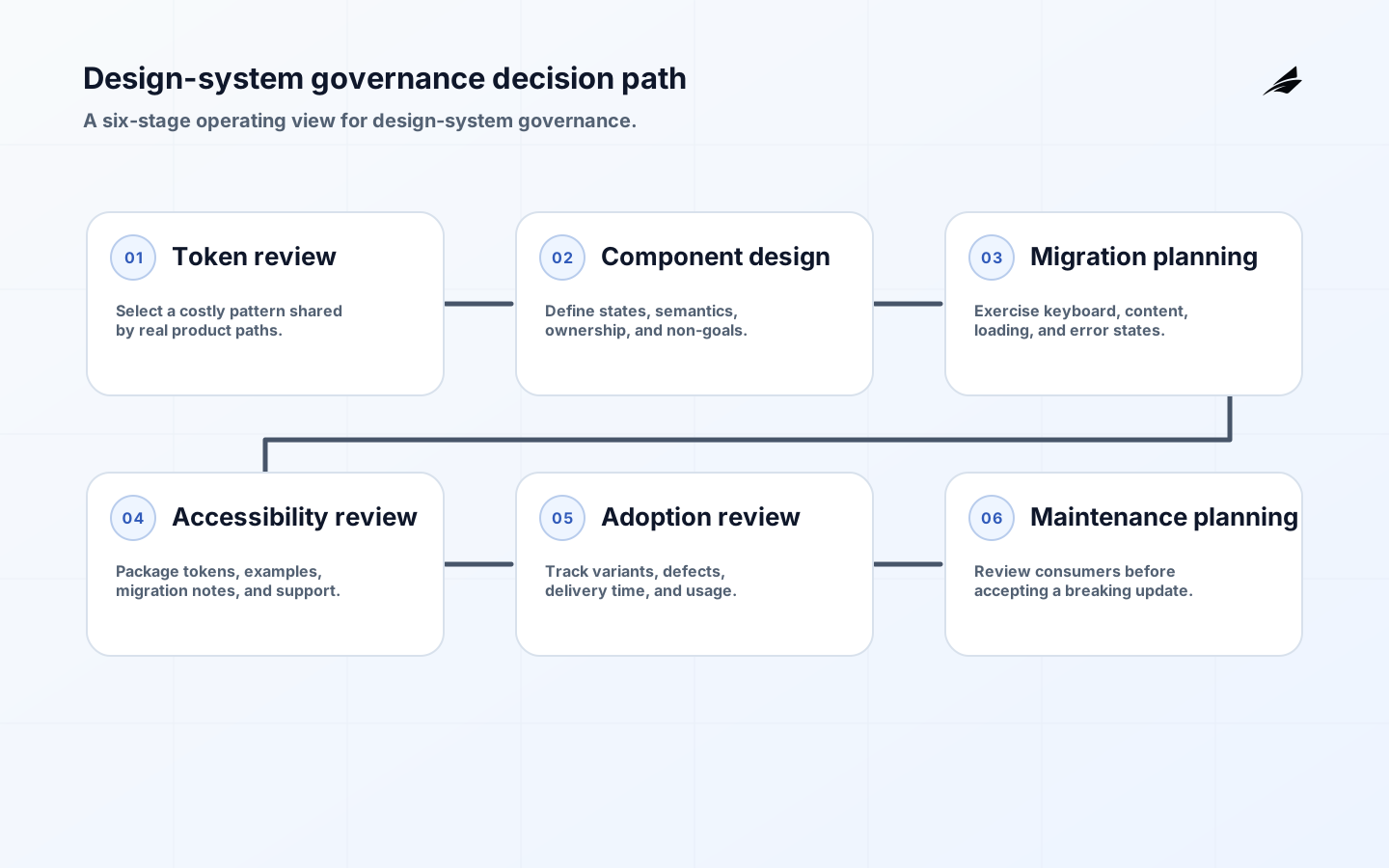
During token review for design-system governance, the planning move that changes the conversation is to begin with a decision boundary. For design systems, start with a repeated high-cost problem such as validation, status, or dense tables. During token review for design-system governance, include behavior and content states; a consistent-looking component with ambiguous keyboard or error behavior only relocates inconsistency. That framing connects technical choices to the people who approve, perform, support, and audit the work.
Set the design systems decision boundary in a governed design system
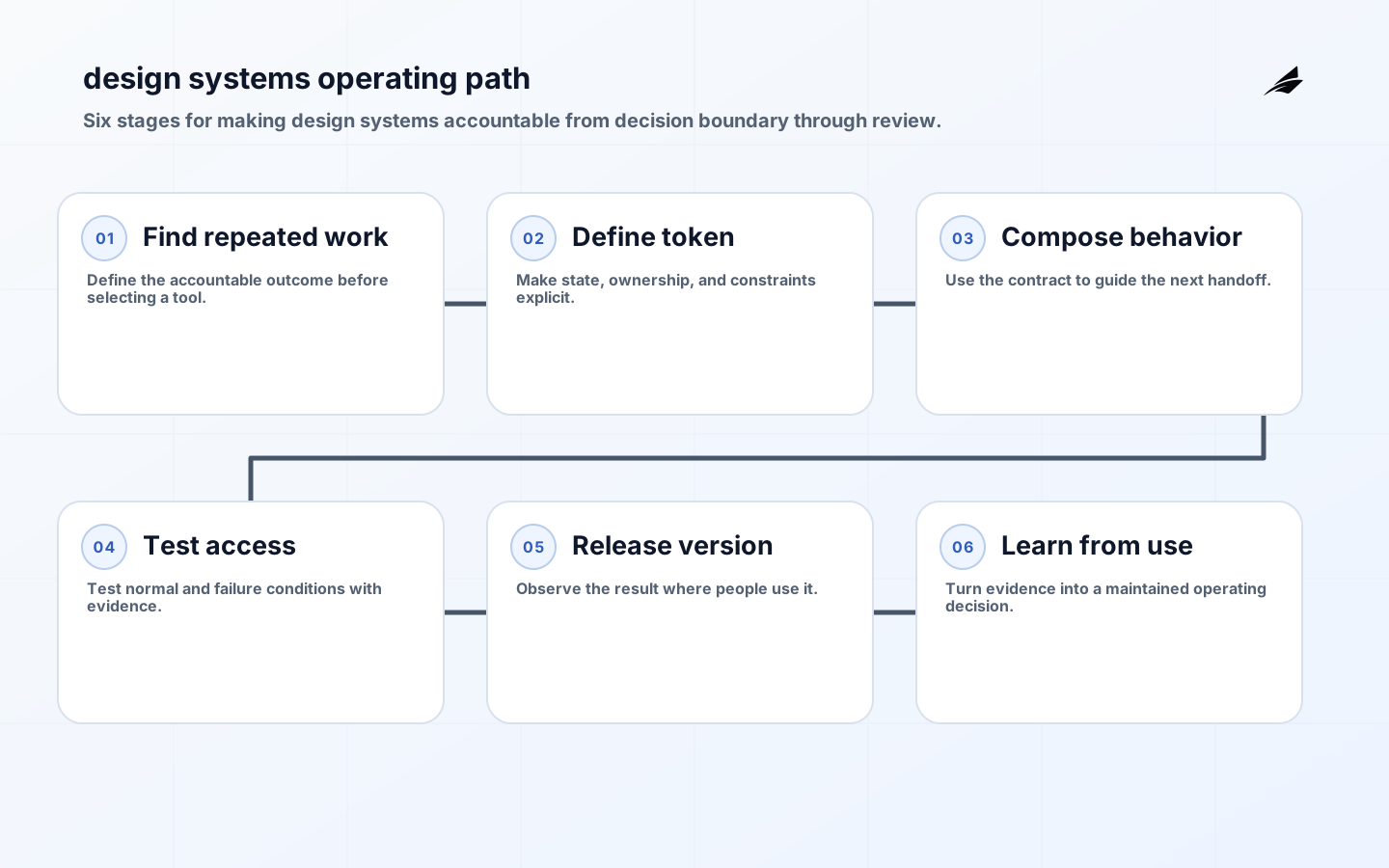
Start with a repeated high-cost problem such as validation, status, or dense tables. During component design for design-system governance, include behavior and content states; a consistent-looking component with ambiguous keyboard or error behavior only relocates inconsistency. During token review for design-system governance, write the promise in plain language: reader, desired outcome, authoritative record, timing, owner, and intervention threshold. This prevents a technical handoff from being mistaken for completion.
For design systems, a boundary also creates an honest non-goal. The first release does not need to solve every adjacent workflow. During token review for design-system governance, it needs an observable path with real state, a known exception, and a person who can make the next safe decision.
| Question | Useful answer | Evidence to keep |
|---|---|---|
| What outcome matters? | A concrete completion or decision. | Business record and acceptance example. |
| What can fail? | Named conditions with recovery paths. | Classification and owner. |
| Who decides? | A role able to change rules or stop rollout. | Decision log. |
| What proves success? | Behavior in the relevant environment. | Trace, test, or workflow record. |
Choose architecture that preserves the promise in a governed design system
Use tokens as the portable layer and components as composed behavior. Map tokens to semantic roles, keep APIs small, expose accessible defaults, and version packages with a compatibility policy. Draw the boundary between trusted state, side effects, and observability before implementation. It reveals where inputs are validated, who can trigger an effect, and how a later reader can reconstruct the decision.
In design systems architecture, prefer interfaces that make safe behavior ordinary. During token review for design-system governance, stable identifiers, explicit data ownership, reviewable change impact, and a modest first scope matter more than novelty. An architecture that the current team cannot explain or operate is not ready for broad adoption.
Implement one complete observable path in a governed design system
Inventory production screens, cluster real repeated patterns, build a reference implementation, and migrate one product path end to end. The migration reveals missing states and forces ownership decisions. Include authorization, real state, a representative error, and a visible outcome in the first vertical slice. A polished demonstration that skips those concerns can support a conversation, but it is not evidence that design systems can carry production work.
- Name accountable business and technical owners.
- Capture a stable identifier for material actions.
- Exercise normal, invalid, and interrupted cases.
- Show state and next action to the relevant reader.
- Document correction, rollback, and communication steps.
| Choice | Use it when | Trade-off |
|---|---|---|
| Small pilot | Workflow and ownership are still being learned. | Some manual handling remains. |
| Guarded rollout | Happy path is proven but scope needs control. | Support coordination increases. |
| Broad adoption | Recovery and measurement are routine. | Governance costs become visible. |
| Redesign | Core boundary no longer fits the task. | Short disruption prevents a larger false economy. |
Design the failure path before scale in a governed design system
A visual rewrite detached from delivery stalls. Other failures are a taxonomy tied to one design tool, every-prop components, and documentation that hides loading, overflow, error, and assistive-technology behavior. Put failure states beside the happy path. During token review for design-system governance, the team should know what is retried, reversible, or sent to human review, and how a user or support agent finds current state without needing raw infrastructure access.
- Could a timeout leave an ambiguous result?
- Can a repeated action cause a second effect?
- Does a public message reveal too much?
- What happens to late, missing, or unauthorized data?
- Who notices, and what can that person do?
Operate from signals instead of anecdotes in a governed design system
Measure adoption on critical paths, duplicated variants, accessibility defects, time to ship common patterns, and unsupported-version age. Repeated status-label invention is evidence of a missing domain decision. Review these with the people receiving the consequences, not solely maintainers. During token review for design-system governance, combine technical timing, business completion, support evidence, and a small sample of real cases to determine whether the stated promise holds.
During token review for design-system governance, establish a baseline before changes and annotate releases, policy changes, and unusual load. That turns “it got worse” into an investigation with evidence. The best design systems metrics connect a system event to the person or record affected.
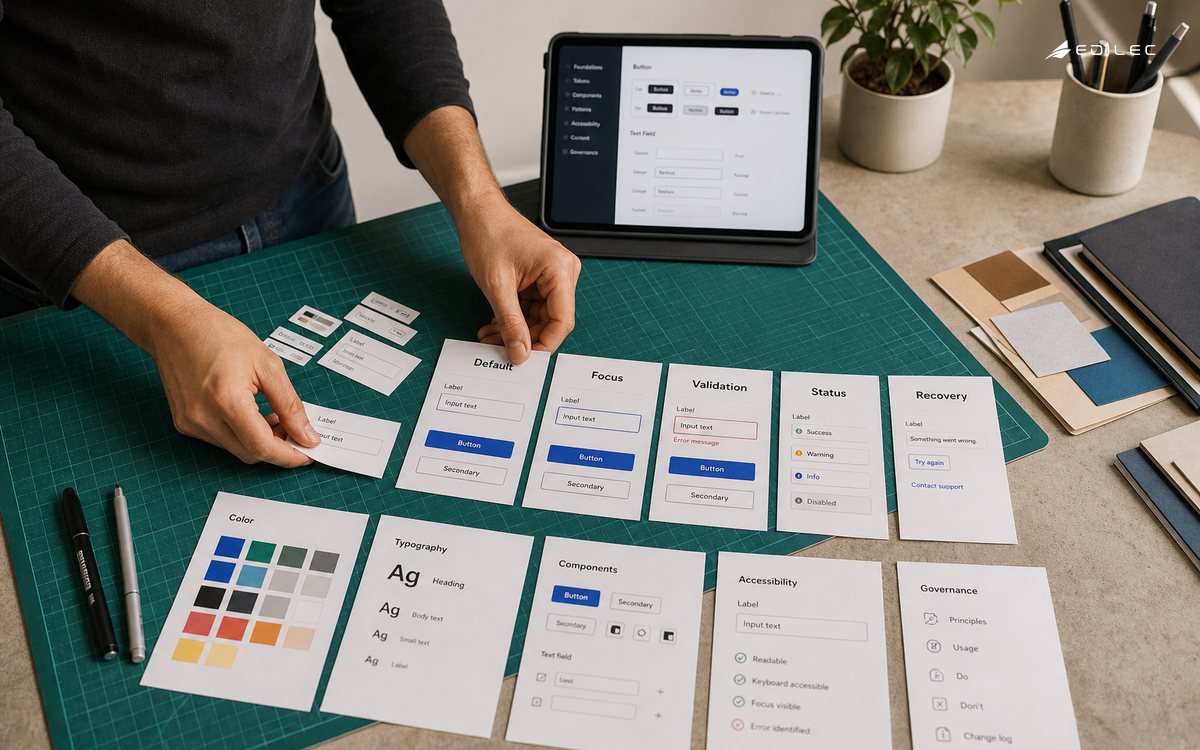
Component quality is visible in awkward states. A date selector, alert, or table should show what happens with long localized text, no results, permission denial, slow data, and keyboard-only input. Documenting those states prevents product teams from making private variants just to ship a workflow. It also makes the system more candid: a component is an opinionated contract, not an infinitely adjustable box.
Contribution governance should favor evidence over committee ritual. Ask a proposed component to show multiple real consumers, a semantic API, accessibility behavior, and a maintenance owner. A pattern found in one urgent screen may be valuable, but it should remain local until a second context proves the shared abstraction. This keeps the design system from becoming a museum of accidental one-offs.
Token naming should describe intent, not an implementation accident. A name such as text-critical or surface-raised can survive a color refresh and explain use to an application developer; a raw hex-derived name cannot. The same discipline applies to spacing, typography, motion, and elevation. Semantic tokens do not eliminate choice, but they put the choice in one reviewed place and make a theme, accessibility adjustment, or brand variation less likely to fork application code.
Release notes should also identify changes in default behavior and accessible names. Consumers of a system need to know what has changed, why it changed, and which version contains the correction.
Make ownership and change behavior explicit in a governed design system
Give maintainers a contribution response promise and a path for breaking changes. Test WCAG behavior in product context; conformance cannot be supplied by a badge. Version decisions that affect consumers, retain enough history for audit and learning, and make current rules easy to find. Maturity means a new team member can understand a problem and take the next safe action without private memory.
The technical foundation for this approach is Design Tokens Format Module and WCAG 2.2. Those references describe mechanisms and standards; applying them responsibly still requires a local decision about users, risk, and operating constraints. Additional implementation context appears in Storybook documentation and the USWDS components documentation.
Related reading for design-system governance
Adjacent decisions often decide whether design systems succeeds in practice. Read Error Handling That Gives People a Safe Next Step, Technical Debt: Prioritizing Reduction with Operational Evidence, How Product Teams Should Think About Frontend Performance to connect this topic with testing, architecture, delivery, and operational ownership. During token review for design-system governance, these are design context, not a substitute for observing the workflow in front of you.
Key takeaways for design systems
- Design systems are a contract for a real outcome, not a tool configuration.
- Name ownership, authoritative state, recovery, and evidence before expanding scope.
- During token review for design-system governance, use a complete pilot to learn the failure path as well as the happy path.
- Measure the promise in the workflow where people rely on it.
Should every UI use the same component? Reuse constraints and decisions, not superficial sameness.
Where do accessibility rules live? In API behavior, tests, documentation, and product review.
How do breaking changes ship? Publish a contract, migration guidance, and deprecation window.
The durable test for design systems is straightforward: can the team describe the promised outcome, show current state, recover from a known failure, and explain the decision to the person affected? Begin with one accountable path, retain evidence that matters, and widen adoption only when that path behaves reliably. It is a quieter form of progress, but it creates software that earns trust under ordinary pressure.
Practical decisions for design-system governance
Use a real workflow to set the boundary. Compare two consumers with different content length, permissions, keyboard behavior, loading, empty, and error states. Promote a pattern only when the shared behavior is real and a maintainer can explain the migration path. A token name should describe intent, while a component contract should describe behavior. This separation keeps product policy with the product that owns it and keeps the shared system useful across contexts. Measure success through fewer local variants, fewer accessibility defects, shorter delivery time for repeated work, and faster correction when a default is wrong.
Related reading for design-system governance
Compare this guide with Error Handling That Gives People a Safe Next Step, Technical Debt: Prioritizing Reduction with Operational Evidence, How Product Teams Should Think About Frontend Performance. During token review for design-system governance, these adjacent articles help connect the implementation choice to ownership, delivery, and operations.
Design Systems Architecture: Decisions for Durable UI Reuse FAQ
Which repeated interface decision costs the most when it drifts?
Begin with the repeated component state that creates the most user confusion or support work, then document its behavior before extracting it.
What is the practical starting point?
Choose one production pattern, capture all states including errors and keyboard behavior, and let a maintainer verify the evidence before publishing it.
When should the team scale the approach?
Expand when the pilot has stable usage evidence, a named maintainer, and a migration path that does not strand existing consumers.
Conclusion: design-system governance
A durable design system starts with one costly interface decision, makes its behavior explicit, and earns wider reuse through evidence. Keep ownership, accessibility states, migration notes, and adoption signals beside the component so the library can evolve without hiding product risk.