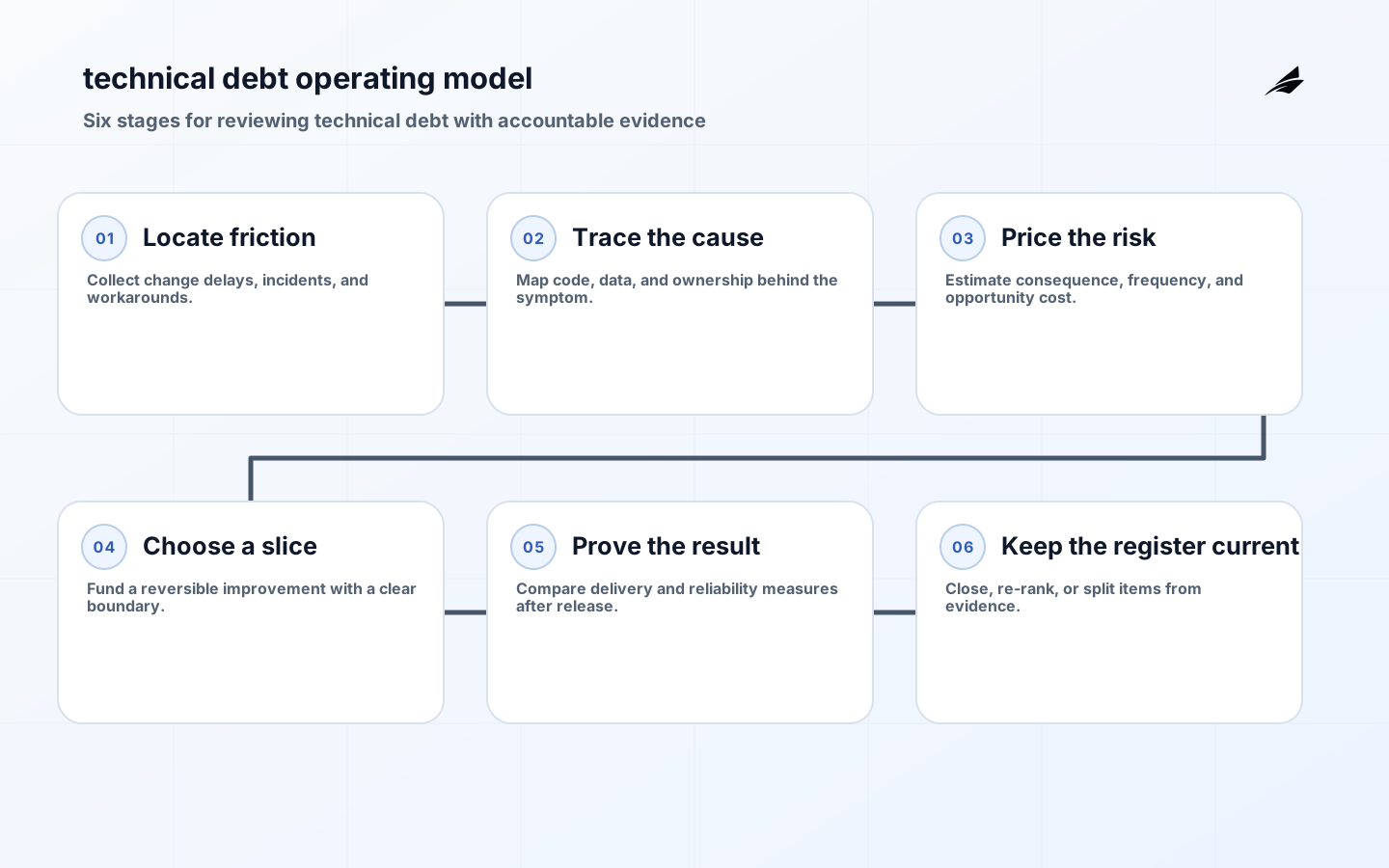
Technical debt matters when a checkout change takes three engineers several days because pricing rules are duplicated in the web client, a service, and a spreadsheet used by support. This guide is for product teams who need to rank debt by the cost of a delayed or unsafe business change, then retire it through small, observable work. The planning unit is a capability with a named owner, entry point, dependency map, and acceptance evidence. That framing keeps the work tied to a decision people can inspect, rather than to a tool purchase or a collection of isolated tickets.
Start with the operating decision
Treat technical debt as a portfolio of choices, not a moral verdict on older code. A shortcut is debt only when it creates a future obligation: extra coordination, repeated defects, slower delivery, a security exposure, or an inability to change a product rule with confidence. Begin with the work people are already struggling to complete. Interview the engineer who must understand the change, the support person who handles the workaround, and the product owner who is waiting for the result. Their evidence gives a debt item a business shape instead of a vague label such as “refactor payments.”

| Question | Working rule | Evidence to collect |
|---|---|---|
| Outcome | Name the decision or task that must improve. | a checkout change takes three engineers several days because pricing rules are duplicated in the web client, a service, and a spreadsheet used by support |
| Authority | Identify who owns the fact and who may change it. | a capability with a named owner, entry point, dependency map, and acceptance evidence |
| Risk | Describe the costly failure before selecting technology. | a broad cleanup programme that consumes capacity but never makes a customer, operator, or engineer task safer or faster |
| Measure | Choose a signal that can change the next investment decision. | lead time for the affected change, escaped defects, rollback frequency, pages or alerts caused by the component, and the age of known exceptions |
Map boundaries and ownership
A useful register records the affected capability, the user-visible consequence, the technical cause, the owner, and a small next experiment. Do not substitute a severity score for explanation. A fragile library upgrade might be urgent because it blocks security patches; a tangled module might be valuable because it prevents a pricing change every month. The same code smell can have different priority in two services. Separate discovery from commitment so a list of concerns does not masquerade as a funded plan.
Map the path from request to outcome with the people who operate it. Include entry points, systems of record, permissions, dependencies, handoffs, and the place where a person can correct an exception. For adjacent implementation concerns, read What Changes When Technical Debt Moves into Production, Test Strategy for Custom Software, and What Changes When Code Review Systems Move into Production. These related guides help distinguish a local implementation choice from the wider delivery practices that keep a service understandable.
| Boundary | Decision to make | Operational check |
|---|---|---|
| Input | Define identity, required fields, and validation responsibility. | Can an invalid technical debt request be rejected with a useful reason? |
| Authority | State the source of truth and who can override it. | Can a reviewer explain which record or rule produced the technical debt result? |
| Change | Version behavior that clients, users, or operators rely on. | Can the team deploy a compatible change and observe its effect? |
| Recovery | Give failures an owner, reference, and safe next action. | Can support resolve a disputed case without an unsafe workaround? |
Design the first observable slice
Ask teams to draw the runtime path before proposing a remedy. Include callers, stores, queues, third-party services, credentials, dashboards, and recovery actions. This exposes hidden coupling and gives reviewers a way to challenge assumptions. It also makes scope choices honest: extracting a domain boundary may require a data migration, while a targeted adapter might remove the immediate risk without promising a rewrite. The decision is about the smallest intervention that changes the operational outcome.
Debt reduction needs the same release discipline as feature work. Define a baseline, choose a representative transaction, and capture how the system behaves during an expected failure. Add tests around the contract you intend to preserve, deploy behind a reversible boundary where practical, and watch the new path after release. Code coverage alone is weak evidence here; a failing dependency, malformed input, or slow query often reveals more than a green unit-test count.
- Write one technical debt decision record with owner, boundary, and success condition.
- Collect ordinary, invalid, delayed, and contradictory examples before estimating broad scope.
- Assign an accountable operator for exceptions and a named escalation path.
- Add correlation references that connect the user-visible outcome to supporting records.
- Test the recovery path as deliberately as the successful path.
- Review lead time for the affected change, escaped defects, rollback frequency, pages or alerts caused by the component, and the age of known exceptions after the first release before expanding the design.
Control risk without blocking work
Capacity planning is the uncomfortable part. Reserve recurring capacity for maintenance and make urgent debt compete visibly with feature work, rather than relying on private heroics. The exact allocation depends on the service and its reliability history. What matters is a regular decision cadence with product and engineering present. That creates room to explain why an invisible change is worth doing and prevents the register becoming a museum of tickets no one expects to address.
Use authoritative guidance with local evidence
The design choices above should be checked against primary guidance and then tested against local constraints. Useful references include Google SRE workbook: eliminating toil, Google SRE: monitoring distributed systems, Martin Fowler on technical debt, OWASP Application Security Verification Standard. These sources explain standards and supported behavior; they do not replace the organization’s own decision about owners, legal obligations, service targets, and user impact. In this technical debt context, turn the guidance into concrete configuration, review evidence, and runbooks that a team can use during a release or incident.
Measure the service and improve it
Security and maintainability meet at boundaries. Dependencies, secrets, authorization checks, schema changes, and build tooling often become debt because their failure is difficult to detect until a release or incident. Record the version and provenance of critical dependencies, make privileged changes reviewable, and rehearse rollback for high-impact paths. The OWASP ASVS is useful as a review input, but a team still needs to connect each control to its own threat model and operating owner.
A review should end in one of three outcomes: fund a bounded change, accept a documented risk with an expiry or trigger, or retire the item because the evidence no longer supports it. “Accept” is not “ignore.” It names the decision maker and the condition that will reopen the issue, such as a vendor end-of-support date or a rise in manual corrections. That simple discipline stops technical debt from becoming a catch-all for every engineering preference.
Key takeaways
- Technical debt should begin with a real operational decision, not an abstract technology preference.
- Use a capability with a named owner, entry point, dependency map, and acceptance evidence as the unit of planning and review.
- Make authority, change behavior, and recovery visible before scaling a design.
- Use authoritative guidance as an input, then validate the result with representative local cases.
- Let lead time for the affected change, escaped defects, rollback frequency, pages or alerts caused by the component, and the age of known exceptions determine whether the next increment is justified.
Frequently asked questions
What is the smallest useful scope for technical debt? Start with one consequential path that has a clear user or operator outcome, a bounded set of records, and a way to recover from failure. The first release should prove ownership and behavior under normal and uncomfortable cases. It does not need to centralize every adjacent process.
When should a person intervene? A product and engineering lead should arbitrate technical debt when a proposed repair displaces a promised outcome, changes a reliability target, or accepts a security exposure. Record the tradeoff, the expected trigger for revisiting it, and the evidence that shaped the priority.
How do we know the design is ready to expand? Add more debt work when the register is being re-ranked from delivery and incident evidence, the first repair reduced a measurable burden, and the team can explain the new boundary. A growing backlog is not a programme; repeatable prioritization is.
Conclusion
Technical debt becomes a durable advantage when the team designs the decision, authority, evidence, and recovery path together. Begin with a checkout change takes three engineers several days because pricing rules are duplicated in the web client, a service, and a spreadsheet used by support, keep the first change narrow enough to observe, and use real operating signals to guide the next investment. That is how a technical choice becomes a service people can trust.