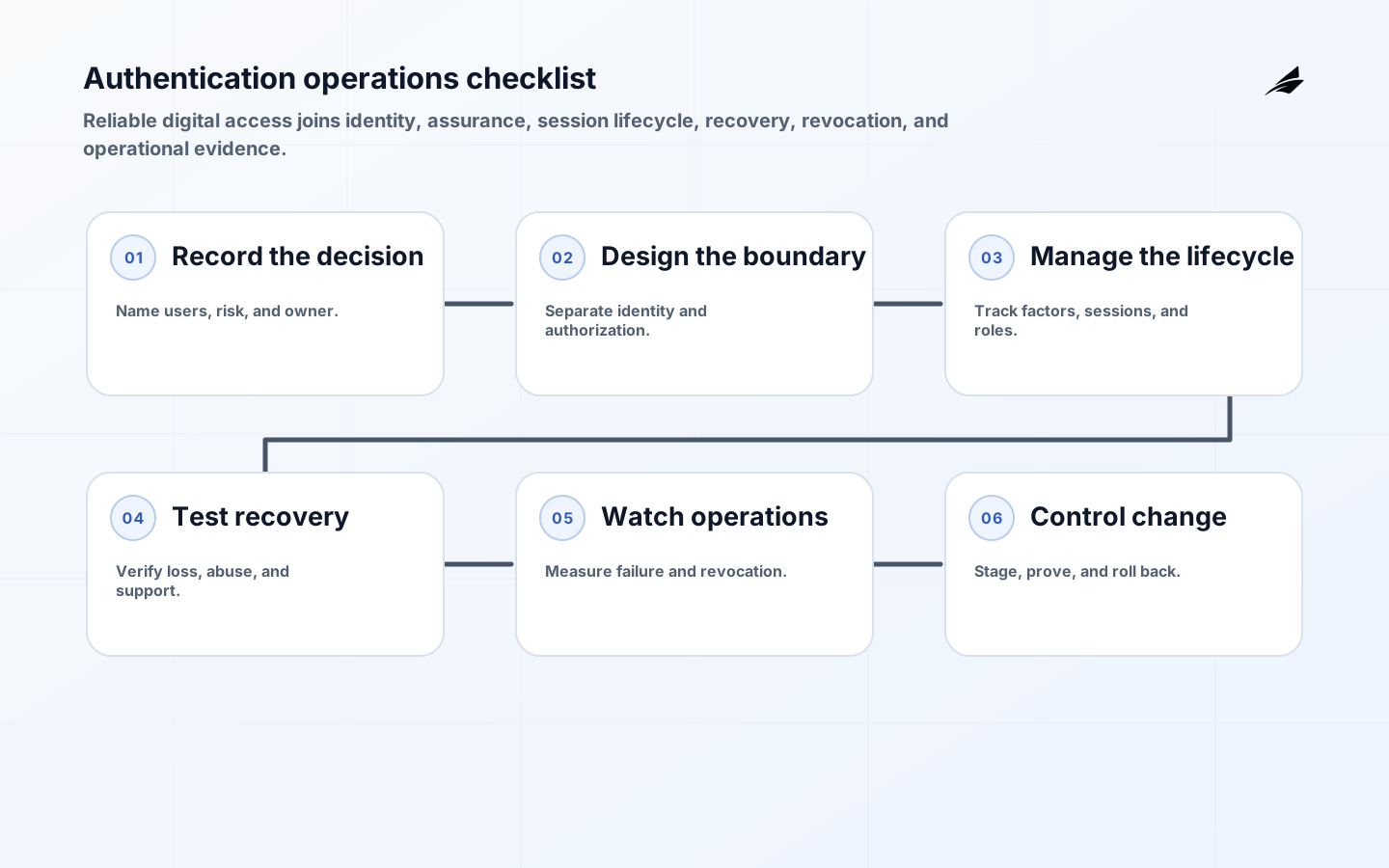
An authentication flows checklist is valuable when it helps an operations leader answer practical questions during a release or incident: Which identity is being established? Which session is still active? What proof is required to recover access? Who can revoke a compromised account? A checklist that only names a protocol or a vendor will not answer those questions. Reliable digital operations depend on a visible chain from authenticator and provider through session, authorization, recovery, logging, and review.
Use this checklist with the surrounding system rather than isolating identity work. Pair it with OpenID Connect production changes, OAuth security decisions, RBAC decisions, and audit log architecture. The related concerns have different authorities, but their failures meet in the user’s session and the operator’s evidence.
Make the authentication decision explicit
Record the user population, protected actions, identity provider or authenticator, assurance expectation, session policy, recovery route, and deprovisioning target. Do not make a universal security claim without stating what the application actually verifies. NIST SP 800-63B provides current guidance on authenticator management and authentication assurance; NIST SP 800-63C addresses federation and assertions. Use these references to calibrate a decision, then name the owner who can approve a change or pause a rollout.
| Checklist area | Decision to record | Evidence to keep |
|---|---|---|
| Identity | Which issuer and subject identify the account? | Provider configuration and mapping policy. |
| Assurance | Which authenticator or step-up is needed? | Risk tier and factor result. |
| Session | When does access begin, refresh, and end? | Session policy and lifecycle event. |
| Recovery | What proof restores access after factor loss? | Recovery case and reviewer. |
| Revocation | How quickly are active paths stopped? | Revocation and reconciliation report. |
| Operations | Who watches failures and exceptions? | Dashboard owner and runbook. |
Design the identity and session boundary
Separate the identity provider, application session, authorization policy, and downstream resource checks. A provider can assert a subject; it does not automatically know which local records or actions that subject may access. Define the stable identifier, tenant context, role source, and session binding. If the application uses a browser redirect, require exact redirect URI matching, state, nonce, and PKCE as appropriate. OpenID Connect Core describes the identity protocol, while RFC 9700 captures current OAuth security practice. Put validation in a shared boundary that every route can use.

Manage credentials and sessions as lifecycle objects
Inventory authenticators, enrollment state, device changes, recovery channels, active sessions, service accounts, and privileged support sessions. Decide whether a factor change revokes existing sessions, requires reauthentication, or starts a review. Keep tokens and reset materials short-lived, single-use, scoped, and absent from general logs. Where bearer-token theft is a material concern, consider sender constraints such as DPoP; RFC 9449 defines a proof-of-possession mechanism that binds a token to a key. Use it only when the ecosystem can operate and monitor the added complexity.
Check recovery and support before launch
Walk through a lost factor, changed phone, compromised session, employee departure, provider outage, duplicate identity, and account-transfer request. For each case, record the proof, limit, notification, approver, expiry, and user-visible result. OWASP’s Authentication Cheat Sheet is a useful review point for generic errors, rate limits, MFA, session management, and recovery. A support agent should be able to help without asking for a password, copying a token, or granting a permanent role. Ambiguous cases should remain pending rather than becoming a silent account takeover path.
- Provider and authenticator ownership is documented for every environment.
- Issuer, audience, nonce, state, code, token, and session checks have negative tests.
- Role changes, factor replacement, and deprovisioning have a defined effect on active sessions and jobs.
- Recovery requires stronger or equivalent proof and leaves a reviewable case.
- Support access is scoped, reasoned, time-limited, and audited.
- The dashboard separates user cancellation, policy denial, provider failure, and suspected abuse.
Verify the checklist against real scenarios
A checklist is complete only when it can be executed. Use representative accounts, neighboring tenants, administrators, disabled users, and service identities. Test a successful login and a response from the wrong issuer; a fresh session and a stale role; an ordinary reset and a repeated reset attempt; a provider delay and a local session revocation. Capture expected status, user message, audit event, metric, and owner for each case. This connects policy language to test evidence and makes gaps visible before an incident creates a production deadline.
Operate with a small, actionable scorecard
Monitor sign-in success, factor challenge completion, reset and recovery volume, session age, revocation delay, MFA coverage, suspicious device changes, denied authorization after role updates, provider metadata changes, and unresolved exceptions. Review the trends with the teams that own identity, product authorization, support, and security. Do not use a high login-success rate as proof that account recovery is safe. A healthy scorecard identifies a decision: rotate a secret, correct a provider mapping, investigate a spike, remove an expired override, or revisit an assurance policy.
Control changes to the authentication path
Treat provider registration, redirect URI, claim mapping, factor policy, session lifetime, recovery proof, and token validation changes as security-relevant releases. Record the old behavior, new behavior, affected users, tests, observability, rollback, and approver. Stage changes by tenant or user group when possible. Keep a last-known-good configuration and a way to pause new sign-ins without blocking safe, already active work more broadly than intended. A small, reversible change beats a global migration that cannot explain which accounts moved or why.
| Change | Pre-release proof | Recovery action |
|---|---|---|
| New provider | Issuer, audience, claims, redirect, and key tests. | Disable registration and return to prior provider. |
| Factor policy | Enrollment, step-up, loss, and support scenarios. | Restore old policy for affected group. |
| Session lifetime | Idle, absolute, renewal, and revocation tests. | Expire or extend under an approved temporary rule. |
| Role mapping | Representative users and deny cases. | Freeze mapping and reconcile local roles. |
| Recovery route | Abuse, expiry, notification, and review tests. | Disable automation and route to manual review. |
Run a cross-team authentication preflight
Bring product, identity, security, support, and operations together for one end-to-end walkthrough. Use a real user journey with an invitation, normal sign-in, a sensitive action, factor loss, role removal, and provider delay. For every transition, ask which system is authoritative, what proof is required, how the user is informed, what event is recorded, and who can correct the state. This is where vague phrases such as active account, trusted device, or verified user become testable states. The review should leave a small list of owners and scenarios, not a policy document that no delivery team can execute.
- A current provider and authenticator inventory with environment owners.
- A state diagram for enrollment, session, role change, recovery, and deprovisioning.
- Negative tests for issuer, audience, nonce, code, token, factor, and session failures.
- A support case with proof, scope, approver, expiry, and notification.
- A dashboard view that separates user, provider, policy, and abuse signals.
- A rollback or containment action for each planned configuration change.
Close the preflight by tracing one account through deprovisioning and later reactivation. Confirm which provider or workforce record is authoritative, when the application denies new requests, how active sessions and background jobs are handled, and what support sees while the state is being reconciled. Then repeat the scenario with a duplicate or changed identity so the team does not confuse a successful reactivation with a safe account link. These cases are ordinary lifecycle events in a digital operation. Writing them into the runbook prevents a hurried operator from restoring access by changing a role or deleting a record whose history is needed for investigation.
For each recovery and revocation path, define the state transition before the operator uses it: pending proof, approved, restored, revoked, or closed. Store the actor, evidence class, expiry, affected sessions, and notification outcome with the case. A dashboard should expose cases that are approved but not yet reconciled, because successful manual approval does not prove that tokens, sessions, jobs, and cached permissions have stopped. This keeps support action separate from authorization truth.
Authentication flows checklist takeaways
- State who authenticates, who asserts identity, and who authorizes the application action.
- Keep credentials, sessions, roles, recovery, and deprovisioning in one lifecycle view.
- Test provider and local failures with the same seriousness as successful sign-in.
- Make support and recovery stronger than a convenient profile lookup.
- Monitor user consequence, stale access, exception age, and time to revoke.
- Treat configuration and policy changes as reversible, evidence-bearing releases.
Frequently asked questions
Should an operations team own the identity provider?
Operations should own the runbook, access to the change process, and escalation response, while identity or security specialists own the trust and assurance policy. Product and application teams still own local session, authorization, and user outcomes. Make the boundaries explicit.
What should happen after a role is removed?
Define whether new requests are denied immediately, whether existing sessions are re-evaluated, and how background jobs are stopped or completed safely. The right answer depends on consequence, but it must be testable and visible to support.
Is manual recovery always unsafe?
No. Manual recovery can be appropriate when it uses stronger proof, independent review, narrow scope, clear expiry, user notification, and an audit record. The unsafe pattern is an informal override with no owner or end state.
Conclusion
Reliable authentication flows are maintained through decisions, tests, evidence, and recovery—not through a one-time configuration review. Use the checklist to make identity, session, authorization, support, and deprovisioning responsibilities visible. When each item has a proof and an owner, digital operations can change the path without losing control of who may act.