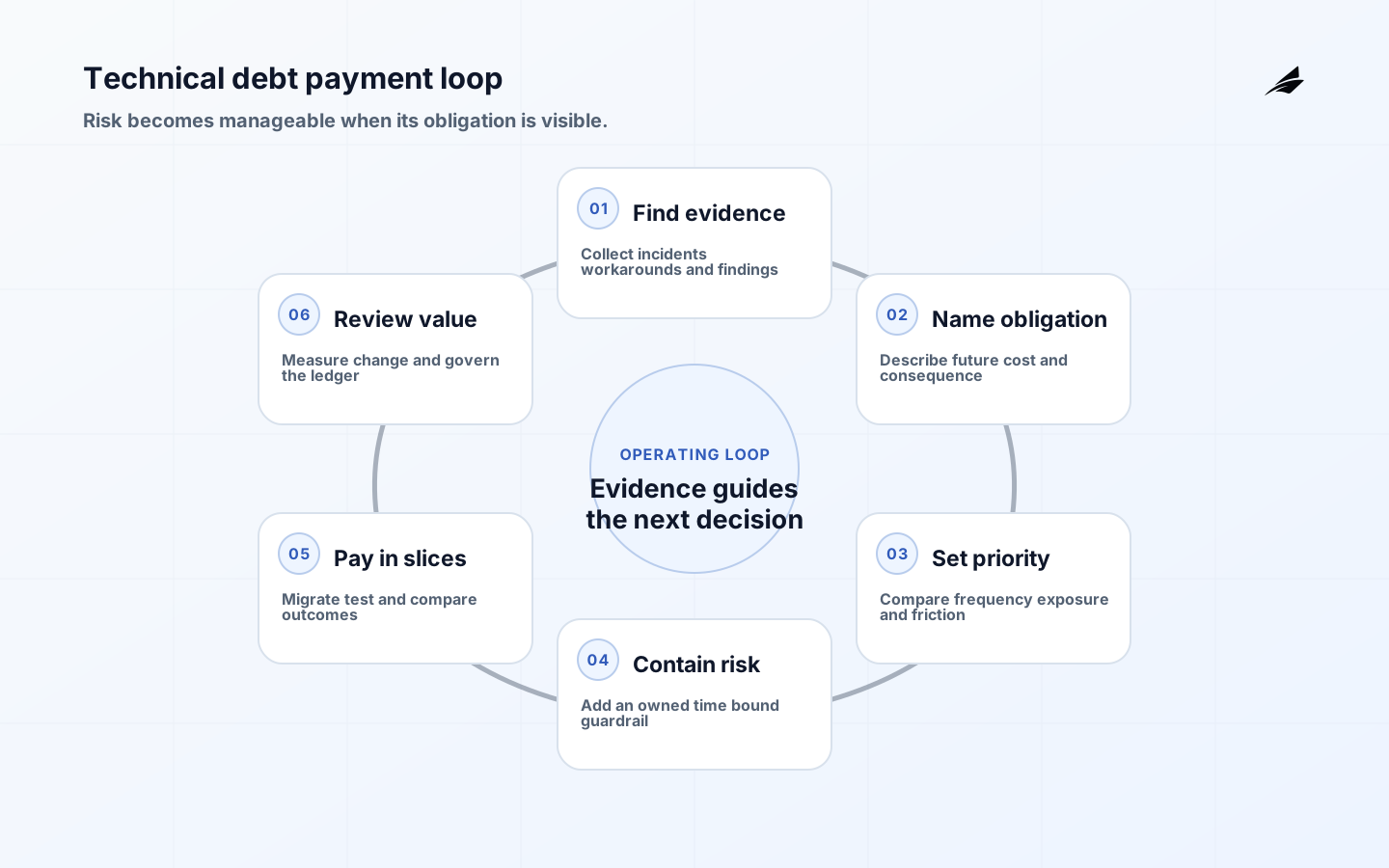
Technical debt is not a moral judgment about code quality. It is a future obligation created when a shortcut, omission, or outdated assumption makes later change harder, riskier, or more expensive. A small workaround can be a sensible trade-off when its boundary and exit condition are known. The same workaround becomes dangerous when it is invisible, unowned, repeated across services, or relied on during a failure that nobody has rehearsed.
A useful technical debt checklist connects the shortcut to an operating consequence. Instead of writing “refactor module,” record that a shared parser rejects a new supplier format, a missing migration test makes releases require manual verification, or an old dependency blocks a security patch. That evidence lets a team choose whether to repair, contain, accept, or retire the debt. The goal is not a zero-debt codebase; it is a system whose risks are visible enough to manage.
For related design and delivery context, see Edilec's database schema design guide, code review systems field guide, internal tool UX field guide, and Node.js APIs guide. Debt often appears at the boundaries between these concerns.
Define debt by the obligation it creates
Classify the obligation before selecting a payment plan. Design debt may be an ambiguous ownership boundary; code debt may be duplicated logic; data debt may be an overloaded field or unsafe migration; test debt may leave a critical failure path unverified; operational debt may require a person to restart a job; security debt may leave an unsupported library or missing access control. The category helps route the conversation, but the consequence decides priority.
Record the decision that created the debt if known. A temporary adapter built to meet a partner deadline has a different intent from a shortcut nobody noticed. Note affected users, systems, data, environments, and failure modes. Include what must remain true while the debt exists. An explicit debt item can be accepted; an undocumented dependency that fails silently cannot be governed.
| Debt category | Typical obligation | Evidence to capture |
|---|---|---|
| Architecture | Change requires coordinated edits | Dependency map and lead time |
| Code | Behavior is duplicated or hard to reason about | Defect pattern and affected paths |
| Data | Meaning or migration is ambiguous | Reconciliation gap and record examples |
| Test | A risky path is not proven | Incident or untested state |
| Operations | Manual intervention carries the workflow | Runbook steps and exception age |
| Security | Exposure or patching is constrained | Finding, asset, and mitigation |
Build a debt ledger from evidence
Collect debt from incidents, postmortems, code review comments, support escalations, vulnerability reports, slow queries, flaky tests, migration notes, manual runbooks, and recurring product exceptions. Ask operators which steps they repeat to make the system work. Ask maintainers which changes they avoid because the blast radius is unclear. Search for expired feature flags, unsupported dependencies, copied logic, unfinished markers in critical paths, and alerts nobody owns, but validate each finding with a consequence before adding it to the ledger.
Give each item a stable identifier, statement, category, affected boundary, owner, origin, evidence, current guardrail, review date, and proposed action. Link it to code, service, record, dashboard, incident, or policy without copying a long explanation into every system. GitHub's code owners model is a useful pattern for making review responsibility explicit; debt ownership should be just as visible as source ownership.
Prioritize carrying cost and consequence
A practical priority review asks five questions: how often does the debt affect work, what is the consequence when it fails, how exposed is it to change or attack, how much does it slow delivery, and how difficult is payment while the system is live? A low-frequency item with a severe security or data consequence may outrank a daily annoyance. A high-frequency manual task may deserve automation because its cumulative cost is large even when no incident has occurred.
Use a relative scale and record uncertainty rather than inventing precision. Add an evidence note such as three incidents in a quarter, two hours of manual verification per release, or a supplier that no longer supports the current library. Separate urgency from effort. A small fix that removes a critical guardrail should be scheduled quickly; a large migration may need containment, a staged payment, and a decision not to pursue full removal.
| Priority signal | Question | Possible decision |
|---|---|---|
| Consequence | What is the worst credible outcome? | Escalate or add a guardrail |
| Frequency | How often does the debt create work or errors? | Fund a repeatable repair |
| Exposure | Which users, data, dependencies, or releases touch it? | Limit scope or migrate first |
| Change friction | What future work does it block or slow? | Pay before a roadmap milestone |
| Uncertainty | Can the team explain behavior and recover? | Run discovery or a failure exercise |
Contain debt before you pay it
Some debt cannot be removed immediately. Add a guardrail that makes the risk bounded: a feature flag with an owner, a rate limit, a validation rule, a canary cohort, a manual approval, a compatibility adapter, or an alert tied to an action. Make the guardrail part of the debt record and give it a review date. A workaround without an expiry becomes another debt item and can conceal whether the original risk is growing.
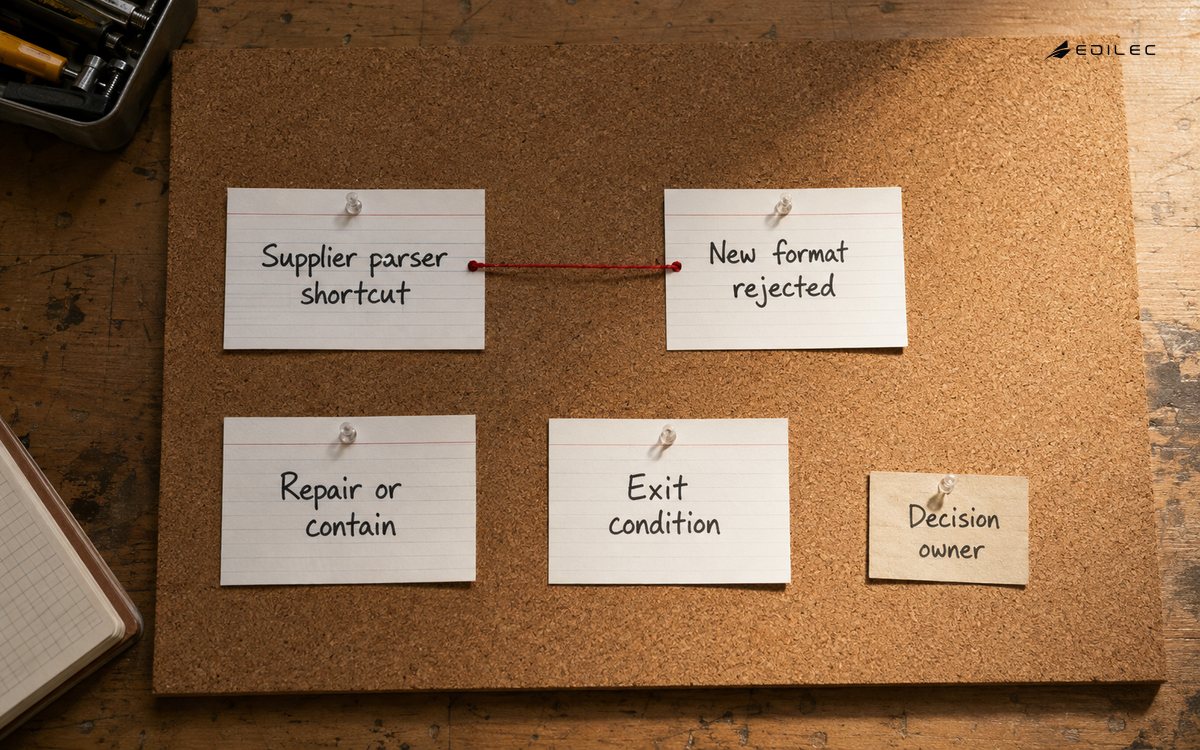
Do not confuse a warning with containment. A dashboard that shows an unsafe permission path is useful only if someone can pause access or repair the exposure. A flaky test may be quarantined only if the missing coverage is named and a critical alternative test exists. OWASP ASVS provides a useful language for verification; apply it to identify what is currently proven, what is missing, and what control reduces the consequence while work is scheduled.
Treat security and dependency debt as time-bound
Unsupported libraries, expired certificates, weak authentication paths, broad service roles, and unpatched platforms can turn technical debt into active exposure. Inventory the asset, version, owner, exploitability or policy impact, available update path, and compensating control. GitHub's Dependabot security update guidance is one example of automating dependency notifications and pull requests; automation still needs triage, testing, and an owner for exceptions.
Integrate security payment with normal delivery. NIST's Secure Software Development Framework connects secure practices to requirements, design, implementation, verification, release, and response. A security debt item should state the affected boundary, evidence, severity, remediation test, rollout plan, and residual risk. Never leave an exception open merely because the team has not written a task to revisit it.
Pay debt through small, observable slices
Break a large payment into behavior-preserving steps: characterize the current behavior, add a missing test, introduce an adapter, migrate one data or traffic cohort, compare outcomes, then remove the old path. Keep the system usable after each step. For a schema problem, add a new representation before deleting the old one. For duplicated logic, establish a contract before consolidating. For a manual queue, instrument volume and outcome before automating it.
Define acceptance evidence and a rollback boundary. A refactor is not paid when code coverage rises if the release still cannot explain a new error. A dependency upgrade is not done when the build passes if production behavior, performance, and security settings are untested. Use a canary, comparison, or repair rehearsal where appropriate. Preserve the original debt item until the guardrail and evidence are updated, then close it with a note explaining what changed.
Measure whether debt payment changed the operation
Track signals that match the obligation: lead time for the affected change, release rollback, defect or incident recurrence, manual minutes, queue age, vulnerability age, constraint failures, p95 latency, support escalations, or time to restore. Establish a baseline before setting a target. A refactor that reduces code size but increases rollback time has not paid the operational debt that matters.
Use observability to connect symptoms to boundaries. Google's SRE monitoring guidance describes latency, traffic, errors, and saturation as useful signals; OpenTelemetry's primer explains how traces, metrics, and logs complement each other. Apply the ideas selectively. A debt review should ask which signal reveals the carrying cost and what action follows, not build a dashboard for every suspected smell.
Make debt a normal planning decision
Reserve capacity for debt based on evidence and risk, not a ritual percentage. Tie a payment to a roadmap change, reliability objective, security deadline, or repeated operational cost. Review new debt in architecture and code review with the same clarity as a feature: what benefit does the shortcut create, what obligation follows, who owns it, what is the guardrail, and when will the decision be reconsidered? This makes intentional trade-offs possible without normalizing invisible risk.
Close items deliberately. Mark accepted when the team understands and can afford the consequence, contained when a guardrail limits it, paid when the obligation and evidence are removed, and blocked when an external dependency prevents change but a risk owner remains active. Do not delete a debt item because it is old. An aging ledger is evidence that ownership or prioritization needs attention.
Run a monthly debt review
Review the highest-consequence open items, newly discovered risks, exceptions nearing expiry, and payments completed since the last review. Ask whether the evidence changed, whether the owner still has authority, and whether the guardrail is still effective. Include product, engineering, operations, security, and support when the debt crosses their boundary. A short review that closes stale items and assigns real decisions is more useful than a large backlog no one can explain.
Look for patterns across the ledger. Many debt items may point to one missing platform capability, ownership gap, or release habit. Repeated manual data correction may mean the schema or source contract needs redesign. Several unsupported dependencies may mean procurement or upgrade policy is weak. Use the ledger to fund systemic improvement, not merely to distribute isolated cleanup tickets.
Key takeaways for technical debt
- Define technical debt by the future obligation and operating consequence it creates.
- Build a ledger from incidents, manual work, vulnerability findings, failed tests, and recurring exceptions.
- Prioritize consequence, frequency, exposure, change friction, effort, and uncertainty rather than age alone.
- Contain risks with owned, observable, time-bound guardrails while payment is scheduled.
- Pay debt in small slices with acceptance evidence and a stated rollback boundary.
- Measure operational change and review the ledger for systemic patterns, not only individual cleanup tasks.
Technical debt questions
What counts as technical debt?
A shortcut, outdated dependency, missing test, ambiguous boundary, manual workaround, or deferred decision that increases future cost, risk, or change friction. The label is useful only when the team can state the obligation, consequence, owner, and evidence.
How should a team prioritize technical debt?
Prioritize by consequence, frequency, exposure, remediation cost, and how strongly the debt blocks needed change. Use incidents, vulnerability age, manual effort, error trends, delivery delay, and recovery evidence to support the decision. Separate urgency from effort so a small but dangerous fix is not hidden behind a large migration.
Should all technical debt be removed?
No. Some trade-offs are intentional and affordable. Keep them when the consequence, owner, review trigger, and guardrail are clear. Pay debt when its carrying cost, security exposure, or change friction exceeds the value of retaining the shortcut.
Conclusion: make debt governable
Technical debt becomes manageable when it is described as an obligation rather than a complaint. Inventory it from real evidence, prioritize consequence and carrying cost, contain what cannot be fixed immediately, pay it in observable slices, and measure whether the operation improved. A living debt ledger gives a growing engineering team permission to make trade-offs while preserving the information needed to decide when those trade-offs are no longer affordable.