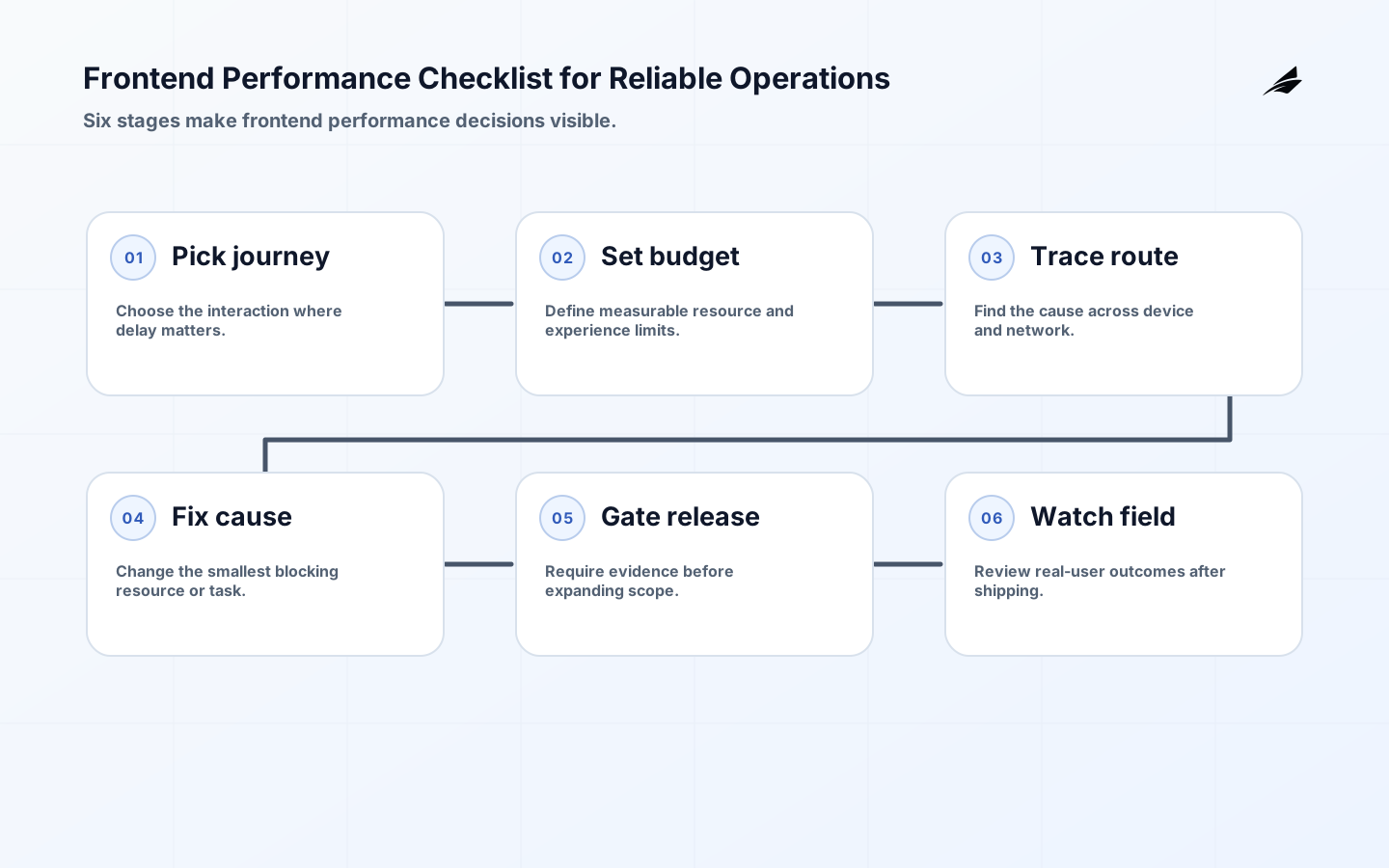
A checklist becomes valuable when every item has an owner and an observable result. “Optimize images” should become “the catalogue hero uses a responsive source and its field LCP is measured for the target cohort.” “Reduce JavaScript” should become “the route no longer parses the report editor before the user opens it.” Specific wording lets product, design, and engineering decide whether a tradeoff is worthwhile.
Make the front-end performance decision explicit
The first artifact should define the user interaction path boundary: critical rendering path, JavaScript budget, image delivery, fonts, third-party code, interaction work, and real-user measurement. Put normal behavior beside the uncomfortable cases, not in a separate risk register. Ask what happens with missing input, delayed dependencies, partial completion, conflicting records, and a human request to reverse the outcome. A useful design makes the answer inspectable by someone outside the implementation team. The chosen authority is field data by page and device class, performance budgets, release diff evidence, and the product journey that users actually take; anything else should be treated as a derived view or an explicitly managed exception. That distinction prevents support staff from having to reconstruct business rules from logs, screenshots, and memory.
| Question | Decision to record | Evidence to keep |
|---|---|---|
| What promise is being made? | a page must become useful quickly for real devices and networks, not only look responsive on a developer workstation | A reviewed example of expected and failed behavior. |
| Where is the boundary? | critical rendering path, JavaScript budget, image delivery, fonts, third-party code, interaction work, and real-user measurement | An owner and a testable interface or workflow. |
| What is the consequential failure? | a new dependency delays the largest content, hydration blocks an interaction, or a visual shift moves a button as someone tries to use it | A negative-path test and recovery record. |
| How is progress judged? | Review timing, resource weight, and field conversion by cohort. | A baseline and a recurring operational review. |
Map the route’s performance contract
Treat frontend performance as a contract among product, engineering, operations, and users. The team should be able to say which record wins, which input may be rejected, which work can be retried, and which outcome must be reviewed by a person. A new dependency delays the largest content, hydration blocks an interaction, or a visual shift moves a button as someone tries to use it That is not an edge case to hide; it is a design input that determines data shape, observability, and support load. Favor decisions that make uncertainty visible. A precise “pending review” state is safer than a confident but invented answer, while a bounded failure response is kinder to users than an endless spinner or a generic success message.
| Area | Practical control | Review question |
|---|---|---|
| Authority | field data by page and device class, performance budgets, release diff evidence, and the product journey that users actually take | Can a new maintainer identify the record that decides the result? |
| Protection | Prioritize critical resources and reserve layout space. | Does the control act before a harmful effect or only report it afterward? |
| Recovery | A documented owner, visible state, and reversible or compensating action. | Can support resolve one representative exception without developer archaeology? |
| Observation | Review timing, resource weight, and field conversion by cohort. | Does the signal distinguish a healthy slow case from a broken one? |
Gate one measurable route change
The safest first release of frontend performance is narrow enough to observe. Use a representative integration, a limited user group, or a bounded traffic slice, then compare expected behavior with production evidence. Measure field and lab data, prioritize critical resources, reserve image and embed dimensions, split noncritical code, and budget third parties. These are not ornaments around the feature; they are the mechanisms that keep a temporary compromise from becoming permanent folklore. Write an exit condition for every flag, compatibility bridge, and manual review queue. When a result differs from the model, pause expansion until the team can explain whether the model, the instrumentation, or the implementation is wrong.
- Write one ordinary and one high-consequence front-end performance example before implementation.
- Make field data by page and device class, performance budgets, release diff evidence, and the product journey that users actually take discoverable to product, support, and the delivery team.
- Exercise the failure case where a new dependency delays the largest content, hydration blocks an interaction, or a visual shift moves a button as someone tries to use it.
- Compare route-level budgets with field outcomes by device class, then decide whether to expand, contain, or redesign the change.
- Turn a production surprise into a changed control, test, or documented accepted risk.
Use web performance references precisely
Standards and official documentation help a team distinguish a preference from a protocol or security constraint. For this frontend performance decision, useful starting references are Web Vitals, Optimize Largest Contentful Paint, Web Performance, React Performance APIs. They do not choose the scope for a particular business, but they provide language for reviewing interoperability, identity, failure behavior, and secure delivery. Read them alongside real examples from the product. A reference is valuable when it changes a design decision, a test, or a runbook; it is not a substitute for measuring the behavior of the system being built.
Track field performance after release
After release, review frontend performance with evidence rather than anecdotes. Watch Largest Contentful Paint, Interaction to Next Paint, Cumulative Layout Shift, long tasks, JavaScript transfer, and conversion by device class. Establish a baseline before setting a target, because an apparently good average can conceal one costly segment, client, tenant, device, or workflow. Pair numbers with a small sample of real cases: trace the input, the rule that applied, the resulting state, and the resolution. That review should result in an explicit choice to retain the design, tune a control, remove unused complexity, or fund a well-described improvement. Ownership matters here: unnamed queues and dashboards do not improve themselves.
Key takeaways
- Frontend performance starts with a concrete promise and a named boundary, not a tool selection.
- Design for the specific consequence that a new dependency delays the largest content, hydration blocks an interaction, or a visual shift moves a button as someone tries to use it.
- Keep field data by page and device class, performance budgets, release diff evidence, and the product journey that users actually take and recovery evidence close to the workflow.
- Use route budgets and cohort outcomes to decide whether to expand or contain the change.
Frequently asked questions (FAQ)
Review the checklist at the route level, not only in a shared platform document. A dashboard with authenticated data, a marketing page with third-party tags, and a mobile workflow have different failure modes. Keep a small exception record when a budget is intentionally exceeded, including the user value, expiry or review date, and mitigation. That turns a temporary compromise into a visible decision rather than permanent drift. Where should a team start with frontend performance? Start where uncertainty already costs time, trust, revenue, or support effort. Describe one end-to-end journey in plain language, including the authoritative record and the first harmful failure. Then choose the smallest control that changes that outcome. This creates useful acceptance criteria and makes it possible to compare a proposed solution with the current process. Broad platform work can follow, but only after the first boundary behaves predictably enough to support people under normal pressure.
How much process is enough for frontend performance? Use controls proportional to consequence. A small change may need only a concise decision record, representative tests, and visible ownership. A boundary that carries sensitive data, money, access, or irreversible work needs stronger evidence, deliberate recovery paths, and recurring review. The point is not to maximize ceremony. It is to ensure that a new dependency delays the largest content, hydration blocks an interaction, or a visual shift moves a button as someone tries to use it can be detected, explained, and corrected without placing the entire burden on the person who happened to notice it first.
A practical performance checklist should also name what is allowed to degrade. A route may accept a slightly slower secondary panel if the primary action becomes ready sooner, but that tradeoff should be visible in the acceptance record. Capture the protected interaction, the resource or task responsible for delay, the cohort used for measurement, and the condition that would reopen the decision. Review mobile, keyboard, assistive-technology, and reduced-motion behavior alongside timing data when those contexts affect the route. This keeps a budget from becoming a narrow score and makes the resulting experience easier to defend.
The strongest checklist item names a decision, not a tool. Instead of requiring a generic performance scan, require evidence that a specific route reaches its primary action within the agreed budget for the intended cohort. Note which secondary work may remain pending, how the page behaves on a constrained connection, and who reviews a breach. Those details keep the checklist grounded in the experience people actually have and make an exception easy to revisit when traffic, content, or dependencies change.
Conclusion
Frontend performance becomes dependable when its promise, authority, failure behavior, and recovery owner are all visible. Keep the first scope narrow, test the point where another person or system relies on the result, and use production evidence to guide the next investment. Related reading: Design Systems Checklist for Reliable Digital Operations, Error Handling Checklist for Reliable Digital Operations, and Database Schema Design Checklist for Reliable Digital Operations.